
SLIDE 1
Greg Leibon Memento, Inc Dartmouth College
Fraud Detection, Quantum Mechanics, and Complex Systems
Lecture 3, CSSS10
Fraud Detection, Quantum Mechanics, and Complex Systems Lecture 3, - - PowerPoint PPT Presentation
Fraud Detection, Quantum Mechanics, and Complex Systems Lecture 3, CSSS10 Greg Leibon Memento, Inc Dartmouth College N=200; K=10; [states]=PlotTheState( N,K); The solution (I think!) NP hard Recall: How we really solve this? Now we
Greg Leibon Memento, Inc Dartmouth College
Fraud Detection, Quantum Mechanics, and Complex Systems
Lecture 3, CSSS10
N=200; K=10; [states]=PlotTheState(N,K);
The solution (I think!) NP hard Recall:
How we really solve this?
Now we cluster in Euclidean space...
function:
xi ∈Ck
k=1 K
2
compute centroids.
Example from: http://en.wikipedia.org/wiki/K-means_algorithm
K-means algorithm:
...until stable.
A hard part is choosing K=#(Clusters) Elbowlogy:
5 10 15 20 25 30 30 40 50 60 70 80 90 Number of Clusters
elbow Though is practice this rarely works in a complex multi-scalar system system
L = xi − µk
( )
xi ∈Ck
k=1 K
2
L
How?
Why is this good, well it takes two to Tango! Spectral Theorem: If <,> is a Hermitian inner product and <Av,w>=<v,Aw>, then there is an orthonormal basis of A eigenvectors. where
The Context Operator Information in Eigenfunctions Not Local
http://www.youtube.com/watch?v=Uu6Ox5LrhJg&feature=response_watch
The Green-Kelvin Identity
f ,Δf = fΔfdr x =
∇f
2dr
x
f ,g = fiwigi
i
f ,g = f (x)g(x)dVol(x)
M
f ,Δf = f jwi(Ii
j − P i j) f j i, j
= 1 2 wiP
i j fi − f j
2 i, j
First three (non-trivial) eigenfunctions The perfect Vagabond functions
Green’s Embedding vagabond embedding Space of mathematics
list_of_geometric_topology_topic list_of_computability_complexity_topic list_of_statistics_articles
rare point are de-emphasized
tries to become a cluster
Kakawa’s Salted Carmel time! (well, except Kakawa wasn’t open)
close all Show=0; N=100; figure(1); [states WR TR]=SnakeRev(N,5,'Vg',Show,1,1,1,1,1,0,0,0,0,0,0,0); figure(2); [states WR TR]=SnakeRev(N,5,'Vg',Show,0,1,1,1,1,0,0,0,0,0,0,0);
figure 1 figure 2
figure 1 figure 2 The answer:
close all Show=1; N=100; figure(1); [states WR TR]=SnakeRev(N,5,'Vg',Show,1,1,1,1,1,0,0,0,0,0,0,0); figure(2); [states WR TR]=SnakeRev(N,5,'Vg',Show,0,1,1,1,1,0,0,0,0,0,0,0);
Theorem: Reversible if and only if there is symmetric conductance matrix such that
N=200; K=10; [states]=PlotTheState(N,K);
starting from equilibrium, if I reflected this you’d never know
Theorem: For a reversible chain, the vagabond embedding is the PCA of the green’s embedding weighted by the equilibrium vector
Theorem: For any chain P , there is a unique (up to a multiplicative constant) conductance W and divergence free, compatible flow F such that
Clearly the vagabond is missing half the geometry.
Shall we dance? chain function
verses
How to find them...
Scenario operators have highly localized eigenfunctions
Text The scenario operator:
The scenario operator:
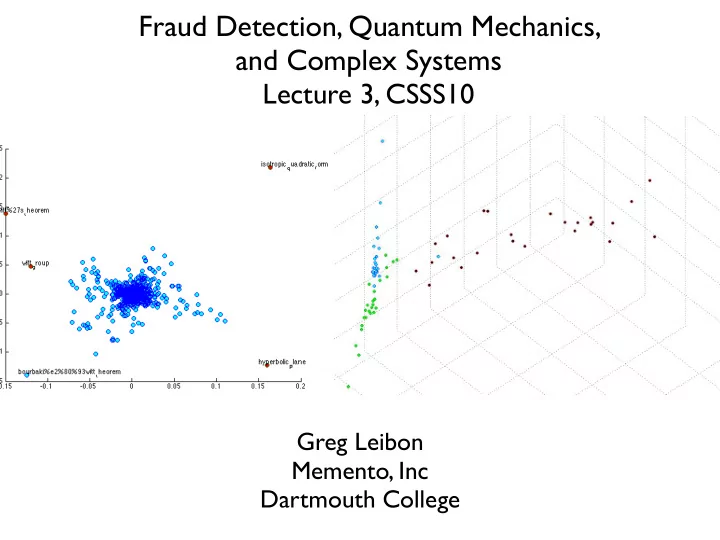
hyperbolic_plane isotropic_quadradic_form witt_theorem witt_group Eigenfunction in the Space of Mathematics
Scenario operators have highly localized eigenfunctions
Reality.... We need something like the vagabond clustering for cycles
Not all cycles are created equally.... Wy do need this fellow to find a naughty cycle?
allows us to detect scenarios which are anomalous relative to the context Claim: The operator Which cycles are in context and which are not?
(all cycles weight 10)
allows us to detect scenarios which are anomalous relative to the context Claim: The operator
http://www.youtube.com/watch?v=KT7xJ0tjB4A
Mathematics of Quantum Mechanics Hilbert Space States Measurements Expectation Deviation
Why does this work?