FPGAs milliseconds+ to reconfjgure custom chips ??? (next week) - - PowerPoint PPT Presentation

fpgas
SMART_READER_LITE
LIVE PREVIEW

FPGAs milliseconds+ to reconfjgure custom chips ??? (next week) - - PowerPoint PPT Presentation

FPGAs milliseconds+ to reconfjgure custom chips ??? (next week) FPGAs ??? GPUs vector computations examples: computation second processor specialized for particular the accelerator concept 2 fmexible, slower functional units


slide-1
SLIDE 1

FPGAs

1

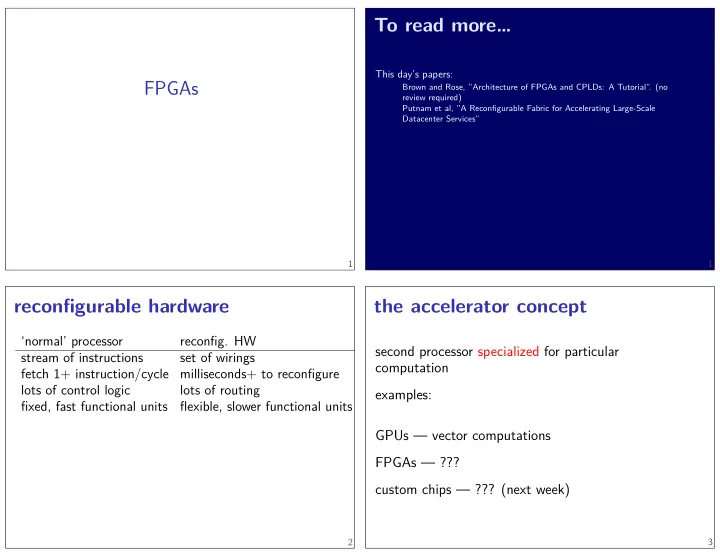
To read more…

This day’s papers:

Brown and Rose, ”Architecture of FPGAs and CPLDs: A Tutorial”. (no review required) Putnam et al, ”A Reconfjgurable Fabric for Accelerating Large-Scale Datacenter Services”

1

reconfjgurable hardware

‘normal’ processor

  • reconfjg. HW

stream of instructions set of wirings fetch 1+ instruction/cycle milliseconds+ to reconfjgure lots of control logic lots of routing fjxed, fast functional units fmexible, slower functional units

2

the accelerator concept

second processor specialized for particular computation examples: GPUs — vector computations FPGAs — ??? custom chips — ??? (next week)

3

slide-2
SLIDE 2

FPGA structure

Brown and Rose, Figure 2

4

FPGA programs: RTL

e.g.: Verilog determines wiring between gates, registers, memories everything happens in parallel every cycle manually specify what’s in registers, etc. same languages used to design real processors

5

RTL example

module counter(clock,reset,value); input clock; input reset;

  • utput value;

reg [32:0] count; always @ (posedge reset or posedge clock) if (reset) begin count <= 0; end else begin count <= count + 1'b1; end assign value = count; endmodule

6

A note about HW programming

not intuitive attempts at easier interfaces: “schematic capture” — draw circuit diagram

common, doesn’t seem great at scale

higher-level tools, e.g., Chisel (Berkeley research project)

compile to RTL; used at scale

automatic translation of C-like language (C to gates)

Very mixed reputation — very hard compilers problem But see Aladdin paper

7

slide-3
SLIDE 3

FPGA design pipeline

Brown and Rose, Figure 7

8

FPGA: place and route

RTL compiles to “gate list” needs to turn into what components in the FPGA to connect not straightforward; hours+ to compute if FPGA nearly full efgects performance — longer wires/more switches

9

Programmable switches: example

Example switch: transistor + SRAM cell

(SRAM cell ≈ 1-bit register)

SRAM cell continously outputs stored value can be written by seperate circuit (not shown)

Brown and Rose, Figure 5

10

Programmable switches: example

Brown and Rose, Figure 5

11

slide-4
SLIDE 4

FPGA routing example

12

FPGA logic block example (1)

13

FPGA logic block example (2)

14

FPGA confjguration

what to do for every switch just loading values into memory that controls switch

15

slide-5
SLIDE 5

FPGA efficiency

most transistors perform routing, not computation much longer signal paths than in CPUs

slower clock rates for same task

development tool usefulness/quality is not great

16

FPGA: more complex logic

many FPGAs include specialized fjxed functionality

RAM adders, multipliers fmoating point units common DSP computations full embedded-class CPU cores …

could implement these using fully programmable logic

but slower/bigger

17

review comments

what are FPGAs good for anyways? versus/combined with GPUs/CPUs?

  • ther large-scale deployments?

programmability?

18

Catapult challenges

datacenter logistics

cost (only 10% more???) power density (cooling, power distribution) physical space

programs across multiple FPGAs

needs fast FPGA-to-FPGA communication centralized allocation

failure handling

19

slide-6
SLIDE 6

The Shell

23% of FPGA (confjgurable) area:

20

CPU to FPGA transfers

10 µs for 16 KB — approx 15 GB/s (about maximum PCIe 3.0 transfer rate)

21

Catapult roles

hand-coded Verilog (RTL language) hand partitioned across FPGAs? precise duplication of existing software

22

Search engine architecture

search query cache top-level aggregator (TLA) MLA MLA index shard index shard index shard index shard index shard index shard index shard index shard index shard index shard ranking service query q u e r y documents d

  • c

u m e n t s documents, query rankings

23

slide-7
SLIDE 7

Search engine architecture

search query cache top-level aggregator (TLA) MLA MLA index shard index shard index shard index shard index shard index shard index shard index shard index shard index shard ranking service query q u e r y documents d

  • c

u m e n t s documents, query rankings

23

Search engine architecture

search query cache top-level aggregator (TLA) MLA MLA index shard index shard index shard index shard index shard index shard index shard index shard index shard index shard ranking service query q u e r y documents d

  • c

u m e n t s documents, query rankings

23

Search engine architecture

search query cache top-level aggregator (TLA) MLA MLA index shard index shard index shard index shard index shard index shard index shard index shard index shard index shard ranking service query q u e r y documents d

  • c

u m e n t s documents, query rankings

23

Search engine architecture

search query cache top-level aggregator (TLA) MLA MLA index shard index shard index shard index shard index shard index shard index shard index shard index shard index shard ranking service query q u e r y documents d

  • c

u m e n t s documents, query rankings

23

slide-8
SLIDE 8

Overall Motivation

24

FPGA operation

recieve: document, some features via shared memory

  • utput: score

each FPGA runs a macropipeline stage — 8 µs (1600 clock cycles)

25

Queue Manager

“model reload” can only store one model at a time — takes 250 µs to load from external RAM

  • n FPGA memories: approx. 40MB capacity

(distributed) trick: proess queries for same model together

26

Feature Extraction FSMs

parallel fjnite-state machines essentially regexes compiled to gates? fully pipelined

27

slide-9
SLIDE 9

Feature Expressions

speialized mathematical expressions custom multithreaded processor model determines what the expressions are mostly integer — small FPGA area — but some FP split across multiple FPGAs threads priority-scheduled

28

“Complex” logic area

29

What are FPGAs good for?

bit-twiddling (lots of simple CPU instrs.)? inherently parallel programs?

perhaps even if difgerent operations — hard for GPUs

low-latency I/O interface and processing? prototyping CPUs, GPUs

30

What are FPGAs bad at?

fmoating point, other ‘big’ arithmetic operations

purpose-built, denser ALUs just win

caching lots of data?

… but sometimes dedicated SRAM blocks

being easy to program well

programming FPGAs ≈ processor design!

31

slide-10
SLIDE 10

FPGAs versus GPUs

both good at doing massively parallel computations FPGAs better at exploiting multiple instruction parallelism? FPGAs can be lower latency for simple operations FPGAs much worse at fmoating point/non-small-integer calculations?

32

Interlude: Homework 3

33

Homework 3 supplied kernel

what does the supplied kernel do?

1 2 … 255 256 257 258 … 511 512 … 255 511 …

34

Exam topics

Memory hierarchy — caches, TLBs Pipelining, instruction scheduling, VLIW Multiple issue/out-of-order:

register renaming and reservation stations reorder bufgers and branch prediction hardware multithreading

Multicore shared memory:

cache coherency protocols/networks relaxed memory models and sequential consistency synchronization: spin locks, transaction memory, etc.

Vector machines, GPUs, other accelerators

35

slide-11
SLIDE 11

Next time: Custom ASICs

higher dev cost/higher efficiency two papers:

  • ne on: automating design of custom ASIC accelerators

(Aladdin) another: a case study using that (Minerva)

all these things probably apply to FPGA stufg

36

Preview: Minerva

Deep Neural Networks — machine learning models accelerating evaluating DNNs (making predictions from a pre-trained model) mathematical tradeofgs (remove “unimportant” things from model) architectural tradeofgs

37

Previre: Aladdin

Tool (used by Minerva) for quickly evaluating accelerator designs Produces fast estimates Complements existing high-level synthesis (“C to gates”-like) tools

38