Forward: Retaining and Expanding UW Madisons Excellence 1 UW - - PowerPoint PPT Presentation

forward retaining and expanding uw madison s excellence
SMART_READER_LITE
LIVE PREVIEW

Forward: Retaining and Expanding UW Madisons Excellence 1 UW - - PowerPoint PPT Presentation

Forward: Retaining and Expanding UW Madisons Excellence 1 UW Madisons Remains a Uniquely Excellent University Record-setting applications Outstanding retention rate Graduation rates are up Time-to-degree is down


slide-1
SLIDE 1

1

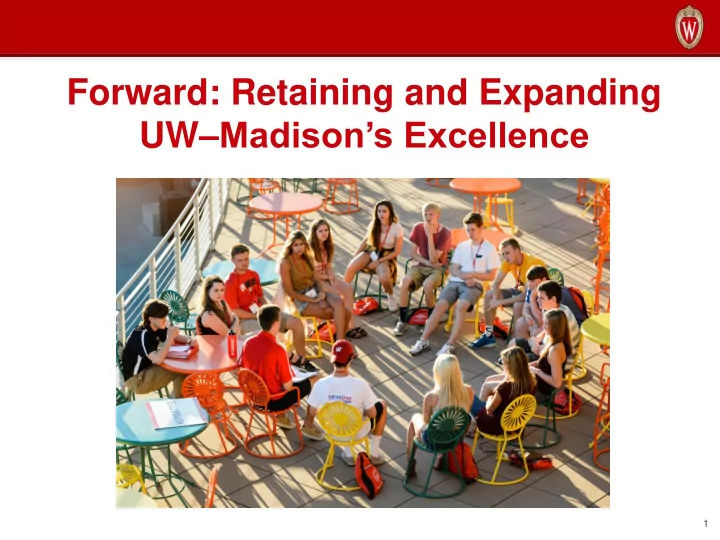
Forward: Retaining and Expanding UW–Madison’s Excellence

slide-2
SLIDE 2

2

UW–Madison’s Remains a Uniquely Excellent University

  • Record-setting applications
  • Outstanding retention rate
  • Graduation rates are up
  • Time-to-degree is down
  • Over half of undergrads graduate w/out debt
  • Our research enterprise is thriving
  • The Wisconsin Idea continues to inspire and

connect us to the people of the state

slide-3
SLIDE 3

3

The Critical Challenge of Maintaining

  • ur Excellence
  • Worrisome trends indicate future challenges to

maintaining our excellence.

  • Securing our future and continued excellence

is the challenge we face, along with many

  • ther top-flight public universities.
  • Meeting this challenge will take effort across

and at all levels of campus.

slide-4
SLIDE 4

4

All institutions and Top 25 excludes UW–Madison. Top 25 does not include University of Michigan, University of Washington–Seattle, University of Minnesota and Pennsylvania State University as data are not available for them for 2006–2009. Source: NSF HERD Survey

0.6% 2.1% 3.0% 2.0% 3.8% 4.0% 0.00% 0.50% 1.00% 1.50% 2.00% 2.50% 3.00% 3.50% 4.00% 4.50% UW-Madison All Institutions Top 25 Federal Research Expenditures Total Research Expenditures

Research Expenditures Annual Rate of Growth (2005–2015)

Worrisome Trends: Research

slide-5
SLIDE 5

5

We have slipped out of the top 5 of national research institutions for the first time since 1972. Next slide shows our research dollars have grown markedly slower than our peers. 2014

  • 1. Johns Hopkins
  • 2. U. of Michigan
  • 3. U. of Washington, Seattle
  • 4. UW–Madison
  • 5. U. of California, San Francisco

2015

  • 1. Johns Hopkins
  • 2. U. of Michigan
  • 3. U. of Washington, Seattle
  • 4. U. of California, San Francisco
  • 5. U. of California, San Diego
  • 6. UW–Madison

Worrisome Trends: Research

slide-6
SLIDE 6

6

  • Last year we had more faculty recruited to other

universities than in any other year.

  • We retained faculty at a good rate, 77%, but still lost

more faculty than ever before in a single year.

  • When other institutions recruit our faculty, they take their reputations

and their grant funds with them

  • We hired fewer faculty than in any year since we have

been keeping records (69 new faculty).

Worrisome Trends: Faculty Recruitment & Retention

slide-7
SLIDE 7

7

U.S. News & World Report’s Best Colleges Ranking for UW–Madison

Worrisome Trends: Academic Rankings

31 32 32 32 34 34 35 35 38 39 41 41 41 42 44 45 47 1 11 21 31 41

2001 2002 2003 2004 2005 2006 2007 2008 2009 2010 2011 2012 2013 2014 2015 2016 2017

U.S. News Best Colleges Ranking (1st to 50th)

Year of U.S. News Ranking

slide-8
SLIDE 8

8

80 85 90 95 100 2007 2008 2009 2010 2011 2012 2013 2014 2015 2016

2nd Year Retention Based on Prior Year's Cohort

Retention Rate To Second Year

95.7% 95.4% All New Freshmen Targeted Minority New Freshmen

Academic Rankings Drop Despite Progress

  • n Key Student Success Indicators
slide-9
SLIDE 9

9

40 50 60 70 80 90 100 2007 2008 2009 2010 2011 2012 2013 2014 2015 2016

Graduation Rate of New Freshmen Entering 6 Years Earlier

6-Year Graduation Rates

85.2% 75.2% Targeted Minority Students All Students

Academic Rankings Drop Despite Progress

  • n Key Student Success Indicators
slide-10
SLIDE 10

10

Using U.S. News & World Report “Best Colleges” Ranking Methodology

Financial Indicators are Driving Academic Rankings Drop

  • Overall ranking has ranged from 35th to 47th in past ten

years.

  • But, UW–Madison’s Financial Resources ranking has

dropped from 47th (2008) to 63rd (2017).

  • UW–Madison’s Average Compensation ranking has

dropped from 62nd (2008) to 85th (2015).

slide-11
SLIDE 11

11

Total Revenue: Annual Rate of Growth (2005–2015)

*Excludes UW. Source: Publicly available financial statements published on each relevant university’s website; excludes revenue from patient care in universities affiliated with hospitals.

0.00% 1.00% 2.00% 3.00% 4.00% 5.00% 6.00%

2.6% 4.2%

UW–Madison’s Revenue Growth Lags Peers

slide-12
SLIDE 12

12

500,000,000 1,000,000,000 1,500,000,000 2,000,000,000 2,500,000,000 3,000,000,000 2005 2006 2007 2008 2009 2010 2011 2012 2013 2014 2015

UW–Madison Total Revenue from All Sources: 2005–2015

Revenue Lag More Pronounced Recently

slide-13
SLIDE 13

13 Comparison Group : U of M, UVA, PSU, UNC, IU Washington, UC B, Purdue, Illinois, Minnesota

0.00% 0.20% 0.40% 0.60% 0.80% 1.00% UW Comparison Group

State Appropriations Annual Growth Rate (05–15)

0% 1% 2% 3% 4% 5% 6% 7% 8% UW Comparison Group

Net Tuition and Fees Annual Growth Rate (05–15)

0% 1% 2% 3% 4% 5% 6% 7% 8% UW Comparison Group

Contracts & Grants Annual Growth Rate (05–15)

0% 1% 2% 3% 4% 5% 6% 7% 8% UW Comparison Group

Ed Activities & Auxiliaries Annual Growth Rate (05–15)

0% 1% 2% 3% 4% 5% 6% 7% 8% UW Comparison Group

Private Gifts Annual Growth Rate (05–15)

0% 2% 4% 6% 8% 10% 12% 14% UW Comparison Group

Other Annual Growth Rate (05–15)

Significant opportunity

** 2005 and 2015 actuals excluding patient care revenues 0.13% annual growth 0.06% annual growth

Revenue Lags Across Nearly All Sources

387,773

830,923 272,492 413,842 85,171 451,742

**

slide-14
SLIDE 14

14

The state cuts we have faced are not the main reason we are falling behind…other schools have also faced similar cuts. It’s our lack of growth in other revenues in the past 10 years… research, tuition, gifts… that has created problems for us. To address this, we need everybody involved!

Be Clear About What this Means:

slide-15
SLIDE 15

15

UVA UW-Madison Berkeley 2005 1,875,288 1,884,738 1,601,561 2015 2,987,516 2,441,941 2,508,916 2025 4,774,447 3,156,522 3,933,716

1,000,000 2,000,000 3,000,000 4,000,000 5,000,000 6,000,000

Total Revenue (000s) UW–Madison goes from 2005 revenue parity with UVA (and ahead of Berkeley ) to lagging by $1.6B and $0.8B respectively

If the Next Ten Years Look like the Last Ten, we will Slip Behind the Competition

slide-16
SLIDE 16

16

Money is necessary but not sufficient to create a top-ranked university… we need a vision to spend the money effectively. Reinvestment priorities:

  • Build faculty & research strength
  • Continue to enhance educational quality
  • Expand access and affordability

But to reinvest, we need resources

Together We Can Reverse Worrisome Trends

slide-17
SLIDE 17

17

What Must We Do at UW to Make Reinvestment Happen?

  • Work to strengthen our 169-year partnership with the

state

  • Develop entrepreneurial strategies to grow new

revenue sources While we must do both, it is the second path that will be the source of most of our future new revenues. State dollars are unlikely to return in large measure.

slide-18
SLIDE 18

18

Governor’s Proposed Budget

The governor’s budget proposes new funding for UW System, a portion of which would return to UW–Madison as new base funding if approved. That’s critically important, but the amount is small relative to our need for new investment.

slide-19
SLIDE 19

19

State Budget Advocacy Strategy

“Reinvest in UW”

  • Legislative Briefings
  • Paid Media Campaign
  • Alumni Engagement
  • Third Party Advocacy
  • Research in Rotunda/UW Lobby Day – April 12
  • Close coordination with faculty/staff/student

lobbying orgs

slide-20
SLIDE 20

20

Entrepreneurial Strategies to Tap New Revenue Sources

  • 1. Expand summer semester
  • 2. Grow programs for professionals
  • 3. Set market-based tuition
  • 4. Explore student mix & numbers
  • 5. Grow alumni support
  • 6. Grow research funds
slide-21
SLIDE 21

21

  • 1. Expand Summer Semester

First full roll-out was summer 2016:

  • 71 new courses
  • More than 1,100 new students
  • 21% increase in tuition revenues

Goal is 10% annual growth in enrollment and revenues through 2020

slide-22
SLIDE 22

22

  • 2. Grow Programs for Professionals
  • Since 2012, we have launched 24 new professional

masters and capstone programs, with over 1,000 new students

  • In coming years, we must identify larger-scale

programs that will bring in 100-plus students and provide significant revenues, beyond their costs

  • Assistance available to design, market, put together a

business plan, and provide seed money to launch

slide-23
SLIDE 23

23

  • 3. Set Market-Based Tuition
  • Reaching market levels for non-resident &

professional-school tuition

  • Expansions in non-resident tuition have brought in

$43 million over the past two years ($30 million used to fill budget cuts from last biennium)

slide-24
SLIDE 24

24

  • 4. Explore Student Mix & Numbers
  • Professional schools are considering their size

(UW schools are smaller than many peers)

  • Undergraduate mix: Regents have lifted the out-of-

state cap, in exchange for our promise to have at least 3,600 Wisconsin freshmen in each class

slide-25
SLIDE 25

25

  • More than halfway toward $3.2B campaign goal
  • 155,000 donors and a new level of giving
  • New gifts/pledges in 2012 (pre-campaign): $291M
  • New gifts/pledges in 2015: $593M

(Most of this is not immediately spendable money; a majority of it will come in through inheritances in the future, or is put into endowment and pays out at 4.5%.)

  • 5. Grow Alumni Support
slide-26
SLIDE 26

26

The impact of one gift

  • $50 million from Ab & Nancy

Nicholas inspired an additional $50 million in gifts

  • New endowment will bring a

UW–Madison education within reach for generations

  • f students
  • 5. Grow Alumni Support: An example
slide-27
SLIDE 27

27

  • 6. Grow Research Funds

Working to grow research:

  • UW 2020: WARF Discovery Initiative
  • 28 proposals funded in first year
  • Better support for UW scientists competing for large,

complex federal grants

  • Growing big, interdisciplinary centers
  • Implement a “concierge approach” to industry

partnerships

slide-28
SLIDE 28

28

What are your ideas?

slide-29
SLIDE 29

29

Together we can reverse worrisome trends and close the revenue gap…allowing us to invest in faculty and students