Foreign Trust Challenges for U.S. Tax Advisors: Navigating Fiduciary - - PowerPoint PPT Presentation

foreign trust challenges for u s tax advisors navigating
SMART_READER_LITE
LIVE PREVIEW

Foreign Trust Challenges for U.S. Tax Advisors: Navigating Fiduciary - - PowerPoint PPT Presentation

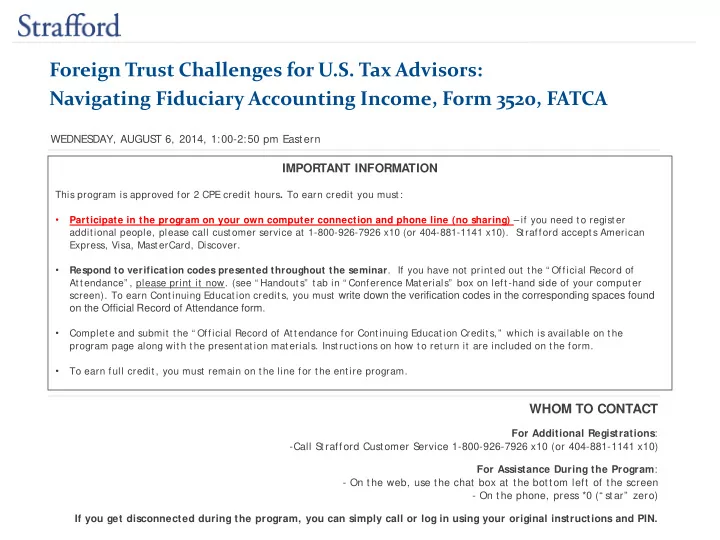
Foreign Trust Challenges for U.S. Tax Advisors: Navigating Fiduciary Accounting Income, Form 3520, FATCA WEDNES DAY, AUGUS T 6, 2014, 1:00-2:50 pm Eastern IMPORTANT INFORMATION This program is approved for 2 CPE credit hours . To earn credit


slide-1
SLIDE 1

Foreign Trust Challenges for U.S. Tax Advisors: Navigating Fiduciary Accounting Income, Form 3520, FATCA

WEDNES DAY, AUGUS T 6, 2014, 1:00-2:50 pm Eastern

WHOM TO CONTACT

For Additional Registrations:

  • Call S

trafford Customer S ervice 1-800-926-7926 x10 (or 404-881-1141 x10) For Assistance During the Program:

  • On the web, use the chat box at the bottom left of the screen
  • On the phone, press *0 (“ star” zero)

If you get disconnected during the program, you can simply call or log in using your original instructions and PIN.

IMPORTANT INFORMATION

This program is approved for 2 CPE credit hours. To earn credit you must:

  • Participate in the program on your own computer connection and phone line (no sharing) –

if you need to register additional people, please call customer service at 1-800-926-7926 x10 (or 404-881-1141 x10). S trafford accepts American Express, Visa, MasterCard, Discover.

  • Respond to verification codes presented throughout the seminar. If you have not printed out the “ Official Record of

Attendance” , please print it now. (see “ Handouts” tab in “ Conference Materials” box on left -hand side of your computer screen). To earn Continuing Education credits, you must write down the verification codes in the corresponding spaces found

  • n the Official Record of Attendance form.
  • Complete and submit the “ Official Record of Attendance for Continuing Education Credits,” which is available on the

program page along with the presentation materials. Instructions on how to return it are included on the form.

  • To earn full credit, you must remain on the line for the entire program.
slide-2
SLIDE 2

Tips for Optimal Quality

S

  • und Qualit y

If you are listening via your computer speakers, please note that the quality

  • f your sound will vary depending on the speed and quality of your internet

connection. If the sound quality is not satisfactory, you may listen via the phone: dial 1-866-873-1442 and enter your PIN when prompted. Otherwise, please send us a chat or e-mail sound@ straffordpub.com immediately so we can address the problem. If you dialed in and have any difficulties during the call, press *0 for assistance. Viewing Qualit y To maximize your screen, press the F11 key on your keyboard. To exit full screen, press the F11 key again.

FOR LIVE EVENT ONLY

slide-3
SLIDE 3

Program Materials

If you have not printed the conference materials for this program, please complete the following steps:

  • Click on the ^ symbol next to “ Conference Materials” in the middle of t he left-

hand column on your screen.

  • Click on the tab labeled “ Handouts” that appears, and there you will see a

PDF of the slides and the Official Record of Attendance for today's program.

  • Double-click on the PDF and a separate page will open.
  • Print the slides by clicking on the printer icon.

FOR LIVE EVENT ONLY

slide-4
SLIDE 4

Foreign Trust Challenges for U.S. Tax Advisors

Lawrence M. Lipoff, Lipoff Global Advisors llipoff@ lipoffadvisors.com August 6, 2014 Cynthia Brittain, Northern Trust cdb11@ ntrs.com Edward Vergara, Withers Bergman edward.vergara@ withers.us.com

slide-5
SLIDE 5

Notice

ANY TAX ADVICE IN THIS COMMUNICATION IS NOT INTENDED OR WRITTEN BY THE S PEAKERS ’ FIRMS TO BE US ED, AND CANNOT BE US ED, BY A CLIENT OR ANY OTHER PERS ON OR ENTITY FOR THE PURPOS E OF (i) AVOIDING PENALTIES THAT MA Y BE IMPOS ED ON ANY TAXP A YER OR (ii) PROMOTING, MARKETING OR RECOMMENDING TO ANOTHER P ARTY ANY MATTERS ADDRES SED HEREIN.

Y

  • u (and your employees, representatives, or agents) may disclose to any and all persons,

without limitation, the tax treatment or tax structure, or both, of any transaction described in the associated materials we provide to you, including, but not limited to, any tax opinions, memoranda, or other tax analyses contained in those materials. The information contained herein is of a general nature and based on authorities that are subj ect to change. Applicability of the information to specific situations should be determined through consultation with your tax adviser.

5

slide-6
SLIDE 6

FACETS THAT MAKE AN ENTITY A TRUST

Cynthia Brittain Vice President and Senior Fiduciary Officer Northern Trust Santa Barbara, Calif. Cdb11@ntrs.com

slide-7
SLIDE 7

7

Initial Classific ations What is a trust, for U.S. tax purposes? Lichtenstein Foundation Stiftung Usufruct Treuhand Establishment Investment trust Are these all Business trust trusts?

slide-8
SLIDE 8

8

Initial Classific ations (Cont.)

Ordinary trusts: 301.7701-4(a) In general, the term “trust” as used in the Internal Revenue Code refers to an arrangement created either by a will or by an inter vivos declaration whereby trustees take title to property for the purpose of protecting or conserving it for the beneficiaries under the ordinary rules applied in chancery or probate courts. Usually the beneficiaries of such a trust do no more than accept the benefits thereof and are not the voluntary planners or creators of the trust arrangement. However, the beneficiaries of such a trust may be the persons who create it and it will be recognized as a trust under the Internal Revenue Code if it was created for the purpose of protecting or conserving the trust property for beneficiaries who stand in the same relation to the trust as they would if the trust had been created by others for them. Generally speaking, an arrangement will be treated as a trust under the Internal Revenue Code if it can be shown that the purpose of the arrangement is to vest in trustees responsibility for the protection and conservation of property for beneficiaries who cannot share in the discharge of this responsibility and, therefore, are not associates in a joint enterprise for the conduct of business for profit.

slide-9
SLIDE 9

9

Initial Classific ations (Cont.)

Business trusts: 301.7701-4(b) There are other arrangements which are known as trusts because the legal title to property is conveyed to trustees for the benefit of beneficiaries, but which are not classified as trusts for purposes of the Internal Revenue Code because they are not simply arrangements to protect or conserve the property for the beneficiaries. These trusts, which are often known as business or commercial trusts, generally are created by the beneficiaries simply as a device to carry on a profit-making business which normally would have been carried on through business

  • rganizations that are classified as corporations or partnerships under the Internal

Revenue Code. However, the fact that the corpus of the trust is not supplied by the beneficiaries is not sufficient reason in itself for classifying the arrangement as an ordinary trust rather than as an association or partnership. The fact that any

  • rganization is technically cast in the trust form, by conveying title to property to

trustees for the benefit of persons designated as beneficiaries, will not change the real character of the organization if the organization is more properly classified as a business entity under Section 301.7701-2.

slide-10
SLIDE 10

10

Initial Classific ations (Cont.)

Investment trusts: 301.7701-4(c)(1) An “investment” trust will not be classified as a trust if there is a power under the trust agreement to vary the investment of the certificate holders. See Commissioner v. North American Bond Trust, 122 F. 2d 545 (2d Cir. 1941), cert. denied, 314 U.S. 701 (1942). An investment trust with a single class of ownership interests, representing undivided beneficial interests in the assets of the trust, will be classified as a trust if there is no power under the trust agreement to vary the investment of the certificate holders. An investment trust with multiple classes of

  • wnership interests ordinarily will be classified as a business entity under Section

301.7701-2; however, an investment trust with multiple classes of ownership interests, in which there is no power under the trust agreement to vary the investment of the certificate holders, will be classified as a trust if the trust is formed to facilitate direct investment in the assets of the trust and the existence of multiple classes of ownership interests is incidental to that purpose.

slide-11
SLIDE 11

11

Initial Classific ations (Cont.)

301.7701-4(c)(2), Example 4: Business interest vs. trust classification: Corporation N purchases a portfolio of bonds and transfers the bonds to a bank under a trust agreement. At the same time, the trustee delivers to N certificates evidencing interests in the bonds. These certificates are sold to public investors. Each certificate represents the right to receive a particular payment with respect to a specific bond. Under section 1286, stripped coupons and stripped bonds are treated as separate bonds for federal income tax purposes. Although the interest

  • f each certificate holder is different from that of each other certificate holder, and

the trust thus has multiple classes of ownership, the multiple classes simply provide each certificate holder with a direct interest in what is treated under section 1286 as a separate bond. Given the similarity of the interests acquired by the certificate holders to the interests that could be acquired by direct investment, the multiple classes of trust interests merely facilitate direct investment in the assets held by the trust. Accordingly, the trust is classified as a trust.

slide-12
SLIDE 12

12

Can A Re tir e me nt Plan Be A T r ust?

Canadian retirement plans - are they so different from U.S. retirement plans? See IRS Notice 2003-75 This notice sets out how these plans are to be treated and certain procedures related to informational return filings. Forms 3520 and 3520-A used to be required. Now, there is a new reporting regime for Canadian RRSPs and RRIFs.

AICPA.ORG: IRS responds to AICPA concerns for filing Forms 3520 and 3520-As on Canadian retirement plans. Similar issues apply for non-US retirement plans.

slide-13
SLIDE 13

13

Can A L ife E state Be A T r ust?

Usufruct: Are they so different from a U.S. life estate? In Public Letter Ruling – 9121035 (91 TNT 116- 47 (February 25, 1991), the IRS characterized a usufruct under German law (a Civil Law country) as a foreign non- grantor trust. In Estate of O.T. Swan, 24 T.C. 803 (1981, acq. 1981-2 C.B. 1., the Tax Court determined that stiftungs should be treated as trusts, for U.S. tax purposes.

slide-14
SLIDE 14

14

Disc losur e s

Not FDIC Insured | No Bank Guarantee | May Lose Value

LEGAL, INVESTMENT AND TAX NOTICE: This information is not intended to be and should not be treated as legal advice, investment advice or tax advice. Readers, including professionals, should under no circumstances rely upon this information as a substitute for their own research or for obtaining specific legal

  • r tax advice from their own counsel.

IRS CIRCULAR 230 NOTICE: To the extent that this communication or any attachment concerns tax matters, it is not intended to be used, and cannot be used by a taxpayer, for the purpose of avoiding any penalties that may be imposed by law. For more information about this notice, see http://www.northerntrust.com/circular230. This presentation is for your private information and is intended for one-on-one use with current or prospective clients of Northern Trust. The information does not constitute investment advice or a recommendation to buy or sell any security, may not be suitable for all investors and is subject to change without notice. Securities products and brokerage services are sold by registered representatives of Northern Trust Securities, Inc. (member NASD, SIPC), a registered investment adviser and wholly owned subsidiary of Northern Trust Corporation.

slide-15
SLIDE 15

CATEGORIES OF FOREIGN TRUSTS

Cynthia Brittain Vice President and Senior Fiduciary Officer Northern Trust Santa Barbara, Calif. Cdb11@ntrs.com

slide-16
SLIDE 16

16

F

  • r

e ign Gr antor T r ust Rule s: Spe c ific T

  • Non- U.S.

Re side nts, Non- U.S. Citize ns

When would I use a foreign grantor trust?

  • Essential tool for non-U.S. residents, non-U.S. citizens who have children

moving to the U.S.

  • Let’s look at the Internal Revenue Code for the requirements:
  • If a trust is a grantor trust (within the meaning of IRC sections 673 through

679), its income and gains generally will be taxed to the grantor (IRC Sect. 671).

  • If a trust is set up by a foreign person, then specific rules, introduced by

the 1996 Small Business Act, will apply to determine whether the trust is a grantor or non-grantor trust.

  • Trusts that were established on or before Sept. 19, 1995 that were grantor

trusts under the general rules of sections 676 or 677 are “grandfathered” as grantor trusts, provided that if any amounts were transferred to such trusts after this date, the portion of the trust attributable to such transfers must separately accounted for (See Notice 97-34, 1997-1 C.B. 422).

slide-17
SLIDE 17

17

F

  • r

e ign Gr antor T r ust Rule s: Spe c ific to Non- U.S. Re side nts, Non- U.S. Citize ns (Cont.)

  • 1. Mom and Dad do not want U.S. estate tax on what they

give to child.

  • 2. Mom and Dad do not want U.S. gift tax on what they

give to child.

  • 3. Mom and Dad do not ever want to have U.S. estate tax.
  • 4. Mom and Dad would like to minimize U.S. income tax.

So, Mom and Dad set up a foreign grantor trust. There are a number of scenarios, but their child is usually named as one of the beneficiaries along with the parents.

  • Mom and Dad

(In China) Child in U.S.

slide-18
SLIDE 18

18

Initial Classific ations

  • IRC 672(f): In general, the grantor trust rules under the code will not apply to

foreign trusts unless the requirements of Sect. 672(f)(2) are satisfied. 672(f)(1) – In general: Notwithstanding any other provision of this subpart, this subpart shall apply only to the extent such application results in an amount (if any) being currently taken into account (directly or through 1 or more entities) under this chapter in computing the income of a citizen or resident of the United States or a domestic corporation. Exception to general rules 672(f)(2)(A) – foreign grantor trust status available if:

  • 1. 672(f)(2)(A)(i) – The power to re-vest absolutely in the grantor title to the

trust property to which such portion is attributable is exercisable solely by the grantor without the approval or consent of any other person or with the consent of a related

  • r subordinate party who is subservient to the grantor, ****or*****
  • 2. 672(f)(2)(A)(ii) – The only amounts distributable from such portion

(whether income or corpus) during the lifetime of the grantor are amounts distributable to the grantor or the spouse of the grantor.

slide-19
SLIDE 19

19

Be ne fits T

  • A F
  • r

e ign Gr antor T r ust

Treatment of income in a foreign grantor trust: NRA: Preferred income tax regime NRA: U.S. estate tax planning NRA: U.S. gift tax avoidance

slide-20
SLIDE 20

20

Disc losur e s

Not FDIC Insured | No Bank Guarantee | May Lose Value

LEGAL, INVESTMENT AND TAX NOTICE: This information is not intended to be and should not be treated as legal advice, investment advice or tax advice. Readers, including professionals, should under no circumstances rely upon this information as a substitute for their own research or for obtaining specific legal

  • r tax advice from their own counsel.

IRS CIRCULAR 230 NOTICE: To the extent that this communication or any attachment concerns tax matters, it is not intended to be used, and cannot be used by a taxpayer, for the purpose of avoiding any penalties that may be imposed by law. For more information about this notice, see http://www.northerntrust.com/circular230. This presentation is for your private information and is intended for one-on-one use with current or prospective clients of Northern Trust. The information does not constitute investment advice or a recommendation to buy or sell any security, may not be suitable for all investors and is subject to change without notice. Securities products and brokerage services are sold by registered representatives of Northern Trust Securities, Inc. (member NASD, SIPC), a registered investment adviser and wholly owned subsidiary of Northern Trust Corporation.

slide-21
SLIDE 21

Slide Intentionally Left Blank

slide-22
SLIDE 22

COMPLEXITIES OF SECT. 679 AND FOREIGN GRANTOR TRUSTS

Edward Vergara Partner Withers Bergman 660 Steamboat Road Greenwich, CT 06830, USA 203-302-4074 edward.vergara@withers.us.com

slide-23
SLIDE 23

Foreign Grantor Trusts: Overview

  • Inbound and outbound

Foreign grantor trusts under S

  • ect. 679

U.S . transferor treated as grantor of foreign trust

Foreign grantor trusts under S

  • ect. 672(f)

Foreign person treated as grantor of foreign trust

23

slide-24
SLIDE 24

Foreign Grantor Trusts: Sect. 679

  • Policy to eliminate deferral opportunities for U.S

. grantors

  • S
  • ect. 679 treats the U.S

. transferor of assets to a foreign trust with U.S . beneficiaries as the owner of the trust assets.

  • Four requirements:

Trust must be a foreign trust.

Transferor must be a U.S . person.

Trust must have one or more U.S . beneficiaries.

Transferor must make a direct or indirect transfer of assets to the trust (also satisfied by trust migration).

24

slide-25
SLIDE 25
  • Sect. 679: Transferor Must Be U.S. Person
  • “ U.S

. person” as defined in S

  • ect. 7701(a)(30):

U.S . citizens

U.S . residents

Domestic partnerships or corporations

Certain estates

Trusts meeting the control and administration tests

Non-resident aliens making a S

  • ect. 6013(g) election to file

j ointly

  • U.S

. person includes NRAs who become U.S . residents within five years of transfer to foreign trust.

Complicates the ability to create an income tax “ drop-off” trust

25

slide-26
SLIDE 26
  • Sect. 679: One Or More U.S. Beneficiaries
  • S
  • ect. 679(c)(1) creates a presumption that every foreign trust has a

U.S . beneficiary.

  • Transferor bears the burden of rebutting the presumption by showing

that:

Under the terms of the trust, no income or principal may be paid

  • r accumulated during the taxable year for the benefit of a U.S

. person.

Termination of the trust during the taxable year would not result in a distribution to a U.S . person.

  • Important considerations:

Local law of the trust may create contingent interest in persons not specifically referenced in the trust.

Trusts or entities with U.S . person partners/ beneficiaries/ members may trigger inclusion.

26

slide-27
SLIDE 27
  • Sect. 679: Transfers: Casting A Wide Net
  • S
  • ect. 679(a) includes both direct and indirect transfers to foreign

trusts.

Direct transfers: Any transfer, for less than fair market value, from the U.S . person to the foreign trust

Indirect and constructive transfers

S

  • me examples of indirect transfers within the scope of

679(a):

Transfer through a foreign person or entity serving as a conduit

Transfer from a U.S . or foreign grantor trust

Constructive transfer via the assumption or satisfaction

  • f trust debt

Transfer of assets to entities owned by a foreign trust

27

slide-28
SLIDE 28
  • Sect. 679: Transfers: Exceptions
  • Testamentary transfers

Any transfers made to a foreign trust under a U.S . or foreign will, including testamentary trusts

  • Transfers for fair market value

Any sale or exchange for fair market value

Caution: Promissory notes only fall within the fair market value exception if:

Transferor and trust are not related persons under Treas.

  • Reg. 1.679-1(c)(5).

Transferor and trust are related persons, but the note is a “ qualified obligation” within the meaning of Treas. Reg. 1.679-4(d)(1).

  • Transfers to charitable or employee trusts

28

slide-29
SLIDE 29
  • Sect. 672(f): Foreign Grantor Ownership Rule
  • General rule: The grantor trust rules do not apply to any

portion of a trust that is treated as owned by a person other than a U.S . citizen, resident or domestic corporation.

  • Exceptions:

Revocable trusts

Trusts that may only distribute during grantor’s life to the grantor or grantor’s spouse

  • S

pecial rules

Certain foreign corporations treated as domestic corporations

Compensatory trusts

29

slide-30
SLIDE 30
  • Sect. 672(f): Foreign Grantor

Ownership Rule (Cont.)

  • Revocable trusts

No denial of grantor trust status where foreign person has power to re-vest title in himself without consent or only with consent

  • f related or subordinate parties under S
  • ect. 672(c)

Presumption of subservient status

Power to re-vest title must be exercisable for 183 days during the tax year.

  • Trusts distributable only to grantor and grantor’s spouse

No denial of grantor trust status when, during the grantor’s life, distributions may only go to grantor or grantor’s spouse

Amounts distributable for the support of dependents qualify for the exception.

30

slide-31
SLIDE 31
  • Sect. 672(f): Treatment Of Foreign Entities
  • For the purposes of 672(f), the following are treated as domestic

corporations:

Controlled foreign corporations (CFCs)

Passive foreign investment companies (PFICs)

Foreign personal holding companies (FPHCs)

Anti-abuse rule

  • Recharacterization of gifts under S
  • ect. 672(f)(4)

A “ purported gift” by a foreign partnership or corporation may, at the IRS ’ discretion, be recharacterized and taxed to the beneficiary.

Gifts from foreign partnerships are recharacterized as ordinary income.

Gifts from foreign corporations are recharacterized as distributions and are subj ect to CFC and PFIC rules.

Beware Treas. Reg. S

  • ect. 1.674(f)-4(a)(2)

31

slide-32
SLIDE 32
  • Sect. 672(f)(5) Anti-Conduit Rule:

Attribution To U.S. Beneficiary

  • Prior to S
  • ect. 672(f)(5), U.S

. persons might transfer assets to a foreign intermediary, who would contribute them to a grantor trust for the benefit of the U.S . person or his affiliates, thereby avoiding U.S . income tax.

  • S
  • ect. 672(f)(5) shuts the door on this type of planning by

denying grantor trust status when the grantor is a foreign person, and a U.S . person beneficiary of trust has previously transferred money to the grantor.

Exception for annual exclusion gifts

32

slide-33
SLIDE 33

DEFINING AND MANAGING TRUST INCOME AND FIDUCIARY ACCOUNTING INCOME

Cynthia Brittain Vice President and Senior Fiduciary Officer Northern Trust Santa Barbara, Calif. Cdb11@ntrs.com

slide-34
SLIDE 34

34

F

  • r

e ign Non- Gr antor T ax Rule s: Har sh Re sults for U.S. Be ne fic iar ie s

When would these harsh rules apply? Foreign non-grantor trusts are generally taxed in the same manner as individuals, with certain modifications (Sect. 641(b)). Let’s compare with a domestic trust …

slide-35
SLIDE 35

35

F

  • r

e ign Non- Gr antor T r ust Rule s

Domestic trust: Will pay U.S. tax on its worldwide income and

capital gains. Items of ordinary income are generally taxed at graduated rates, now up to 39.6%, after allowance of certain deductions and credits.

Similarly to the tax rates for individuals, long-term capital gains

are taxed in the trust at 15% (unless a high income earner under the American Taxpayer Relief Act of 2012).

In calculating taxable income, a trust will receive a deduction for

any distributions to its beneficiaries, to the extent that these distributions carry out the trust’s “distributable net income (“DNI”) for the year ((Section 661(a)). The DNI distributed will retain its character as income or capital gains in the hands of the recipient beneficiary and will be taxed to them (Section 662(b)). Capital gain is usually tax in the trust.

slide-36
SLIDE 36

36

F

  • r

e ign Non- Gr antor T r ust Rule s: DNI

Domestic trusts: DNI consists of the trust’s fiduciary accounting income, with

modifications (Sect. 643(a)).

Standards rates apply, and income and capital gains retain

their character (Sect. 662(b)).

Foreign trusts: As long as there is a current-year distribution of a trust’s

income and gains to a recipient, the tax due should not differ significantly (except for the allowance of deductions and credits) between a foreign grantor trust and a domestic grantor trust.

slide-37
SLIDE 37

37

T hr

  • wbac k Rule s

The throwback rules essentially attempt to treat the beneficiary as having

received the income and gains when they were earned.

There is a “penalty” for failure to distribute and pay tax when due.

So, any distributions in later years in excess of DNI (under the first-in,

first-out basis) will be taxed at the recipient’s highest marginal income tax rate for the year in which the income or gain was earned by the trust.

Capital gains lose their status effectively as LTCGs, and such are taxed

as ordinary income.

The throwback rules add an interest charge to the taxes in order to offset

the benefits of the tax deferral (Sect. 668).

This interest charge accrues from the year in which the income or gain is

recognized and ends with the year that the UNI amount is distributed, and is assessed at the rate applicable to underpayment of tax, as adjusted, compounded daily.

In many instances, the throwback rules can wipe out any economic benefit

from the deferral and can actually deplete all the trust assets.

Domesticating the foreign trust will not solve the issue. UNI remains in the

U.S. domestic trust, and the throwback rules apply as the UNI is distributed.

slide-38
SLIDE 38

38

De fault Me thod Of T axation T

  • Mitigate UNI

The default rule is used to assist a taxpayer who did not

receive any supporting accounting to complete the foreign non-grantor trust beneficiary statement. The taxpayer uses this statement to ascertain UNI vs. DNI.

The default rule is wholly an administrative creation and

has no statutory underpinning, other than the usual grant of authority to Treasury and the Service to issue regulations and rules that are necessary to carry out congressional

  • intent. The method is described in the instructions to Form

3520.

There may be certain investment strategies that can assist

to bail out the trust’s UNI.

Consider modeling the default rules and potential payout

strategies

slide-39
SLIDE 39

39

Disc losur e s

Not FDIC Insured | No Bank Guarantee | May Lose Value

LEGAL, INVESTMENT AND TAX NOTICE: This information is not intended to be and should not be treated as legal advice, investment advice or tax advice. Readers, including professionals, should under no circumstances rely upon this information as a substitute for their own research or for obtaining specific legal

  • r tax advice from their own counsel.

IRS CIRCULAR 230 NOTICE: To the extent that this communication or any attachment concerns tax matters, it is not intended to be used, and cannot be used by a taxpayer, for the purpose of avoiding any penalties that may be imposed by law. For more information about this notice, see http://www.northerntrust.com/circular230. This presentation is for your private information and is intended for one-on-one use with current or prospective clients of Northern Trust. The information does not constitute investment advice or a recommendation to buy or sell any security, may not be suitable for all investors and is subject to change without notice. Securities products and brokerage services are sold by registered representatives of Northern Trust Securities, Inc. (member NASD, SIPC), a registered investment adviser and wholly owned subsidiary of Northern Trust Corporation.

slide-40
SLIDE 40

Slide Intentionally Left Blank

slide-41
SLIDE 41

COMPLEXITIES WITH FOREIGN NON-GRANTOR TRUSTS

Edward Vergara Partner Withers Bergman 660 Steamboat Road Greenwich, CT 06830, USA 203-302-4074 edward.vergara@withers.us.com

slide-42
SLIDE 42
  • Sect. 667: The “Throwback Rule”
  • Prior to the “ throwback tax,” foreign non-grantor trusts

generally were not subj ect to U.S income tax on undistributed foreign source income, which created an opportunity for deferral or elimination of U.S . income taxes on income and gains ultimately benefitting a U.S . taxpayer.

  • Applies to any distribution from a foreign non-grantor trust to

a U.S . beneficiary in excess of current year DNI.

  • S

uch distributions are deemed “ accumulat ion dist ribut ions” and are taxable to the U.S . beneficiary under S

  • ect. 667.
  • Practical effect is taxation of all accumulated income at
  • rdinary income rates, plus penalty interest charge. Effective

rate of taxation can reach 100% .

42

slide-43
SLIDE 43

Planning Distributions To Avoid Throwback

  • Use “default method”

Interest charge only applies to amounts in excess of 125%

  • f average distributions

received during the three prior years.

All distributions, whether income or principal, will be taxable.

  • Avoid accumulations

Payment of yearly DNI to U.S . “ mirror trust”

  • Throwback rule exceptions

Include specific bequests – exempt under S

  • ect. 663(a)(1)

Bequests for specific sums are payable in not more than three installments.

S pecific bequests do not carry DNI to beneficiary under TR 1.663(a)-1.

  • FAI exception
  • Distribution of appreciated assets

Distributions of property other than cash are valued at the lesser of the trust’s basis in the property and the fair market value, reducing distribution value.

  • Insurance solutions

43

slide-44
SLIDE 44

CFC And PFIC Attribution: Foreign Trusts

  • CFC overview and attribution rules
  • PFIC overview and attribution rules
  • The authority of proposed regulations
  • Potential solutions

As with the throwback rule, the CFC and PFIC attribution rules are aimed at taxpayers who use foreign entities to defer U.S. income taxation.

44

slide-45
SLIDE 45

CFC Attribution: CFC Basics

  • A foreign corporation is classified as a CFC if:

More than 50%

  • f either (i) the total combined voting power of

all classes of stock or (ii) the total value of the corporation’s stock …

… Is owned directly, indirectly or constructively by U.S . shareholders each owning 10%

  • r more of the total combined

vot ing power of all classes of stock on any day during the taxable year.

  • U.S

. shareholders of a CFC must include in gross income their pro rata share of the CFC’s S ubpart F income.

S ubpart F generally includes most passive investment income and income from certain transactions with related parties.

45

slide-46
SLIDE 46

CFC Attribution To Foreign Trust Beneficiaries

  • In determining whether a U.S

. taxpayer is a 10% shareholder in a corporation, the IRS considers shares owned directly, indirectly and constructively.

  • Under S
  • ect. 958(a)(2), stock owned by or for a foreign

corporation, partnership, trust or estate is considered as being

  • wned proportionately by such entity’s shareholders, partners
  • r beneficiaries.
  • The regulations note that the determination of a beneficiary’s

proportionate interest is a facts-and-circumstances analysis.

  • FS

A 199952014 and TR 1.958-1(d) ex. 3 suggest that the facts- and-circumstances test will attribute CFC ownership to trust beneficiaries without regard to the beneficiary’s actual ability to vote the shares.

46

slide-47
SLIDE 47

PFIC Attribution: PFIC Basics

  • Unlike the CFC rules, the PFIC rules do not take control into account.
  • A PFIC is a foreign corporation that meets either test of S
  • ect. 1297(a):

75%

  • r more of the corporation’s gross income is “ passive” income.

Average of assets held by the corporation during the taxable year that produce (or are held for the production of) passive income is 50% .

  • Two punitive taxes for U.S

. PFIC shareholders:

Tax on distributions:

Excess dist ribut ions: Distribution that exceeds 125%

  • f average distribution in

three preceding years; subj ect to S

  • ect. 1291 “ deferred tax” regime + interest

Non-excess dist ribut ions: Distributions that are not excess distributions are taxed as ordinary dividends, but no QDI treatment is available.

Tax on gain recognized on disposition:

All gain recognized on disposition is treated like an excess distribution.

  • Elections to avoid punitive taxes:

QEF election: S hareholder pays pro rata share of PFIC ordinary income each year.

Mark-to-market: S hareholder of marketable PFIC shares includes FMV of shares in excess of basis as ordinary income each year.

47

slide-48
SLIDE 48

PFIC Attribution To Foreign Trust Beneficiaries

  • As with the CFC attribution rules, S
  • ect. 1298(a)(3) provides for

attribution of ownership of PFIC shares by U.S . beneficiaries of foreign trusts.

The proposed regulations indicate that attribution of PFIC shares through indirect ownership is a facts-and-circumstances analysis.

  • Lingering uncertainty regarding effect of proposed regulations
  • TAM 200733024

Foreign non-grantor trust liquidated PFIC positions and distributed half of its assets to U.S . beneficiaries.

IRS relied on 1298(b)(5), without reliance on the proposed regulations, and applied the PFIC disposition rules to the liquidation and distribution.

However, neither S

  • ect. 1298 nor S
  • ect. 1291 refer to “ indirect” PFIC
  • shareholders. Only the proposed regulations make this connection.

48

slide-49
SLIDE 49

Possible Planning Solutions

  • Be aware of the U.S

. tax characterization of foreign entities at the time of formation

Elective entity regime allows some flexibility.

Caution: Reclassification of existing entities is treated as a liquidation for U.S . tax purposes, and may trigger CFC and PFIC attribution rules.

Caution: Tax effects of pass-through treatment should be carefully considered.

  • Consider using grantor trusts to hold CFC and PFIC assets

Beneficiaries of a grantor trust are not subj ect to the CFC and PFIC attribution rules

49

slide-50
SLIDE 50

Slide Intentionally Left Blank

slide-51
SLIDE 51

FEATURES THAT MAKE A TRUST A FOREIGN TRUST

Managing Director Lipoff Global Advisors 46 Powder Horn Drive Suffern, New York 10901-2428 lllipoff@lipoffadvisors.com

Lawrence M. Lipoff, TEP, CPA, CEBS (914) 262-6812 Consultant Friedman LLP 1700 Broadway New York, New York 10019-5826 llipoff@friedmanllp.com

slide-52
SLIDE 52

Illustrative Cases

  • Grantor Trust Ceases to be Grantor Trust

(§684)

  • Pre-immigration Planning - §679 Five Year

Rule

  • Foreign Trusts Often Have Foreign Business

Company Holding Assets – CFC & PFIC Rules

  • United States Filing Information Not Available

52

slide-53
SLIDE 53

Defining Foreign Trust

All trusts are deemed to be foreign unless both the “Court Test” and “Control Test” met

  • Court Test: Court in United States able to exercise

primary supervision over trust administration

  • Control Test: One of more United States persons

have authority to control all substantial decisions

  • f the trust

Accidental tripping of Control Test rules to become foreign trust does have twelve month

  • pportunity to correct

53

slide-54
SLIDE 54

Foreign Grantor Trust Compliance

  • New FBAR – FinCEN Form 114 – Report of Foreign

Bank and Financial Accounts

  • Form 3520 – Annual Return to Report Transactions

With Foreign Trusts and Receipt of Certain Foreign Gifts

  • Form 3520-A – Annual Information Return of Foreign

Trust With a U.S. Owner

  • Form 4970 – Tax on Accumulation Distribution of

Trusts

  • Form 8832- Entity Classification Election

54

slide-55
SLIDE 55

Section 684

Direct or deemed transfers by a United States person to a foreign trust are taxable under §684 as a sale or exchange for the amount of the property’s fair market value Gains but not losses are recognized Death of grantor creates an exception

55

slide-56
SLIDE 56

§679 & Pre-Immigration Planning (1/2)

To avoid future United States gift and estate tax exposure, non-United States person might place assets in trust before becoming United States resident alien There is a difference in being a United States person for income (objective) and transfer (subjective) tax purposes – can be RA for one and NRA for the other

56

slide-57
SLIDE 57

§679 & Pre-Immigration Planning (2/2)

If a nonresident alien transfers property to a foreign trust within five years of making a transfer to a foreign trust, §679(a)(4) makes trust a grantor trust from the residency starting date An intermediary’s transfer to foreign trust will also toll §679(a)(4)

57

slide-58
SLIDE 58

Foreign Trusts & Foreign Business Company

Controlled Foreign Corporation (CFC) – generally include proportionate share of investment and other Subpart F income – 50% of vote or value owned by “US shareholders” with 10% of voting stock Passive Foreign Investment Company (PFIC) – US shareholders taxed

  • n direct and indirect dispositions of stock and “excess

distributions” - 75% of gross income is passive or 50% average passive assets CFC trumps PFIC classification Planning often involves checking-the-box – either up to 12 months prospective or 75 days retroactively (or 3 years and 75 days retroactively with IRS permission) Various elections to potentially mitigate anti-deferral provisions

58

slide-59
SLIDE 59

United States Filing Information

For Foreign Trusts September 19, 1995 was end of former grantor trust rules - grandfathered if compliant Current rules, effective after August 20, 1996, basically (i) revocable or (ii) during lifetime distributable only to grantor and/or spouse

59

slide-60
SLIDE 60

Defining Foreign Trust

All trusts are deemed to be foreign unless both the “court test” and “control test” are met.

  • Court test: Court in U.S. is able to exercise primary supervision over trust

administration.

  • Control test: One or more U.S. persons have authority to control all

substantial decisions of the trust. Accidental tripping of the control test rules to become a foreign trust does have 12-month opportunity to correct.

60

slide-61
SLIDE 61

§684 Caution

Direct or deemed transfers by a U.S. person to a foreign trust are taxable under §684 as a sale or exchange for the amount of the property’s fair market value. Gains, but not losses, are recognized. Death of grantor creates an exception.

61