Forced Labor Case Study: U.S. v. Olga Murra 1980s - Sisters - - PDF document

forced labor case study u s v olga murra
SMART_READER_LITE
LIVE PREVIEW

Forced Labor Case Study: U.S. v. Olga Murra 1980s - Sisters - - PDF document

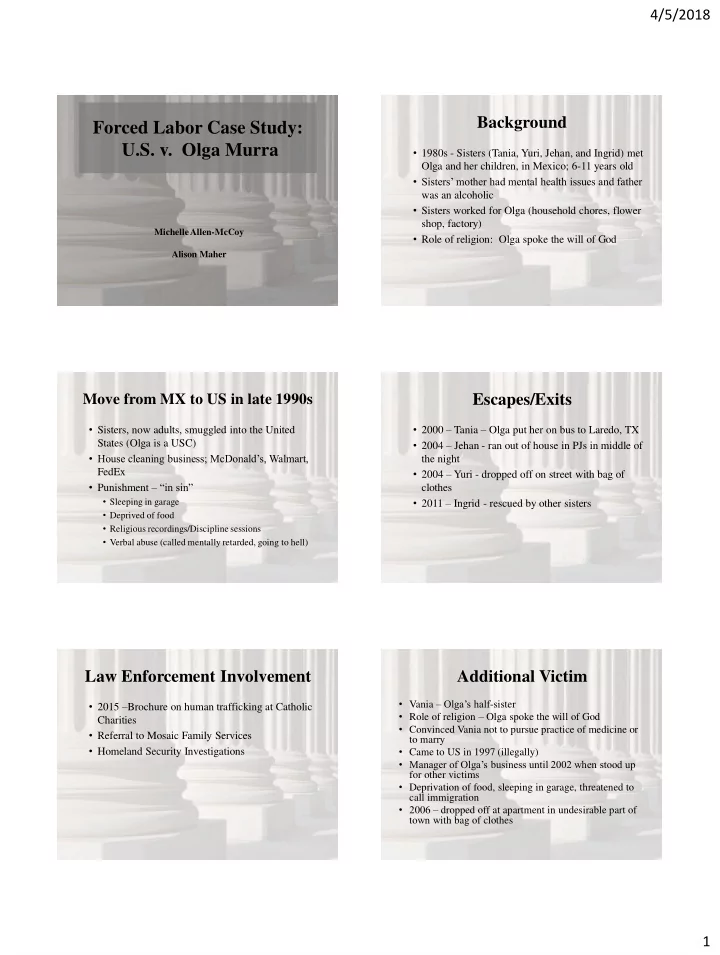
4/5/2018 Background Forced Labor Case Study: U.S. v. Olga Murra 1980s - Sisters (Tania, Yuri, Jehan, and Ingrid) met Olga and her children, in Mexico; 6-11 years old Sisters mother had mental health issues and father was an


slide-1
SLIDE 1

4/5/2018 1

Forced Labor Case Study: U.S. v. Olga Murra

Michelle Allen-McCoy Alison Maher

Background

  • 1980s - Sisters (Tania, Yuri, Jehan, and Ingrid) met

Olga and her children, in Mexico; 6-11 years old

  • Sisters’ mother had mental health issues and father

was an alcoholic

  • Sisters worked for Olga (household chores, flower

shop, factory)

  • Role of religion: Olga spoke the will of God

Move from MX to US in late 1990s

  • Sisters, now adults, smuggled into the United

States (Olga is a USC)

  • House cleaning business; McDonald’s, Walmart,

FedEx

  • Punishment – “in sin”
  • Sleeping in garage
  • Deprived of food
  • Religious recordings/Discipline sessions
  • Verbal abuse (called mentally retarded, going to hell)

Escapes/Exits

  • 2000 – Tania – Olga put her on bus to Laredo, TX
  • 2004 – Jehan - ran out of house in PJs in middle of

the night

  • 2004 – Yuri - dropped off on street with bag of

clothes

  • 2011 – Ingrid - rescued by other sisters

Law Enforcement Involvement

  • 2015 –Brochure on human trafficking at Catholic

Charities

  • Referral to Mosaic Family Services
  • Homeland Security Investigations

Additional Victim

  • Vania – Olga’s half-sister
  • Role of religion – Olga spoke the will of God
  • Convinced Vania not to pursue practice of medicine or

to marry

  • Came to US in 1997 (illegally)
  • Manager of Olga’s business until 2002 when stood up

for other victims

  • Deprivation of food, sleeping in garage, threatened to

call immigration

  • 2006 – dropped off at apartment in undesirable part of

town with bag of clothes

slide-2
SLIDE 2

4/5/2018 2

Additional Victim

  • Maurizio – met Olga in Mexico
  • Came from abusive home, looking for family
  • Came to US with Olga in 1990’s
  • 2001 – Olga sent him to CA on a bus
  • 2009 – Olga sent for Maurizio to provide

medical care for her husband

  • Once, husband passed –Olga kicked him out

Forced Labor 18 U.S.C. 1589

  • Defendant provided or obtained labor and

services of [Victims]

  • Defendant provided or obtained services of

[Victims] through a scheme, plan, or pattern intended to cause [Victims] to believe that non-performance would result in serious harm or physical restraint

  • Defendant acted knowingly

Serious Harm

  • Any harm, whether physical or non-

physical, including psychological, financial,

  • r reputational harm, that is sufficiently

serious under all circumstances to compel a reasonable person of the same background and in the same circumstances to perform

  • r to continue to perform labor or services

in order to avoid incurring that harm

Forced Labor

  • If victims suffered consequences in

connection with services, either as punishment or as part of a climate of fear that overcame her will and compelled her service, that is sufficient to establish the second element of forced labor

Forced Labor

  • Consider surrounding circumstances -

Atmosphere of violence, verbal abuse and insults, isolation, poor working and living conditions, denial of adequate food, water, rest, and medical care, withholding of pay,

  • r any combination

MOSAIC’S ROLE

VICTIM SERVICES

slide-3
SLIDE 3

4/5/2018 3

Initial Contact

  • Survivors reach out to Mosaic and have initial

intake with case management

  • Due to length of time since escape, most

critical needs were counseling and legal

  • Significant hesitation about coming forward

and need for support

  • Case manager refers for legal consultation

Legal Consultation and Reporting

  • Identification process
  • Orientation to reporting options and criminal

justice process

  • Risks and benefits of reporting
  • Immigration relief available
  • Allow survivor time to weigh options and ask

follow up questions

  • Follow up meetings to ensure preparedness to

report

  • Early role as liaison between survivors and

investigating agent

Continued Presence and T Visa Interaction

  • Use of trusted law enforcement contact
  • Critical - timely request for continued presence
  • Presence of immigration-related threats and

retaliation

– Efforts to attack survivors through employment – Vulnerabilities

  • Decision on timing of T filing – victim

services perspective

Protecting Survivor Privacy Interests in Records

  • Defense served Mosaic subpoena “any and all

communications, reports, interview notes, work product, client tracking form, intake forms or

  • ther writings or information electronic or paper,

by or between/to and from Mosaic Family Services, AND ANYONE ELSE” regarding all survivors with deadline one week prior to trial

  • Responded with assertions of all applicable

privileges; after in camera review and interview

  • f custodians of records, court upheld claims

Rulings on Privilege

  • Failed defense arguments:

– Mental health privilege did not apply to LPC interns – By denying representation for a T visa, client denied existence of attorney-client relationship – Survivors ‘discussed the same subject matter’ in reporting to government that they discussed with attorney

  • On appeal, privilege claims upheld

– Mosaic leave to intervene denied; amicus filed through pro bono counsel – Court ruled license-eligible individuals acting under supervision

  • f licensed counselors get privilege

– In both contexts, no one disclosed any portion of actual confidential communications that would amount to waiver