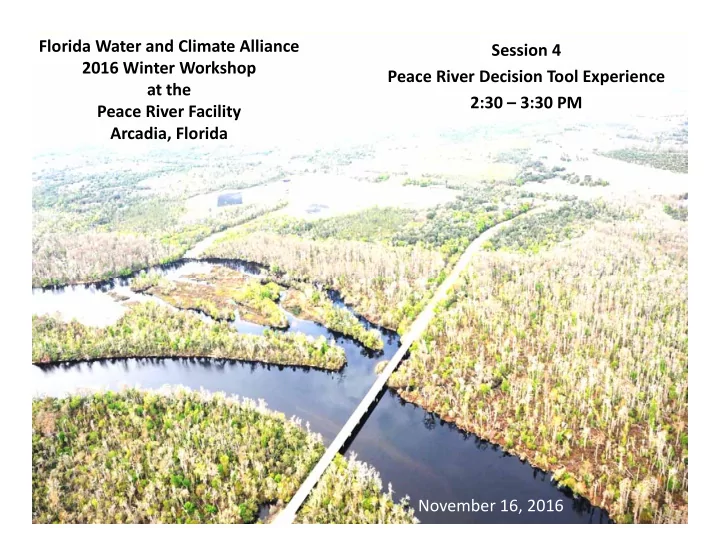
SLIDE 1 Florida Water and Climate Alliance 2016 Winter Workshop at the Peace River Facility Arcadia, Florida November 16, 2016 Session 4 Peace River Decision Tool Experience 2:30 – 3:30 PM
SLIDE 2 The Peace River Manasota Regional Water Supply Authority
- Created in 1982
- 4 Member Counties
- Serves a population of
about 500,000
SLIDE 3 Drainage Basin & the Peace River Facility
Peace River Facility
SLIDE 4
The Peace River Facility
SLIDE 5
The Peace River is our Source Water
SLIDE 6
120 MGD River Intake Pump Station
SLIDE 7
How Much is 120 MGD?
Enough to Fill Raymond James Stadium to the Upper Deck Every Day
SLIDE 8
Reservoir 2 Reservoir 1
6.5 BG in Off-Stream Storage
SLIDE 9
51 MGD Treatment Capacity
SLIDE 10
21 Finished Water ASR Wells
6 BG in Underground Storage
SLIDE 11
During Months without ASR Recovery
SLIDE 12
During Months with ASR Recovery
SLIDE 13 The Upper Peace River can go Completely Dry
Picture by Sam Stone during 2000-1 drought Picture from FDEP’s “Florida’s Water” webpage
SLIDE 14
The Peace River near Arcadia - typical dry and wet season views
SLIDE 15
- River flows vary dramatically (8 Mgd – 18 Bgd)
SLIDE 16
Although more than 25 miles from the Gulf of Mexico, our river intake is tidally influenced
SLIDE 17
SLIDE 18 How Much is 3 millimeters a Year?
them on top of each other = 3 mm
- This is 1.2 inches in 10 years
- This is 1 foot in 100 years
- Some Suggest that due to
the Anthropogenic Linkage, this Rate is Accelerating
SLIDE 19
The Peace River Facility
SLIDE 20
2010-2013 USGS top/bottom continuous (15-minute) recorder data at the Facility’s intake
SLIDE 21
SLIDE 22
Model domain = hourly averaged data when upstream flow was >80 and < 500 cfs & 30-day preceding flow < 500 cfs
Data Used in Statistical Model Development
SLIDE 23
SLIDE 24 Limited number of parameters to non- autocorrelated accounting for 1% variation
SLIDE 25 Probability (%) 2025 2050 2075 cm inches cm inches cm inches
90% (best case) 7 2.8 13 5.0 20 7.7 50% (median expected) 13 5.1 24 9.4 37 14.4 5% (worst case) 22 8.7 41 16.1 63 24.6 Projected potential probabilities of future increases in near future sea-level rise along southwest Florida coast (IPCC))
- Future sea-level changes applied in the
statistically based modeling used USEPA estimates estimating the probability of occurrence
- Provided potential range of sea-level change at
three future 25-year intervals
SLIDE 26
6 Scenarios Selected
Scenario Sea Level Rise (inches) baseline 1 2.8 2 5.0 3 7.7 4 14.4 5 24.6
SLIDE 27 700 us/cm
Predicted statistical distribution of conductivity at the Facility intake under each future sea-level rise alternative (using available 2010-2013 flow and stage data)
baseline Scenario 1 Scenario 2 Scenario 3 Scenario 4 Scenario 5
SLIDE 28 Formulating Future SLR Scenario Curves for River/TDS Relationship
- Use SAS model to project median TDS for
scenario at 300 cfs river flow
- Mimic proportional TDS expansion and
compression ratios taken from baseline data for 100 and 500 CFS limits, respectively
- Set high flow convergence to good quality
water, i.e. 15,000 cfs = 100 mg/L TDS
- Fit polynomial expression to the datum
SLIDE 29
SLIDE 30
SLIDE 31
System Reliability Modeling Starts by Defining Fundamental Solvent & Solute Mass Balance Relationships (Solute in this case is TDS)
SLIDE 32
- Solving for Day Ending reservoir and ASR volumes is
straightforward
- Solving for Day-Ending TDS concentrations is more
rigorous (examples below)
SLIDE 33 System Reliability Model
- PRO-PAT Model (Peace River Operability
Platform Assessment Tool)
- Excel-based decision tool
- 6 embedded SLR scenarios
- Model has 109 Variables
– 49 operational variables – 60 climate associated variables
- Can apply a monthly multiplier for rainfall
- Can change monthly multiplier for evaporation
- Can apply a monthly flow multiplier for 3 streams
SLIDE 34 Reliability Measures
(# days met full demands) (total days)
(# days met full demands with TDS < 500 mg/L) (total days)
SLIDE 35 Summary
- Decisions Made Today Must be Considered in
View of What is Likely in 50 – 100 years
- Strategic Planning Must Consider Adaptation
Management Strategies
- Guidelines can only speak to process generalities
– Utilities must employ creativity in customizing Adaptive Management Decision Tools and Strategies for their own reality
- Don’t be afraid to borrow approaches from others,
we are all in this together!
- Likewise, share approaches you have developed
with others!
SLIDE 36
SLIDE 37 Acknowledgements
- Ralph Montgomery - Atkins
- Mike Coates, PG – PRMRWSA
- Mike Heyl/SWFWMD
- Others
- Sam Stone – PRMRWSA
- Mark McNeal, PG - ASRUS Inc.
- Pete Larkin, PG - CH2M HILL
- Ryan Messer, PE – CH2M HILL
- Florida Water and Climate Alliance