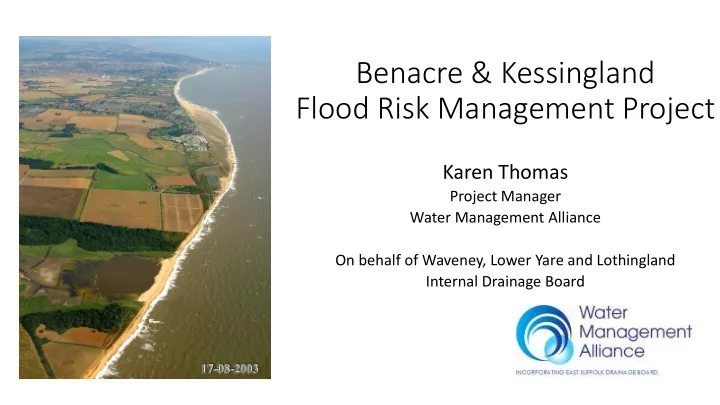
SLIDE 1 Benacre & Kessingland Flood Risk Management Project
Karen Thomas
Project Manager Water Management Alliance On behalf of Waveney, Lower Yare and Lothingland Internal Drainage Board
SLIDE 3
SLIDE 4
Courtesy of Mike Page
SLIDE 5 Courtesy of Mike Page
2016
SLIDE 6 Courtesy of Mike Page and Benacre Estates
2017
SLIDE 7
Breach Risk to Kessingland Levels
SLIDE 8
Alternative Flood Risk Management Options
SLIDE 9 What’s at Tidal Risk?
Circa 44 Homes Commercial businesses 600 acres + Agriculture Abstraction Tourism Recreation and Access Transport links (A12) Utilities (water, electric) Landscape Wildlife
SLIDE 10
SOUTH AREA 08/01/2019
SLIDE 11
SOUTH AREA 08/01/2019
SLIDE 12
NORTH AREA 08/01/2019
SLIDE 13
NORTH AREA 08/01/2019
SLIDE 14
Fluvial Flood Risk
SLIDE 15
Surface water fl flooding in Kessingland
SLIDE 16 Preferred alignments of potential new defences
Benacre flood defence options
SLIDE 17
Parkdean Resorts Alignment Options
SLIDE 18 Benacre Estates- Lothingland Valley set-back
SLIDE 19 Economics studies
- Wider economic study from Mott
MacDonalds
- Identifies £130M of wider economic
benefits arising from an adaptive approach
- SCC Highways report estimated present
value losses (PV Losses), accrued over a 50 years (2018 –2068), are £253,717,000 for the Do Nothing plus climate change scenario.
- Both reports will feed into economic
appraisal in OBC
- Form basis of wider partnership funding
ask for a scheme
SLIDE 20 Stakeholder Engagement
- Partnership approach
- Project Board supported by local
Councillors and MP Peter Aldous
- Multi-agency project team
- Local leadership from Kessingland
Parish Council
- 150 stakeholders attended initial
drop-in Nov 2017
- Autumn 2019- update on latest
information and likely preferred
- ptions
- Spring 2020- final rounds of
engagement and OBC submission
SLIDE 21 Recent progress
From October 2018
- RFCC decision on Levy funding
- WMA & Jacobs programme for 18 months OBC
- Includes Parkdean Resorts costed options in the appraisal
- Developing our stakeholder engagement approach and share evidence
- Identify potential funding routes (funding framework) for the capital scheme
including private elements
- Technical work to be developed over next 12 months- coastal change, ground
conditions, outline designs for defences and pump capacity
- Develop a preferred option and engage local people Autumn 2019 and Spring 2020
- Submit Business Case June 2020
SLIDE 22 Opportunities & challenges
- Outside of the FDGIA Business
Case- the project aims to deliver wider benefits and attract broader funding streams
- Opportunities for landscape scale
adaptation
- Freshwater capture and storage for
habitat enhancement and agriculture
- Fisheries, tourism and access can
be enhanced
- Need to attract investors
- £10-15M scheme
SLIDE 23