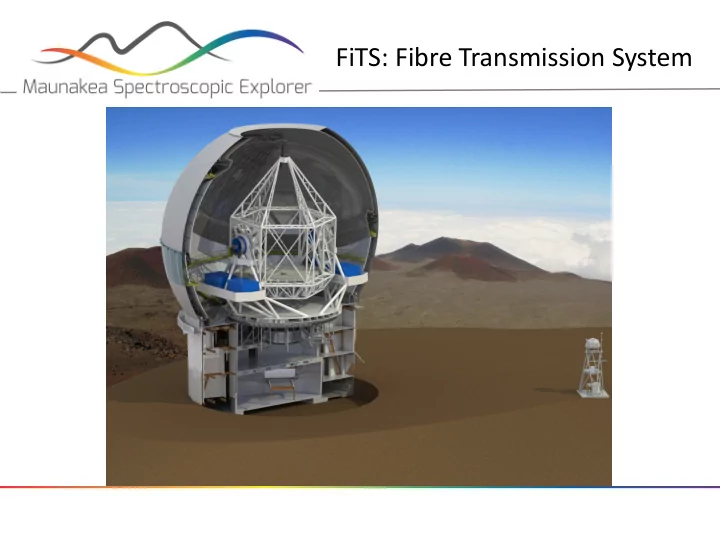
FiTS: Fibre Transmission System Overview Maunakea Spectroscopic - - PowerPoint PPT Presentation
FiTS: Fibre Transmission System Overview Maunakea Spectroscopic Explorer (MSE) Background Science goals FiTS: The Fibre Transmission System Requirements Design and Analysis Status and Future Work The UVic Fibre Test
Overview
- Maunakea Spectroscopic Explorer (MSE)
– Background – Science goals
- FiTS: The Fibre Transmission System
– Requirements – Design and Analysis – Status and Future Work
- The UVic Fibre Test Facility
– Goals of the facility – UVic / FTO Team
- Conclusions
2 Fibre Transmission system, 12/8/2017
- Wide field, highly multiplexed spectroscopic facilities are
urgently needed, especially to complement wide field imaging facilities
- It is relatively straightforward to upgrade 3.6 m CFHT to a
wide field 11 m telescope in existing building on MaunaKea (in a “dome” with a larger aperture)
- Formal conceptual design study has just been completed by
international partnership that includes Canada, France, Hawaii, China, India, Australia, Spain
- http://mse.cfht.hawaii.edu/
3 Fibre Transmission system, 12/8/2017
Background on MSE
- The Universe is composed of Dark
Matter and Dark Energy both of which are challenging for
- bservations
- Dark Matter perhaps best explored
by studying very large samples of stars in the Milky Way
- Dark Energy perhaps best explored
by studying very large samples of galaxies at different distances over the whole sky
- => Need precision spectroscopy of
tens to hundreds of millions of faint stars and galaxies over whole sky
4 Fibre Transmission system, 12/8/2017
BIG Science questions
WMAP 9yr
See MSE Detailed Science case:
http://mse.cfht.hawaii.edu/science/mse-science-docs/DSC/MSE_DSC_ExpDraft_27May2016.pdf
- Faint targets => large collecting area, very efficient optical system
- Large area => large field (effectively limited by physical sizes of lenses)
- Typical target densities => thousands of spectra
- Target selection => fibers are only practical solution
- Precision spectroscopy requires extremely well characterized, stable spectra
5 Fibre Transmission system, 12/8/2017
Science to Requirements
Therefore, MSE top-level requirements are:
- Telescope: 11 m aperture, 1.5 sq. deg field
- Wavelength range: 0.37 – 1.8 um
- > 3200 low/medium resolution spectra, > 1000 high res spectra per field
- Spectral resolution from R=2,500 to R=40,000
- Sensitivity: 24 magnitude objects (@SNR=2)
- Spectro-photometric accuracy < 3%
- Velocity precision of 20 km/s (@SNR=5)
- Science requirements flow down into key FiTS requirements
– Throughput
- > 90% @ 900 nm (HR fibres)
- > 85% @ 900 nm (LMR fibres)
– Focal Ratio Degradation (FRD) < 5% – Spectral and photometric stability
- Requirements still TBD
- However fiber transport usually produces significant light
losses, variable transmission and variable image quality
– Need to pay careful attention to details of design of FiTS, including extensive testing of all options and components
6 Fibre Transmission system, 12/8/2017
FiTS Requirements
7 Fibre Transmission system, 12/8/2017
FiTS Design
Fibre optic cables carry light from MSE prime-focus… To 2 High-Resolution Spectrographs… and 6 Low/Med -Resolution Spectrographs (in the lower Coudé room) Distance: 35 m to HR 50 m to LMR
8 Fibre Transmission system, 12/8/2017
FiTS Design
MSE Top-End Assembly (prime focus)
Fibre positioning system (supplied by others)
- Individually positions 4332 fibres w/in field
- De-rotates field motion during observation
9 Fibre Transmission system, 12/8/2017
Cable Design and Analysis
- Working with FibreTech Optica to
develop modular fibre cables
- Need high throughput fibre
materials and excellent AR coatings,
- ver a very broad wavelength range
- Preparing for Delta-CoDR in late winter/early spring
- Currently working to fully define requirements
- Project still needs:
– Better definition of integration and test sequence with the positioning system and telescope – A plan for addressing stability requirements, through modelling or testing – Research into candidate fibre materials – Research into broadband AR coatings for fibres
- Project will be a multi-million dollar effort
– Testing of so many fibres is time consuming and expensive
10 Fibre Transmission system, 12/8/2017
Status and Future Work
- Currently being built in Dr. Colin Bradley’s lab within the Department of
Mechanical Engineering
- Began construction in November following a visit to FiberTech Optica
(FTO) by two team members (see poster!)
- Planned tests include:
- Ring test
- explore fibre focal ratio degradation (FRD), aiming to verify the FRD
< 5% requirement
- Formed beam test
- study the effects of fibre cladding, joining procedures and dynamics
- n FRD (simulating on-sky conditions)
- Multi-fibre behaviour, cross-talk and throughput
- Test automation
11
UVic FiTS Facility
Fibre Transmission system, 12/8/2017
Schematic of the Formed Beam Test
12
UVic FiTS Facility II
Fibre Transmission system, 12/8/2017
Schematic of the Ring Test
- Stephanie Monty (BSc student, Astronomy)
– Managing project, responsible for requirements definition
- Farbod Jahandar (MSc student, Astronomy) and Collin Kielty
(PhD student, Astronomy)
– Software development, image processing and motion control
- Jooyoung Lee (MASc student, Mech Engineering)
– Opto-mechanical design, hardware development
- Supervision from Dr. Kim Venn (Physics and Astronomy) and
- Dr. Colin Bradley (Mech Engineering)
13 Fibre Transmission system, 12/8/2017
UVIC Team
- MSE is an exciting project, addressing the need for highly-
multiplexed, wide-field spectroscopy
- FiTS Fibre Transmission System is an integral part of the
facility design
– Requirements and scale of project are challenging
- Challenges exist in the design, construction and testing
- Keys to success are a strong partnership between NRC-H, FTO
and UVic, leveraging the capabilities of each organization
14 Fibre Transmission system, 12/8/2017