Finiteness of associated primes of local cohomology modules over - - PowerPoint PPT Presentation

finiteness of associated primes of local cohomology
SMART_READER_LITE
LIVE PREVIEW

Finiteness of associated primes of local cohomology modules over - - PowerPoint PPT Presentation

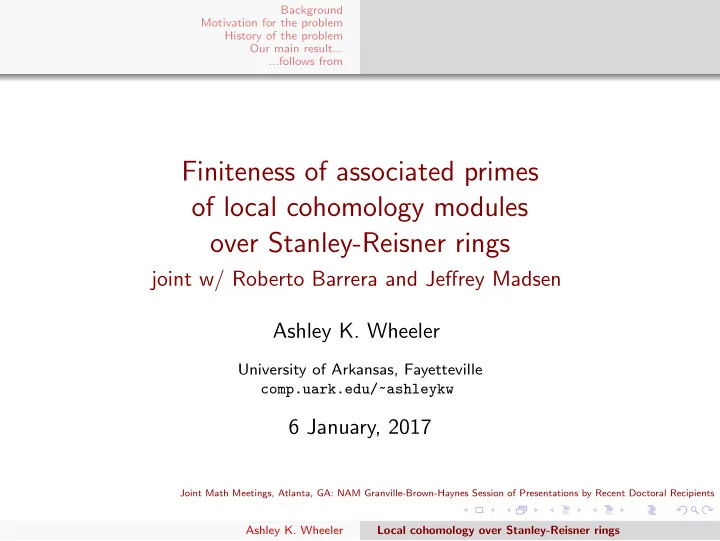
Background Motivation for the problem History of the problem Our main result... ...follows from Finiteness of associated primes of local cohomology modules over Stanley-Reisner rings joint w/ Roberto Barrera and Jeffrey Madsen Ashley K.


slide-1
SLIDE 1

Joint Math Meetings, Atlanta, GA: NAM Granville-Brown-Haynes Session of Presentations by Recent Doctoral Recipients

Background Motivation for the problem History of the problem Our main result... ...follows from

Finiteness of associated primes

  • f local cohomology modules
  • ver Stanley-Reisner rings

joint w/ Roberto Barrera and Jeffrey Madsen Ashley K. Wheeler

University of Arkansas, Fayetteville comp.uark.edu/~ashleykw

6 January, 2017

Ashley K. Wheeler Local cohomology over Stanley-Reisner rings

slide-2
SLIDE 2

Joint Math Meetings, Atlanta, GA: NAM Granville-Brown-Haynes Session of Presentations by Recent Doctoral Recipients

Background Motivation for the problem History of the problem Our main result... ...follows from

Thank-you for the invitation to speak!

Local cohomology has applications to Cosmology and String Theory, and it is one of the most active research areas in Commutative Algebra.

Ashley K. Wheeler Local cohomology over Stanley-Reisner rings

slide-3
SLIDE 3

Joint Math Meetings, Atlanta, GA: NAM Granville-Brown-Haynes Session of Presentations by Recent Doctoral Recipients

Background Motivation for the problem History of the problem Our main result... ...follows from

Thank-you for the invitation to speak!

Local cohomology has applications to Cosmology and String Theory, and it is one of the most active research areas in Commutative Algebra. Little is known about local cohomology modules.

Ashley K. Wheeler Local cohomology over Stanley-Reisner rings

slide-4
SLIDE 4

Joint Math Meetings, Atlanta, GA: NAM Granville-Brown-Haynes Session of Presentations by Recent Doctoral Recipients

Background Motivation for the problem History of the problem Our main result... ...follows from Local cohomology modules Localization

Local cohomology modules

  • R = commutative Noetherian ring with 1
  • I = ideal in R
  • M=R-module (may or may not be Noetherian or finitely generated)
  • j = non-negative integer

The jth local cohomology module of M with support in I is defined as the following direct limit of Ext modules: Hj

I(M) = lim

− →

t

Extj

R(R/It, M).

Ashley K. Wheeler Local cohomology over Stanley-Reisner rings

slide-5
SLIDE 5

Joint Math Meetings, Atlanta, GA: NAM Granville-Brown-Haynes Session of Presentations by Recent Doctoral Recipients

Background Motivation for the problem History of the problem Our main result... ...follows from Local cohomology modules Localization

It is the right derived functor of H0

I (?):

H0

I (M) :=

  • t

AnnM It ={u ∈ M | uIt = 0 for some t} = lim − →

t

HomR(R/It, M)(= lim − →

t

Ext0

R(R/It, M))

the global sections of the sheaf ˜ M with support on the closed subscheme Spec R/I ⊂ Spec R.

Ashley K. Wheeler Local cohomology over Stanley-Reisner rings

slide-6
SLIDE 6

Joint Math Meetings, Atlanta, GA: NAM Granville-Brown-Haynes Session of Presentations by Recent Doctoral Recipients

Background Motivation for the problem History of the problem Our main result... ...follows from Local cohomology modules Localization

  • H1

I (M) measures the obstruction to extending a section of a sheaf

to a global section; put X = Spec R and U = X \ Spec(R/I) 0 → H0

I (M) → H0(X, ˜

M) → H0(U, ˜ M|U) → H1

I (M) → 0

Ashley K. Wheeler Local cohomology over Stanley-Reisner rings

slide-7
SLIDE 7

Joint Math Meetings, Atlanta, GA: NAM Granville-Brown-Haynes Session of Presentations by Recent Doctoral Recipients

Background Motivation for the problem History of the problem Our main result... ...follows from Local cohomology modules Localization

  • H1

I (M) measures the obstruction to extending a section of a sheaf

to a global section; put X = Spec R and U = X \ Spec(R/I) 0 → H0

I (M) → H0(X, ˜

M) → H0(U, ˜ M|U) → H1

I (M) → 0

  • If (R, m) is a local ring and M is finite generated, then Hj

m(M)

can detect regular sequences, compute depth, and reveal the Cohen-Macaulay and Gorenstein properties.

Ashley K. Wheeler Local cohomology over Stanley-Reisner rings

slide-8
SLIDE 8

Joint Math Meetings, Atlanta, GA: NAM Granville-Brown-Haynes Session of Presentations by Recent Doctoral Recipients

Background Motivation for the problem History of the problem Our main result... ...follows from Local cohomology modules Localization

In practice, Hj

I(M) is the jth cohomology module of the ˘

Cech complex 0 → M →

  • i

Mfi →

  • i<j

Mfifj → · · · → Mf1···fs → 0 where:

  • f1, . . . , fs ∈ R generate I up to radical
  • given any f ∈ R and any R-module N, Nf = N ⊗R Rf, and Rf = R[ 1

f ] is the

localization of R at f

  • the maps in the complex are the natural localization maps u → u

1 Ashley K. Wheeler Local cohomology over Stanley-Reisner rings

slide-9
SLIDE 9

Joint Math Meetings, Atlanta, GA: NAM Granville-Brown-Haynes Session of Presentations by Recent Doctoral Recipients

Background Motivation for the problem History of the problem Our main result... ...follows from Local cohomology modules Localization

Localization

Localizing at a prime ideal gives the stalk at a point in the Zariski topolgy: Spec R = {prime ideals in R} ← topological space V(J) = {primes containing the ideal J} ← its closed sets = Spec R/J R localized at P is given by RP = R

  • 1

f | f ∈ R \ P

  • and NP = N ⊗R RP

Ashley K. Wheeler Local cohomology over Stanley-Reisner rings

slide-10
SLIDE 10

Joint Math Meetings, Atlanta, GA: NAM Granville-Brown-Haynes Session of Presentations by Recent Doctoral Recipients

Background Motivation for the problem History of the problem Our main result... ...follows from Local cohomology modules Localization

Localization is flat; as a result, many questions can be reduced to the local case (local-global principle).

(statement about an R-module N is true)

(same statement about NP is true for all P ∈ AssR N)

  • AssR N = assassinator of N, set of all primes associated to N
  • P is associated to N means P = AnnR(u), the set of ring elements that

annihilate some element u ∈ N; equivalently, P ∈ AssR N if and only if R/P is isomorphic to a submodule of N.

Ashley K. Wheeler Local cohomology over Stanley-Reisner rings

slide-11
SLIDE 11

Joint Math Meetings, Atlanta, GA: NAM Granville-Brown-Haynes Session of Presentations by Recent Doctoral Recipients

Background Motivation for the problem History of the problem Our main result... ...follows from Local cohomology modules Localization

Localization is flat; as a result, many questions can be reduced to the local case (local-global principle).

(statement about an R-module N is true)

(same statement about NP is true for all P ∈ AssR N)

  • AssR N = assassinator of N, set of all primes associated to N
  • P is associated to N means P = AnnR(u), the set of ring elements that

annihilate some element u ∈ N; equivalently, P ∈ AssR N if and only if R/P is isomorphic to a submodule of N.

Local cohomology is the local-global analogue to sheaf cohomology.

Ashley K. Wheeler Local cohomology over Stanley-Reisner rings

slide-12
SLIDE 12

Joint Math Meetings, Atlanta, GA: NAM Granville-Brown-Haynes Session of Presentations by Recent Doctoral Recipients

Background Motivation for the problem History of the problem Our main result... ...follows from Finiteness of associated primes Counterexamples Affirmatives

Finiteness of associated primes

Our project is motivated by the following: Question (C. Huneke 1990) Do the local cohomology modules over a Noetherian ring R have finitely many associated primes?

Ashley K. Wheeler Local cohomology over Stanley-Reisner rings

slide-13
SLIDE 13

Joint Math Meetings, Atlanta, GA: NAM Granville-Brown-Haynes Session of Presentations by Recent Doctoral Recipients

Background Motivation for the problem History of the problem Our main result... ...follows from Finiteness of associated primes Counterexamples Affirmatives

Finiteness of associated primes

Our project is motivated by the following: Question (C. Huneke 1990) Do the local cohomology modules over a Noetherian ring R have finitely many associated primes? (Answer: No.)

Ashley K. Wheeler Local cohomology over Stanley-Reisner rings

slide-14
SLIDE 14

Joint Math Meetings, Atlanta, GA: NAM Granville-Brown-Haynes Session of Presentations by Recent Doctoral Recipients

Background Motivation for the problem History of the problem Our main result... ...follows from Finiteness of associated primes Counterexamples Affirmatives

Counterexamples

  • A. Singh 2000: R = Z[u, v, w, x, y, z]

(ux + vy + wz) = ⇒ | AssR(H3

(x,y,z)R)| = ∞

Reason: This local cohomology module has p-torsion for all primes p ∈ Z.

Ashley K. Wheeler Local cohomology over Stanley-Reisner rings

slide-15
SLIDE 15

Joint Math Meetings, Atlanta, GA: NAM Granville-Brown-Haynes Session of Presentations by Recent Doctoral Recipients

Background Motivation for the problem History of the problem Our main result... ...follows from Finiteness of associated primes Counterexamples Affirmatives

Counterexamples

  • A. Singh 2000: R = Z[u, v, w, x, y, z]

(ux + vy + wz) = ⇒ | AssR(H3

(x,y,z)R)| = ∞

Reason: This local cohomology module has p-torsion for all primes p ∈ Z.

  • M. Katzman 2002:

R = K[s, t, u, v, x, y] (su2x2 − (s + t)uvxy + tv2y2) (K = any field) = ⇒ | AssR(H2

(x,y)R)| = ∞

Also shows torsion for infinitely many ring elements. Unlike in Singh’s example, this ring is local.

Ashley K. Wheeler Local cohomology over Stanley-Reisner rings

slide-16
SLIDE 16

Joint Math Meetings, Atlanta, GA: NAM Granville-Brown-Haynes Session of Presentations by Recent Doctoral Recipients

Background Motivation for the problem History of the problem Our main result... ...follows from Finiteness of associated primes Counterexamples Affirmatives

  • Singh and I. Swanson 2004: generalized Katzman’s results with examples of

normal hypersurfaces

  • of characteristic 0 with rational singularities and
  • of characteristic p that are F-regular

Ashley K. Wheeler Local cohomology over Stanley-Reisner rings

slide-17
SLIDE 17

Joint Math Meetings, Atlanta, GA: NAM Granville-Brown-Haynes Session of Presentations by Recent Doctoral Recipients

Background Motivation for the problem History of the problem Our main result... ...follows from Finiteness of associated primes Counterexamples Affirmatives

  • Singh and I. Swanson 2004: generalized Katzman’s results with examples of

normal hypersurfaces

  • of characteristic 0 with rational singularities and
  • of characteristic p that are F-regular

Are there instances where the answer is yes?

Ashley K. Wheeler Local cohomology over Stanley-Reisner rings

slide-18
SLIDE 18

Joint Math Meetings, Atlanta, GA: NAM Granville-Brown-Haynes Session of Presentations by Recent Doctoral Recipients

Background Motivation for the problem History of the problem Our main result... ...follows from Finiteness of associated primes Counterexamples Affirmatives

  • Singh and I. Swanson 2004: generalized Katzman’s results with examples of

normal hypersurfaces

  • of characteristic 0 with rational singularities and
  • of characteristic p that are F-regular

Are there instances where the answer is yes? (Yes.)

Ashley K. Wheeler Local cohomology over Stanley-Reisner rings

slide-19
SLIDE 19

Joint Math Meetings, Atlanta, GA: NAM Granville-Brown-Haynes Session of Presentations by Recent Doctoral Recipients

Background Motivation for the problem History of the problem Our main result... ...follows from Finiteness of associated primes Counterexamples Affirmatives

Affirmatives

  • M. Hellus 2001: M = R is Cohen-Macaulay and
  • AssR(H3

(x,y)R) is finite for every x, y ∈ R

  • AssR(H3

(x1,x2,y)R) is finite for x1, x2 ∈ R a regular sequence and y ∈ R Ashley K. Wheeler Local cohomology over Stanley-Reisner rings

slide-20
SLIDE 20

Joint Math Meetings, Atlanta, GA: NAM Granville-Brown-Haynes Session of Presentations by Recent Doctoral Recipients

Background Motivation for the problem History of the problem Our main result... ...follows from Finiteness of associated primes Counterexamples Affirmatives

Affirmatives

  • M. Hellus 2001: M = R is Cohen-Macaulay and
  • AssR(H3

(x,y)R) is finite for every x, y ∈ R

  • AssR(H3

(x1,x2,y)R) is finite for x1, x2 ∈ R a regular sequence and y ∈ R

  • T. Marley 2001: (R, m) is local, M is finitely generated and
  • dim R ≤ 3
  • dim R = 4 and R is regular on the punctured spectrum (Spec R \ m is

smooth)

  • dim R = 5, R is unramified, regular, and M is torsion-free

Ashley K. Wheeler Local cohomology over Stanley-Reisner rings

slide-21
SLIDE 21

Joint Math Meetings, Atlanta, GA: NAM Granville-Brown-Haynes Session of Presentations by Recent Doctoral Recipients

Background Motivation for the problem History of the problem Our main result... ...follows from Finiteness of associated primes Counterexamples Affirmatives

Affirmatives

  • M. Hellus 2001: M = R is Cohen-Macaulay and
  • AssR(H3

(x,y)R) is finite for every x, y ∈ R

  • AssR(H3

(x1,x2,y)R) is finite for x1, x2 ∈ R a regular sequence and y ∈ R

  • T. Marley 2001: (R, m) is local, M is finitely generated and
  • dim R ≤ 3
  • dim R = 4 and R is regular on the punctured spectrum (Spec R \ m is

smooth)

  • dim R = 5, R is unramified, regular, and M is torsion-free
  • Marley and J. Vassilev 2002: M is finitely generated and
  • dim M ≤ 3
  • dim R ≤ 4
  • dim M/IM ≤ 2 and M satisfies Serre’s condition Sdim M−3
  • dim M/IM ≤ 3, AnnR M = 0, R is unramified, and M satisfies

Sdim M−3

Ashley K. Wheeler Local cohomology over Stanley-Reisner rings

slide-22
SLIDE 22

Joint Math Meetings, Atlanta, GA: NAM Granville-Brown-Haynes Session of Presentations by Recent Doctoral Recipients

Background Motivation for the problem History of the problem Our main result... ...follows from Finiteness of associated primes Counterexamples Affirmatives

  • S. Takagi and R. Takahashi 2008: M = ωR, the canonical module of a

Cohen-Macaulay ring of finite F-representation type (FFRT) = ⇒ affirmative for M = R Gorenstein of FFRT

Ashley K. Wheeler Local cohomology over Stanley-Reisner rings

slide-23
SLIDE 23

Joint Math Meetings, Atlanta, GA: NAM Granville-Brown-Haynes Session of Presentations by Recent Doctoral Recipients

Background Motivation for the problem History of the problem Our main result... ...follows from Finiteness of associated primes Counterexamples Affirmatives

  • S. Takagi and R. Takahashi 2008: M = ωR, the canonical module of a

Cohen-Macaulay ring of finite F-representation type (FFRT) = ⇒ affirmative for M = R Gorenstein of FFRT

  • H. Robbins 2014: M = R is a polynomial or power series ring over a two- or

three- dimensional normal domain with an isolated singularity, finitely generated over a field of characteristic 0

Ashley K. Wheeler Local cohomology over Stanley-Reisner rings

slide-24
SLIDE 24

Joint Math Meetings, Atlanta, GA: NAM Granville-Brown-Haynes Session of Presentations by Recent Doctoral Recipients

Background Motivation for the problem History of the problem Our main result... ...follows from Finiteness of associated primes Counterexamples Affirmatives

  • S. Takagi and R. Takahashi 2008: M = ωR, the canonical module of a

Cohen-Macaulay ring of finite F-representation type (FFRT) = ⇒ affirmative for M = R Gorenstein of FFRT

  • H. Robbins 2014: M = R is a polynomial or power series ring over a two- or

three- dimensional normal domain with an isolated singularity, finitely generated over a field of characteristic 0

  • B. Bhatt, M. Blickl´

e, G. Lyubeznik, Singh, and W. Zhang (BBLSZ) 2014: M = R is a smooth Z-algebra Idea: In the smooth case, p-torsion can be controlled.

Ashley K. Wheeler Local cohomology over Stanley-Reisner rings

slide-25
SLIDE 25

Joint Math Meetings, Atlanta, GA: NAM Granville-Brown-Haynes Session of Presentations by Recent Doctoral Recipients

Background Motivation for the problem History of the problem Our main result... ...follows from Finiteness of associated primes Counterexamples Affirmatives

  • S. Takagi and R. Takahashi 2008: M = ωR, the canonical module of a

Cohen-Macaulay ring of finite F-representation type (FFRT) = ⇒ affirmative for M = R Gorenstein of FFRT

  • H. Robbins 2014: M = R is a polynomial or power series ring over a two- or

three- dimensional normal domain with an isolated singularity, finitely generated over a field of characteristic 0

  • B. Bhatt, M. Blickl´

e, G. Lyubeznik, Singh, and W. Zhang (BBLSZ) 2014: M = R is a smooth Z-algebra Idea: In the smooth case, p-torsion can be controlled.

Proving anything more broad has been HARD!

Ashley K. Wheeler Local cohomology over Stanley-Reisner rings

slide-26
SLIDE 26

Joint Math Meetings, Atlanta, GA: NAM Granville-Brown-Haynes Session of Presentations by Recent Doctoral Recipients

Background Motivation for the problem History of the problem Our main result... ...follows from Regular in characteristic p Regular local in characteristic 0 Equicharacteristic Mixed characteristic Characteristic-free

Regular in characteristic p

Theorem (Huneke and R. Sharp 1993) Yes, when R is a regular ring containing a field of characteristic p > 0.

Ashley K. Wheeler Local cohomology over Stanley-Reisner rings

slide-27
SLIDE 27

Joint Math Meetings, Atlanta, GA: NAM Granville-Brown-Haynes Session of Presentations by Recent Doctoral Recipients

Background Motivation for the problem History of the problem Our main result... ...follows from Regular in characteristic p Regular local in characteristic 0 Equicharacteristic Mixed characteristic Characteristic-free

Regular in characteristic p

Theorem (Huneke and R. Sharp 1993) Yes, when R is a regular ring containing a field of characteristic p > 0. Regular rings are pretty nice...

(regular = ⇒ complete intersection = ⇒ Gorenstein = ⇒ Cohen-Macaulay)

Ashley K. Wheeler Local cohomology over Stanley-Reisner rings

slide-28
SLIDE 28

Joint Math Meetings, Atlanta, GA: NAM Granville-Brown-Haynes Session of Presentations by Recent Doctoral Recipients

Background Motivation for the problem History of the problem Our main result... ...follows from Regular in characteristic p Regular local in characteristic 0 Equicharacteristic Mixed characteristic Characteristic-free

Regular in characteristic p

Theorem (Huneke and R. Sharp 1993) Yes, when R is a regular ring containing a field of characteristic p > 0. Regular rings are pretty nice...

(regular = ⇒ complete intersection = ⇒ Gorenstein = ⇒ Cohen-Macaulay)

but it’s still a fairly broad class of rings.

Ashley K. Wheeler Local cohomology over Stanley-Reisner rings

slide-29
SLIDE 29

Joint Math Meetings, Atlanta, GA: NAM Granville-Brown-Haynes Session of Presentations by Recent Doctoral Recipients

Background Motivation for the problem History of the problem Our main result... ...follows from Regular in characteristic p Regular local in characteristic 0 Equicharacteristic Mixed characteristic Characteristic-free

Regular in characteristic p

Theorem (Huneke and R. Sharp 1993) Yes, when R is a regular ring containing a field of characteristic p > 0. Regular rings are pretty nice...

(regular = ⇒ complete intersection = ⇒ Gorenstein = ⇒ Cohen-Macaulay)

but it’s still a fairly broad class of rings. Why characteristic p?

Ashley K. Wheeler Local cohomology over Stanley-Reisner rings

slide-30
SLIDE 30

Joint Math Meetings, Atlanta, GA: NAM Granville-Brown-Haynes Session of Presentations by Recent Doctoral Recipients

Background Motivation for the problem History of the problem Our main result... ...follows from Regular in characteristic p Regular local in characteristic 0 Equicharacteristic Mixed characteristic Characteristic-free

To prove things in characteristic p: use the Frobenius map F e : R → R r → rpe.

  • In characteristic p it’s a ring map!

(F e(r + s) = (r + s)pe = rpe + spe = F e(r) + F e(s))

  • F e(R) ∼

= R as rings

  • When R is regular, it is locally free as a module over itself.

Huneke & Sharp: It suffices to show for R local, and so write R ∼ = F e(R)⊕me(∼ = R⊕me) as modules.

Ashley K. Wheeler Local cohomology over Stanley-Reisner rings

slide-31
SLIDE 31

Joint Math Meetings, Atlanta, GA: NAM Granville-Brown-Haynes Session of Presentations by Recent Doctoral Recipients

Background Motivation for the problem History of the problem Our main result... ...follows from Regular in characteristic p Regular local in characteristic 0 Equicharacteristic Mixed characteristic Characteristic-free

Then using the Ext definition of local cohomology:

AssR(Hj

I M) = AssF e(R)

  • (Hj

I M)⊗RF e(R)

  • = AssF e(R)
  • lim

− →

t

Extj

R(R/It, M) ⊗R F e(R)

  • = AssF e(R)
  • lim

− →

e

Extj

R(R/Ipe

, M) ⊗R F e(R)

  • = AssF e(R)
  • lim

− →

e

Extj

F e(R)(R/Ipe

⊗RF e(R), M⊗RF e(R))

  • = AssF e(R)
  • lim

− →

e

Extj

F e(R)(F e(R)/IF e(R), M ⊗R F e(R))

  • = AssR
  • lim

− →

e

Extj

R(R/I, M ⊗R R

  • = AssR
  • lim

− →

e

Extj

R((R/I)⊕me , M

  • = AssR
  • lim

− →

e

Extj

R(R/I, M)⊕me

  • ⊆ AssR
  • Extj

R(R/I, M)

  • Ashley K. Wheeler

Local cohomology over Stanley-Reisner rings

slide-32
SLIDE 32

Joint Math Meetings, Atlanta, GA: NAM Granville-Brown-Haynes Session of Presentations by Recent Doctoral Recipients

Background Motivation for the problem History of the problem Our main result... ...follows from Regular in characteristic p Regular local in characteristic 0 Equicharacteristic Mixed characteristic Characteristic-free

Regular local in characteristic 0

Theorem (Lyubeznik 1993) Yes, it is also true for a regular local ring containing a field of characteristic 0.

Ashley K. Wheeler Local cohomology over Stanley-Reisner rings

slide-33
SLIDE 33

Joint Math Meetings, Atlanta, GA: NAM Granville-Brown-Haynes Session of Presentations by Recent Doctoral Recipients

Background Motivation for the problem History of the problem Our main result... ...follows from Regular in characteristic p Regular local in characteristic 0 Equicharacteristic Mixed characteristic Characteristic-free

Regular local in characteristic 0

Theorem (Lyubeznik 1993) Yes, it is also true for a regular local ring containing a field of characteristic 0. Uses the burgeoning theory of D-modules.

Ashley K. Wheeler Local cohomology over Stanley-Reisner rings

slide-34
SLIDE 34

Joint Math Meetings, Atlanta, GA: NAM Granville-Brown-Haynes Session of Presentations by Recent Doctoral Recipients

Background Motivation for the problem History of the problem Our main result... ...follows from Regular in characteristic p Regular local in characteristic 0 Equicharacteristic Mixed characteristic Characteristic-free

Regular local in characteristic 0

Theorem (Lyubeznik 1993) Yes, it is also true for a regular local ring containing a field of characteristic 0. Uses the burgeoning theory of D-modules. Actually proved a stronger result: For R regular containing a field

  • f characteristic 0, and any maximal ideal m in R, the number of

associated primes of Hj

I(M) contained in m is finite.

Ashley K. Wheeler Local cohomology over Stanley-Reisner rings

slide-35
SLIDE 35

Joint Math Meetings, Atlanta, GA: NAM Granville-Brown-Haynes Session of Presentations by Recent Doctoral Recipients

Background Motivation for the problem History of the problem Our main result... ...follows from Regular in characteristic p Regular local in characteristic 0 Equicharacteristic Mixed characteristic Characteristic-free

J.-E. Bj¨

  • rk 1979: Over a formal power series ring in finitely many variables over

a field of characteristic 0, there exists a class of holonomic D-modules, to which local cohomology modules belong. An associated prime in m is the restriction of a prime in the completion ˆ R of R with respect to m, that is associated to Hj

I ˆ R(M ⊗R ˆ

R) ∼ = Hj

I (M) ⊗R ˆ

R. Cohen’s Structure Theorem: ˆ R ∼ = R/m[[x1, . . . , xn]] = ⇒ Hj

I (M) ⊗R ˆ

R = Hj

ˆ I ( ˆ

M) is holonomic. Holonomic modules are semisimple = ⇒ finitely many associated primes.

Ashley K. Wheeler Local cohomology over Stanley-Reisner rings

slide-36
SLIDE 36

Joint Math Meetings, Atlanta, GA: NAM Granville-Brown-Haynes Session of Presentations by Recent Doctoral Recipients

Background Motivation for the problem History of the problem Our main result... ...follows from Regular in characteristic p Regular local in characteristic 0 Equicharacteristic Mixed characteristic Characteristic-free

Equicharacteristic

Later, Lyubeznik somewhat reconciled the characteristic p and 0 cases. Theorem (Lyubeznik 2000) For R regular containing a field of characteristic p or 0, and any maximal ideal m in R, the number of associated primes of Hj

I(M)

contained in m is finite.

Ashley K. Wheeler Local cohomology over Stanley-Reisner rings

slide-37
SLIDE 37

Joint Math Meetings, Atlanta, GA: NAM Granville-Brown-Haynes Session of Presentations by Recent Doctoral Recipients

Background Motivation for the problem History of the problem Our main result... ...follows from Regular in characteristic p Regular local in characteristic 0 Equicharacteristic Mixed characteristic Characteristic-free

Equicharacteristic

Later, Lyubeznik somewhat reconciled the characteristic p and 0 cases. Theorem (Lyubeznik 2000) For R regular containing a field of characteristic p or 0, and any maximal ideal m in R, the number of associated primes of Hj

I(M)

contained in m is finite. The proof reduces to one or the other characteristic, after which the techniques are different.

Ashley K. Wheeler Local cohomology over Stanley-Reisner rings

slide-38
SLIDE 38

Joint Math Meetings, Atlanta, GA: NAM Granville-Brown-Haynes Session of Presentations by Recent Doctoral Recipients

Background Motivation for the problem History of the problem Our main result... ...follows from Regular in characteristic p Regular local in characteristic 0 Equicharacteristic Mixed characteristic Characteristic-free

Lyubeznik: If A is any regular ring containing a field and for all f ∈ A, the localized rings Af have finite D-length, then the local cohomology modules over A all have finitely many associated primes.

Ashley K. Wheeler Local cohomology over Stanley-Reisner rings

slide-39
SLIDE 39

Joint Math Meetings, Atlanta, GA: NAM Granville-Brown-Haynes Session of Presentations by Recent Doctoral Recipients

Background Motivation for the problem History of the problem Our main result... ...follows from Regular in characteristic p Regular local in characteristic 0 Equicharacteristic Mixed characteristic Characteristic-free

Lyubeznik: If A is any regular ring containing a field and for all f ∈ A, the localized rings Af have finite D-length, then the local cohomology modules over A all have finitely many associated primes.

Lyubeznik 1997: Over [a finitely generated algebra over] a formal power series ring A in finitely many variables over a field of characteristic p, there exists a class of F-finite F-modules, to which local cohomology modules belong.

Ashley K. Wheeler Local cohomology over Stanley-Reisner rings

slide-40
SLIDE 40

Joint Math Meetings, Atlanta, GA: NAM Granville-Brown-Haynes Session of Presentations by Recent Doctoral Recipients

Background Motivation for the problem History of the problem Our main result... ...follows from Regular in characteristic p Regular local in characteristic 0 Equicharacteristic Mixed characteristic Characteristic-free

Lyubeznik: If A is any regular ring containing a field and for all f ∈ A, the localized rings Af have finite D-length, then the local cohomology modules over A all have finitely many associated primes.

Lyubeznik 1997: Over [a finitely generated algebra over] a formal power series ring A in finitely many variables over a field of characteristic p, there exists a class of F-finite F-modules, to which local cohomology modules belong. So do the localizations Af.

Ashley K. Wheeler Local cohomology over Stanley-Reisner rings

slide-41
SLIDE 41

Joint Math Meetings, Atlanta, GA: NAM Granville-Brown-Haynes Session of Presentations by Recent Doctoral Recipients

Background Motivation for the problem History of the problem Our main result... ...follows from Regular in characteristic p Regular local in characteristic 0 Equicharacteristic Mixed characteristic Characteristic-free

Lyubeznik: If A is any regular ring containing a field and for all f ∈ A, the localized rings Af have finite D-length, then the local cohomology modules over A all have finitely many associated primes.

Lyubeznik 1997: Over [a finitely generated algebra over] a formal power series ring A in finitely many variables over a field of characteristic p, there exists a class of F-finite F-modules, to which local cohomology modules belong. So do the localizations Af. An associated prime in m is the restriction of a prime in the completion ˆ R of R with respect to m, that is associated to Hj

I ˆ R(M ⊗R ˆ

R) ∼ = Hj

I (M) ⊗R ˆ

R.

Ashley K. Wheeler Local cohomology over Stanley-Reisner rings

slide-42
SLIDE 42

Joint Math Meetings, Atlanta, GA: NAM Granville-Brown-Haynes Session of Presentations by Recent Doctoral Recipients

Background Motivation for the problem History of the problem Our main result... ...follows from Regular in characteristic p Regular local in characteristic 0 Equicharacteristic Mixed characteristic Characteristic-free

Cohen’s Structure Theorem: ˆ R ∼ = R/m[[x1, . . . , xn]]. Bj¨

  • rk 1979: The localizations ˆ

Rf have finite D-length in characteristic 0. Lyubeznik 1997: The localizations ˆ Rf are F-finite in characteristic p; F-finite = ⇒ finite F-length. finite F-length = ⇒ finite D-length.

Ashley K. Wheeler Local cohomology over Stanley-Reisner rings

slide-43
SLIDE 43

Joint Math Meetings, Atlanta, GA: NAM Granville-Brown-Haynes Session of Presentations by Recent Doctoral Recipients

Background Motivation for the problem History of the problem Our main result... ...follows from Regular in characteristic p Regular local in characteristic 0 Equicharacteristic Mixed characteristic Characteristic-free

Mixed characteristic

Theorem (Lyubeznik 2000) Also yes, when R is regular local and unramified.

Ashley K. Wheeler Local cohomology over Stanley-Reisner rings

slide-44
SLIDE 44

Joint Math Meetings, Atlanta, GA: NAM Granville-Brown-Haynes Session of Presentations by Recent Doctoral Recipients

Background Motivation for the problem History of the problem Our main result... ...follows from Regular in characteristic p Regular local in characteristic 0 Equicharacteristic Mixed characteristic Characteristic-free

Mixed characteristic

Theorem (Lyubeznik 2000) Also yes, when R is regular local and unramified. Proof reduces to the known results in equicharacteristic.

Ashley K. Wheeler Local cohomology over Stanley-Reisner rings

slide-45
SLIDE 45

Joint Math Meetings, Atlanta, GA: NAM Granville-Brown-Haynes Session of Presentations by Recent Doctoral Recipients

Background Motivation for the problem History of the problem Our main result... ...follows from Regular in characteristic p Regular local in characteristic 0 Equicharacteristic Mixed characteristic Characteristic-free

Characteristic-free

Theorem (Lyubeznik 2010) Affirmative when R is a polynomial ring in finitely many variables

  • ver a field.

Ashley K. Wheeler Local cohomology over Stanley-Reisner rings

slide-46
SLIDE 46

Joint Math Meetings, Atlanta, GA: NAM Granville-Brown-Haynes Session of Presentations by Recent Doctoral Recipients

Background Motivation for the problem History of the problem Our main result... ...follows from Regular in characteristic p Regular local in characteristic 0 Equicharacteristic Mixed characteristic Characteristic-free

Characteristic-free

Theorem (Lyubeznik 2010) Affirmative when R is a polynomial ring in finitely many variables

  • ver a field.

This was already known, as a consequence of Bj¨

  • rk’s results. But

this is the first truly characteristic-free proof.

Ashley K. Wheeler Local cohomology over Stanley-Reisner rings

slide-47
SLIDE 47

Joint Math Meetings, Atlanta, GA: NAM Granville-Brown-Haynes Session of Presentations by Recent Doctoral Recipients

Background Motivation for the problem History of the problem Our main result... ...follows from Regular in characteristic p Regular local in characteristic 0 Equicharacteristic Mixed characteristic Characteristic-free

Characteristic-free

Theorem (Lyubeznik 2010) Affirmative when R is a polynomial ring in finitely many variables

  • ver a field.

This was already known, as a consequence of Bj¨

  • rk’s results. But

this is the first truly characteristic-free proof. Key ingredient: Updated notion of holonomicity by V. Bavula (2009).

Ashley K. Wheeler Local cohomology over Stanley-Reisner rings

slide-48
SLIDE 48

Joint Math Meetings, Atlanta, GA: NAM Granville-Brown-Haynes Session of Presentations by Recent Doctoral Recipients

Background Motivation for the problem History of the problem Our main result... ...follows from Stanley-Reisner rings T -spaces Finite length Rings of differential operators Holonomicity

Our main result

We use methods very similar to Lyubeznik to show the following: Theorem (BMW 2015) If R is a Stanley-Reisner ring over a field and its associated simplicial complex is a T-space, then the set of associated primes

  • f any local cohomology module over R is finite.

Ashley K. Wheeler Local cohomology over Stanley-Reisner rings

slide-49
SLIDE 49

Joint Math Meetings, Atlanta, GA: NAM Granville-Brown-Haynes Session of Presentations by Recent Doctoral Recipients

Background Motivation for the problem History of the problem Our main result... ...follows from Stanley-Reisner rings T -spaces Finite length Rings of differential operators Holonomicity

Stanley-Reisner rings

  • S = K[x1, . . . , xn], the polynomial ring over a field K
  • ∆ = simplicial complex with vertices labelled by the variables x1, . . . , xn
  • I∆ = (xi1 · · · xit | {xi1, . . . , xit} /

∈ ∆)S is called the face ideal of ∆ over K

K[∆] = S/I∆ is called the Stanley-Reisner ring of ∆ over K.

Ashley K. Wheeler Local cohomology over Stanley-Reisner rings

slide-50
SLIDE 50

Joint Math Meetings, Atlanta, GA: NAM Granville-Brown-Haynes Session of Presentations by Recent Doctoral Recipients

Background Motivation for the problem History of the problem Our main result... ...follows from Stanley-Reisner rings T -spaces Finite length Rings of differential operators Holonomicity

To each face F ∈ ∆ corresponds a prime ideal PF generated by the variables not appearing in F.

Ashley K. Wheeler Local cohomology over Stanley-Reisner rings

slide-51
SLIDE 51

Joint Math Meetings, Atlanta, GA: NAM Granville-Brown-Haynes Session of Presentations by Recent Doctoral Recipients

Background Motivation for the problem History of the problem Our main result... ...follows from Stanley-Reisner rings T -spaces Finite length Rings of differential operators Holonomicity

To each face F ∈ ∆ corresponds a prime ideal PF generated by the variables not appearing in F. In fact, the minimal primes (minimal in AssR R/(0) with respect to containment) are in bijection with the facets of ∆.

Ashley K. Wheeler Local cohomology over Stanley-Reisner rings

slide-52
SLIDE 52

Joint Math Meetings, Atlanta, GA: NAM Granville-Brown-Haynes Session of Presentations by Recent Doctoral Recipients

Background Motivation for the problem History of the problem Our main result... ...follows from Stanley-Reisner rings T -spaces Finite length Rings of differential operators Holonomicity

T-spaces

A simplicial complex ∆ is a T-space means for every face F ∈ ∆, if x / ∈ F then there exists a facet in ∆ containing F but not x.

Ashley K. Wheeler Local cohomology over Stanley-Reisner rings

slide-53
SLIDE 53

Joint Math Meetings, Atlanta, GA: NAM Granville-Brown-Haynes Session of Presentations by Recent Doctoral Recipients

Background Motivation for the problem History of the problem Our main result... ...follows from Stanley-Reisner rings T -spaces Finite length Rings of differential operators Holonomicity

T-spaces

A simplicial complex ∆ is a T-space means for every face F ∈ ∆, if x / ∈ F then there exists a facet in ∆ containing F but not x. Example ∆ = {{x, y}, {x, z}, {y, z}, {w}, {x}, {y}, {z}} I∆ = (xw, yw, zw, xyz, xyw, xzw, yzw)S R = S/I∆ = K[x, y, z, w] (z, w) ∩ (y, w) ∩ (x, w) ∩ (x, y, z) Is (the simplicial complex associated to) R a T-space?

Ashley K. Wheeler Local cohomology over Stanley-Reisner rings

slide-54
SLIDE 54

Joint Math Meetings, Atlanta, GA: NAM Granville-Brown-Haynes Session of Presentations by Recent Doctoral Recipients

Background Motivation for the problem History of the problem Our main result... ...follows from Stanley-Reisner rings T -spaces Finite length Rings of differential operators Holonomicity

T-spaces

A simplicial complex ∆ is a T-space means for every face F ∈ ∆, if x / ∈ F then there exists a facet in ∆ containing F but not x. Example ∆ = {{x, y}, {x, z}, {y, z}, {w}, {x}, {y}, {z}} I∆ = (xw, yw, zw, xyz, xyw, xzw, yzw)S R = S/I∆ = K[x, y, z, w] (z, w) ∩ (y, w) ∩ (x, w) ∩ (x, y, z) Is (the simplicial complex associated to) R a T-space? (Yes.)

Ashley K. Wheeler Local cohomology over Stanley-Reisner rings

slide-55
SLIDE 55

Joint Math Meetings, Atlanta, GA: NAM Granville-Brown-Haynes Session of Presentations by Recent Doctoral Recipients

Background Motivation for the problem History of the problem Our main result... ...follows from Stanley-Reisner rings T -spaces Finite length Rings of differential operators Holonomicity

Example

∆ = {{x, y}, {z, w}, {x}, {y}, {z}, {w}} I∆ = (xz, xw, yz, yw, xyz, xyw, xzw, yzw)S R = S/I∆ = K[x, y, z, w] (z, w) ∩ (x, y)

Is it a T-space?

Ashley K. Wheeler Local cohomology over Stanley-Reisner rings

slide-56
SLIDE 56

Joint Math Meetings, Atlanta, GA: NAM Granville-Brown-Haynes Session of Presentations by Recent Doctoral Recipients

Background Motivation for the problem History of the problem Our main result... ...follows from Stanley-Reisner rings T -spaces Finite length Rings of differential operators Holonomicity

Example

∆ = {{x, y}, {z, w}, {x}, {y}, {z}, {w}} I∆ = (xz, xw, yz, yw, xyz, xyw, xzw, yzw)S R = S/I∆ = K[x, y, z, w] (z, w) ∩ (x, y)

Is it a T-space? (No.)

Ashley K. Wheeler Local cohomology over Stanley-Reisner rings

slide-57
SLIDE 57

Joint Math Meetings, Atlanta, GA: NAM Granville-Brown-Haynes Session of Presentations by Recent Doctoral Recipients

Background Motivation for the problem History of the problem Our main result... ...follows from Stanley-Reisner rings T -spaces Finite length Rings of differential operators Holonomicity

Example

∆ = {{x, y}, {z, w}, {x}, {y}, {z}, {w}} I∆ = (xz, xw, yz, yw, xyz, xyw, xzw, yzw)S R = S/I∆ = K[x, y, z, w] (z, w) ∩ (x, y)

Is it a T-space? (No.) In fact, a graph is a T-space if and only if none of its vertices have degree 1.

Ashley K. Wheeler Local cohomology over Stanley-Reisner rings

slide-58
SLIDE 58

Joint Math Meetings, Atlanta, GA: NAM Granville-Brown-Haynes Session of Presentations by Recent Doctoral Recipients

Background Motivation for the problem History of the problem Our main result... ...follows from Stanley-Reisner rings T -spaces Finite length Rings of differential operators Holonomicity

Finite length

Consensus says the problem with studying local cohomology modules is that they are just too big. We want ways to “control” their size.

Ashley K. Wheeler Local cohomology over Stanley-Reisner rings

slide-59
SLIDE 59

Joint Math Meetings, Atlanta, GA: NAM Granville-Brown-Haynes Session of Presentations by Recent Doctoral Recipients

Background Motivation for the problem History of the problem Our main result... ...follows from Stanley-Reisner rings T -spaces Finite length Rings of differential operators Holonomicity

Finite length

Consensus says the problem with studying local cohomology modules is that they are just too big. We want ways to “control” their size. Common approach: Construct a filtration of R-submodules 0 = N0 ⊂ N1 ⊂ · · · ⊂ Nl = N in such a way that each of the factors Ni/Ni−1 has finitely many associated primes.

Ashley K. Wheeler Local cohomology over Stanley-Reisner rings

slide-60
SLIDE 60

Joint Math Meetings, Atlanta, GA: NAM Granville-Brown-Haynes Session of Presentations by Recent Doctoral Recipients

Background Motivation for the problem History of the problem Our main result... ...follows from Stanley-Reisner rings T -spaces Finite length Rings of differential operators Holonomicity

We get the result by the containment AssR(N) ⊂

  • i

AssR(Ni/Ni−1), provided the filtration has finite length.

Ashley K. Wheeler Local cohomology over Stanley-Reisner rings

slide-61
SLIDE 61

Joint Math Meetings, Atlanta, GA: NAM Granville-Brown-Haynes Session of Presentations by Recent Doctoral Recipients

Background Motivation for the problem History of the problem Our main result... ...follows from Stanley-Reisner rings T -spaces Finite length Rings of differential operators Holonomicity

We get the result by the containment AssR(N) ⊂

  • i

AssR(Ni/Ni−1), provided the filtration has finite length. Problem: When N is not finitely generated (e.g., N = Hj

IM) it is

HARD! to prove it has finite length.

Ashley K. Wheeler Local cohomology over Stanley-Reisner rings

slide-62
SLIDE 62

Joint Math Meetings, Atlanta, GA: NAM Granville-Brown-Haynes Session of Presentations by Recent Doctoral Recipients

Background Motivation for the problem History of the problem Our main result... ...follows from Stanley-Reisner rings T -spaces Finite length Rings of differential operators Holonomicity

Strategy: Show finite length over a larger ring, an R-algebra. For example, D.

Ashley K. Wheeler Local cohomology over Stanley-Reisner rings

slide-63
SLIDE 63

Joint Math Meetings, Atlanta, GA: NAM Granville-Brown-Haynes Session of Presentations by Recent Doctoral Recipients

Background Motivation for the problem History of the problem Our main result... ...follows from Stanley-Reisner rings T -spaces Finite length Rings of differential operators Holonomicity

Strategy: Show finite length over a larger ring, an R-algebra. For example, D. Lyubeznik 2000: To show local cohomology modules have finite D-length it is enough to show Rf, for any f ∈ R, has finite D-length.

  • consequence of the ˘

Cech complex definition of local cohomology

  • Proving Rf has finite D-length is still HARD! (recall Bj¨
  • rk’s result from

earlier)

Ashley K. Wheeler Local cohomology over Stanley-Reisner rings

slide-64
SLIDE 64

Joint Math Meetings, Atlanta, GA: NAM Granville-Brown-Haynes Session of Presentations by Recent Doctoral Recipients

Background Motivation for the problem History of the problem Our main result... ...follows from Stanley-Reisner rings T -spaces Finite length Rings of differential operators Holonomicity

Rings of differential operators

Local cohomology modules are D-modules.

  • K = field
  • R = K-algebra
  • D = D(R; K) is the set of “derivatives” we are allowed to take in R and

coefficients are in the field K; includes multiplication by elements in R

D stands for the ring of operators of R over K. The operators include multiplication by elements in R = ⇒ D is an R-algebra, i.e., D-modules are R-modules.

Ashley K. Wheeler Local cohomology over Stanley-Reisner rings

slide-65
SLIDE 65

Joint Math Meetings, Atlanta, GA: NAM Granville-Brown-Haynes Session of Presentations by Recent Doctoral Recipients

Background Motivation for the problem History of the problem Our main result... ...follows from Stanley-Reisner rings T -spaces Finite length Rings of differential operators Holonomicity

Example

(1) char K = 0

Ashley K. Wheeler Local cohomology over Stanley-Reisner rings

slide-66
SLIDE 66

Joint Math Meetings, Atlanta, GA: NAM Granville-Brown-Haynes Session of Presentations by Recent Doctoral Recipients

Background Motivation for the problem History of the problem Our main result... ...follows from Stanley-Reisner rings T -spaces Finite length Rings of differential operators Holonomicity

Example

(1) char K = 0 = ⇒ DS = D(S; K) is the Weyl algebra Kx1, . . . , xn,

∂ ∂x1 , . . . , ∂ ∂xn Ashley K. Wheeler Local cohomology over Stanley-Reisner rings

slide-67
SLIDE 67

Joint Math Meetings, Atlanta, GA: NAM Granville-Brown-Haynes Session of Presentations by Recent Doctoral Recipients

Background Motivation for the problem History of the problem Our main result... ...follows from Stanley-Reisner rings T -spaces Finite length Rings of differential operators Holonomicity

Example

(1) char K = 0 = ⇒ DS = D(S; K) is the Weyl algebra Kx1, . . . , xn,

∂ ∂x1 , . . . , ∂ ∂xn

  • r, as an S-algebra, DS = S

∂ ∂x1 , . . . , ∂ ∂xn . Ashley K. Wheeler Local cohomology over Stanley-Reisner rings

slide-68
SLIDE 68

Joint Math Meetings, Atlanta, GA: NAM Granville-Brown-Haynes Session of Presentations by Recent Doctoral Recipients

Background Motivation for the problem History of the problem Our main result... ...follows from Stanley-Reisner rings T -spaces Finite length Rings of differential operators Holonomicity

Example

(1) char K = 0 = ⇒ DS = D(S; K) is the Weyl algebra Kx1, . . . , xn,

∂ ∂x1 , . . . , ∂ ∂xn

  • r, as an S-algebra, DS = S

∂ ∂x1 , . . . , ∂ ∂xn .

(2) char K = p > 0

Ashley K. Wheeler Local cohomology over Stanley-Reisner rings

slide-69
SLIDE 69

Joint Math Meetings, Atlanta, GA: NAM Granville-Brown-Haynes Session of Presentations by Recent Doctoral Recipients

Background Motivation for the problem History of the problem Our main result... ...follows from Stanley-Reisner rings T -spaces Finite length Rings of differential operators Holonomicity

Example

(1) char K = 0 = ⇒ DS = D(S; K) is the Weyl algebra Kx1, . . . , xn,

∂ ∂x1 , . . . , ∂ ∂xn

  • r, as an S-algebra, DS = S

∂ ∂x1 , . . . , ∂ ∂xn .

(2) char K = p > 0 = ⇒ DS is strictly larger than the Weyl algebra – must include the divided powers ∂p

i = 1 p! ∂p ∂xp

i

Ashley K. Wheeler Local cohomology over Stanley-Reisner rings

slide-70
SLIDE 70

Joint Math Meetings, Atlanta, GA: NAM Granville-Brown-Haynes Session of Presentations by Recent Doctoral Recipients

Background Motivation for the problem History of the problem Our main result... ...follows from Stanley-Reisner rings T -spaces Finite length Rings of differential operators Holonomicity

Example

(1) char K = 0 = ⇒ DS = D(S; K) is the Weyl algebra Kx1, . . . , xn,

∂ ∂x1 , . . . , ∂ ∂xn

  • r, as an S-algebra, DS = S

∂ ∂x1 , . . . , ∂ ∂xn .

(2) char K = p > 0 = ⇒ DS is strictly larger than the Weyl algebra – must include the divided powers ∂p

i = 1 p! ∂p ∂xp

i

(3) R = S/J

Ashley K. Wheeler Local cohomology over Stanley-Reisner rings

slide-71
SLIDE 71

Joint Math Meetings, Atlanta, GA: NAM Granville-Brown-Haynes Session of Presentations by Recent Doctoral Recipients

Background Motivation for the problem History of the problem Our main result... ...follows from Stanley-Reisner rings T -spaces Finite length Rings of differential operators Holonomicity

Example

(1) char K = 0 = ⇒ DS = D(S; K) is the Weyl algebra Kx1, . . . , xn,

∂ ∂x1 , . . . , ∂ ∂xn

  • r, as an S-algebra, DS = S

∂ ∂x1 , . . . , ∂ ∂xn .

(2) char K = p > 0 = ⇒ DS is strictly larger than the Weyl algebra – must include the divided powers ∂p

i = 1 p! ∂p ∂xp

i

(3) R = S/J = ⇒ D = D(R; K) = I(J)

JDS , where I(J) denotes the idealizer of J, the

set of operators δ ∈ DS such that δ(J) ⊆ J

Ashley K. Wheeler Local cohomology over Stanley-Reisner rings

slide-72
SLIDE 72

Joint Math Meetings, Atlanta, GA: NAM Granville-Brown-Haynes Session of Presentations by Recent Doctoral Recipients

Background Motivation for the problem History of the problem Our main result... ...follows from Stanley-Reisner rings T -spaces Finite length Rings of differential operators Holonomicity

  • ∂t

i = K[x1, . . . , xi−1, xi+1, . . . , xn]-linear maps 1 t! ∂t ∂xt

i : R → R where

xu

i →

u

t

  • xt−u

i

, called divided powers

  • monomial notation xa∂t = xa1

1 · · · xan n ∂t1 1 · · · ∂tn n

Theorem (BMW 2015) If R = S/I∆ is a Stanley-Reisner ring whose simplicial complex is a T-space then D is generated as an R-algebra by operators of the form xi∂t

i.

Ashley K. Wheeler Local cohomology over Stanley-Reisner rings

slide-73
SLIDE 73

Joint Math Meetings, Atlanta, GA: NAM Granville-Brown-Haynes Session of Presentations by Recent Doctoral Recipients

Background Motivation for the problem History of the problem Our main result... ...follows from Stanley-Reisner rings T -spaces Finite length Rings of differential operators Holonomicity

  • ∂t

i = K[x1, . . . , xi−1, xi+1, . . . , xn]-linear maps 1 t! ∂t ∂xt

i : R → R where

xu

i →

u

t

  • xt−u

i

, called divided powers

  • monomial notation xa∂t = xa1

1 · · · xan n ∂t1 1 · · · ∂tn n

Theorem (BMW 2015) If R = S/I∆ is a Stanley-Reisner ring whose simplicial complex is a T-space then D is generated as an R-algebra by operators of the form xi∂t

i.

  • W. Traves 1999: δ = xi∂t

i =

⇒ δ ∈ D

Ashley K. Wheeler Local cohomology over Stanley-Reisner rings

slide-74
SLIDE 74

Joint Math Meetings, Atlanta, GA: NAM Granville-Brown-Haynes Session of Presentations by Recent Doctoral Recipients

Background Motivation for the problem History of the problem Our main result... ...follows from Stanley-Reisner rings T -spaces Finite length Rings of differential operators Holonomicity

  • ∂t

i = K[x1, . . . , xi−1, xi+1, . . . , xn]-linear maps 1 t! ∂t ∂xt

i : R → R where

xu

i →

u

t

  • xt−u

i

, called divided powers

  • monomial notation xa∂t = xa1

1 · · · xan n ∂t1 1 · · · ∂tn n

Theorem (BMW 2015) If R = S/I∆ is a Stanley-Reisner ring whose simplicial complex is a T-space then D is generated as an R-algebra by operators of the form xi∂t

i.

  • W. Traves 1999: δ = xi∂t

i =

⇒ δ ∈ D We show: T-space = ⇒ the converse

Ashley K. Wheeler Local cohomology over Stanley-Reisner rings

slide-75
SLIDE 75

Joint Math Meetings, Atlanta, GA: NAM Granville-Brown-Haynes Session of Presentations by Recent Doctoral Recipients

Background Motivation for the problem History of the problem Our main result... ...follows from Stanley-Reisner rings T -spaces Finite length Rings of differential operators Holonomicity

Holonomicity

Lyubeznik modified and applied Bavula’s definition of holonomicity to characteristic-freely prove the local cohomology modules over a polynomial ring over a field have finitely many associated primes:

Ashley K. Wheeler Local cohomology over Stanley-Reisner rings

slide-76
SLIDE 76

Joint Math Meetings, Atlanta, GA: NAM Granville-Brown-Haynes Session of Presentations by Recent Doctoral Recipients

Background Motivation for the problem History of the problem Our main result... ...follows from Stanley-Reisner rings T -spaces Finite length Rings of differential operators Holonomicity

Holonomicity

Lyubeznik modified and applied Bavula’s definition of holonomicity to characteristic-freely prove the local cohomology modules over a polynomial ring over a field have finitely many associated primes: DS has a filtration of K-vector spaces K = F0 ⊂ F1 ⊂ · · · where for each j ∈ Z≥0, Fj = K · {xa∂t | a1 + · · · + an + t1 + · · · tn ≤ j}, called the Bernstein filtration.

Ashley K. Wheeler Local cohomology over Stanley-Reisner rings

slide-77
SLIDE 77

Joint Math Meetings, Atlanta, GA: NAM Granville-Brown-Haynes Session of Presentations by Recent Doctoral Recipients

Background Motivation for the problem History of the problem Our main result... ...follows from Stanley-Reisner rings T -spaces Finite length Rings of differential operators Holonomicity

Recall: If R = S/J then D = I(J)

JDS

= ⇒ Gj = Fj∩I(J)

JDS

gives a filtration G0 ⊂ G1 ⊂ · · · on D. For R = S/I∆, D = Rxi∂t

i | 1 ≤ i ≤ n, t ≥ 0

= ⇒ Gj = K · {xa∂t | a1 + · · · + an + t1 + · · · tn ≤ j and for each i, ai ≥ ti}; we call G0 ⊂ G1 ⊂ · · · the Bernstein filtration on R.

Ashley K. Wheeler Local cohomology over Stanley-Reisner rings

slide-78
SLIDE 78

Joint Math Meetings, Atlanta, GA: NAM Granville-Brown-Haynes Session of Presentations by Recent Doctoral Recipients

Background Motivation for the problem History of the problem Our main result... ...follows from Stanley-Reisner rings T -spaces Finite length Rings of differential operators Holonomicity

Definition (Bavula 2009; Lyubeznik 2010; BMW 2015)

A D-module N is holonomic means there exists an ascending chain of K-modules N0 ⊂ N1 ⊂ · · · (called a K-filtration) satisfying (i) ∪iNi = N and (ii) for all i and j, GjNi ⊂ Ni+j, such that for all i, dimK Ni ≤ Cidim R for some constant C.

Ashley K. Wheeler Local cohomology over Stanley-Reisner rings

slide-79
SLIDE 79

Joint Math Meetings, Atlanta, GA: NAM Granville-Brown-Haynes Session of Presentations by Recent Doctoral Recipients

Background Motivation for the problem History of the problem Our main result... ...follows from Stanley-Reisner rings T -spaces Finite length Rings of differential operators Holonomicity

Definition (Bavula 2009; Lyubeznik 2010; BMW 2015)

A D-module N is holonomic means there exists an ascending chain of K-modules N0 ⊂ N1 ⊂ · · · (called a K-filtration) satisfying (i) ∪iNi = N and (ii) for all i and j, GjNi ⊂ Ni+j, such that for all i, dimK Ni ≤ Cidim R for some constant C.

Theorem (BMW 2015) Every holonomic D-module has finite length.

Ashley K. Wheeler Local cohomology over Stanley-Reisner rings

slide-80
SLIDE 80

Joint Math Meetings, Atlanta, GA: NAM Granville-Brown-Haynes Session of Presentations by Recent Doctoral Recipients

Background Motivation for the problem History of the problem Our main result... ...follows from

Theorem (BMW 2015) Suppose R is a Stanley-Reisner ring over a field and its simplicial complex is a T-space. Then for all f ∈ R, the localized ring Rf is holonomic.

Ashley K. Wheeler Local cohomology over Stanley-Reisner rings

slide-81
SLIDE 81

Joint Math Meetings, Atlanta, GA: NAM Granville-Brown-Haynes Session of Presentations by Recent Doctoral Recipients

Background Motivation for the problem History of the problem Our main result... ...follows from

Theorem (BMW 2015) Suppose R is a Stanley-Reisner ring over a field and its simplicial complex is a T-space. Then for all f ∈ R, the localized ring Rf is holonomic. Corollary The local cohomology modules Hj

IM over R have finitely many

associated primes.

Ashley K. Wheeler Local cohomology over Stanley-Reisner rings

slide-82
SLIDE 82

Joint Math Meetings, Atlanta, GA: NAM Granville-Brown-Haynes Session of Presentations by Recent Doctoral Recipients

Background Motivation for the problem History of the problem Our main result... ...follows from

More questions

(1) Does K have to be a field? (2) Is there an example of a non- T-space where the result fails?

Ashley K. Wheeler Local cohomology over Stanley-Reisner rings

slide-83
SLIDE 83

Joint Math Meetings, Atlanta, GA: NAM Granville-Brown-Haynes Session of Presentations by Recent Doctoral Recipients

Background Motivation for the problem History of the problem Our main result... ...follows from

More questions

(1) Does K have to be a field? (2) Is there an example of a non- T-space where the result fails? Questions from the audience?

This research was conducted under the supervision of W. Zhang at the 2015 AMS Mathematical Research Communities (MRC) on Commutative Algebra, which is supported by a grant from the National Science Foundation.

Ashley K. Wheeler Local cohomology over Stanley-Reisner rings