Finding Out How Well M AKING P ROGRAM A SSESSMENT W ORK FOR Y OU - - PDF document

finding out how well
SMART_READER_LITE
LIVE PREVIEW

Finding Out How Well M AKING P ROGRAM A SSESSMENT W ORK FOR Y OU - - PDF document

PowerPoint slides for a workshop session in Finding Out How Well M AKING P ROGRAM A SSESSMENT W ORK FOR Y OU Students Are Learning The Ohio State University What Were Teaching 2:00-3:30 PM, Friday 8 March 2013 Dr. Tom Angelo, Adjunct


slide-1
SLIDE 1

1

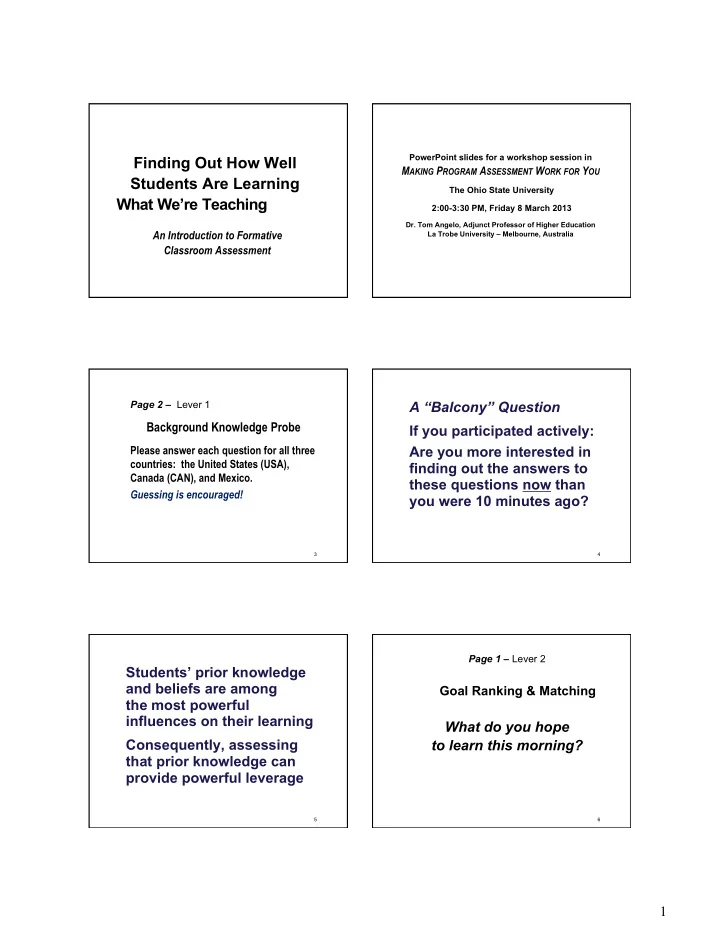
Finding Out How Well Students Are Learning What We’re Teaching

An Introduction to Formative

Classroom Assessment

PowerPoint slides for a workshop session in

MAKING PROGRAM ASSESSMENT WORK FOR YOU

The Ohio State University 2:00-3:30 PM, Friday 8 March 2013

  • Dr. Tom Angelo, Adjunct Professor of Higher Education

La Trobe University – Melbourne, Australia

3

Page 2 – Lever 1

Background Knowledge Probe

Please answer each question for all three countries: the United States (USA), Canada (CAN), and Mexico. Guessing is encouraged!

4

A “Balcony” Question If you participated actively: Are you more interested in finding out the answers to these questions now than you were 10 minutes ago?

5

Students’ prior knowledge and beliefs are among the most powerful influences on their learning Consequently, assessing that prior knowledge can provide powerful leverage

6

Page 1 – Lever 2

Goal Ranking & Matching

What do you hope to learn this morning?

slide-2
SLIDE 2

2

7

The Usefulness of Shared Goals

Without shared goals, we are less likely to collaborate willingly and effectively.

What are your learning goals today? What are your colleagues’ goals? How much common ground—in terms of shared goals—can you find?

8

Teaching Objectives for this Session

  • 1. Propose seven research-based guidelines to improve

teaching and learning

  • 2. Demonstrate applications of those guidelines
  • 3. Provide hands-on experience with those applications
  • 4. Encourage you to identify possible applications to

your own teaching and your students’ learning

Tom Angelo -- thomas.a.angelo@gmail.com 9

Intended Learning Outcomes for this Session By the end of this brief workshop, participants will have:

  • 1. Evaluated the relevance to their own teaching practice of seven

(7) research-based guidelines proposed in the workshop

  • 2. Evaluated the potential usefulness of at least five (5) new

strategies/techniques practiced during the workshop

  • 3. Committed to adapt and apply at least two or three (2-3)

strategies/techniques to improve their students’ learning

  • 4. Identified at least two (2) useful resources and references

for follow up

Tom Angelo -- thomas.a.angelo@gmail.com 10

2nd “Balcony” Question If you participated actively: What differences do you note between “teaching

  • bjectives” and “intended

learning outcomes”? (Are they consequential differences?)

Tom Angelo -- thomas.a.angelo@gmail.com

“It’s not what we do, but what students do that’s the important thing.”

Biggs, J. & Tang, C. (2007). Teaching for Quality Learning at University, 3rd Edition. Berkshire: McGraw-Hill, p. 19.

12

Page 3 – Lever 6

Collaborative Learning Technique

Think-Pair-Share

This is a “Low-Threshold Application”

  • Low complexity – easy to use
  • Low cost – in time and effort
  • Low risk – to teachers or learners
  • Relatively high ROI (Return on Investment)
  • Potentially worth adapting?
slide-3
SLIDE 3

3

13

Page 4 – Lever 1

Background Knowledge Probe A simple, quick way to assess students’ prior knowledge before we begin teaching – to better fit teaching to learning and to provide feedback to students.

14

Page 13 – Lever 5

Another “Low-Threshold Application”

Applications Card

Ideas/Techniques Possible Applications

15

  • Shared TRUST
  • Shared LANGUAGE & CONCEPTS
  • Shared GOALS

Three Preconditions for Deep Learning

16

Page 5 – Lever 1

Concept Tests

17

Page 6 – Lever 3

Two Simple Metacognitive “Levers”

The Minute Paper

and

The Muddiest Point

18

Page 7 – Lever 4

Group Informal Feedback on Teaching is the

G.I.F.T.

slide-4
SLIDE 4

4

19

Page 8 – Lever4

Discussion Draft Questions for an Undergraduate Course/Teaching Feedback Form

20

Page 13

Applications Card

Ideas/Techniques Possible Applications

21

Page 12

Seven Levers for Deeper Learning

  • Please mark each of the 7 “levers” with

a plus sign, minus sign, or question mark

  • Use the plus ( + ) if you understand and agree
  • Use the minus ( – ) if you understand,

but disagree

  • Use the question mark (?) if the lever’s

meaning is unclear – or if you’re unsure

22

A “Balcony” Question If you followed directions: Did you read and think about the list on page 8 any differently than you would have if you had simply been asked to “read it”?

23

A Two-Sentence Summary

  • f this morning’s workshop

It’s what the learners do that matters most to their learning. But teachers can greatly and positively influence what learners do and learn.

24

Page 13 – Guidelines #1 & #3

The Minute Paper and The Muddiest Point

slide-5
SLIDE 5

5

25

  • Page 15

Why Give Learners Feedback? How Can We Make it More Consequential and Useful?

26

  • Assessment & Feedback

for Learning: A Gap-Analysis Approach Find the Gaps Mind the Gaps Close the Gaps

27

Page 13 – Lever 5

Applications Card

Ideas/Techniques Possible Applications

28

Page 19 – Lever 5

Applications Card

Choose one of your possible applications. Prepare to answer the three questions below about that specific application:

  • What is it?
  • Why do you think it might be useful?
  • How do you think you might use it?

29

Page 9 –

Seven Levers for Deeper Learning

  • Prior knowledge and beliefs
  • High expectations and clear goals
  • Metacognition – Learning tools
  • Standards, assessment and feedback
  • Connections – Transfer and application
  • Collaboration toward shared goals
  • Time invested in engaged, active learning

30

slide-6
SLIDE 6

6 Please complete the workshop evaluation.

Feel free to send further questions, comments, critiques and suggestions to

thomas.a.angelo@gmail.com