Financing Energy Access Sustainable Energy Access for All Africans - - PowerPoint PPT Presentation

financing energy access
SMART_READER_LITE
LIVE PREVIEW

Financing Energy Access Sustainable Energy Access for All Africans - - PowerPoint PPT Presentation

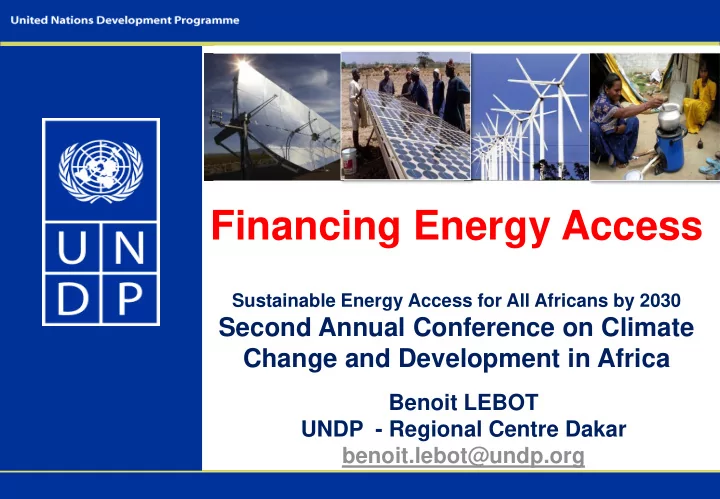
Financing Energy Access Sustainable Energy Access for All Africans by 2030 Second Annual Conference on Climate Change and Development in Africa Benoit LEBOT UNDP - Regional Centre Dakar benoit.lebot@undp.org Sizing Energy Access & its

slide-1
SLIDE 1

Financing Energy Access

Sustainable Energy Access for All Africans by 2030

Second Annual Conference on Climate Change and Development in Africa

Benoit LEBOT UNDP - Regional Centre Dakar benoit.lebot@undp.org

slide-2
SLIDE 2

In 2009:

  • 585 Million Africans without electricity
  • $US 9.1 Billion spent for access to modern

energy services

Source: IEA & UNDP

1

Sizing Energy Access & its Financial needs

slide-3
SLIDE 3

2

Electricity access overview in the world

585 million in sub-Saharan Africa lack access to electricity Connection rates as low as 8% in rural areas

  • Source: Figures from IEA, 2010 & Forecast by the WB, 2006

25 50 75 100 1970 1990 2004 2020 (Forecast)

Latin America Mid-East/North Africa East Asia & Pacific South Asia

Africa

% of population with access to electricity

slide-4
SLIDE 4

Sizing Energy Access & its Financial needs Under BAU, in 2030

  • 645 Million Africans with electricity but
  • 1 Billion poor without it

To meet Universal Access to Energy in 2030: $US 48 Billion/year needed (3% of global energy expenditure)

Source: IEA & UNDP

3

slide-5
SLIDE 5

4

slide-6
SLIDE 6

5

UNDP Multifunctionnal Platforms

slide-7
SLIDE 7

6

slide-8
SLIDE 8

GHG Emissions GHG Concentration GHG Sinks (Sequestration)

2012 394 ppm

http://co2now.org/

450 ppm ~+2°C

32 Gtons CO2 /year 15 Gtons CO2 /year

slide-9
SLIDE 9

1 2 3 4

Today Tomorrow

slide-10
SLIDE 10

Short lessons learned from the mobile technology In 2011, 5.9 Billion mobile users worldwide

Reasons for sharp uptake, including in developing world:

  • Standard technology
  • Low-cost handsets
  • Pre-paid platform
  • Liberalization of telecoms market through a sound

regulatory environment

9

slide-11
SLIDE 11

Four possible conditions to lower cost for financing energy access

  • Reduce balance of system
  • Eliminate taxes & tariffs on clean energy

services

  • Reduce subsidies of fossil fuels
  • Promote entrepreneurship & income-

generating activities 10

slide-12
SLIDE 12

Encouraging productive use pays

In Nepal, direct benefits of electricity :

  • $150/year of revenue per electrified household
  • $912/year of revenue per electrified household

with productive activities 11

slide-13
SLIDE 13

Understanding the Stakeholders & their barriers

4 Stakeholders:

Consumers/ Users Policy Makers Local Financers Supply chain & Infrastructure

12

slide-14
SLIDE 14

Understanding the Stakeholders & their barriers

The Barriers are Lack of:

Consumers/ Users Policy Makers Local Financers Supply chain & Infrastructure

Affordability X X X Access X X Expertise X X X X Motivation X X X Awareness X X X X Business Model X X Cost Effectiveness X X X

13

slide-15
SLIDE 15

Upfront cost to modern energy will remain high for the poorest energy consumers

14

Increasing access to finance to the poor

slide-16
SLIDE 16

Raising funds for Energy Access

Role of public finance: IEA estimates that to provide the $48 B for universal access:

  • $18 B to come from multilateral & bilateral

development sources

  • $15 B from domestic budget
  • $15 B from the private sector
slide-17
SLIDE 17

16

Strategic Financing Position of different types of financers

Bankability

Perceived Risk

slide-18
SLIDE 18

Five principle models exist to provide upfront cost:

  • 1. Dealer/supplier credit-based sales
  • 2. Consumer credit through commercial banks
  • 3. Consumer credit through Micro-Finance Instit.
  • 4. Fee-for-service model (equipment=property of

service providers)

  • 5. Public sector-operated revolving fund credit

scheme 17

Increasing access to finance to the poor

slide-19
SLIDE 19

Raising funds for Energy Access

Possible additional sources of public finance 18

slide-20
SLIDE 20
  • 1. International Public Finance for

development & climate change

  • $15 B in 1980
  • $7 B in late 1990s
  • $9.1 B in 2009
  • 1. Prioritize Energy in development agenda &

development assistance

  • 2. GEF, GCF, Cancun $100 B pledge: tbc: NAMA,

SE4E, Energy + 19

Raising funds for Energy Access

slide-21
SLIDE 21
  • 2. Domestic Budget Contribution
  • Phase out subsidies on fossil energy
  • Cross subsidies between on-grid & off-grid
  • Levy on fossil fuel

20

Raising funds for Energy Access

In 2009, Global Subsidies on Fossil Energy : $312 B Clean Energy : $57 M

slide-22
SLIDE 22
  • 3. Carbon Finance

Improved cookstoves: up to 1 ton/yr avoided GHG CDM : Programme of Activities Supported NAMAs: National Appropriate Mitigation Actions

Raising funds for Energy Access

slide-23
SLIDE 23
  • 1. Clear policy statement & targets
  • 2. Consumer education & community participation
  • 3. Standardization of equipment
  • 4. Research & Development

22

Removing non-economic barriers

(embed in national development strategy, grid extension)

slide-24
SLIDE 24
  • Contribute to CC Mitigation (through

NAMA)

  • Clean Energy for CC Adaptation
  • Success of Mobile : engage on-grid RE

23

Financing Energy Access: Opportunities from CC

slide-25
SLIDE 25

Clean Start initiative: a joint UNDP-UNDCF Feed in Tariff for on grid Renewable Energy www.MDGCarbonFacility.org Sustainable Energy for All (Gap Analysis)

24

UNDP Flagships Programmes

slide-26
SLIDE 26

25

slide-27
SLIDE 27

26

Benoit LEBOT UNDP - Regional Centre Dakar benoit.lebot@undp.org