Financial Strategy Asset Management - rate of asset turnover The - - PDF document

financial strategy
SMART_READER_LITE
LIVE PREVIEW

Financial Strategy Asset Management - rate of asset turnover The - - PDF document

STRATEGIC PROFIT MODEL Margin Management - profit margins Financial Strategy Asset Management - rate of asset turnover The Strategic Profit Model Financial Leverage Management Margin Management (cont.) MARGIN MANAGEMENT


slide-1
SLIDE 1

1

Financial Strategy

The Strategic Profit Model

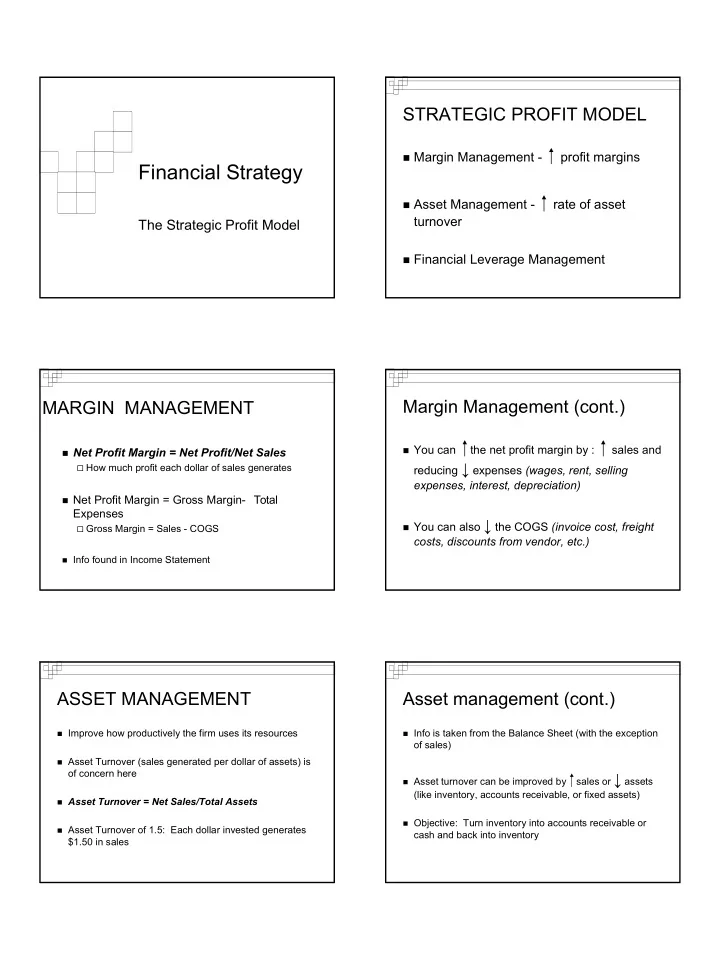
STRATEGIC PROFIT MODEL

Margin Management -  profit margins Asset Management -  rate of asset

turnover

Financial Leverage Management

MARGIN MANAGEMENT

Net Profit Margin = Net Profit/Net Sales

How much profit each dollar of sales generates

Net Profit Margin = Gross Margin

  • Total

Expenses

Gross Margin = Sales - COGS Info found in Income Statement

Margin Management (cont.)

You can  the net profit margin by :  sales and

reducing ↓ expenses (wages, rent, selling expenses, interest, depreciation)

You can also ↓ the COGS (invoice cost, freight

costs, discounts from vendor, etc.)

ASSET MANAGEMENT

Improve how productively the firm uses its resources Asset Turnover (sales generated per dollar of assets) is

  • f concern here

Asset Turnover = Net Sales/Total Assets Asset Turnover of 1.5: Each dollar invested generates

$1.50 in sales

Asset management (cont.)

Info is taken from the Balance Sheet (with the exception

  • f sales)

Asset turnover can be improved by  sales or ↓ assets

(like inventory, accounts receivable, or fixed assets)

Objective: Turn inventory into accounts receivable or

cash and back into inventory

slide-2
SLIDE 2

2

Asset Management (cont.)

Accounts receivable choices:

Bank cards, Proprietary Cards (like Sears), or Private

Label Credit Cards with 3rd party “factor”

Asset turnover is similar to inventory turnover

but more encompassing

includes fixed and variable assets, not just level of

average inventory Inventory Turnover = Net Sales / Avg.

Inventory

RETURN ON ASSETS

ROA reflects both Margin Management and

Asset Management

ROA = Net Profit Margin X Asset Turnover

ROA = (Net Profit/Net Sales) X (Net Sales/Total Assets)

ROA = Net Profits/Total Assets

ROA (cont.)

ROA is used to evaluate the performance of

stores and used to evaluate managers

Firms can get their return on assets in different

ways

Discounters have low profit margins but high turnover Specialty stores have high profit margins but low

turnover

ROA (cont.)

ROA can be compared across different types of

firms

measures of how well a retailer is performing

Asset turnover and profit margins can’t be

compared across different types of retailers given retailers’ varying strategies

Improving ROA

Increase sales

lower prices, better advertising, minimize stockouts,

control inventories

Control COGS

monitor supplier’s prices and payment terms take advantage of special discounts and trade deals,

better credit terms

  • pportunistic buying

Control expenses Control assets

slide-3
SLIDE 3

3

Improving ROA

Control Expenses

cut costs carefully be careful of inadequate service or unqualified sales

help

Control Assets

Quick response - stock should reflects demand Eliminate slow moving merchandise, prune brands

and sizes

FINANCIAL LEVERAGE MANAGEMENT

Leverage Ratio = Total Assets/Owner’s Equity (Net

Worth) Net Worth = Total Assets - Total Liabilities

Assuming debt allows a retailer to expand and grow Financial Leverage positively affects % return on

stockholder’s equity

RETURN ON NET WORTH

RONW = ROA X Leverage Ratio

Financial Constraints of Electronic Retailers

Cost of distribution centers and warehouses Discounts and price wars abound Marketing consumes revenue (it costs money to

advertise and draw people to your web site)

Costly to develop web sites, continuously improve them,

and service them

Financial hurdles (cont.)

Customer service costs more than expected Fees/rents are high on portals like Yahoo Rent and other marketing costs can run 65% of sales

according to the Boston Consulting Group

Is the web just a catalog business with lower barriers to

entry? Will margins get better?