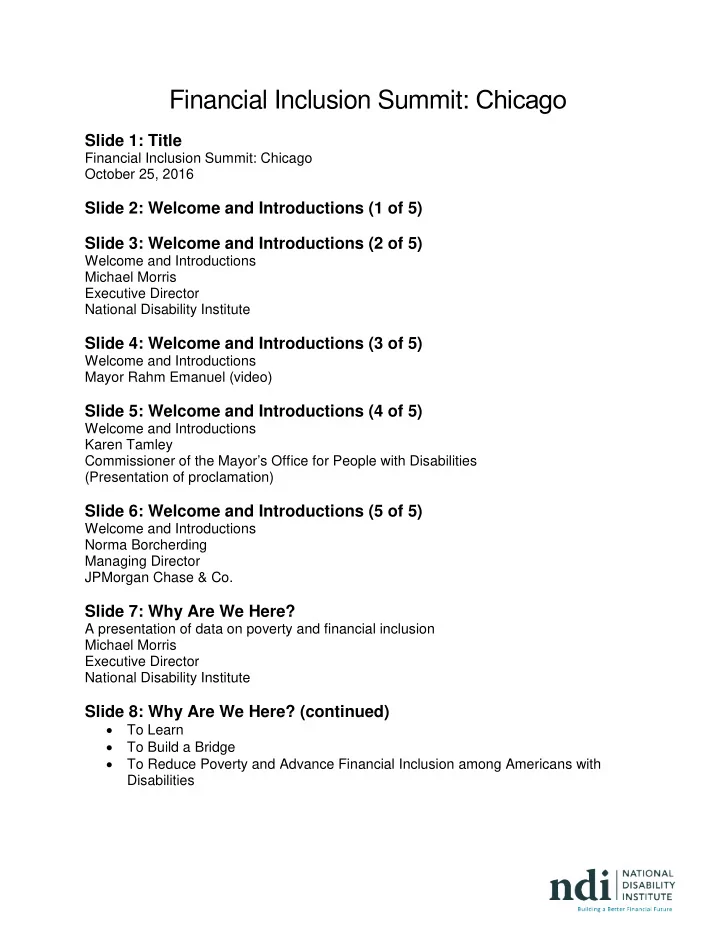
Financial Inclusion Summit: Chicago Slide 1: Title Financial - - PDF document

financial inclusion summit chicago
SMART_READER_LITE
LIVE PREVIEW

Financial Inclusion Summit: Chicago Slide 1: Title Financial - - PDF document

Financial Inclusion Summit: Chicago Slide 1: Title Financial Inclusion Summit: Chicago October 25, 2016 Slide 2: Welcome and Introductions (1 of 5) Slide 3: Welcome and Introductions (2 of 5) Welcome and Introductions Michael Morris


slide-1
SLIDE 1

Financial Inclusion Summit: Chicago

Slide 1: Title

Financial Inclusion Summit: Chicago October 25, 2016

Slide 2: Welcome and Introductions (1 of 5) Slide 3: Welcome and Introductions (2 of 5)

Welcome and Introductions Michael Morris Executive Director National Disability Institute

Slide 4: Welcome and Introductions (3 of 5)

Welcome and Introductions Mayor Rahm Emanuel (video)

Slide 5: Welcome and Introductions (4 of 5)

Welcome and Introductions Karen Tamley Commissioner of the Mayor’s Office for People with Disabilities (Presentation of proclamation)

Slide 6: Welcome and Introductions (5 of 5)

Welcome and Introductions Norma Borcherding Managing Director JPMorgan Chase & Co.

Slide 7: Why Are We Here?

A presentation of data on poverty and financial inclusion Michael Morris Executive Director National Disability Institute

Slide 8: Why Are We Here? (continued)

  • To Learn
  • To Build a Bridge
  • To Reduce Poverty and Advance Financial Inclusion among Americans with

Disabilities

slide-2
SLIDE 2

Slide 9: The Promise of the Americans with Disabilities Act (ADA)

“… the Nation's proper goals regarding individuals with disabilities are to assure equality

  • f opportunity, full participation, independent living, and economic self-sufficiency for

such individuals …”

Slide 10: Data from FDIC, FINRA Investor Education Foundation and U.S. Census Bureau tells us:

  • Adults with disabilities are twice as likely to live in poverty as those without

disability.

  • The disparity in the poverty rate between people with and without disabilities

grows with age.

  • Of households headed by an adult with disability, 46 percent were unbanked or

underbanked and more likely using alternative financial services (such as pawnshops and payday lenders), as compared to 29 percent of households headed by a person without a disability.

  • Of households headed by an adult with a disability, 73 percent reported having

no savings accounts, as compared to 47 percent of households headed by a person without a disability.

Slide 11: 2012 FINRA Foundation National Financial Capability Study

  • 81 percent of people with disabilities did not have an emergency fund to cover

three months of expenses, as compared to 54 percent of people without disabilities;

  • 70 percent of people with disabilities responded they could not come up with

$2,000 in an emergency, as compared to 37 percent of people without disabilities;

  • Only 18 percent of people with disabilities had determined their retirement

savings needs, as compared to 41 percent of people without disabilities;

  • 41 percent of people with disabilities used methods of non-bank borrowing, such

as a pawnshop or payday loan, as compared to 29 percent of people without disabilities; and

  • 50 percent reported they were “not at all satisfied” with their current financial

condition, as compared to 30 percent of people without disabilities.

Slide 12: Banking Status

Households headed by an adult with a disability are:

  • More likely to be unbanked or underbanked
  • More likely to be longer term unbanked
  • More likely to open an account to receive direct deposit paychecks or other

income, such as Social Security benefits

  • Less likely to report future plans to join or rejoin the banking system when

unbanked

slide-3
SLIDE 3

Slide 13: What Else Do We Know?

  • Less likely to have both checking and savings accounts
  • Less likely to have a savings account
  • More likely to use direct deposit
  • More likely to use prepaid cards

Slide 14: Chicago Facts

People with disabilities in Chicago are:

  • Twice as likely not to graduate high school than a person without disabilities (27
  • vs. 14%).
  • Almost three times as likely not to have a college degree than a person without

disabilities (15 vs. 40%).

  • Twice as likely to be earning less than $35,000 in last the 12 months.
  • Half as likely to earn more than $75,000 than a person without a disability (9 vs.

18%).

  • Almost three times more likely unemployed or not in labor force as a person

without a disability (28 vs. 72%).

  • More likely living at or below 150% of the poverty level (45% persons with

disabilities vs. 29% persons without disabilities).

  • Almost twice as likely to be unbanked or underbanked than a person without a

disability.

Slide 15: No Single Solution

While there is no single solution or strategy to reduce poverty, increase income and saving, and to advance financial inclusion among Americans with disabilities, this Summit will identify and design strategic opportunities for sustainable change at an individual and a community level.

Slide 16: What is NDI Doing?

  • A. DISABLE POVERTY Campaign
  • On July 26, 2016, National Disability Institute (NDI) invited individuals,
  • rganizations, corporations and financial institutions to join the DISABLE

POVERTY social media campaign. (www.disablepoverty.org)

  • Campaign focuses on two goals:
  • Decrease the number of working age adults with disabilities living in poverty

by 50 percent; and

  • Increase financial inclusion and the use of mainstream banking products and

services by 50 percent.

Slide 17: Disable Poverty

Disable Poverty is a grassroots campaign which aims to increase awareness about the nearly one in three Americans with disabilities that live in poverty and remain outside the economic mainstream. The two overarching goals of the campaign, to be achieved in the next 10 years, are to:

slide-4
SLIDE 4

Decrease the number of working-age adults with disabilities living in poverty by 50% Increase the use of mainstream banking products and services among Americans with disabilities by 50%. Take the pledge at disablepoverty.org.

Slide 18: Take the Pledge and Commit to Action!

[Screen shot from disablepoverty.org.]

Slide 19: What is NDI Doing? (continued)

  • B. Financial Inclusion Summits in Three Cities
  • Seattle, September 16
  • Chicago, October 25
  • Columbus, November 16

These Summits bring the government, disability and financial communities together to make practical suggestions to assure people with disabilities access to mainstream financial services.

Slide 20: Review the Agenda

  • Presentations on Chicago area efforts to improve financial inclusion and stability

for individuals with disabilities

  • Advancing Financial Inclusion Panel: Challenges and Opportunities for Working-

Age Adults with Disabilities

  • Advancing Financial Inclusion Panel: Collaboration with Financial Institutions
  • Roundtable group discussions to make practical suggestions on future actions for

sustainable change

  • Lunch with guest keynote speaker Michael W. Frerichs, State Treasurer
  • Review of group recommendations
  • Next steps and Wrap-Up

Slide 21: Frame the Discussion of Financial Capability and Financial Well-being

  • Ultimate goal is to support people with disabilities to achieve financial stability
  • To better understand the connection and pathway to financial stability, consider:

Financial Education (Knowledge and Skills)  Financial (Actions)  Financial Stability (Outcomes)

Slide 22: Financial Education

  • Financial education provides the knowledge and skills an individual needs to

effectively manage one’s money.

  • Financial education topics include:
  • Setting financial goals
  • Identifying income vs. expenses
  • Planning and maintaining a household spending plan
  • Managing checking and savings services
slide-5
SLIDE 5
  • Developing and maintaining good credit
  • Identifying needs over wants
  • Avoiding money traps and recognizing predatory lending practices
  • Comparing financial products and services

Slide 23: Financial Capability

Financial Capability is about applying the knowledge and skills to make informed decisions when it comes to one’s finances. Examples:

  • Learn how to balance a checkbook in a financial education class
  • Better understanding of amount of money he or she has to spend and takes

action to reduce banking overdraft fees

Slide 24: Financial Stability

Financial stability is the outcome of combining the knowledge and actions to make positive financial decisions. For individuals with and without disabilities, financial stability produces:

  • An improved economic future
  • Increased long-term planning
  • Improved physical and mental health
  • Better choices about where to live and
  • Greater level of social, civic and economic participation.

Slide 25: New Opportunities for Economic Inclusion of People with Disabilities

  • ABLE Accounts
  • Section 503 Requirements for federal contractors to hire and retain workers with

disabilities

  • Workforce Innovation and Opportunity Act (WIOA)

Slide 26: ABLE Accounts

  • Tax-advantaged savings accounts
  • Will overcome savings limits of SSI, Medicaid and other federal benefits
  • Washington state program will open in 2017
  • Visit www.ablenrc.org

Slide 27: Section 503

  • Affirmative obligations on federal contractors to be proactive in recruiting, hiring,

accommodating, retaining and advancing workers with disabilities

  • For federal contractors and subcontractors (the Final Rule in effect as of March

24, 2014), sets for the first time a 7 percent utilization goal for individuals with disabilities

slide-6
SLIDE 6
  • Responsibility for oversight is the U.S. Department of Labor’s Office of Federal

Contract Compliance Programs (www.dol.gov/ofccp/regs/compliance/factsheets)

Slide 28: WIOA

  • Enactment of WIOA in July 2014 provides new opportunities for the workforce

development system to participate in financial literacy activities

  • WIOA not only supports access to high quality skills development and

certification programs, but it also is to focus on increasing worker prosperity and economic self-sufficiency

  • New requirements to offer youth and adults with and without disabilities financial

literacy activities coordinated with employment and training activities

  • See Integrating Financial Capability and Asset Building Strategies into the Public

Workforce Development System (http://www.leadcenter.org/resource- center/report/integrating-financial-capability-and-asset-building-strategies-public- workforce-development-system)

Slide 29: Advancing Financial Inclusion Panel: Challenges and Opportunities for Working-age Adults with Disabilities

Panel Discussion

Slide 30: Challenges and Opportunities for Working-age Adults with Disabilities

  • Carleda Johnson, Financial Stability Coordinator, Access Living
  • Erick Lopez, Disability Specialist, Mayor's Office for People with Disabilities
  • Chasse Rehwinkel, Director of Policy, State Treasurer’s Office

Moderator: Michael Morris

Slide 31: Presenter

Advancing Financial Inclusion Panel Carleda Johnson Financial Stability Coordinator Access Living

Slide 32: Financial Empowerment for People with Disabilities

Access Living of Metropolitan Chicago Carleda Johnson www.accessliving.org

Slide 33: Access Living Working Towards Independence

  • Established in 1980, Access Living is a non-profit that is a change agent

committed to fostering an inclusive society that enables Chicagoans with disabilities to live fully-engaged and self-directed lives.

slide-7
SLIDE 7
  • Nationally recognized as a leading force in the disability advocacy community,

Access Living challenges stereotypes, protects civil rights, and champions social reform.

  • Our staff and volunteers combine knowledge and personal experience to deliver

programs and services that equip people with disabilities to advocate for themselves.

  • Access Living is at the forefront of the disability rights movement, removing

barriers so people with disabilities can live the future they envision.

Slide 34: Financial Literacy at Access Living

  • Access Living Financial Literacy classes use the FDIC national financial

education curriculum ‘Money Smart.’

  • Money Smart is a comprehensive financial education curriculum designed to help

low and moderate income individuals with disabilities enhance their financial skills and create positive banking relationships

  • Over the course of 11 weeks, participants are equipped with materials and tools

to help them better manage and take control of their personal finances.

  • When consumers attend the financial literacy classes a stipend will be given and

set aside for every class they attend, in the end a lump sum will be given to each participant to save or invest.

Slide 35: Barriers to Achieving Financial Inclusion Linda Preston

  • Lack of financial understanding between financial institutions and consumers
  • People with disabilities low and unpredictable income
  • High transaction cost for consumers
  • Lack of suitable products
  • Complex options
  • Limited Financial Literacy
  • Changing environment
  • Lack of check and balance to protect people with disabilities

Slide 36: Access Living’s Holistic Approach to Financial Literacy

  • Building confidence by identifying what participants already know
  • Recognizing emotional, generational and cultural influences
  • Helping participants understand their individual relationship with MONEY
  • Aid participants in creating a savings culture
  • Outreach and relationship building with financial institutions
  • Providing participants with one-on-one meetings to further facilitate learning

Slide 37: Contact Us!

Carleda Johnson Financial Stability Coordinator For Access Living 312-640-2159 | cjohnson@accessliving.org

slide-8
SLIDE 8

Please visit our website www.accessliving.org

Slide 38: Advancing Financial Inclusion Panel

Erick Lopez Disability Specialist Community Work Incentive Coordinator Mayor's Office for People with Disabilities

Slide 39: Challenges Social Security Beneficiaries have with managing their benefits:

  • Supplemental Security Income (SSI)
  • Restrictions on Assets & Resources of $2,000 monthly
  • No or limited access to financial education to make better money

decisions Slide 40: How can someone who receives SSI start to develop assets?

  • Student Earned Income Exclusion (SEIE)
  • Impairment Related Work Expenses (IRWEs)
  • Blind Work Expenses (BWEs)
  • Property Essential to Self-support (PESS)
  • Plan to Achieve Self-Support (PASS)
  • Individual Development Account (IDA)

Slide 41: What do people with disabilities want from a banking relationship?

  • Respectful customer service
  • Affordable products
  • Help with understanding and selecting financial products

Slide 42: Mayor’s Office for People with Disabilities Work Incentive Planning & Assistance Program

Erick Lopez Disability Specialist Community Work Incentive Coordinator 2102 W. Ogden Avenue, Chicago IL 60612 312-746-5743 erick.lopez@cityofchicago.org

Slide 43: Advancing Financial Inclusion Panel

Chasse Rehwinkel Director of Policy, State Treasurer’s Office

slide-9
SLIDE 9

Slide 44: ABLE

  • In December, 2014, Congress passed the Achieving a Better Life Experience

Act.

  • The law was more than a decade in development and allowed states to set up

529-like savings programs for persons with disability or blindness.

  • Illinois passed its state version of the ABLE bill in the spring session of 2015, and

the Governor signed it into law that summer.

Slide 45: What Does ABLE Do?

  • ABLE is a tax-advantaged savings program for persons with blindness or

disability.

  • Like Bright Start and Bright Directions, the Treasurer’s Office is the administrator
  • f the Illinois ABLE program.
  • Eligible beneficiaries for the program are people who are entitled to benefits

based on blindness or disability under Title II or XVI of the Social Security Act or have a “disability certification” filed with the US Treasury Secretary, and disabled before the age of 26.

Slide 46: Challenges

While ABLE has a number of similarities with 529 College Savings plans, a number of differences present unique issues for states:

  • ABLE accounts will be lower dollar, higher transaction compared to College

Savings,

  • The smaller population for people with blindness or disability create a smaller

pool size,

  • Unlike College Savings, ABLE accounts have a wide variety of investment date

ranges.

Slide 47: Solutions

In order to create the best possible programing for its residents, Illinois has explored a consortium model for ABLE. The consortium’s role is to:

  • Issue RFPs for services on behalf of members,
  • Share common administrative, or “back-end” services,
  • States maintain ownership of accounts,
  • More efficient scalability.

By pooling resources, this model is projected to realize various cost savings, thereby driving down fees.

Slide 48: ABLE Consortium

A group of eleven like-minded states have signed an interstate agreement, pledging to work with each other on establishing an ABLE Consortium that would offer best in-class services at the lowest possible pricing.

slide-10
SLIDE 10

State/Population (table) Alaska 738,432 Illinois 12,859,995 Iowa 3,123,899 Kansas 2,911,641 Minnesota 5,489,594 Missouri 6,083,672 New Jersey 8,938,175 Nevada 2,890,845 North Carolina 10,042,802 Pennsylvania 12,802,503 Rhode Island 1,056,298

Slide 49: More Information

Treasurer’s Website includes a page for ABLE: www.illinoistreasurer.gov Included:

  • Email address for questions
  • One page introductory fact sheet
  • More information will be added in the coming months

Contact Chasse Rehwinkel: crehwinkel@illinoistreasurer.gov

Slide 50: Advancing Financial Inclusion Panel

Collaboration with Financial Institutions Panel Discussion

Slide 51: Challenges and Opportunities for Working-age Adults with Disabilities

  • Glenn Brewer, Community Affairs Specialist, FDIC
  • Drew Beres, General Counsel, Deputy Chief Operating Officer, Office of City

Treasurer

  • Dory Rand, President, Woodstock Institute

Moderator: Michael Morris

Slide 52: Advancing Financial Inclusion Panel

Glenn Brewer Community Affairs Specialist FDIC

Slide 53: Community Affairs Branch: What Do We Do?

  • The Community Affairs Branch assists financial institutions in developing

strategies that are responsive to the credit, service and investment needs

  • f the communities we both serve.
slide-11
SLIDE 11
  • The Community Affairs Branch participates in the supervision and regulation of

FDIC insured banks; banks are examined routinely for safety and soundness and compliance with the Community Reinvestment Act.

Slide 54: 2016 Community Affairs Branch Focus

The Economic Inclusion Ladder

  • The Community Affairs Branch’s work in 2016 is focused in primarily 5 areas of
  • pportunity that work to deliver and support economic inclusion.
  • Each area of opportunity builds capability and access to expand inclusion.
  • It all begins with financial education and access to insured deposit

accounts. [Art of ladder. From bottom to top: Financial Education, Insured Deposit Accounts, Consumer Credit and Household Savings, Affordable Mortgage Credit, Financial Services for Small Business]

Slide 55: More Specifically: 2016 FDIC Performance Goal:

Develop and implement targeted strategies to expand access to mainstream financial institutions by populations that are disproportionately likely to be unbanked or underbanked.

Slide 56: Historical Perspective

Community Affairs completed a summary analysis of the FDIC “2013 National Survey of Unbanked and Underbanked Households” and other data related to the banking experience of individuals/families with disabilities. Our analysis shows that generally households headed by persons with a disability were more likely to be unbanked and underbanked than their non-disabled comparators.

Slide 57: Historical Perspective (continued)

When added together, approximately one-third of non-disabled households are not fully banked compared to 46.5% of disabled households.

Slide 58: Historical Perspective (cont.)

This data is informative in further defining action plans for people with disabilities that promote access to financial education and mainstream banking solutions.

Slide 59: FDIC CAB Work Underway

FDIC CAB continues to make strategic connections:

  • National Federation of the Blind: Money Smart Braille for further collaboration on

MS for the visually impaired, to explore the use by their 52 state affiliates;

  • National Association of Councils on Development Disabilities: 54 state Councils
  • n Developmental Disabilities, who is assisting us in defining the need for

financial literacy curriculum training programs and other services at their state councils;

  • The national office of The Arc: 650 individual chapters.
slide-12
SLIDE 12

Slide 60: FDIC Recent CAB Events

Spring and Summer, 2016:

  • Money Smart Train the Trainer for Individuals with Disabilities: sessions recently

held in partnership with The Arc. Focus was to train ARC staff/team members in the Money Smart curriculum to help facilitate future trainings of their state affiliates.

  • Banker Roundtables and Community Development Forums to discuss best

practices for improving access and engagement of disabled individuals and families.

Slide 61: Next Steps

  • Continue support of Bank On chapters to encourage and foster banking

relationships within the disabled community

  • Continue the linkages between FDIC regulated banks and the communities they

serve; facilitate educational and training opportunities to expand awareness, best practices and engagement

Slide 62: Conclusion

  • FDIC is committed to fostering and participating in efforts that bring economic

inclusion to all of the communities we serve.

  • Our focus is to support and deliver tangible results that reduce the incidence of

underbanked or non-banked families, to help in removing barriers that block access to the financial mainstream.

Slide 63: Advancing Financial Inclusion Summit

Drew Beres General Counsel, Deputy Chief Operating Officer Office of City Treasurer

Slide 64: BankOn Chicago

BankOn Chicago is a joint effort by the Treasurer’s Office, local banks, and community partners to help unbanked and under-banked Chicagoans get access to mainstream checking and savings accounts. [Art of Partners’ logos: Chase, Citi, Fifth Third Bank, First Savings Bank of Hegewisch, GuarantyBank, Illinois Service Federal, mb financial bank, Marquette Bank, PNC, SSCFCU, Bank of America, UrbanPartnershipBank, TCF Bank, Office of the City Treasurer]

Slide 65: Advancing Financial Inclusion Summit

Dory Rand President Woodstock Institute

slide-13
SLIDE 13

Slide 66: The Community Reinvestment Act & Financial Inclusion for People with Disabilities

Dory Rand, President Woodstock Institute

Slide 66: Financial Empowerment Integration Outcomes

  • Increased participation in financial empowerment training
  • Increased completion of Financial Empowerment Level 1 Certification
  • Increased recruitment of facilitators for financial empowerment workshops
  • Increased awareness and access to financial empowerment related resources,

services and tools

  • Increased commitment to ensuring accessibility and inclusivity among other

service providers

Slide 67: Woodstock Institute Mission & Focus Areas

Create a just financial system in which lower-wealth persons and communities of color can achieve economic security and community prosperity.

  • Equitable lending and investments
  • Wealth creation and preservation
  • Safe and affordable financial products, services, and system

Slide 68: Community Reinvestment Act (CRA)

  • Trillions for LMI communities since enactment in 1977
  • Enacted in response to “redlining”
  • Obligation “to meet the credit needs of [their] local communities”
  • CRA Exams (only for institutions with FDIC insurance)
  • Generally, every three years
  • Possible ratings: Outstanding, Satisfactory, Needs-to-improve, Substantial

Noncompliance

  • Examiner considers public comments in CRA file
  • Disability community can participate in public comment process

Slide 69: CRA Tests (for large banks)

  • Lending: Small business and mortgage Loans; Home equity loans for home

modifications/improvements (ramps, elevators, railings, etc.), Loans for wheelchairs or assistive technology

  • Investments: Grants to not-for-profits for financial capability, home ownership

counseling, and other programs; financing and investments in accessible, affordable housing

  • Retail Services: Accessible ATMs, branches, websites, mobile
slide-14
SLIDE 14

Slide 70: A Bank in the Midwest

  • Downgraded to Needs-to-improve on latest CRA exam
  • Bank cannot pursue M&A or open/close branches until back to Satisfactory or

above CRA rating

  • Working with National Community Reinvestment Coalition (NCRC) and local

members to develop a CRA Plan

Slide 71: Branch Closures

  • National trend
  • Notice requirements
  • Right to submit comments for public CRA file
  • Right to request public meeting with regulators
  • Related concerns regarding declines in small business lending

Slide 72: Mergers & Acquisitions

  • Bank needs CRA rating of Satisfactory or higher
  • Regulators consider CRA Performance, public benefit, convenience and needs of

the community, public comments

  • Conditional Approvals
  • Can require CRA plans with:
  • Community input (opportunity for disability community)
  • & Measurable outcomes
  • Can require non-objection to opening and closing of branches

Slide 73: A Bank Merger

  • Meetings with NCRC and over 100 member CBOs
  • $16.1 Billion over five years
  • $5.7 Billion in Mortgage Lending in LMI areas
  • $6.6 Billion in Small Business Lending in LMI areas
  • $3.7 Billion in Community Development Lending and Investment
  • 10 new branches in LMI communities and/or majority minority communities

Slide 74: Another Bank Merger

  • Woodstock submitted a comment to OCC
  • OCC issued a Conditional Approval, requiring:
  • Submission of a strong, public CRA plan with community input
  • Compliance with branch closure and consolidation plan, including bank

must obtain OCC non-objection to branch closings

Slide 75: For more information

Find us at www.woodstockinst.org Facebook.com/woodstockinstitute @woodstockinst

slide-15
SLIDE 15

Slide 76: Break Slide 77: Group Discussions

  • 1. Outreach to Disability Community
  • 2. Expanding Financial Education and Coaching to People with Disabilities
  • 3. Improving Financial Inclusion for People with Disabilities by Financial Institutions
  • 4. Building Public-Private Sector Collaboration

Slide 78: Roundtable Discussion Instructions

  • Each table should select a recorder to take notes and a spokesperson to share

your recommendations with the full audience when we reconvene.

  • There are four questions. Each table should prepare recommendations for all

four questions.

  • Each table should select at least one additional question to answer.
  • You have one hour for group discussion. Please spend the last 15 minutes

selecting your priority recommendations. (Top three per question and make sure your spokesperson is prepared to share with the group.)

  • If you have a question, please raise your hand. Alice and I will be circulating and

come to your table.

Slide 79: Group Discussion: Questions for Chicago

  • 1. What can financial institutions do to increase engagement of working-age adults

with disabilities with mainstream financial products and services?

  • 2. What can financial institutions do to keep customers with disabilities in the

banking system and invest in long-term customer relationships? As a person with a disability, what do I want from a banking relationship?

  • 3. What can disability organizations do to improve financial capability for people

with disabilities? Who could they collaborate with to increase availability of financial education and coaching?

  • 4. How can we expand outreach to the disability community to educate eligible

individuals with disabilities about the benefits of opening an ABLE account?

Slide 80: Luncheon Keynote Speaker

Michael W. Frerichs State Treasurer

Slide 81: Reports and Recommendations from Group Discussions Slide 82: Next Steps and Wrap-Up

Alice Coday Michael Morris

slide-16
SLIDE 16

Slide 83: LEARN – Upcoming Training Opportunities

  • CFBP Your Money, Your Goals Training: Inclusion & Disability Awareness

December 13, 2016; 8:45 a.m. – 4:00 p.m.; FDIC, Chicago Regional Office, 300 South Riverside Plaza, Suite 1700, Chicago, IL

Slide 84: DISABLE POVERTY – Take the Pledge

  • Ask everyone at your organization to take the pledge and make a commitment to

action

  • Share the DISABLE POVERTY campaign with your staff and clients through

social media, newsletters and community partnerships

  • Use the DISABLE POVERTY toolkit
  • Offer financial education and other volunteer support services to disability and

advocacy organizations

Slide 85: EXPLORE – The Top 12 Financial Wellness Links: www.realeconomicimpact.org/resources/links

  • Connect with Peers
  • Become a Bank On Chicago Community Partner
  • Become a Bank On Chicago Financial Partner
  • Become an Illinois Asset Building Group Partner
  • Credit and Debt - Integrating financial capability to build credit and reduce debt
  • Savings – Become an ABLE Ambassador
  • Banking – Learn more about BankOn Chicago:

http://www.chicagocitytreasurer.com/ofi/bank-on-chicago/

  • Offer financial education classes – use programs like Money Smart (FDIC)
  • Track and report your conversion rate of unbanked clients to banked

clients

Slide 86: No title.

Today’s event was made possible through the generous support of JPMorgan Chase.