Final Presentation CPG and Tegotae based Locomotion Control of - - PowerPoint PPT Presentation

β–Ά
final presentation
SMART_READER_LITE
LIVE PREVIEW

Final Presentation CPG and Tegotae based Locomotion Control of - - PowerPoint PPT Presentation

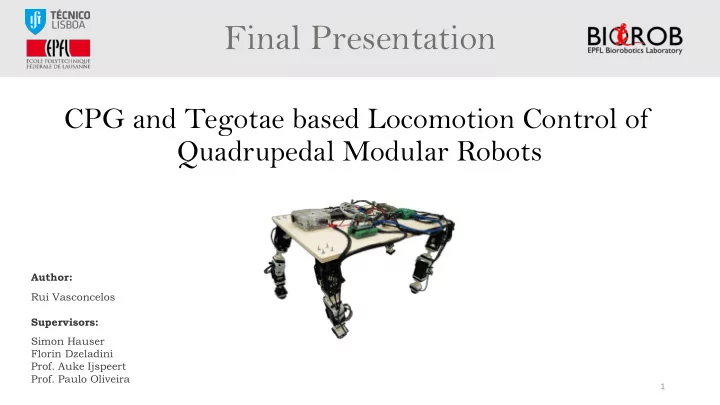
Final Presentation CPG and Tegotae based Locomotion Control of Quadrupedal Modular Robots Author: Rui Vasconcelos Supervisors: Simon Hauser Florin Dzeladini Prof. Auke Ijspeert Prof. Paulo Oliveira 1 Control Problem Is there a general


slide-1
SLIDE 1

Final Presentation

CPG and Tegotae based Locomotion Control of Quadrupedal Modular Robots

Author: Rui Vasconcelos Supervisors: Simon Hauser Florin Dzeladini

  • Prof. Auke Ijspeert
  • Prof. Paulo Oliveira

1

slide-2
SLIDE 2

Is there a general approach to control arbitrary modular robots?

Control Problem

2

slide-3
SLIDE 3

Is there a general approach to control arbitrary modular robots?

Simplifications: 1. 8 degrees of freedom 2. Symmetric configuration 3. Central body

Control Problem

quadrupedal

3

slide-4
SLIDE 4

Bioinspiration

[Ijspeert A.]

4

slide-5
SLIDE 5

Methods

slide-6
SLIDE 6

Base Morphology

Simulation Hardware

Simplifications: 1. Planar Limbs 2. Specialized foot

𝐢π‘₯𝑕 = 1.4 Kg 𝐢π‘₯𝑕 = 2 Kg

6

slide-7
SLIDE 7

Base Morphology

Simulation

𝜘 πœ˜π‘ π‘“π‘” 𝜘 𝜐 (𝑦, 𝑧, 𝑨) (Ξ¦, Θ, Ξ¨) (𝐺

𝑦, 𝐺 𝑧, 𝐺 𝑨)

7

slide-8
SLIDE 8

Base Morphology

Hardware

18V 18V 12V RS-485 TTL

8

slide-9
SLIDE 9

Base Morphology

Current

Hardware

IMU 3D force Joint Reference Joint Position New

9

slide-10
SLIDE 10

Step Trajectory

πœ„π‘›π‘π‘¦ π‘ž2 π‘ž1 π‘ž3 π‘š2 β„Žπ‘‘π‘’ π‘š1 β„Žπ‘‘π‘₯ πœ„π‘›π‘π‘¦ π‘ž1 π‘ž4 π‘ž3 π‘š2 π‘š1

Parameters: 1. πœ„π‘›π‘π‘¦ 2. β„Žπ‘‘π‘’ 3. β„Žπ‘‘π‘₯

Swing phase Stance phase

10

slide-11
SLIDE 11

π‘ž1 π‘ž2 π‘ž4 π‘ž3

πœšπ‘’ πœšπ‘—

Control Approaches

𝑗 = 1 𝑗 = 2 𝑗 = 4 𝑗 = 3

Open Loop CPG Tegotae

Parameters: 1. 𝑔 2. 𝑒𝑔 3. πœ”π‘—π‘˜ = βˆ’πœ”π‘˜π‘— Parameters : 1. 𝑔 2. 𝜏

𝑗 = 1 𝑗 = 2 𝑗 = 4 𝑗 = 3

11

slide-12
SLIDE 12

π‘ž1 π‘ž2 π‘ž4 π‘ž3

πœšπ‘’ πœšπ‘—

Control Approaches

Open Loop CPG Tegotae Binary Tegotae

Parameters: 1. 𝑔 2. 𝑒𝑔 3. πœ”π‘—π‘˜ = βˆ’πœ”π‘˜π‘—

𝑗 = 1 𝑗 = 2 𝑗 = 4 𝑗 = 3

12

slide-13
SLIDE 13

Goals

slide-14
SLIDE 14

Thesis Goals

Open Loop CPG Tegotae

  • 1. Trajectory
  • 2. Duty factor

Energy Speed Stability Steady State

  • 1. Trajectory
  • 2. Effect of 𝜏
  • 3. Scaled by

frequency?

  • 4. Binary Tegotae?

Convergence

14

slide-15
SLIDE 15

Results

slide-16
SLIDE 16

π‘ž1 π‘ž2 π‘ž4 π‘ž3

πœšπ‘’ πœšπ‘—

Control Approaches

Open Loop CPG Tegotae Binary Tegotae

Parameters: 1. 𝑔 2. 𝑒𝑔 3. πœ”π‘—π‘˜ = βˆ’πœ”π‘˜π‘—

𝑗 = 1 𝑗 = 2 𝑗 = 4 𝑗 = 3

16

slide-17
SLIDE 17

Subject to:

Particle Swarm Optimization

Open Loop CPG

> β„Žπ‘›π‘—π‘œ

Maximize :

Validation on hardware

17

slide-18
SLIDE 18

Subject to:

Particle Swarm Optimization

Open Loop CPG

Maximize :

18

slide-19
SLIDE 19

Particle Swarm Optimization

Open Loop CPG

𝑀𝑒 [𝑛 βˆ™ π‘‘βˆ’1] 0.25 0.5 0.75 1 Trot BL Maximize :

19

slide-20
SLIDE 20

Particle Swarm Optimization

Open Loop CPG

𝑀𝑒 [𝑛 βˆ™ π‘‘βˆ’1] 0.25 0.5 0.75 1 Trot Rotary Gallop BL Maximize :

20

slide-21
SLIDE 21

Particle Swarm Optimization

Open Loop CPG

𝑀𝑒 [𝑛 βˆ™ π‘‘βˆ’1] 0.25 0.5 0.75 1 Trot Rotary Gallop Bound BL Maximize :

21

slide-22
SLIDE 22

Maximize :

Particle Swarm Optimization

Open Loop CPG

Imposed Trot

𝑀𝑒 [𝑛 βˆ™ π‘‘βˆ’1] 0.25 0.5 0.75 1 Trot Rotary Gallop Bound BL

Trot

𝑔 = 0.25 𝐼𝑨 , πœ„π‘›π‘π‘¦ = 0.3 𝑠𝑏𝑒 , β„Žπ‘‘π‘₯ = 15 𝑛𝑛, β„Žπ‘‘π‘’ = 0 𝑛𝑛

Validation on hardware

22

Validated on hardware β‰₯ 0.5

slide-23
SLIDE 23

Steady State Systematic Search: Trajectories

Open Loop CPG

𝑔 = 0.25 𝐼𝑨

Simulation

23

slide-24
SLIDE 24

Open Loop CPG

Steady State Systematic Search: Trajectories

Hardware

𝑔 = 0.25 𝐼𝑨 𝑒𝑔 = 0.5

24

slide-25
SLIDE 25

π‘ž1 π‘ž2 π‘ž4 π‘ž3

πœšπ‘’ πœšπ‘—

Control Approaches

Open Loop CPG Tegotae Binary Tegotae

Parameters: 1. 𝑔 2. 𝑒𝑔 3. πœ”π‘—π‘˜ = βˆ’πœ”π‘˜π‘—

𝑗 = 1 𝑗 = 2 𝑗 = 4 𝑗 = 3

  • 1. Convergence
  • 2. Steady State

25

slide-26
SLIDE 26
  • 1. Convergence

Tegotae

Trot 𝜚0 = [0,0,0,0]

𝝉 = 𝟏. πŸ‘πŸ”

Hardware

𝑔 = 0.25 𝐼𝑨 , πœ„π‘›π‘π‘¦ = 0.3 𝑠𝑏𝑒 , β„Žπ‘‘π‘₯ = 15 𝑛𝑛, β„Žπ‘‘π‘’ = 0 𝑛𝑛 26

slide-27
SLIDE 27
  • 1. Convergence

Binary Tegotae

𝝉𝒄 = 𝟏. πŸ•

27

slide-28
SLIDE 28
  • 1. Convergence

Binary Tegotae

28

slide-29
SLIDE 29

Tegotae

  • 2. Steady State

29

Simulation

  • 1. Trajectory
  • 2. Effect of 𝜏
slide-30
SLIDE 30

Tegotae

  • 2. Steady State

30

Simulation

3. Scaled by frequency?

  • 1. Trajectory
  • 2. Effect of 𝜏
slide-31
SLIDE 31

Tegotae

  • 2. Steady State

31

Simulation

3. Scaled by frequency?

  • 1. Trajectory
  • 2. Effect of 𝜏

Best 15 Speed Best 15 Energy Efficiency

slide-32
SLIDE 32

Tegotae

𝑔 = 0.25 𝐼𝑨 , πœ„π‘›π‘π‘¦ = 0.3 𝑠𝑏𝑒 , β„Žπ‘‘π‘₯ = 15 𝑛𝑛, β„Žπ‘‘π‘’ = 0 𝑛𝑛

  • 2. Steady State

Hardware

32

slide-33
SLIDE 33

Tegotae

Hardware 𝝉 = 𝟏 𝝉 = 𝟏. πŸ’

  • 2. Steady State

33

slide-34
SLIDE 34

Tegotae

  • 2. Steady State

Step cycle

𝝉 = 𝟏 𝝉 = 𝟏. πŸ’ Hardware

34

slide-35
SLIDE 35

Tegotae

  • 2. Steady State

𝝉 = 𝟏 𝝉 = 𝟏. πŸ’ Hardware

35

slide-36
SLIDE 36

Tegotae

  • 2. Steady State

Hardware

36

𝝉 = 𝟏. πŸ” 𝝉 = 𝟐

slide-37
SLIDE 37
  • 2. Steady State

Binary Tegotae

37

𝝉𝒄 = 𝟏. πŸ• 𝝉𝒄 = 𝟏. πŸ•

slide-38
SLIDE 38

Conclusions

slide-39
SLIDE 39

Conclusions

Open Loop CPG Tegotae Binary Tegotae

1. Slower convergence 2. Less efficient steady state

39

Simulation VS Hardware

Particle Swarm Optimizations:

𝑀𝑒 [𝑛 βˆ™ π‘‘βˆ’1] 0.25 0.5 0.75 1 Trot Rotary Gallop Bound BL β„Žπ‘‘π‘’ = 0

Systematic Search: Convergence:𝜏 Steady state: 𝜏 Fast + Efficient

𝜏

Stable

𝜏(𝑒)

Trot β„Žπ‘‘π‘₯ ∈ 10,20 𝑛𝑛

πœ„π‘›π‘π‘¦

Fast + Efficient H:

πœ„π‘›π‘π‘¦

Slow + Efficient S:

slide-40
SLIDE 40

Future Work

1. More experiments! 2. Rough Terrain

40

Tegotae

3. Compliance 4. Mophology changes

Crawling?

slide-41
SLIDE 41

Ground Reaction Force [N]

41

Future Work

Tegotae

1. More experiments! 2. Rough Terrain 3. Compliance 4. Mophology changes

slide-42
SLIDE 42

Acknowledgements

42

slide-43
SLIDE 43

Final Presentation

CPG and Tegotae based Locomotion Control of Quadrupedal Modular Robots

Author: Rui Vasconcelos Supervisors: Simon Hauser Florin Dzeladini

  • Prof. Auke Ijspeert
  • Prof. Paulo Oliveira

43

slide-44
SLIDE 44

Appendix: Cat Gallop

44

slide-45
SLIDE 45

Appendix: Validation on β„Žπ‘‘π‘’ β‰  0

Validation on hardware π’Šπ’•π’– = πŸ” 𝒏𝒏

45

slide-46
SLIDE 46

Appendix: Statistics on CLSS

46

slide-47
SLIDE 47

Appendix: Simulation VS Hardware

47

slide-48
SLIDE 48

Appendix: Open Loop Systematic Search

48

slide-49
SLIDE 49

Appendix: Open Loop Systematic Search

49

slide-50
SLIDE 50

Appendix: D-S run

Open Loop CPG

𝑀𝑒 [𝑛 βˆ™ π‘‘βˆ’1] 0.25 0.5 0.75 1 Trot Rotary Gallop D-S run

50

slide-51
SLIDE 51

Appendix: 0.75 Hz Binary Convergence

51

slide-52
SLIDE 52

Appendix: Robot version 1

52

slide-53
SLIDE 53

Appendix: Hardware Limitations

53

slide-54
SLIDE 54

Appendix: PSO Results

54

slide-55
SLIDE 55

Appendix: PSO Results

55