Final exam location: Clough 152 Please fill out your CIOS survey! - - PowerPoint PPT Presentation

final exam location clough 152
SMART_READER_LITE
LIVE PREVIEW

Final exam location: Clough 152 Please fill out your CIOS survey! - - PowerPoint PPT Presentation

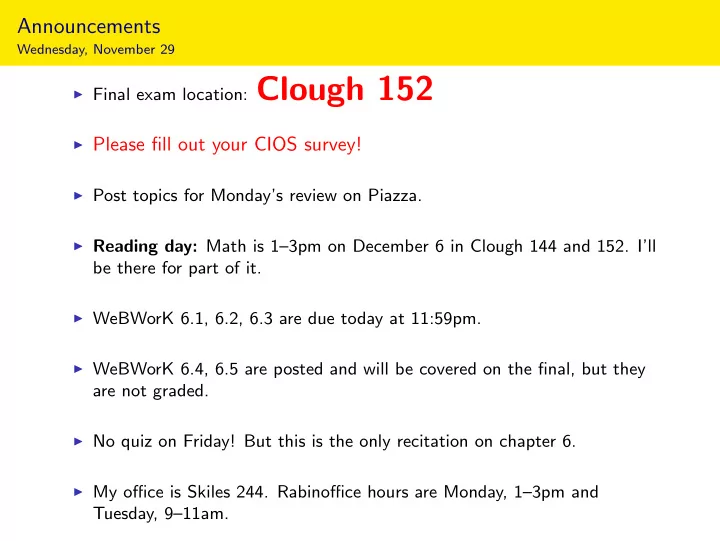
Announcements Wednesday, November 29 Final exam location: Clough 152 Please fill out your CIOS survey! Post topics for Mondays review on Piazza. Reading day: Math is 13pm on December 6 in Clough 144 and 152. Ill be there


slide-1
SLIDE 1

Announcements

Wednesday, November 29

◮ Final exam location: Clough 152 ◮ Please fill out your CIOS survey! ◮ Post topics for Monday’s review on Piazza. ◮ Reading day: Math is 1–3pm on December 6 in Clough 144 and 152. I’ll

be there for part of it.

◮ WeBWorK 6.1, 6.2, 6.3 are due today at 11:59pm. ◮ WeBWorK 6.4, 6.5 are posted and will be covered on the final, but they

are not graded.

◮ No quiz on Friday! But this is the only recitation on chapter 6. ◮ My office is Skiles 244. Rabinoffice hours are Monday, 1–3pm and

Tuesday, 9–11am.

slide-2
SLIDE 2

Section 6.5

Least Squares Problems

slide-3
SLIDE 3

Motivation

We now are in a position to solve the motivating problem of this third part of the course: Suppose that Ax = b does not have a solution. What is the best possible approximate solution? Problem To say Ax = b does not have a solution means that b is not in Col A. The closest possible b for which Ax = b does have a solution is b = projCol A(b). Then A x = b is a consistent equation. A solution x to A x = b is a least squares solution.

slide-4
SLIDE 4

Least Squares Solutions

Let A be an m × n matrix.

Definition

A least squares solution of Ax = b is a vector x in Rn such that b − A x ≤ b − Ax for all x in Rn.

Col A Ax Ax Ax A x = b = projCol A(b) b b − A x Note that b − A x is in (Col A)⊥. [interactive]

In other words, a least squares solution x solves Ax = b as closely as possible. Equivalently, a least squares solution to Ax = b is a vector x in Rn such that A x = b = projCol A(b). This is because b is the closest vector to b such that A x = b is consistent.

slide-5
SLIDE 5

Least Squares Solutions

Computation

Theorem

The least squares solutions to Ax = b are the solutions to (ATA) x = ATb. This is just another Ax = b problem, but with a square matrix ATA! Note we compute x directly, without computing b first. Why is this true? Alternative when A has orthogonal columns v1, v2, . . . , vn:

  • b = projCol A(b) =

n

  • i=1

b · vi vi · vi vi The right hand side equals A x, where x = b · v1 v1 · v1 , b · v2 v2 · v2 , · · · , b · vn vn · vn

  • .
slide-6
SLIDE 6

Least Squares Solutions

Example

Find the least squares solutions to Ax = b where: A =   1 1 1 1 2   b =   6   . So the only least squares solution is x = 5 −3

  • .
slide-7
SLIDE 7

Least Squares Solutions

Example, continued

How close did we get?

x y z Col A v1 v2 5v1 −3v2

√ 6

  • b = A
  • 5

−3

  • b

[interactive]

Let v1 =   1 1 1   and v2 =   1 2   be the columns of A, and let B = {v1, v2}. Note x = 5

−3

  • is just the B-coordinates of

b, in Col A = Span{v1, v2}.

slide-8
SLIDE 8

Least Squares Solutions

Second example

Find the least squares solutions to Ax = b where: A =   2 −1 1 2   b =   1 −1   . So the only least squares solution is x = 1/3 −1/3

  • .

[interactive]

slide-9
SLIDE 9

Least Squares Solutions

Uniqueness

When does Ax = b have a unique least squares solution x?

Theorem

Let A be an m × n matrix. The following are equivalent:

  • 1. Ax = b has a unique least squares solution for all b in Rn.
  • 2. The columns of A are linearly independent.
  • 3. ATA is invertible.

In this case, the least squares solution is (ATA)−1(ATb). Why? If the columns of A are linearly dependent, then A x = b has many solutions:

Col A v1 v2 v3

  • b = A

x b [interactive]

Note: ATA is always a square matrix, but it need not be invertible.

slide-10
SLIDE 10

Application

Data modeling: best fit line

Find the best fit line through (0, 6), (1, 0), and (2, 0).

(0, 6) (1, 0) (2, 0) 1 −2 1 y = − 3 x + 5 A

  • 5

−3

  6   =   1 −2 1   [interactive]

slide-11
SLIDE 11

Poll

slide-12
SLIDE 12

Application

Best fit ellipse

Find the best fit ellipse for the points (0, 2), (2, 1), (1, −1), (−1, −2), (−3, 1), (−1, −1). The general equation for an ellipse is x2 + Ay 2 + Bxy + Cx + Dy + E = 0 So we want to solve: (0)2 + A(2)2 + B(0)(2) + C(0) + D(2) + E = 0 (2)2 + A(1)2 + B(2)(1) + C(2) + D(1) + E = 0 (1)2 + A(−1)2 + B(1)(−1) + C(1) + D(−1) + E = 0 (−1)2 + A(−2)2 + B(−1)(−2) + C(−1) + D(−2) + E = 0 (−3)2 + A(1)2 + B(−3)(1) + C(−3) + D(1) + E = 0 (−1)2 + A(−1)2 + B(−1)(−1) + C(−1) + D(−1) + E = 0 In matrix form:         4 2 1 1 2 2 1 1 1 −1 1 −1 1 4 2 −1 −2 1 1 −3 −3 1 1 1 1 −1 −1 1               A B C D E       =         −4 −1 −1 −9 −1         .

slide-13
SLIDE 13

Application

Best fit ellipse, continued

A =        4 2 1 1 2 2 1 1 1 −1 1 −1 1 4 2 −1 −2 1 1 −3 −3 1 1 1 1 −1 −1 1        b =        −4 −1 −1 −9 −1        . AT A =      36 7 −5 12 7 19 9 −5 1 −5 9 16 1 −2 −5 1 12 12 1 −2 6      AT b =      −19 17 20 −9 −16      Row reduce:      36 7 −5 12 −19 7 19 9 −5 1 17 −5 9 16 1 −2 20 −5 1 12 −9 12 1 −2 6 −16           1 405/266 1 −89/133 1 201/133 1 −123/266 1 −687/133     

Best fit ellipse: x2 + 405 266y 2 − 89 133xy + 201 133x − 123 266y − 687 133 = 0

  • r

266x2 + 405y 2 − 178xy + 402x − 123y − 1374 = 0.

slide-14
SLIDE 14

Application

Best fit ellipse, picture

(0, 2) (2, 1) (1, −1) (−1, −2) (−3, 1) (−1, 1)

266x2 + 405y 2 − 178xy + 402x − 123y − 1374 = 0

[interactive]

Remark: Gauss invented the method of least squares to do exactly this: he predicted the (elliptical) orbit of the asteroid Ceres as it passed behind the sun in 1801.

slide-15
SLIDE 15

Application

Best fit parabola

What least squares problem Ax = b finds the best parabola through the points (−1, 0.5), (1, −1), (2, −0.5), (3, 2)? Answer: 88y = 53x2 − 379 5 x − 82

slide-16
SLIDE 16

Application

Best fit parabola, picture

(−1, 0.5) (1, −1) (2, −0.5) (3, 2)

88y = 53x2 − 379 5 x − 82

[interactive]

slide-17
SLIDE 17

Application

Best fit linear function

What least squares problem Ax = b finds the best linear function f (x, y) fitting the following data? x y f (x, y) 1 1 1 −1 3 −1 4 Answer: f (x, y) = −3 2x − 3 2y + 2

slide-18
SLIDE 18

Application

Best fit linear function, picture

x y f (x, y) Graph of f (x, y) = − 3 2 x − 3 2 y + 2

f (1, 0) (1, 0, 0) f (0, 1) (0, 1, 1) f (−1, 0) (−1, 0, 3) f (0, −1) (0, −1, 4)

[interactive]

slide-19
SLIDE 19

Application

Bust-fit Trigonometric Function

For fun: what is the best-fit function of the form y = A + B cos(x) + C sin(x) + D cos(2x) + E sin(2x) + F cos(3x) + G sin(3x) passing through the points −4 −1

  • ,

−3

  • ,

−2 −1.5

  • ,

−1 .5

  • ,

1

  • ,

1 −1

  • ,

2 −.5

  • ,

3 2

  • ,

4 −1

  • ?

(−4, −1) (−3, 0) (−2, −1.5) (−1, .5) (0, 1) (1, −1) (2, −.5) (3, 2) (4, −1)

y ≈ −0.14 + 0.26 cos(x) − 0.23 sin(x) + 1.11 cos(2x) − 0.60 sin(2x) − 0.28 cos(3x) + 0.11 sin(3x)

[interactive]

slide-20
SLIDE 20

Summary

◮ A least squares solution of Ax = b is a vector

x such that b = A x is as close to b as possible.

◮ This means that

b = projCol A(b).

◮ One way to compute a least squares solution is by solving the system of

equations (ATA) x = ATb. Note that ATA is a (symmetric) square matrix.

◮ Least-squares solutions are unique when the columns of A are linearly

independent.

◮ You can use least-squares to find best-fit lines, parabolas, ellipses, planes,

etc.