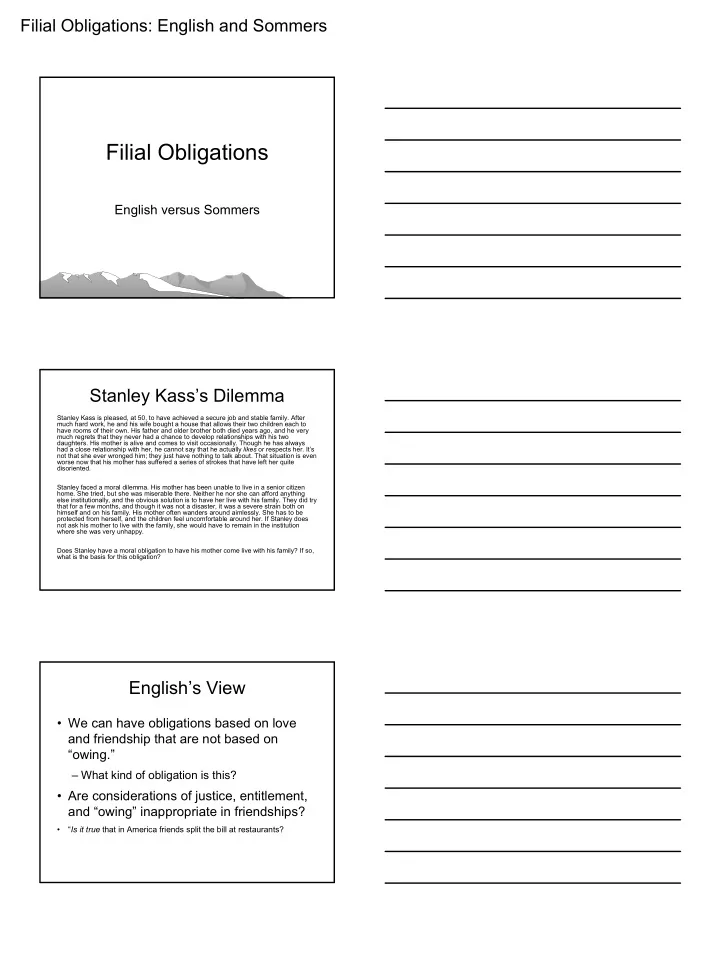
Filial Obligations English versus Sommers Stanley Kasss Dilemma - - PDF document

filial obligations
SMART_READER_LITE
LIVE PREVIEW

Filial Obligations English versus Sommers Stanley Kasss Dilemma - - PDF document

Filial Obligations: English and Sommers Filial Obligations English versus Sommers Stanley Kasss Dilemma Stanley Kass is pleased, at 50, to have achieved a secure job and stable family. After much hard work, he and his wife bought a house


slide-1
SLIDE 1

Filial Obligations: English and Sommers Ethics 1

Filial Obligations

English versus Sommers

Stanley Kass’s Dilemma

Stanley Kass is pleased, at 50, to have achieved a secure job and stable family. After much hard work, he and his wife bought a house that allows their two children each to have rooms of their own. His father and older brother both died years ago, and he very much regrets that they never had a chance to develop relationships with his two

  • daughters. His mother is alive and comes to visit occasionally. Though he has always

had a close relationship with her, he cannot say that he actually likes or respects her. It’s not that she ever wronged him; they just have nothing to talk about. That situation is even worse now that his mother has suffered a series of strokes that have left her quite disoriented. Stanley faced a moral dilemma. His mother has been unable to live in a senior citizen

  • home. She tried, but she was miserable there. Neither he nor she can afford anything

else institutionally, and the obvious solution is to have her live with his family. They did try that for a few months, and though it was not a disaster, it was a severe strain both on himself and on his family. His mother often wanders around aimlessly. She has to be protected from herself, and the children feel uncomfortable around her. If Stanley does not ask his mother to live with the family, she would have to remain in the institution where she was very unhappy. Does Stanley have a moral obligation to have his mother come live with his family? If so, what is the basis for this obligation?

English’s View

  • We can have obligations based on love

and friendship that are not based on “owing.”

– What kind of obligation is this?

  • Are considerations of justice, entitlement,

and “owing” inappropriate in friendships?

  • “Is it true that in America friends split the bill at restaurants?
slide-2
SLIDE 2

Filial Obligations: English and Sommers Ethics 2

Parents and Children

“The relationship between children and their parents should be one of friendship characterized by mutuality rather than one

  • f reciprocal favors.”

Obligations Based on Love

The parental argument, “you ought to do x because we did y for you” should be replaced by

  • “We love you and you will be happier if

you do” or

  • “We believe you love us and anyone

who loved us would do x.”

How “Others” View American Culture

  • One of the most successful Philosophy

Club events ever

  • “Others”—students from other cultures—

highlighted two issues of American culture

– Lack of real, deep friendships – Lack of respect for parents and the elderly

slide-3
SLIDE 3

Filial Obligations: English and Sommers Ethics 3

Sommers: Special Duties

  • Disagrees with English on filial duty
  • Also challenges standard ethical theories:

“Kantianism and utilitarianism…seem better designed for telling us what we should be doing for everyone impartially than for explaining something like filial

  • bligation.”

Sommers’ Examples

  • Elderly man ejected by son-in-law
  • Live-in housekeeper and babysitter

rebuffed by children

  • Proud elders graduating; children absent

Historically Accepted

  • Aristotle: obligation to parents like an
  • bligation to repay a debt
  • Aquinas: “making a return for benefits

received

  • Even utilitarian Sidgwick: “all are agreed

that there are such duties.

slide-4
SLIDE 4

Filial Obligations: English and Sommers Ethics 4

…and then there is Peter Singer

  • Ready to dine with friends; sick father calls
  • Singer:

“to decide impartially I must sum up the preferences for and against going to dinner with my friends, and those for and against visiting my

  • father. Whatever action satisfies

more preferences, adjusted according to the strength of the preference, this is the action I ought to take.”

Ethical Pull

  • For modern utilitarians and Kantians, all persons

count equally. “Equal-pull thesis”

  • Sommers: special relations require differential

pull.

– Determined by particular features of relationship – Also by social conventions which establish expectations – Failure to meet conventional expectations is an affront to dignity.

A Duty of Gratefulness

  • Much more complicated than keeping a

promise, paying a debt

  • “…include such things as being grateful,

loyal, attentive, respectful, and deferential”

  • Melden: the fact that there is love and

affection that unites members of the family…in no way undercuts the fact that there [are also] rights and obligations.”

slide-5
SLIDE 5

Filial Obligations: English and Sommers Ethics 5

The Sentimentalist Objection (p. 726, middle)

  • To carry out some obligations also requires

certain feelings.

  • But we cannot be obligated to have feelings.
  • Sommers: this ignores

– that persons who lack feelings for their parents may be culpable for that very lack

– the extent to which people are responsible for their characters.

David Cash and Sherrice Iverson

  • Cash sees his friend Strohmeyer molest 7-

year-old Sherrice Iverson in Nevada

  • casino. Strohmeyer then killed her.
  • Cash: "I'm not going to get upset over

somebody else's life. I just worry about myself first." All the publicity has made it easier for me to “score with women.”

Responsible for His Character?

  • Strohmeyer gets life in prison. No law

against what Cash did. (Should there be?)

  • Cash becomes nuclear engineering

student at UC-Berkeley. Many protest and want him expelled.

  • Even assuming Cash could not stop

Strohmeyer, is he blameworthy for his emotional response?

  • Are we responsible for our characters?
slide-6
SLIDE 6

Filial Obligations: English and Sommers Ethics 6

Virtue Ethics Approach

  • There are “appropriate emotional

responses to situations”

  • Even aside from action, indifference is not

an appropriate response to the suffering of

  • ne’s parent or child.
  • Contrast with Kantian duty