Basic Beliefs of Confucianism Rulers should be good moral examples. - - PDF document

basic beliefs of confucianism
SMART_READER_LITE
LIVE PREVIEW

Basic Beliefs of Confucianism Rulers should be good moral examples. - - PDF document

5/25/2017 Basic Beliefs of Confucianism Rulers should be good moral examples. Filial Piety-respect for your elders. Education is the way to advance in society. China Review Civil Service Exams-for government jobs. Family is the


slide-1
SLIDE 1

5/25/2017 1

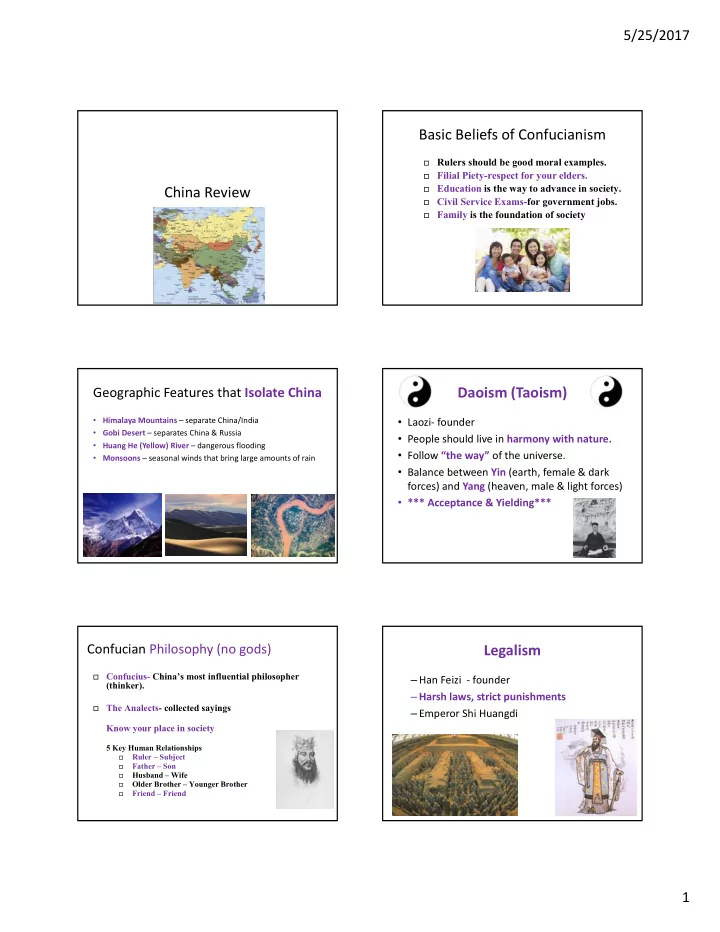
China Review

Geographic Features that Isolate China

  • Himalaya Mountains – separate China/India
  • Gobi Desert – separates China & Russia
  • Huang He (Yellow) River – dangerous flooding
  • Monsoons – seasonal winds that bring large amounts of rain

Confucian Philosophy (no gods)

 Confucius- China’s most influential philosopher

(thinker).

 The Analects- collected sayings

Know your place in society

5 Key Human Relationships

Ruler – Subject

Father – Son

Husband – Wife

Older Brother – Younger Brother

Friend – Friend

Basic Beliefs of Confucianism

 Rulers should be good moral examples.  Filial Piety-respect for your elders.  Education is the way to advance in society.  Civil Service Exams-for government jobs.  Family is the foundation of society

Daoism (Taoism)

  • Laozi‐ founder
  • People should live in harmony with nature.
  • Follow “the way” of the universe.
  • Balance between Yin (earth, female & dark

forces) and Yang (heaven, male & light forces)

  • *** Acceptance & Yielding***

Legalism

–Han Feizi ‐ founder –Harsh laws, strict punishments –Emperor Shi Huangdi

slide-2
SLIDE 2

5/25/2017 2

Early Chinese Civilization

– Started over 4000 years ago in the Huang He River (Yellow River) Valley …deadly flooding – Heart of China = Agriculture (farming) – Terrace farming

Middle Kingdom

– Geographic features like mountains, deserts and jungles isolated Ancient China – No cultural diffusion/act as barriers – Heaven, Hell and China‐ Ethnocentrism (belief that your culture is better than others)

Dynasties of China

  • During China’s history it has experienced rule

by a number of dynasties (ruling families).

  • Shang Dynasty
  • Zhou Dynasty‐ first books, accurate calendar,

silk making, Mandate of Heaven to overthrow the Shang.

Mandate of Heaven

  • Heaven (gods) gave an emperor the right to

rule.

  • When the ruler had heavens approval, things

were good.

  • When the ruler lost the Mandate of Heaven,

things were bad and it was time for a new dynasty (ruling family).

Signs the Ruler had the Mandate of Heaven

  • 1. Peace
  • 2. Prosperity $$$
  • 3. Building roads & canals
  • 4. Land given to the peasants
  • 5. People are protected

Signs the Ruler lost the Mandate of Heaven

  • 1. Natural disasters‐ floods, earthquakes,

storms

  • 2. High taxes
  • 3. Rulers corrupt
  • 4. Wars
  • 5. Famine (starvation) & Disease
slide-3
SLIDE 3

5/25/2017 3

Dynastic Cycle

Qin Dynasty

221 B.C.E. – 206 B.C.E.

Han Dynasty

206 B.C.E. – 220 C.E.

  • Emperor Wudi
  • Civil Service Exams based on Confucian

teachings to get a government job, not family connections.

  • Paper making from wood pulp
  • Acupuncture
  • Silk Road‐ 4,000 mile trade route from China

to Italy.

Tang & Song Dynasties

  • Golden Age
  • Grand Canal‐ increased trade and travel
  • Calligraphy
  • Pagodas

Ming Dynasty

  • Took control of China in 1368 C.E. by
  • verthrowing the Mongols (who had been

ruling for 900 years) and pushing them back behind the Great Wall.

  • porcelain
  • Overseas expansion
  • Zheng He, a Chinese admiral exchanged luxury

goods like silks and exotic animals with Europeans.

Reasons why westerners were interested in China….

 tea, spices, porcelain, silk  trade rights  new markets for goods

slide-4
SLIDE 4

5/25/2017 4

Imperialism in China

  • British merchants traded opium in China in

the late 1700’s. China tried to stop imports of the addictive drug.

  • In 1839, to keep trade open the British and

Chinese fought the Opium War.

  • Great Britain won because of their military

and industrial strength.

Treaty of Nanjing 1842

*China had to pay for Great Britain's war costs

  • Open ports to British trade
  • Give Hong Kong to the British (until 1997)
  • Extraterritoriality‐ British citizens in China live

under British rules and tried in British courts.

Spheres of Influence

Boxer Rebellion

1900

  • The nationalist group “The Boxers” assaulted

foreign communities across China in an effort to kick out foreigners.

  • Japan and western armies quickly defeated

the boxers and forced the Chinese to grant foreigners even more concessions.

Sun Yixian

1911

  • President of the Chinese Republic
  • Three Principles of the People
  • Nationalism, Democracy & Livelihood (jobs)
  • Stepped down because he couldn’t unite

China.

  • Rival warlords fought for power.

Chinese Civil War

  • Jiang Jieshi‐ Nationalist leader of the

Guomindang and supported by the middle class.

  • Mao Zedong‐ Communist party leader and

supported by the peasants.

  • Long March‐ 100,000 Communist’s retreated

6,000 miles and only 20,000 survived. Mao set up a base in Northern China.

slide-5
SLIDE 5

5/25/2017 5

Reasons for Communist Success

  • Support of the peasants.
  • Support of women and rejecting the

inequalities of Confucian philosophy.

  • Hit‐and‐run guerrilla warfare.
  • People thought Nationalists were corrupt.

Jiang Jieshi flees…

  • In 1949, Jiang Jieshi and the Nationalist party
  • f the Guomindang fled to the island of

Taiwan, or the Republic of China (Capitalist Asian Tiger).

People’s Republic of China

1949

  • Mao Zedong‐ Communist, one party dictatorship
  • Agricultural society into a modern industrial

nation.

  • Literacy increased
  • Health care
  • Social classes eliminated
  • Women were equal
  • Basic rights of all denied

The Great Leap Forward

1958

  • Goal: Increase agricultural and industrial
  • utput
  • People were put on communes, groups of

people who lived and worked together.

  • Production quotas
  • Poorly made goods
  • Farming output decreased
  • Outcome: Widespread famine and death

The Cultural Revolution

1966

  • Goal: Renew people’s loyalty to communism

and establish a more equitable society.

  • Mao shut down schools and urged students to

experience the revolution for themselves.

  • Students formed Red Guards and attacked

teachers, government officials and factory managers.

  • Outcome: economy slows, people fear

arrest, no one is educated.

Deng Xiaoping

1976

  • Four Modernizations
  • Farming‐ methods modernized
  • Industry‐upgraded
  • Science and technology‐promoted &

developed

  • Defense‐systems and military forces improved
slide-6
SLIDE 6

5/25/2017 6

Deng Xiaoping

  • Ended communes.
  • Allowed a small amount of capitalism.
  • Farmers could grow extra food and sell it for

a profit.

  • Allowed some private business to produce

goods and services.

  • Allowed foreigners to own and operate

businesses in a special zone.

Deng Xiaoping

  • Results of Reforms:
  • Economy grew
  • Better standard of living for some
  • Foreign relations and trade improved.
  • Crime and corruption grew
  • Gap between rich and poor increased
  • Desire for political freedom…..

Tiananmen Square

May 1989

  • Demonstrators in Beijing occupied Tiananmen

Square and demanded more political rights and freedoms.

  • When they refused to leave, the government

sent in troops and tanks.

  • Thousands were killed or wounded.

Maintaining control and order were more important to the Chinese government than political freedom for their people.

Overpopulation

 Over one billion people  One Child Policy  Chinese government provides birth control  Financial Incentives to couples who limit their

family to one child.

Return of Hong Kong

  • 1842‐ Great Britain gained the island of Hong
  • Kong. It modernized and became very

wealthy.

  • July 1, 1997 Hong Kong was turned over to

the Chinese government.

  • China agreed not to change Hong Kong’s social

and economic system for 50 years and allowed the island some self‐rule.

Korea

 Cultural bridge between Japan and China (selective

borrowing)

 Korean War 1950-1953  North - Communist - Aligned with the Soviet

Union

 South - Democratic – Aligned with the United

States

 Containment –stop the spread of communism  Stalemate (Demilitarized Zone-DMZ)

slide-7
SLIDE 7

5/25/2017 7

North Korea

 Totalitarian Dictatorship  Kim Jong IL- died in 2012 and his

son Kim Jung Un took over.

 Nuclear Weapons  Axis of Evil  People are starving

South Korea

 Asian Tiger

 Economic power  Kia cars, small electronics

 Wealthy Capitalistic Country  Aligned with the US

Which belief system was the basis for the civil service exams given during the Han, Tang, and Song dynasties? (1) legalism (3) Buddhism (2) Daoism (4) Confucianism

  • Opium War (1839–1842
  • Taiping Rebellion (1850–1864)
  • Boxer Rebellion (1898–1901)

This series of events is most closely associated with the (1) spread of communism to China and Korea (2) growing concerns about the influence of the West in China (3) alliance formed between Vietnam and China (4) increasing expansion of civil and political rights in China

The Long March is significant in Chinese history because it (1) ended Japanese occupation of China (2) reinforced the concept of the Mandate of Heaven (3) caused the Boxer Rebellion (4) established Mao Zedong as a revolutionary leader

slide-8
SLIDE 8

5/25/2017 8

slide-9
SLIDE 9

5/25/2017 9

slide-10
SLIDE 10

5/25/2017 10

slide-11
SLIDE 11

5/25/2017 11