Fidelity Bonds: Advocating Direct Loss from Employee Theft, - - PowerPoint PPT Presentation

fidelity bonds advocating direct
SMART_READER_LITE
LIVE PREVIEW

Fidelity Bonds: Advocating Direct Loss from Employee Theft, - - PowerPoint PPT Presentation

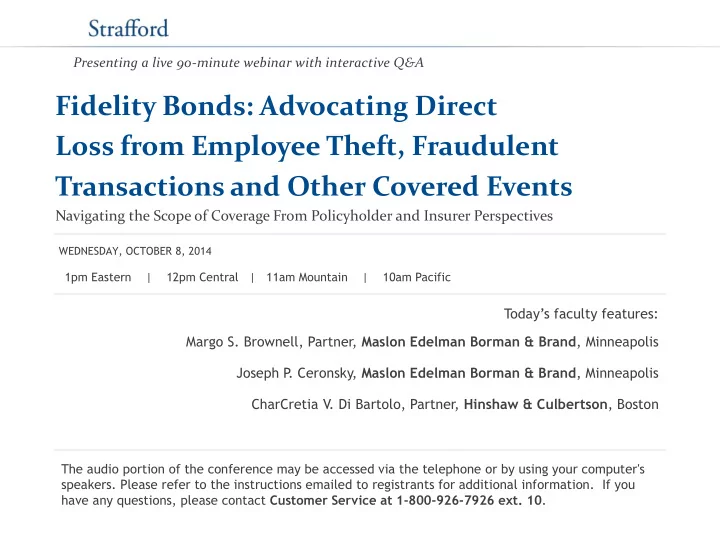
Presenting a live 90-minute webinar with interactive Q&A Fidelity Bonds: Advocating Direct Loss from Employee Theft, Fraudulent Transactions and Other Covered Events Navigating the Scope of Coverage From Policyholder and Insurer Perspectives


slide-1
SLIDE 1

Fidelity Bonds: Advocating Direct Loss from Employee Theft, Fraudulent Transactions and Other Covered Events

Navigating the Scope of Coverage From Policyholder and Insurer Perspectives

Today’s faculty features:

1pm Eastern | 12pm Central | 11am Mountain | 10am Pacific

The audio portion of the conference may be accessed via the telephone or by using your computer's

  • speakers. Please refer to the instructions emailed to registrants for additional information. If you

have any questions, please contact Customer Service at 1-800-926-7926 ext. 10.

WEDNESDAY, OCTOBER 8, 2014

Presenting a live 90-minute webinar with interactive Q&A Margo S. Brownell, Partner, Maslon Edelman Borman & Brand, Minneapolis Joseph P . Ceronsky, Maslon Edelman Borman & Brand, Minneapolis CharCretia V. Di Bartolo, Partner, Hinshaw & Culbertson, Boston

slide-2
SLIDE 2

Sound Quality If you are listening via your computer speakers, please note that the quality

  • f your sound will vary depending on the speed and quality of your internet

connection. If the sound quality is not satisfactory, you may listen via the phone: dial 1-866-927-5568 and enter your PIN when prompted. Otherwise, please send us a chat or e-mail sound@straffordpub.com immediately so we can address the problem. If you dialed in and have any difficulties during the call, press *0 for assistance. Viewing Quality To maximize your screen, press the F11 key on your keyboard. To exit full screen, press the F11 key again.

FOR LIVE EVENT ONLY

slide-3
SLIDE 3

For CLE purposes, please let us know how many people are listening at your location by completing each of the following steps:

  • In the chat box, type (1) your company name and (2) the number of

attendees at your location

  • Click the SEND button beside the box

If you have purchased Strafford CLE processing services, you must confirm your participation by completing and submitting an Official Record of Attendance (CLE Form). You may obtain your CLE form by going to the program page and selecting the appropriate form in the PROGRAM MATERIALS box at the top right corner. If you'd like to purchase CLE credit processing, it is available for a fee. For additional information about CLE credit processing, go to our website or call us at 1-800-926-7926 ext. 35.

FOR LIVE EVENT ONLY

slide-4
SLIDE 4

If you have not printed the conference materials for this program, please complete the following steps:

  • Click on the ^ symbol next to “Conference Materials” in the middle of the left-

hand column on your screen.

  • Click on the tab labeled “Handouts” that appears, and there you will see a

PDF of the slides for today's program.

  • Double click on the PDF and a separate page will open.
  • Print the slides by clicking on the printer icon.

FOR LIVE EVENT ONLY

slide-5
SLIDE 5

Direct Loss in Fidelity Bonds Scope of Coverage

Margo Brownell Joseph Ceronsky MASLON EDELMAN BORMAN & BRAND, LLP. Presented by CharCretia DiBartolo HINSHAW & CULBERTSON, LLP October 8, 2014

slide-6
SLIDE 6

Fidelity Coverage - Background

  • Various forms of fidelity coverage
  • (e.g. Financial Institution Bond, Commercial Crime

Policy, Financial Institution Crime Policy)

  • Stand alone policy or “add-on” coverage
  • Provide coverage for employee dishonesty or

theft, forgery, counterfeit money, burglary, robbery, theft, larceny, some electronic (telefacsimile fraud, funds transfer fraud, computer fraud)

  • Standard Form 24

6

slide-7
SLIDE 7

Fidelity Coverage - Background

  • First Party Coverage--Not a Liability Policy
  • “Although employee dishonesty policies may cover the

loss of third-party property in the possession of the insured, these polices do not serve as liability insurance to protect employers against tortious acts committed against third-parties by their employees.” Lynch Props., Inc. v. Potomac Ins. Co of Ill., 140 F.3d 622, 629 (5th Cir. 1998) (citation omitted).

  • Some courts have held that Bonds provide coverage for

the liability of the Insured for the loss of third party funds in certain circumstances, but the majority of courts hold that third party losses are not covered by a fidelity bond or policy.

7

slide-8
SLIDE 8
  • Historically, the FIB is a risk sharing

agreement between banks and insurers.

  • E.g., banks are in business of making loans so no

coverage for loss resulting from bad loans.

  • Banks less able to protect against loss resulting

from employee crime (i.e. embezzlement) so the bond provides coverage for this risk.

8

slide-9
SLIDE 9

Rules of Construction: Does Contra Proferentem Apply?

  • “Standard fidelity bonds are drafted by sophisticated parties

(representatives of the banking and insurance industries); therefore, the traditional rule of construing any ambiguity in favor of coverage does not apply.”

First State Bank v. Ohio Cas. Ins. Co., 555 F.3d 564, 568 (7th Cir. 2009) see also: Tri City Nat'l Bank v. Fed. Ins. Co., 674 N.W.2d 617, 621-622 (Wis. Ct.

  • App. 2003)

FDIC v. Insurance Co. of N. Am., 105 F.3d 778, 786-787 (1st Cir. 1997); Sharp v. Federal Savings and Loan Insurance Corp., 858 F.2d 1042, 1046 (5th Cir. 1988)

9

slide-10
SLIDE 10
  • “This, however, does not change the fact that, as between Aetna and

Home [Savings and Loan], Home had little say in the drafting of this particular bond…. While specific evidence regarding Home's and Aetna's intentions here might persuade us to do otherwise, the absence of such evidence leaves us with the basic rule of construing the bond, where unclear, in Home's favor.”

Home Sav. & Loan v. Aetna Casualty & Sur. Co., 817 P.2d 341, 347 n.5 (Utah Ct. App.1991) (distinguishing Sharp) see also:

  • Am. Cas. Co. v. Etowah Bank, 288 F.3d 1282, 1285 (11th Cir. 2002) (applying Georgia law)

FDIC v. Oldenburg, 34 F.3d 1529, 1545 (10th Cir. 1994) (applying Utah Law) Fountainebleau Community Bank v. Fidelity & Deposit Co., 1994 U.S. Dist. LEXIS 3880 (E.D. La. Mar. 30, 1994) (applying Louisiana Law) Transamerica Ins. Co. v. FDIC, 465 N.W.2d 713, 715-16 (Minn. Ct. App. 1991), aff’d in part and rev’d in part on other grounds, 489 N.W.2d 224 (Minn. 1992).

10

slide-11
SLIDE 11

Insuring Agreement (A) Dishonesty

  • Loss resulting directly from dishonest or

fraudulent acts committed by an Employee acting alone or in collusion with others.

  • Such dishonest or fraudulent acts must be

committed by the Employee with the manifest intent:

(a) To cause the Insured to sustain such loss, and (b) To obtain improper financial benefit for the Employee

  • r another person or entity.

11

slide-12
SLIDE 12

Who Is An “Employee”?

Common Elements: (1) Right to direct and control in the performance of duty. (2) Direct compensation by wages, salaries or commissions.

12

slide-13
SLIDE 13

Who Is An “Employee”?

"Employee" does not mean: (1) Any agent, broker, factor, commission, merchant, consignee, independent contractor or representative of the same general character.

13

slide-14
SLIDE 14

Who Is An “Employee”?

Endorsements may expand or alter who is considered to be an employee: (1) Independent Contractor Endorsement (2) Designated Agent As Employee Endorsement (3) Agent Extension Endorsement

14

slide-15
SLIDE 15

Who Is An “Employee”?

Brokers as "employees“

U.S. Fire Ins. Co. v. Nine Thirty FEF Investments, LLC and Nine Thirty VC Investments LLC, Index No. 603284/09 (N.Y. Sup. Ct. October 1, 2013)

  • Outside Investment Advisor Rider provided coverage

for loss resulting directly from dishonest acts of any Outside Investment Advisor named in the schedule

  • Exclusion (x) – excluded coverage for loss resulting

directly from dishonest acts of a broker

15

slide-16
SLIDE 16

New Hampshire Ins. Co. v. MF Global, Inc., 970 N.Y.S.2d 16, 108 A.D. 3d 463 (N.Y.App. Div. July 16, 2013)

  • MF Global was a commodities futures broker and

Clearing Member of CME

  • A commodities broker in MF Global's Tennessee
  • ffice made unauthorized trades and sustained a

$141 million loss on commodities futures

  • CME Clearing House demanded an intraday

settlement to cover the loss

  • MF Global paid CME and sought coverage under

fidelity policy

16

slide-17
SLIDE 17

New Hampshire Ins. Co. v. MF Global, Inc., 970 N.Y.S.2d 16, 108 A.D. 3d 463 (N.Y.App. Div. July 16, 2013)

  • Remanded for a determination of whether the rogue

trader was an "employee."

17

slide-18
SLIDE 18

New Hampshire Ins. Co. v. MF Global, Inc., 970 N.Y.S.2d 16, 108 A.D. 3d 463 (N.Y.App.Div. July 16, 2013)

  • "Employee" defined as "(i) a person under an implied

contract of employment or services with the insured; (ii) a person working under the direct control and supervision of the insured; or (iii) a person who is paid by the insured under their payroll system."

  • "[E]mployee does not mean any independent broker . . .

remunerated on a sales or commission basis unless specifically agreed by the insurer and endorsed on the bond."

18

slide-19
SLIDE 19

New Hampshire Ins. Co. v. MF Global, Inc., 970 N.Y.S.2d 16, 108 A.D. 3d 463 (N.Y.App. Div. July 16, 2013)

  • Factual questions as to whether trader was an

"employee"

  • Paid on a commission basis
  • 1099 not W-2
  • no evidence of who supervised or in what

capacity – who directed or controlled?

19

slide-20
SLIDE 20

Direct v. Indirect

  • Loss resulting directly from dishonest or fraudulent acts committed

by an Employee acting alone or in collusion with others.

  • Exclusion (v) – “The Bond does not cover … indirect or

consequential loss of any nature”

  • “[T]he indirect loss exclusion’ in the Policies ‘reinforces the conclusion that

the policy meant to insure [insured] only against immediate harm from employee dishonesty but not for any obligations [insured] might have to

  • thers as a result of that dishonesty.”

Fireman’s Fund Ins. Co. v. Special Olympics Int'l, Inc., 249 F. Supp. 2d 19, 28 (D. Mass. 2003) (quotation

  • mitted)

20

slide-21
SLIDE 21

Direct v. Indirect – Two Tests, Split of Jurisdictions

  • Proximate Cause Test
  • Described as requiring than an employee's conduct

was "a substantial contributing factor to the harm suffered." RBC Mortgage Co. v. National Union Fire

  • Ins. Co. of Pittsburgh, PA, 812 N.E.2d 728, 736, (Ill.
  • App. Ct. 2004).
  • See also Scirex Corp. v. Federal Ins. Co., 313 F.3d

841, 848-50 (3d Cir. 2002) (adopting proximate cause test; applying Pennsylvania law); Auto Lenders Acceptance Corp. v. Gentilini Ford, Inc.,854 A.2d 378 (N.J. 2004) (same).

21

slide-22
SLIDE 22

Direct v. Indirect

  • “Direct Means Direct”
  • Narrower Approach
  • “[F]ocus on whether the employer suffered actual

depletion of funds as a direct (immediate) result

  • f the employee's conduct.” Direct Mortg. Corp. v.

Nat'l Union Fire Ins. Co. of Pittsburgh, PA, 625 F.

  • Supp. 2d 1171, 1175 (D. Utah 2008)
  • See also Vons Cos., Inc. v. Federal Ins. Co., 212

F.3d 489 (9th Cir. 2000); Lynch Properties Inc. v. Potomac Ins. Co., 140 F. 3d 622 (5th Cir. 1998).

22

slide-23
SLIDE 23

Direct v. Indirect – The Ownership Provision

SECTION 10. OWNERSHIP This Bond shall apply to loss of Property (a) owned by the Insured, (b) held by the insured in any capacity, or (c) for which the Insured is legally liable.

  • “elaborates on the losses covered under the bond…. There is

no strict ownership requirement under the bond … losses are covered … even when the property is only held in some capacity for another or is property for which the insured is legally liable.”

Marion v. Hartford Fire Ins. Co., 525 Fed. Appx. 129, 133 (3d Cir. 2013) (embezzlement of money obtained through fraudulent CDs)

23

slide-24
SLIDE 24

Direct v. Indirect – The Ownership Provision

  • (a) owned by the Insured = straightforward
  • (b) held by the insured in any capacity
  • “Title is a non-sequitur” - Third-party liability resulting from loss of

money held in insured’s account as collateral was a direct loss.

RBC Dain Rauscher, Inc. v. Federal Ins. Co., 370 F. Supp. 2d 886 (D. Minn. 2005)

  • Many “direct means direct” cases clarify bond would cover

liability resulting from loss of property held by insured. –

See, e.g., Universal Mortg. Corp. v. Württembergische Versicherung AG, 651 F.3d 759, 762 n.1 (7th Cir. 2011)

  • (c) for which the Insured is legally liable
  • must be preexisting legally duty, not resulting third party liability

24

slide-25
SLIDE 25

New Hampshire Ins. Co. v. MF Global, Inc., 970 N.Y.2d 16, 108 A.D. 3d 463 (N.Y.App. Div. 2013)

  • Broker's conduct in making unauthorized trades was "the

direct and proximate cause of MF Global's loss”

  • “In light of the immediacy of the payment, … and the

regulatory scheme upon which it was premised, MF Global's loss cannot be fairly viewed as simply satisfying a contractual liability to the CME…. [T]he payment … is not a third-party loss for which MF Global is liable, but rather a direct loss to MF Global under the bonds.”

25

slide-26
SLIDE 26

New Hampshire Ins. Co. v. MF Global, Inc., 970 N.Y.2d 16, 108 A.D. 3d 463 (N.Y.App. Div. 2013)

  • Distinguishes Aetna Cas. & Sur. Co. v. Kidder, Peabody & Co.,

246 A.D.2d 202, 676 N.Y.S.2d 559 (1998).

  • Immediate payment vs. litigation settlement with third parties

for stock irregularities caused by insider trading

  • Time between employee conduct and payment critical

distinction for MF Global court

  • (No Trading Loss Exclusion)

26

slide-27
SLIDE 27

Manifest Intent

  • No coverage for negligent or reckless conduct
  • Standards applied in different jurisdictions:

– Specific v. general intent – Purpose to cause insured to sustain a loss – Employee knew that loss was "substantially

certain" to follow from ee's actions

– RTC v. Fid. & Deposit Co. of Md., 205 F.3d 615,

636-646 (3rd Cir. (N.J.) 2000).

27

slide-28
SLIDE 28

Manifest Intent

  • First Defiance Fin. Corp. v. Progressive Cas. Ins.

Co., 688 F.3d 265, 271-72 (6th Cir. (Ohio) 2012)

  • "An insured meets the requirement [of proving

manifest intent] where 'a particular result is substantially certain to follow from the conduct.'"

  • Embezzlement is a "zero-sum game" – the employer

must lose for the employee to win.

28

slide-29
SLIDE 29

Financial Benefit

Dishonest and fraudulent acts must be committed with the manifest intent: . . . (b) To obtain financial benefit for the Employee or another person or entity. "Financial Benefit" does not include employee benefits earned in the normal course of employment including salaries, commissions, fees, bonuses, promotions, awards, profit sharing or pensions.

29

slide-30
SLIDE 30

Financial Benefit

  • K2 Settlement, LLC v. Certain Underwriters at

Lloyds, No. 11-0191, 2012 U.S. Dist. LEXIS 170832 (W.D.Pa. Nov. 30, 2012)

  • Mortgage brokers bond
  • Insured performed title insurance services and acquired

PASS to perform those services

  • In liquidating PASS pursuant to the asset purchase

agreement, covered shortages in PASS escrow accounts by taking funds from insured's escrow account

  • No coverage – not intended to obtain financial benefit ut to

avoid escrow shortfall

30

slide-31
SLIDE 31

Time-Based Defenses - Discovery

  • FIB is a “discovery” policy
  • “Discovery of the loss” starts the clock for the

Notice and Proof of Loss time periods

  • Discovery and notice within a short time—within

the policy period

31

slide-32
SLIDE 32

Time-Based Defenses - Notice

  • “At the earliest practicable moment, not to

exceed sixty (60) days, after discovery of loss, the Insured shall give the Company notice of the loss.

  • “Mere suspicion of loss” does not trigger notice
  • bligation
  • Substantial Compliance is Sufficient
  • Notice-Prejudice Rule

32

slide-33
SLIDE 33

Time-Based Defenses – Proof of Loss

  • Example: “Within 6 months after such discovery,

the Insured shall furnish to the Company proof of loss, duly sworn to, with full particulars.”

  • Prejudice to insurer may be required in prejudice

states, e.g. Minnesota

33

slide-34
SLIDE 34

Time-Based Defenses – Suit Limitations

  • Example: Not before 60 days after proof of loss filed and

not after 2 years of discovery

  • Exception:

– “[E]xcept that any action … to recover under this Bond on

account of any judgment against the Insured in any suit mentioned in General Agreement (F) … shall be brought within 24 months from the date upon which the judgment and such suit shall become final.”

– General Agreement (F) applies to “any suit or legal

proceedings brought against the Insured to enforce the Insured’s liability … on account of any loss, claim or damage which … would constitute a collectible loss under this Bond….”

  • Prejudice to insurer may not be required even in

prejudice states, e.g. Minnesota

34

slide-35
SLIDE 35

Time-Based Defenses - Interplay Between Proof of Loss and Suit Limitations

  • Suit Limitations: not before 60 days after proof of loss filed

and not after 2 years of discovery

  • Citizens State Bank v. Capitol Indem. Corp., No. C1-95-321,

1995 Minn. App. LEXIS 929, at *4 (Minn. Ct. App. July 18, 1995) (unpublished)

  • Bank had insufficient information to file proof of loss until

customer’s bankruptcy proceeding completed, and 60 days later ran up against two-year suit limitations.

  • Court found suit limitation unreasonable in these

circumstances

35

slide-36
SLIDE 36

Computer Fraud

  • Various forms of coverage for electronic crime

including

– funds transfer fraud, – computer crime, – computer fraud.

  • Most require direct loss from use of computer or

access to computer systems.

  • Use of computer must be more than incidental to

loss in order for coverage to apply.

36

slide-37
SLIDE 37

Computer Fraud

  • Computer Crime Insuring Agreement

(Coverage F) provides coverage for “direct loss of, or your direct loss from damage to, Money, Securities and Other Property directly caused by Computer Fraud.”

37

slide-38
SLIDE 38

Computer Fraud

  • The Policy defines Computer Fraud as:

The use of any computer to fraudulently cause a transfer of Money, Securities or Other Property from inside the Premises or Banking Premises:

1.

to a person (other than a Messenger) outside the Premises or Banking Premises;

2.

To a place outside the Premises or Banking Premises.

38

slide-39
SLIDE 39

Universal American Corp. v. National Union Fire Insurance Company of Pittsburgh, PA, 959 N.Y.S.2d 849, 2013 N.Y Slip. Op. 23003, 2013 WL 69241 (N.Y. Sup.

  • Ct. 2013)

– Provisions of “computer systems fraud” insurance

policy, which was issued to health insurance company that offered Medicare managed-care plans, Medicare prescription drug benefits and other insurance products

– Covered “fraudulent entry” of data or computer

programs into the company’s computer system which resulted in loss

– No coverage for fraudulent claims which were entered

into system by authorized health care providers; coverage was directed at misuse or manipulation of computer system itself, rather than at situations where fraud arose from content of claim and system was

  • therwise properly utilized.

39

slide-40
SLIDE 40
  • Pestmaster Servs., Inc. v. Travelers Cas. & Sur.
  • Co. of Am., CV 13-5039-JFW MRWX, 2014 WL

3844627 (C.D. Cal. July 17, 2014)

– No Funds Transfer or Computer Fraud:

  • Claimed losses did not “flow immediately” and “directly”

from Priority 1’s use of a computer.

  • Pestmaster expressly authorized ACH transfers from its

account to Priority 1’s account so that Priority 1 could pay Pestmaster’s payroll and payroll tax obligations pursuant to their agreement. Thus, there was no loss when funds were initially transferred to Priority 1 because the transfers were authorized by Pestmaster.

40

slide-41
SLIDE 41

Pestmaster Servs., Inc. v. Travelers Cas. & Sur.

  • Co. of Am., CV 13-5039-JFW MRWX, 2014 WL

3844627 (C.D. Cal. July 17, 2014)

  • Losses suffered by Pestmaster did not occur until after

the transfer when Priority 1 decided to use those funds to pay its own obligations rather than Pestmaster’s federal payroll taxes in breach of their agreement.

  • No direct loss

41

slide-42
SLIDE 42

Retail Ventures, Inc. v. National Union Fire Ins.

  • Co. of Pittsburgh, PA, 691 F.3d 821 (6th Cir. 2012)
  • Proximate cause standard applied to determining

whether losses resulted directly from use of a computer

42

slide-43
SLIDE 43

END

Questions Welcome

CharCretia DiBartolo cdibartolo@hinshawlaw.com Margo Brownell margo.brownell@maslon.com Joseph Ceronsky joseph.ceronsky@maslon.com

43