FICHE DE PRESENTATION DES ENSEIGNEMENTS DEPARTEMENT : ANTHROPOLOGIE - - PDF document

fiche de presentation des enseignements
SMART_READER_LITE
LIVE PREVIEW

FICHE DE PRESENTATION DES ENSEIGNEMENTS DEPARTEMENT : ANTHROPOLOGIE - - PDF document

FICHE DE PRESENTATION DES ENSEIGNEMENTS DEPARTEMENT : ANTHROPOLOGIE NIVEAU : 5 SEMESTRE : 1 NOM DE LENSEIGNANT : EDONGO NTEDE Pierre Franois & KAH Evans GRADE : Matre de Confrences & Assistant UNITE DENSEIGNEMENT : U.E ANT 541


slide-1
SLIDE 1

FICHE DE PRESENTATION DES ENSEIGNEMENTS

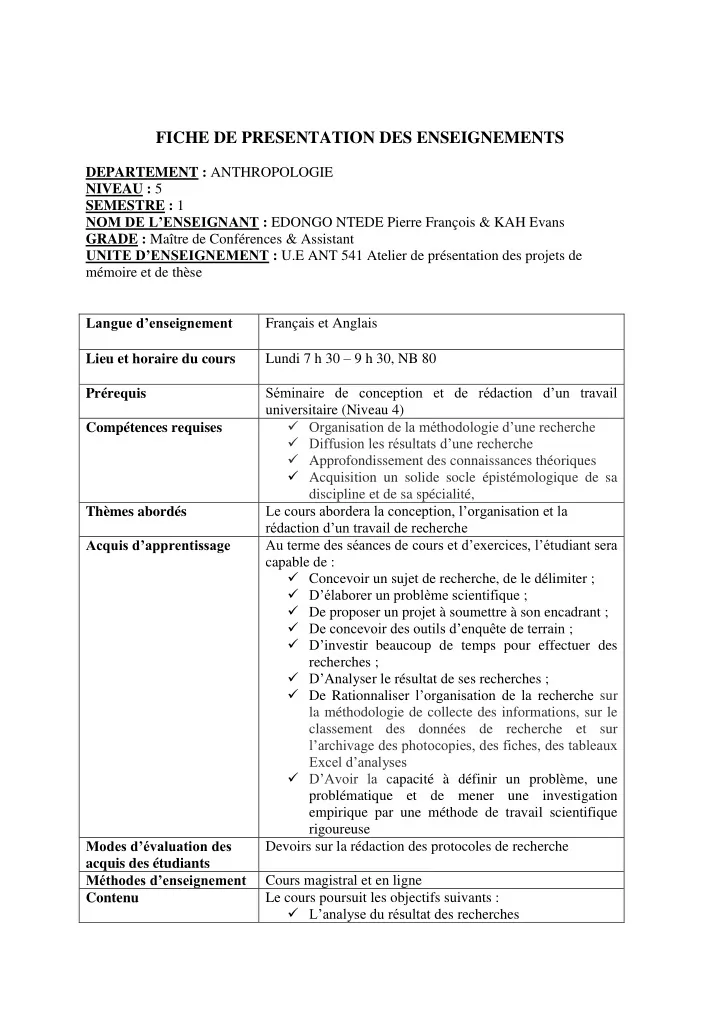
DEPARTEMENT : ANTHROPOLOGIE NIVEAU : 5 SEMESTRE : 1 NOM DE L’ENSEIGNANT : EDONGO NTEDE Pierre François & KAH Evans GRADE : Maître de Conférences & Assistant UNITE D’ENSEIGNEMENT : U.E ANT 541 Atelier de présentation des projets de mémoire et de thèse Langue d’enseignement Français et Anglais Lieu et horaire du cours Lundi 7 h 30 – 9 h 30, NB 80 Prérequis Séminaire de conception et de rédaction d‘un travail universitaire (Niveau 4) Compétences requises  Organisation de la méthodologie d‘une recherche  Diffusion les résultats d‘une recherche  Approfondissement des connaissances théoriques  Acquisition un solide socle épistémologique de sa discipline et de sa spécialité, Thèmes abordés Le cours abordera la conception, l‘organisation et la rédaction d‘un travail de recherche Acquis d’apprentissage Au terme des séances de cours et d‘exercices, l‘étudiant sera capable de :  Concevoir un sujet de recherche, de le délimiter ;  D‘élaborer un problème scientifique ;  De proposer un projet à soumettre à son encadrant ;  De concevoir des outils d‘enquête de terrain ;  D‘investir beaucoup de temps pour effectuer des recherches ;  D‘Analyser le résultat de ses recherches ;  De Rationnaliser l‘organisation de la recherche sur la méthodologie de collecte des informations, sur le classement des données de recherche et sur l‘archivage des photocopies, des fiches, des tableaux Excel d‘analyses  D‘Avoir la capacité à définir un problème, une problématique et de mener une investigation empirique par une méthode de travail scientifique rigoureuse Modes d’évaluation des acquis des étudiants Devoirs sur la rédaction des protocoles de recherche Méthodes d’enseignement Cours magistral et en ligne Contenu Le cours poursuit les objectifs suivants :  L‘analyse du résultat des recherches

slide-2
SLIDE 2

 L‘organisation de la recherche sur la méthodologie de collecte des informations, sur le classement des données de recherche et sur l‘archivage des photocopies, des fiches, des tableaux Excel d‘analyses  L‘acquisition de la capacité à définir un problème, une problématique et de mener une investigation empirique par une méthode de travail scientifique rigoureuse Bibliographie

  • Beaud, M., 1991, L‘Art de la thèse, Paris : éd. La

Découverte

  • Bernard H. R., Research Methods in anthropology.

Qualitative and quantitative approches. London. Sage Publications, 1994.

  • Drapeau M. Les critères de scientificité en recherche
  • qualitative. Pratiques psychologiques 2004 ; 10:79-

86.

  • Fereol, G., et Deubel, Ph. 1993, Méthodologie des

sciences sociales : Armand Collin

  • Grawitz, M., 1993 Méthode des sciences sociales :

Dalloz, 8ème éd.

  • Jones R, Britten N, Culpepper L et al. Oxford

textbook of primary care. Volume 1 : Principles and

  • concepts. Oxford University Press, 2005.
  • Mbonji Edjenguèlè & Edongo Ntede, Propédeutique

à l‘anthropologie sociale et culturelle, Paris, L‘Harmattan, 2017.

  • Mbonji Edjenguèlè, 2005, L‘Ethno-perspective ou la

méthode du discours de l‘ethno-anthropologie culturelle, Yaoundé : PUY

  • Muchielli, A., 1991, Les Méthodes qualitatives,

Paris : PUF

  • Quivy, R., Camperhoudt, L., 1995, Manuel de

recherche en sciences sociales, Paris : Dunod

  • Van Royen P. Cours d‘introduction à la recherche
  • qualitative. Institut médecine tropicale de Bruxelles,

décembre 2007. Plan du cours (réparti sur 8 semaines au moins) 1ière semaine : Généralité sur la thèse de Doctorat ;
 2ième semaine : Formulation d‘un sujet de thèse
 3ième semaine : Le calendrier et le timing de rédaction 4ième semaine : Le plan détaillé 5ième semaine : La recherche documentaire et de terrain
 6ième semaine : La structure et le contenu d‘une thèse 7ième semaine : Les consignes de rédaction (conseil Scientifique de la FALSH) 8ième semaine : Communication et soutenance de la

slide-3
SLIDE 3

thèse Disclaimer: Some information in this course work are obtained from online documents as well as that of colleagues and are not solely my personal data. COURSE FINDING A RESEARCH AREA OF INTEREST We expect that students after some years of studies can define at least an area of interest for the thesis project, if not already a more specified subject. The exact subject is determined in consultation with a teacher/supervisor. Generally, you will be more motivated to perform the project if you define the subject yourself. Try first to define broadly your research interests, before consulting course coordinators and teachers. Typical thesis subjects at the department are related to the actual ongoing research, so check the homepages on the department

  • research. Other possibilities for subjects can be found at other departments and outside of the
  • university. Many municipalities and companies have a link on their homepage with

suggestions to thesis projects, or you can contact them and discuss possibilities. External projects are beneficial in many ways, but remember that the research question must have academic relevance. Just doing a practical work task for an external

  • rganization is not sufficient at the Master‘s level. Therefore, discuss carefully the actual

research question with potential supervisors at the department. It is recommended to start this process in good time before the start of the course, to avoid losing too much time of the project. At least use the semester before the master thesis work for finding a subject. You are welcome to contact the course coordinator to discuss options and ideas before contacting other teachers to discuss the options with them. Moreover during any subject course you can discuss possibilities with the teachers. At this stage, make clear that you want to discuss ideas without requestin g that the teacher will act as supervisor. The definitive allocation of supervisors is done by the course coordinator at the moment that you start your thesis work.

slide-4
SLIDE 4

Working together with another student As the thesis project is the final project of your master studies, you should perform the project independently, producing a report solely by yourself. It is required that even if you work together on a common project, you need to define two sub-projects for each of the students, resulting in two reports. An alternative (however so far never tried) is that you each write one paper (shorter report), and put the two papers together into a compilation thesis with a common summary and synthesis section. Your supervisor, what to expect In many cases you will have a supervisor allocated already before the start of the course. In general it is the teacher with whom you came to agreement with on a more detailed idea/project plan for your thesis work. The supervisor will help you to get started and keeping you on track. However, you do the work and write the report. It is recommended to agree already at the start of the project on a number of meetings, where you discuss the progress of your work and possibly needed adaptations and The supervisor should indicate ‗green light‘ before you can submit the thesis for examination and present your work in the master defense seminar. However, if the supervisor considers the work insufficient, yet has already put a lot of effort to raise your work to the required level, then you can be allowed to present your work for the exam committee. In those cases the supervisor indicates that he/she does not approve the work, but leaves the grading decision to the exam committee. Project plan Your first task will be the formulation of a project plan. This plan of max two A4 pages of text (+ references and possible figures/tables) should give a summary of your project. The plan must contain a working title and names of those who are involved inthe project. Further you should formulate a main question and a number of hypothese sor or sub-questions, as

  • needed. Focus on the research questions, available data and methodology in the summary.

Take care that you describe the available data in detail, and how to use the data in relation to the research question.

slide-5
SLIDE 5

Selecting research a topic. This may be a general area of study or an issue of professional or personal interest. Topics are broad, such as the effects of divorce, reasons for delinquency, impact of homelessness, or how elites use the media. Focus your research very specifically Don't try to have your research cover too broad an area. Now you may think that this will distort what you want to do. This may be the case, but you will be able to do the project if it is narrowly defined. Usually a broadly defined project is not do-able. By defining too broadly it may sound better to you, but there is a great chance that it will be unmanageable as a research

  • project. When you complete your research project it is important that you have something

specific and definitive to say. This can be accommodated and enhanced by narrowly defining your project. Otherwise you may have only broadly based things to say about large areas that really provide little guidance to others that may follow you. Often the researcher finds that what he/she originally thought to be a good research project turns out to really be a group of research projects. Do one project for your dissertation and save the other projects for later in your career. Don't try to solve all of the problems in this one research project. How to write a title on your proposal I'm amazed at how often the title is left for the end of the student's writing and then somehow forgotten when the proposal is prepared for the committee. A good proposal has a good title and it is the first thing to help the reader begin to understand the nature of your work. Use it wisely! Work on your title early in the process and revisit it often. It's easy for a reader to identify those proposals where the title has been focused upon by the student. Preparing a good title means: ...having the most important words appear toward the beginning of your title,

slide-6
SLIDE 6

...limiting the use of ambiguous or confusing words, ...breaking your title up into a title and subtitle when you have too many words, And ...including key words that will help researchers in the future find your work. How to formulate Research Questions It's important that your research proposal be organized around a set of questions that will guide your research. When selecting these guiding questions try to write them so that they frame your research and put it into perspective with other research. These questions must serve to establish the link between your research and other research that has preceded you. Your research questions should clearly show the relationship of your research to your field of

  • study. Don't be carried away at this point and make your questions too narrow. You must start

with broad relational questions. A good question Do adult learners in a rural adult education setting have characteristics that are similar to adult learners in general? A poor question: What are the characteristics of rural adult learners in an adult education program? (toonarrow) A poor question: How can the XYZ Agency better serve rural adult learners? (Not generalizable) Originality of a research topic Now here are a few more ideas regarding the defining of your research project through your proposal. Make sure that you will be benefitting those who are participating in the research. Don't

  • nly see the subjects as sources of data for you to analyze. Make sure you treat them as

participants in the research. They have the right to understand what you are doing and you have a responsibility to share the findings with them for their reaction. Your research should not only empower you with new understandings but it should also empower those who are participating with you.

slide-7
SLIDE 7

Choosing a Research site Deciding on where you will conduct the research is a major decision. If you are from another area of the country or a different country there is often an expectation that you will return to your "home" to conduct the research. This may yield more meaningful results, but it will also most likely create a situation whereby you are expected to fulfill other obligations while you are home. For many students the opportunity to conduct a research project away from home is an important one since they are able to better control many of the intervening variables that they cannot control at home. Think carefully regarding your own situation before you make your decision.  D‘élaborer un problème scientifique ; Elaborating a scientific problem A research problem is indicating what is an unusual happening. The putting of a social problem in logical manner showing the gap between the normal and the abnormal. A research problem shows situation a and b with the former showing the normal and the latter showing the abnormal or the unsual. The area of interest here is for the researcher to be able to clearly identify a problem and see how to solve it using the scientific method. Problematic or problem statement Here, after clearly identifying a problem, the researcher shows how the problem will be handled in a clearly defined field of study or specialty. The researcher indicates the theoretical

  • rientation that will be used. Here, there is a clear demarcation and focus of the research

narrowing down the study to a specific domain. This is because a topic can be handled by people of diverse disciplines; this is why it is necessary for an anthropologist to handle it within the framework of his discipline or specialty.

slide-8
SLIDE 8

Focusing a research topic Focus the question. A topic is too broad for actually conducting a study. This makes the next step crucial: We must narrow the topic to focus on a specific research question that a study can address. Often this requires reviewing the research literature and developing hypotheses that often come from social theory. For example, a broad topic—reasons for delinquency becomes the focused research question: Are teenage East Asian immigrant males with strong ties to their home culture and who have not assimilated into the new society more likely to engage in delinquent acts than those with weaker home culture ties and who have assimilated? Notice how the initial broad topic, reasons for delinquency, becomes focused. We focus on a specific reason for delinquency (i.e., degree of assimilation) and look at a specific group of people (i.e., teenaged immigrant males from East Asia). Designing the study once we settle on a research question, we need to design the study. Designing a study requires making many decisions about the type of case or sample to select, how to measure relevant factors, and what research technique (e.g., questionnaire, experiment) to employ. At this stage as well, decision making is informed by theory. Collect data. After we design a study in detail, we must carefully record and verify information typically in the form of numbers. Next we must transfer numerical data into a computer-readable format if it is not already in that format.

  • 5. Analyze the data. This step usually requires the use of computer software to manipulate the

numerical data to create many charts, tables, graphs, and statistical measures. These computer-generated documents provide a condensed picture of the data.

  • 6. Interpret the data. After we produce charts, tables, and statistics, we must determine what

they mean. We examine the analyzed data, use knowledge of the research topic, and draw on theory to answer our research question. We Design the study. Once we Qualitative Approach to Social Research.

slide-9
SLIDE 9

Many social scientists who adopt a qualitative approach follow a slightly different set of steps than they use in quantitative studies. These steps also vary according to the specific qualitative research methods used. In addition, this approach is more fluid and less linear, or step by step.

  • 1. Acknowledge self and context. Social scientists also start with a topic as with quantitative

research, but the start is simultaneous with performing a self-assessment and situating the topic in a socio-historical context. Many qualitative researchers rely on personal beliefs, biography, or specific current issues to identify a topic of interest or importance.

  • 2. Adopt a perspective. Qualitative researchers may ponder the theoretical-philosophical

paradigm or place their inquiry in the context of ongoing discussions with other researchers. Rather than narrowing down a topic, this means choosing a direction that may contain many potential questions. 3–6. Design a study and collect, analyze, and interpret data. As with quantitative research, a qualitative researcher will design a study, collect data, analyze data, and interpret data. More so than the quantitative researcher, a qualitative researcher is likely to collect, analyze, and interpret data simultaneously. This is a fluid process with much going back and forth among the steps multiple times. Often the researcher not only uses or tests a past theory, but also builds new theory. At the interpret data stage, the qualitative researcher creates new concepts and theoretical interpretations.

  • 7. Inform others. This is similar for both approaches, but here again, the style of a report

varies according to the approach used. (See Figure 2.) Next we consider examples of two qualitative studies. Each illustrates a type of study that is the focus of a chapter, field research-ethnography, and historical-comparative research. An example of presenting a thesis project

  • 1. Select a topic. Women gaining full citizenship rights
  • 2. Socio-cultural context. U.S. women did not get the right to serve on juries after they won

the national right to vote in 1920. The right was not upheld by the Supreme Court until 1975. Women gained the right at dramatically different times in different states (also sometimes losing and regaining the right). Advocated by women‘s groups, the issue was hotly contested for many decades.

slide-10
SLIDE 10

Design, collect, analyze, and interpret. The seven authors devoted the most part of two years to gathering data on jury-rights movements in fifteen states between the 1910s and the late

  • 1960s. They visited twenty-two archives (specialized libraries with historical records) in the

various states. They examined the records of movement organizations, consulted local newspapers and relevant magazines, and read all relevant legal and political documents (i.e., court decisions, legislative hearings, and statutes) in each of the fifteen states. In addition to analyzing details of each state and movement organization, they looked at the length of time required to enact jury rights for women in each state and classified specific features of each

  • rganization and its activities. The major finding was that in states where jury rights were

won most quickly, organizations had engaged in strategic actions. They had continuously adjusted their demands, sought a range of political allies, and changed the way they phrased their arguments. In states where progress was very slow, movement groups were sporadic, inconsistent, or inflexible and failed to take advantage of changing conditions. The place of the theory in your thesis or dissertation How does theory fit in: As with many ethnographies, the study is largely descriptive with little theory. The author provides a little theory on how a gang provides social organization and services to a local community, the economics of drug dealing, and how local poor people must negotiate with a range of others for their day-to-day survival. The seven-step process are oversimplified. In practice, we rarely complete step 1, then leave it entirely to move to step 2, and so on. Research is more of an interactive process, and the steps blend into each other. A later step may stimulate the reconsideration of an earlier one. The process is not strictly linear; it may flow in several directions before reaching an end. Research does not abruptly end at step 7. This is an ongoing process, and the end of one study often stimulates new thinking and fresh research questions. The seven-step cycle is for a single research study. Each study builds on prior research and contributes to a larger body of knowledge. The broader process of conducting scientific research and accumulating new knowledge requires many researchers conducting numerous

  • studies. A single researcher may work on multiple studies at once, or several researchers may

collaborate on one study. Likewise, one study may result in one or several scholarly articles, and sometimes one article will report on several smaller studies.

slide-11
SLIDE 11

Writing a research proposal The next step is to write a research proposal. The primary aim of the research proposal is to guide you through the rest of the research. However, by writing a good research proposal you also convince others that you are able to conduct high-quality research that is original, relevant and feasible, using appropriate theories and methods. Finally, you demonstrate that you can write the research clearly and attractively. Follow the instructions given by your supervisor carefully and make extensive use of the feedback you receive. In addition you can use the knowledge from the research design oriented courses in your track to help you with writing the research proposal. You are expected to finalise your proposal after the first 4 weeks of your research project. The proposal consists of a maximum of 5.000 words, and the structure of the first chapters follows closely the outline of a scientific report. In each proposal the following points need to be addressed:

  • Fill in the research proposal title
  • Add a title page with your name, a title, your contact details and the name of your supervisor
  • Introduction

 Societal background or problem scientific background and previous studies. What is the underlying scientific problem and what are the most important contributions in this area?  Identification of the gap in literature: what hasn‘t been done yet? This is not necessarily exhaustive. A more in-depth literature survey can be part of the research work.

  • Based on this, the research aim, question and optional sub-questions and research

framework.

  • Short elaboration on the research questions. If required, clarify your questions and you can

briefly state how you approach the problem theoretically and methodically.

  • Scientific relevance, explain how this study contributes to filling the gap in literature and

what you add theoretically or methodologically to the field of Sustainable Development.

  • Societal relevance: how do you help solving the societal problem?
  • If required, a brief outline of the proposal
  • Theory o Explain what theory you use
  • Explain how you use the theory, do you build theory, or do you test theory?
slide-12
SLIDE 12
  • Background: briefly explain the theory
  • Why is this theory appropriate?
  • The concepts that you use from the theory and why these are relevant
  • Give definitions of your concepts
  • Argue why concepts are related, if possible state hypotheses
  • Methods o The methods you use and why (qualitative or quantitative)
  • The type of data you will collect (survey, interviews, patent analysis, etc)
  • The data sources you use
  • How the data will be collected
  • How concepts are measured (e.g. add questionnaire items or give an interview scheme)
  • How will you analyse your data (e.g. multivariate statistics or open coding, etc.)?
  • The reliability and validity of your methods
  • How will this answer your research question?
  • Planning and agreements o First of all, include the starting date of your thesis which you

agreed upon with your supervisor. Start planning from this date onwards (see next point).

  • Give a planning in time for all activities of the research. A 45 EC thesis will take 32 weeks
  • f full-time work. A 30 EC thesis will take 21.5 weeks of full-time work. The number of full-

time working weeks can be spread over a longer period, e.g. if you are taking a course or have a job alongside your thesis, if you are planning holidays during the thesis work or other reasons which means you have to work part-time on the thesis. You have to make this very clear in your time plan.

  • You cannot switch or vice versa, after the Examiners has approved your research proposal.
  • It is not possible to change your topic up or down.
  • Take deadlines into account (see planning, deadlines and extensions)
  • Include other activities that you have, such as holidays or unfinished courses.
  • Include the consumption of the available

Supervision (including reading hours of your supervisor(s)).

  • The most important agreements you made about your working relationship and supervision
  • modes. These are important for grading the process and in case the Board of Examiners needs

to intervene in the process.

slide-13
SLIDE 13
  • References o Use a reference manager (Mendeley) to generate a consistent list of references.
  • Refer to (peer-reviewed) articles.

Conducting the research and writing a thesis While you are waiting for the approval of your research proposal, you should continue with conducting the research, as the 15 working days will count towards the deadline of your

  • thesis. However, you are not allowed to go abroad or start an internship before approval of the

research proposal has been received. The exact contents of this step depends on how you and your supervisor have agreed on supervision. It is therefore important that you have regular contact with your supervisor and that you follow up on agreements. Make your own report of each meeting. From you supervisor you may expect that he or she also follows up on

  • agreements. However, the initiative for contact is always with the student.

If unexpected delays or other problems come up, discuss these with your supervisor. If required you can ask the Board of Examiners for an extension, giving appropriate reasons for the delay (such as issues with data collection, illness). The extension can be 8 weeks (45 EC)

  • r 6 weeks (30 EC) maximum.

4

slide-14
SLIDE 14

A (limited) number of computers is available for students working on their thesis, in room 11.16. The key of this room can be picked up at the secretariat, room 10.20. First come, first served. During this step you are also expected to write your thesis. Always economise your words and get rid of sections that are redundant. Basically, anything that does not contribute to answering the research question is redundant. Further, almost all repetitions are redundant (there is for example no need to repeat the research question throughout the paper). Be transparent in the structure of your writing and your arguments, use consistent terminology and be consistent in the order that you mention things (for example variables) throughout the

  • thesis. Finally, you have to write to the point and be very precise. Given that the introduction,

theory, and methods are already discussed above the following elements are required for the remainder of the thesis:

  • Add a summary to the thesis, limit this to 400 words.
  • Preface
  • The structure of the introduction, theory and methods chapters of your thesis is very similar

to that of your research proposal. Often you can adapt and extend these parts of your proposal to your current work and include the comments that were given by the second reader (if any). Most work will probably be a further specification of the methods section. Finally, do not forget to change future tense to past tense or present tense!

  • Results o Present the actual results you get. Start with general points (overall model

performances, general descriptive results or overall impressions). Then become more specific (for example link to hypotheses).

  • Use tables or figures to present results if required and discuss the tables. In case of

qualitative research, illustrative quotes can help explain the context and bring text alive.

  • Link the results back to the theory section or specific hypotheses.
  • Give alternative explanations in case of unexpected findings.
  • Conclusions1 o Give your research question and a very short summary of what you have

done (the only time repetition is allowed).

  • Give the answer to the research question. Do not simply repeat your results!
  • Discussion o What are the limitations of the research? You can use the concepts of

reliability and validity to help you here. You can also perform a sensitivity study, if relevant. Be critical, but convince the reader that your research still has an added value.

slide-15
SLIDE 15
  • Theoretical implications. How did you extend current theoretical insights and add to the

literature? This should link back to your contribution in the introduction. You can give avenues for further research here.

  • Managerial or policy implications. What advice follows from your research? Make sure that

these recommendations follow from your results and that they are in line with your research

  • question. Don‘t be too speculative and try to avoid normative terms like ‗must‘ or ‗should‘.
  • References as above
  • Acknowledgements o You can include a short word of thanks to those who made this

research possible. Please remember that this is part of a professional publication. It is not appropriate to thank all your friends for the great student life you had during the past five years, or to personally thank people for the coffee they drank with you. 1 Sections conclusions/discussion may be swapped around according to your scientific discipline‘s customs. Presenting the project The presentation takes a maximum of 20 minutes. You are also expected to take questions during 20 minutes afterwards. The presentation should roughly follow the structure of the thesis or dissertation:

  • short outline of the problem
  • problem definition and research question
  • analytical and theoretical framework
  • research method
  • main results,
  • conclusions and discussion

Avoid to treat everything you did in the research project, but rather focus on the highlights. Your supervisor is expected to be present at the presentation (see examination and requirements) and can ask questions (apart from the audience). Be prepared for questions from audience members who are less familiar with your work.

slide-16
SLIDE 16

After your final report has been approved by both your supervisor(s), submit it. This is an

  • bligatory part of the process.

Examination and requirements

  • The first product is the research proposal, which can be graded as ―approved‖, ―approved if

conditions are fulfilled‖ or ―rejected‖. While waiting for the assessment of your proposal, please continue working on the thesis. It is not allowed to go abroad or start an internship before the proposal has been approved. If the proposal is approved, the student can continue with the research, but the Board might give you some additional advice. If the proposal is judged ―approved if conditions are fulfilled‖, then there is a list of concerns that needs to be

  • addressed. Students have four weeks to address these issues and to hand in an adjusted
  • proposal. Your deadline for the final thesis will not be adjusted if you have to re-write the
  • proposal. If a proposal is rejected, the student will have to start the course over with a

different supervisor and a different topic. If the student fails to submit a proposal before the deadline or if after two months no proposal has been approved, the proposal will automatically be rejected, unless there are good reasons for that.

  • Thirdly, the student will give an oral presentation about the research at the earliest
  • pportunity. The grade is given by two staff members who are present during the presentation
  • ne of which should be the thesis supervisor.

Proposing a project for submission What is a proposal anyway? A good proposal should consist of the first threechapters of the dissertation. It should begin with a statement of the problem/background information (typically Chapter I of the dissertation), then move on to a review of the literature (Chapter 2), and conclude with a defining of the research methodology (Chapter 3). Of course, it should be written in a future tense since it is a proposal. To turn a good proposal into the first three chapters of the dissertation consists of changing the tense from future tense to past tense (from "This is what I would like to do" to "This is what I did") and making any changes based on

slide-17
SLIDE 17

the way you actually carried out the research when compared to how you proposed to do it. Often the intentions we state in our proposal turn out different in reality and we then have to make appropriate editorial changes to move it from proposal to dissertation. Research methods and conception of data collection tools Choose your methodology wisely. Don't be too quick in running away fromusing a quantitative methodology because you fear the use of statistics. A qualitative approach to research can yield new and exciting understandings, but it should not be undertaken because

  • f a fear of quantitative research. A well designed quantitative research study can often be

accomplished in very clear and direct ways. A similar study of a qualitative nature usually requires considerably more time and a tremendous burden to create new paths for analysis where previously no path had existed. Choose your methodology wisely! Sometimes a combined methodology makes the most sense. You can combine a qualitative preliminary study (to define your population more clearly, to develop your instrumentation more specifically or to establish hypotheses for investigation) with a quantitative main study to yield a research project that works well. The Writing process For qualitative research, the analysis can be done manually or by the use of softwares adapted for ethnographic researches. With the quantitative research, the students can make use of data analysis software for quantitative data. Details are covered in another course. Besides doing research the main task in the master thesis project is writing the thesis. Many students need more time than planned for putting together the thesis and several become halted in the process. In first instance your supervisor should help. However it cannot be expected that the supervisor will correct your text in any possible detail, so if you have problems with the language and writing there are other possibilities for support. Check the literature list in chapter 6 for books on doing research, how to write and how to present. The book Lindsay, David (2013) Scientific Writing: Thinking in Words is recommended and available in Geolibrary.

slide-18
SLIDE 18

Now this is the part we've been waiting for. I must assume that you have come up with a good idea for research, had your proposal approved, collected the data, conducted your analyses and now you're about to start writing the dissertation. If you've done the first steps well this part shouldn't be too bad. In fact it might even be enjoyable!  De Rationnaliser l‘organisation de la recherche sur la méthodologie de collecte des informations, sur le classement des données de recherche et sur l‘archivage des photocopies, des fiches, des tableaux Excel d‘analyses The major myth in writing a dissertation is that you start writing at Chapter One and then finish your writing at Chapter Five. This is seldom the case. The most productive approach in writing the dissertation is to begin writing those parts of the dissertation that you are most comfortable with. Then move about in your writing by completing various sections as you think of them. At some point you will be able to spread out in front of you all of the sections that you have written. You will be able to sequence them in the best order and then see what is missing and should be added to the dissertation. This way seems to make sense and builds

  • n those aspects of your study thatare of most interest to you at any particular time. Go with

what interests you, start your writing there, and then keep building! (David Kraenzel - North Dakota State University - wrote in describing the "A to Z Method". Look at the first section of your paper. When you are ready go ahead and write it. If you are not ready, move section-by-section through your paper until you find a section where you have some input to make. Make your input and continue moving through the entire paper - from A to Z - writing and adding to those sections for which you have some input. Each time you work on your paper follow the same A to Z process. This will help you visualize the end product of your efforts from very early in your writing and each time you work on your paper you will be building the entire paper - from A to Z. Thanks David!) If you prepared a comprehensive proposal you will now be rewarded! Pull out the proposal and begin by checking your proposed research methodology. Change the tense from future tense to past tense and then make any additions or changes so that the methodology section truly reflects what you did. You have now been able to change sections from the proposal to sections for the dissertation. Move on to the Statement of the Problem and the Literature Review in the same manner.

slide-19
SLIDE 19

As you get involved in the actual writing of your dissertation you will find that conservation

  • f paper will begin to fade away as a concern. Just as soon as you print a draft of a chapter

there will appear a variety of needed changes and before you know it another draft will be

  • printed. And, it seems almost impossible to throw away any of the drafts! After awhile it will

become extremely difficult to remember which draft of your chapter you may be looking at. Print each draft of your dissertation on a different color paper. With the different colors

  • f paper it will be easy to see which is the latest draft and you can quickly see which draft a

committee member might be reading. Dissertation-style writing is not designed to be entertaining. Dissertation writing should be clear and unambiguous. To do this well you should prepare a list of key words that are important to your research and then your writing should use this set of key words throughout. There is nothing so frustrating to a reader as a manuscript that keeps using alternate words to mean the same thing. If you've decided that a key phrase for your research is "educational workshop", then do not try substituting other phrases like "in-service program", "learning workshop", "educational institute", or "educationalprogram." Always stay with the same phrase - "educational workshop." It will be very clear to the reader exactly what you are referring to. Review two or three well organized and presented dissertations. Examine their use of headings, overall style, typeface and organization. Use them as a model for the preparation of your own dissertation. In this way you will have an idea at the beginning of your writing what your finished dissertation will look like. A most helpful perspective! A simple rule - if you are presenting information in the form of a table or graph make sure you introduce the table or graph in your text. And then, following the insertion of the table/graph, make sure you discuss it. If there is nothing to discuss then you may want to question even inserting it. Another simple rule - if you have a whole series of very similar tables try to use similar words in describing each. Don't try and be creative and entertaining with your writing. If each introduction and discussion of the similar tables uses very similar wording then the reader can easily spot the differences in each table.

slide-20
SLIDE 20

We are all familiar with how helpful the Table of Contents Make sure your proposal has a comprehensive review of the literature included. Now this idea, at first thought, may not seem to make sense. I have heard many students tell me that "This is only the proposal. I'll do a complete literature search for the dissertation. I don't want to waste the time now." But, this is the time to do it. The rationale behind the literature review consists of an argument with two lines of analysis: 1) this research is needed, and 2) the methodology I have chosen is most appropriate for the question that is being asked. Now, why would you want to wait? Now is the time to get informed and to learn from others who have preceded you! If you wait until you are writing the dissertation it is too late. You've got to do it some time so you might as well get on with it and do it now. Plus, you will probably want to add to the literature review when you're writing the final dissertation. (Thanks to a website visitor from Mobile, Alabama who helped to clarify this point.) With the ready availability of photocopy machines you should be able to bypass many of the hardships that previous dissertation researchers had to deal with in developing their literature

  • review. When you read something that is important to your study, photocopy the relevant

article or section. Keep your photocopies organized according to categories and sections. And, most importantly, photocopy the bibliographic citation so that you can easily reference the material in your bibliography. Then, when you decide to sit down and actually write the literature review, bring out your photocopied sections, put them into logical and sequential

  • rder, and then begin your writing.

4.3 The correct type of written presentation

slide-21
SLIDE 21

The report will reflect what you did in the master thesis project and be your personal intellectual belonging. There are a number of criteria to keep in mind while you are collecting material, performing your analysis and putting this together by writing the report. The aim is to produce a scientific report showing that you systematically have a scientific critical attitude to all information and results that you present, as required for scientific academic work. The scientific report should be presented such that it is possible to verify each fact and step. Own results should be critically analyzed so that the conclusions drawn are logical and easy to

  • follow. The research problem must be formulated and put into alarger perspective, and

aim/hypothesis clearly spelled out. The background to the problem is presented by describing the actual state-of-the-art of research on the topic and this is again used in a comparison with the results of the actual research. Facts are presented with references to scientific peer reviewed sources as much as possible. It must be possible for the reader to verify what is

  • presented. The experiment/work needs to be presented in such a way that it can be repeated by

the reader. Structure of the report In general the common structure of a written scientific report should be followed. You are free to do useful changes and define your own chapter distribution, but with the common structure, the following build-up of the report is meant: Introduction Background Method Results Discussion Conclusions References Appendices To make it easy for readers to follow your critical analysis, it is preferred that you have separate chapters for results and for discussion. In the ‗results‘ part present your findings in clear figures, maps and tables such the reader can follow the reasoning in the discussion. The

slide-22
SLIDE 22

discussion must clarify the links to other research references that supports or conflicts your results. A general writing advice is to start early with the writing process or at least think ahead how you would like to arrange your report. In general it is relatively easy tocompile information for writing up the methodology and background. The difficult part may be to select what to include and what not to include, and to achieve a fluent running text. It happens often that you have collected many ‗facts‘ from literature in short paragraphs and that the text of your thesis is just a collection of those paragraphs without logical connection or any ‗storyline‘. To prevent this type of problems you might have to re-write sections and rephrase the connections between paragraphs several times. Quantitative Approach Qualitative Approach Measure objective facts Construct social reality, cultural meaning Focus on variables Focus

  • n interactive processes, events. Reliability the key factor Authenticity the key factor. Value

free Values present and explicit Separate theory and data Theory and data fused. Independent

  • f context Situationally constrained Many cases, subjects Few cases, subjects

Statistical analysis thematic analysis Researcher detached Researcher involved