Fiat-Chrysler The Challenges of Global Powertrain Engineering - - PowerPoint PPT Presentation

fiat chrysler
SMART_READER_LITE
LIVE PREVIEW

Fiat-Chrysler The Challenges of Global Powertrain Engineering - - PowerPoint PPT Presentation

Fiat-Chrysler The Challenges of Global Powertrain Engineering University of Michigan 07/25/12 Chris Cowland Advanced and SRT Powertrain Chrysler Group LLC Advanced Powertrain Engineering History Industrial Partnerships July 11, 1899:


slide-1
SLIDE 1

Advanced Powertrain Engineering

Chris Cowland Advanced and SRT Powertrain Chrysler Group LLC
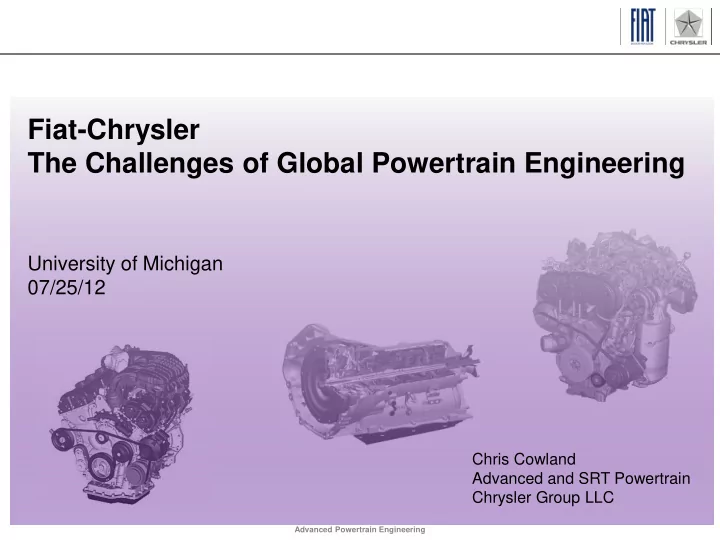
Fiat-Chrysler The Challenges of Global Powertrain Engineering

University of Michigan 07/25/12

slide-2
SLIDE 2

History – Industrial Partnerships

Advanced Powertrain Engineering

1920-1924: Walter P Chrysler teams with Fred Zeder, Owen Skelton and Carl Breer, to design a revolutionary new car. 1925 Chrysler founded. 1928 partners with the Dodge brothers. July 11, 1899: Fiat company charter “Societa Anonima Fabbrica Italiana Automobili Torino”

  • signed. Led by Gianni Agnelli from 1966 – 2003.

1899 Fiat Founded 1925 Chrysler Founded 1928 Dodge 1934-71 1958-78 1964 1967 1969-93 1984 1985 MHI DSM 1989 1998- 2007 2003 2009 1992 2010 2000-05 1979 1969 1986 1993 1988 1975 2011 1974 1991 1999

slide-3
SLIDE 3

Fiat-Chrysler

What are we trying to achieve together?

  • True global producer of passenger vehicles
  • Full spectrum of vehicles (A-F class)
  • Multiple Brand approach
  • Existing and emerging markets
  • Capitalize on synergies
  • Combine/develop best practices e.g. WCM

What are the challenges?

  • Global market regulatory/requirement differences
  • Managing portfolio complexity without duplication
  • Cultural differences
  • Learn from previous collaborations/ownerships

Advanced Powertrain Engineering

X Y

slide-4
SLIDE 4

Fiat-Chrysler Global Powertrain

Advanced Powertrain Engineering

Engine/Transmission Research and Development 8 7 Engine/Transmission Manufacturing 7 13

Jiading (R&D) Ranjangaon (R&D, Mfg) Bielsko Biala (Mfg) Orbassano (R&D) Mirafiori (R&D) Verrone (Mfg) Balocco (R&D) Betim (R&D,Mfg)

Cordoba (Mfg)

Pomigliano (R&D) Pratola Serra (Mfg) Termoli (Mfg) Auburn Hills (R&D) Chelsea (R&D) Trenton (Mfg x 2) Mack (Mfg) Dundee (Mfg) Toledo (Mfg) Conner (Mfg) Windsor (R&D) Kokomo (Mfg x 3) Kokomo Cast (Mfg) Satillo (Mfg x 2) Etobicoke Cast (Mfg) Yucca (R&D) Santa Fe (R&D) Shanghai (R&D) Pune (R&D) Chennai (R&D)

slide-5
SLIDE 5

Fiat-Chrysler Vehicle Brands

Advanced Powertrain Engineering

Need to achieve brand differentiation at the powertrain level without excessive part proliferation

Differentiate via :

  • Technology level
  • Brand sound engineering
  • Transient response/feel
  • Underhood appearance
  • Power/torque ratings
  • Torque curve shaping
  • Transmission type
  • Shift strategy and feel
slide-6
SLIDE 6

Global CO2 Emission Regulations

Advanced Powertrain Engineering

Proposed Targets

US 2025: 107 EU 2020: 95 US-LDV EU

CO2 legislation is core driver in all regions for the foreseeable future – EU leads but absolute limits converging

slide-7
SLIDE 7

Global Emissions Regulations

Advanced Powertrain Engineering

SULEV30

US PM Standards 2017-2025 =3 mg/mi (1.9 mg/km)

US Standard

Emissions legislation is core driver in all regions for the foreseeable future – US leads but absolute limits converging

slide-8
SLIDE 8

Fuel Economy/Emissions Test Procedures

Advanced Powertrain Engineering

Average vehicle demand energy (Jeep Patriot - AWD)

FTP Combined = 10.34 MJ NEDC Combined = 6.06 MJ

US Drive Cycle European Drive Cycle

US FTP Euro NEDC Japan Undefined

Chrysler - EPA(Combined) Fiat 500 - EPA(Combined) Chrysler - NEDC(Combined)

Different test procedures have a huge cost/resource impact without tangible benefit to local air quality/global warming

slide-9
SLIDE 9

Fuels and Lubricants

Advanced Powertrain Engineering

Gasoline Sulphur Levels

lower value = refinery average, upper value = refinery cap (retail values will be higher).

Region Fuel Lubricant Service Interval

NAFTA 89-100 RON GF 4 or 5 5-10K miles EAEM Western Europe Eastern Europe 95-98 RON 90-98 RON ACEA

  • r

OEM Spec 12.5-18.6K miles LATAM 93-98 RON API or OEM Spec 6-9.3K miles APAC* 88-98 RON ILSAC or OEM Spec Usage Specific

* Manganese and methanol added to increase octane adversely affecting aftertreatment robustness

Regional differences in fuel and lubricants result in considerable additional work to implement global powertrains around the world

slide-10
SLIDE 10

Fuel/Vehicle Pricing – Cost of Ownership

Advanced Powertrain Engineering

Oil change in Europe $60 Minimum generic oil $160 Typical cost (higher at OEM) $300 High end Oil change in US $30 Generic oil $80 Synthetic oil (higher at OEM) $160 High end (synthetic)

$72,502* 201 hp (150 kW), AWD 3.0L Turbo Diesel

* 19% VAT,duties, foreign exchange, distribution

$46,875 225 hp (168 kW), AWD 3.0L Turbo Diesel

US Europe

Cost of vehicle ownership is significantly higher outside the US resulting in different vehicle attribute preferences

slide-11
SLIDE 11

EU vs US Market Differences

Advanced Powertrain Engineering

Vehicle footprint correlates to disposable income Market Quartiles: US vs EU A/B/C egment D E F 4% 1% 6% 89% 23.7 – 27.0 < 23.6 mpg 27.1 – 31.8 > 31.8 mpg $7.80/gal. $3.80/gal. CAFE Equivalent 22% 22% 22% 34%

slide-12
SLIDE 12

Powertrain Portfolio - Engines

Advanced Powertrain Engineering

slide-13
SLIDE 13

Powertrain Portfolio - Engines

Advanced Powertrain Engineering

Cummins RAM Truck Chrysler Sales Mix (US Market) Fiat Sales Mix (Euro Market) Maserati Gasoline Diesel Chrysler Fiat

Gasoline – Fiat = small displacement/lower output Chrysler = larger displacement Diesel – Fiat = significant in-house portfolio Chrysler = 100% purchased

slide-14
SLIDE 14

Powertrain Portfolio - Transmissions

Advanced Powertrain Engineering

FWD options similar for Fiat and Chrysler AMT/DCT transmissions more prevalent outside the US Chrysler has larger capacity RWD transmissions

Chrysler Sales Mix (US Market) Fiat Sales Mix (Euro Market) Automatic Manual Chrysler Fiat

slide-15
SLIDE 15

Design/Validation Boundary Conditions

Advanced Powertrain Engineering

Chrysler Fiat

Individual Tests Combined Cycle

  • Coolant Temperature = 100 °C
  • Oil Temperature = 100 °C
  • Fuel Energy (LHV) = 43.05 MJ/kg
  • Electrical Loads = None
  • Accessory Drive = Fully equipped
  • Coolant Temperature = 90 °C
  • Oil Temperature = Floats
  • Fuel Energy (LHV) = 42.5 MJ/kg
  • Electrical Loads = Loaded
  • Accessory Drive = Various levels

Opportunity to rationalize future test procedures

slide-16
SLIDE 16

World Class Manufacturing (WCM)

WCM is ….

A system based on the systematic reduction of all types of waste and loss through the contribution of everyone and the rigorous use of methods and standards Applies its’ principles to all aspects of the plant

  • rganization, from quality to maintenance, cost

control to logistics, in a culture of continuous improvement Was born of the collaboration between Fiat and the best European and Japanese experts, with the aim to develop a recognized, world class production standard

Deliverables: Continuous improvement

Safety Workplace Organization Quality Maintenance Logistics Cost Deployment

Goals:

Zero Accidents, Zero Waste, Zero Breakdowns, Zero Inventories

Two result examples from Fiat:

Energy Efficiency Improvement

  • 1,700 projects introduced in 2011
  • 80% energy savings increment over 2010
  • €38 million savings

Waste Reduction

  • 1,900 projects introduced in 2011
  • €50 million savings

Time Waste

Huge opportunities for efficiency improvements and waste reduction over very large global manufacturing footprint

slide-17
SLIDE 17

Key Technology/Powertrain Transfer Examples

Advanced Powertrain Engineering

MultiAir DDCT Diesel Engines V6 Gas Engines Multispeed ATX Cylinder Deactivation Small I4 Gas Engines Axle Disconnect (4wd) Hybrid/Electric CNG

slide-18
SLIDE 18

Social/Cultural

Advanced Powertrain Engineering

Start early vs work late Leisure time “Football?” Racing

slide-19
SLIDE 19
  • Minimal Overlap within Powertrain portfolios but still need rationalization
  • CO2 driving downsized engines in all regions
  • Joint entity has key technical capabilities in all necessary technologies for future – diesel

emissions, advanced valvetrain, high efficiency transmissions, cylinder de-activation, pressure charging, advanced fuel systems

  • Lack of harmonization in worldwide legislation is a vast waste of money and effort – but little

hope of change

  • Fundamental differences in engineering practices, books of knowledge etc already narrowing –

good opportunity to question the paradigms

  • Customer requirements/perceptions around the world are widely different but MAY start to

converge if fuel prices increase dramatically in the US

  • World Class Manufacturing is a cultural change with huge savings opportunity
  • Out of phase economy highs and lows (US and Europe) allow some resource opportunities
  • Joint R & D offers significant technical and financial benefits
  • Global purchasing leverage benefits considerable

Advanced Powertrain Engineering

Truly a Marriage of Equals???

Key Conclusions