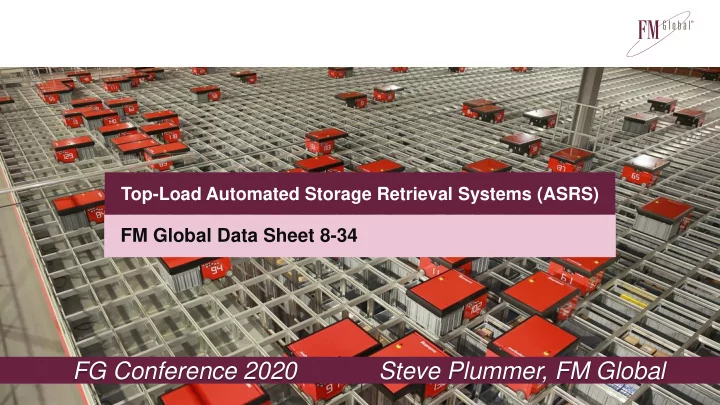
SLIDE 1
Top-Load Automated Storage Retrieval Systems (ASRS)
FM Global Data Sheet 8-34
FG Conference 2020 Steve Plummer, FM Global
SLIDE 2
commercial property insurer
edge research and testing
insured customers
property loss prevention
FM Global
SLIDE 3 FM Global Data Sheet 8-34
- Free on fmglobal.com
- Mini-load ASRS
- Rack-structure ASRS
- Vertically enclosed ASRS
- Top-loading ASRS
- Solid-walled containers
SLIDE 4 Different ASRS Types
- Ref. www.storagesolutionsinc.com
Rack-structure ASRS
(e.g., pallet shuttle system)
Mini-load ASRS Vertically enclosed ASRS
SLIDE 5
What are top-loading ASRS?
SLIDE 6 Fire at a food distribution warehouse UK, February 2019
SLIDE 7 Fire department report
- First fire in the UK involving a building of this nature
- Ignition due to arcing in the charging process of a robot
- 30 minutes from fire discovery to fire brigade call
- During this period, the sprinkler system was turned off for a
period of 5 minutes
- Fire was deep seated and impossible to access
- All tactical options were used including ultra-high-pressure
lances, compressed air foam, and traditional hoses
- Despite efforts of seven fire departments over four days, the
building was a total loss
SLIDE 8
FM Global Testing
A series of full-scale fire tests were conducted
Solid walled plastic containers Ceiling sprinklers Fixed monitor nozzles
SLIDE 9
FM Global Configuration ▪ 20 m2 ▪ Storage height: 5.5 m ▪ Ceiling: 12 m Ignition ▪ Base of storage ▪ Beneath robot ▪ Under-1 sprinkler Sprinkler Protection ▪ K200, QR ▪ 5.2 bar = 49 mm/min
SLIDE 10
FM Global Sprinkler protection is controlling the fire. Sprinklers turned off after 30 minutes to see if the fire is out.
SLIDE 11 FM Global Smoke generation was
SLIDE 12 FM Global Sprinklers turned back
used to extinguish the fire.
SLIDE 13
What did we learn?
Sprinklers can suppress the fire Manual water monitors help extinguish the fire Robots obstruct sprinklers and water monitors
SLIDE 14
What did we learn?
Lower ceilings can reduce the hazard Vertical barriers stop the spread and segregate the hazard Pre-incident planning is critical
SLIDE 15
What is changing?
▪ Sprinkler protection & water supply ▪ Fixed monitor nozzles ▪ Early notification ▪ Vertical barriers ▪ Grid access ▪ Pre-incident planning ▪ Electrical system maintenance
New guidance
SLIDE 16
Sprinkler Protection
Sprinkler Protection ▪ Per Data Sheet 8-34, Tables 17 & 18 Table 17. Storage < 6.1 m
SLIDE 17
Sprinkler Protection
Sprinkler Protection ▪ Per Data Sheet 8-34, Tables 17 & 18 Table 18. Storage > 6.1 m
SLIDE 18
Water Supply
Design ceiling-level sprinklers, fixed monitor nozzles, and small hose stations for: ❑ Minimum 2 hours for ceiling heights ≤ 7.6 m ❑ Minimum 4 hours for ceiling heights > 7.6 m
SLIDE 19
Vertical Barriers
Limits horizontal fire spread
▪ Barriers limit fire area (max. 93 m2) ▪ Subdivision of storage
Provides design flexibility
▪ Separation of storage for difficult to access areas
SLIDE 20
Water Monitors
▪ For ceilings higher than 7.6 m and no vertical barriers ▪ Manual operation via remote control ▪ Infrared cameras needed ▪ Minimum two monitors
▪ To reach any grid location
▪ Monitor spacing
▪ Per manufacturer specification ▪ Tested 30 m spacing, representing 900 m2 protected area
Long wave IR with 17o FOV lens
SLIDE 21
Early Notification
Notification ▪ Early notification via sensitive heat or smoke detection ▪ Activation stops robot charging ▪ Sends robots back to a designated holding area Robots should vacate grid to non-combustible area ▪ Obstructs fire protection and creates hazard ▪ Triggered by early detection (prior to sprinkler operation)
SLIDE 22
Grid Access
▪ Access to top grid is important for final extinguishment ▪ Floor-level access walkways or similar access around storage perimeter ▪ Mezzanine level walkways around the perimeter ▪ Elevated mezzanines across the storage grid if > 30 m wide ▪ Require at least two points of egress
SLIDE 23
Pre-incident Planning
Pre-incident planning is critical
▪ Fire department may not be informed of installation in existing building ▪ Materials list of stored commodities ▪ Access around the gird ▪ Training
▪ Top of grid access points ▪ Use of fire monitors
▪ Fire testing shows that fire extinguishment is slow ▪ Prolonged fire service efforts may be required (before turning off protection) ▪ Written and tested pre-incident plan
SLIDE 24 FM Global InsurerFMGlobal @FMGlobal FM Global
Steve Plummer
Thank You