FerMINI - Fermilab Search for Millicharged Particle & Strongly - - PowerPoint PPT Presentation

fermini fermilab search for millicharged particle
SMART_READER_LITE
LIVE PREVIEW

FerMINI - Fermilab Search for Millicharged Particle & Strongly - - PowerPoint PPT Presentation

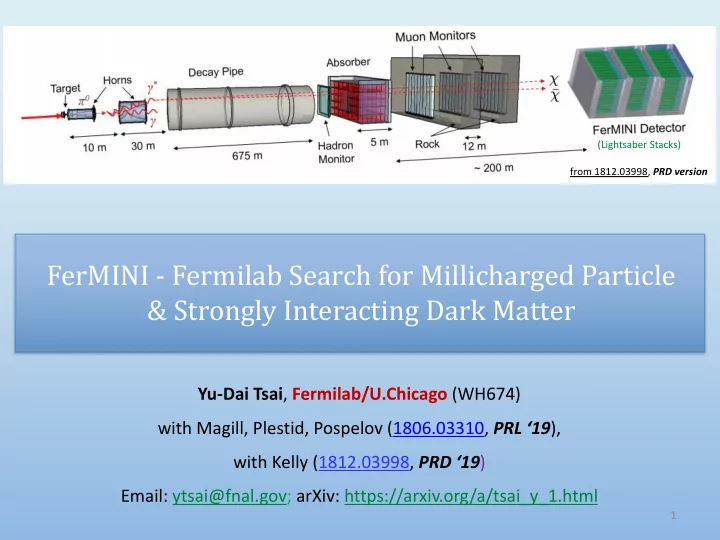
(Lightsaber Stacks) from 1812.03998, PRD version FerMINI - Fermilab Search for Millicharged Particle & Strongly Interacting Dark Matter Yu-Dai Tsai , Fermilab/U.Chicago (WH674) with Magill, Plestid, Pospelov (1806.03310, PRL 19 ), with


slide-1
SLIDE 1

FerMINI - Fermilab Search for Millicharged Particle & Strongly Interacting Dark Matter

1

Yu-Dai Tsai, Fermilab/U.Chicago (WH674) with Magill, Plestid, Pospelov (1806.03310, PRL ‘19), with Kelly (1812.03998, PRD ‘19) Email: ytsai@fnal.gov; arXiv: https://arxiv.org/a/tsai_y_1.html

(Lightsaber Stacks) from 1812.03998, PRD version

slide-2
SLIDE 2

Yu-Dai Tsai Fermilab/U.Chicago Maxim Pospelov Minnesota / Perimeter Ryan Plestid McMaster Joe Bramante Queen’s U Cindy Joe Fermilab Zarko Pavlovic Fermilab Andy Haas NYU Chris Hill OSU Jim Hirschauer Fermilab David Miller U Chicago David Stuart UCSB Albert de Roeck CERN Bithika Jain ICTP-SAIFR

FerMINI Proposal DOE + LDRD (35 pgs)

Ryan Heller Fermilab

slide-3
SLIDE 3

Long-Lived Particles in the High-Energy Frontier of the Intensity Frontier

3

  • Light Scalar & Dark Photon at BoreXino & LSND, 1706.00424 (proton-charge radius anomaly)
  • Dipole Portal Heavy Neutral Lepton, 1803.03262 (LSND/MiniBooNE anomalies)
  • Dark Neutrino at Scattering Exp: CHARM-II & MINERvA! 1812.08768 (MiniBooNE Anomaly)
  • Closing dark photon, inelastic dark matter, and muon g-2 windows; &

the LongQuest Proposal! 1908.07525 (muon g-2 Anomaly) Tsai, de Niverville, Liu, 1908.07525, LongQuest

slide-4
SLIDE 4

4

Tsai, de Niverville, Liu, 1908.07525

Inelastic Dark Matter:

slide-5
SLIDE 5
  • Motivations & Intro to Millicharged Particle (MCP)
  • The FerMINI Experiment
  • Link to Strongly Interacting Dark Matter
  • Broader Perspective:

Why proton-fixed target? High energy + Intensity; Not assume abundance Why MeV to GeV? Many anomalies and new physics explanations (Maybe we don’t need to search in the dark)

Outline

5

Yu-Dai Tsai, Fermilab, 2019

slide-6
SLIDE 6

Some anomalies involving MeV-GeV+ Explanations

6

  • Muon g-2
  • Proton charge radius anomaly
  • LSND & MiniBooNE anomaly
  • EDGES result

︙ ︙

Below ~ MeV there are also strong astrophysical/cosmological bounds

slide-7
SLIDE 7

Millicharged Particles

Is electric charge quantized? Other Implications

Yu-Dai Tsai, Fermilab, 2019

7

slide-8
SLIDE 8
  • Is electric charge quantized and why? A long-standing question!
  • U(1) allows arbitrarily small (any real number) charges.

Why don’t we see them? Motivates Dirac quantization, Grand Unified Theory (GUT), etc, to explain such quantization (anomaly cancellations fix some SM 𝑉(1)% charge assignments)

  • Testing if e/3 is the minimal charge
  • MCP could have natural link to dark sector (dark photon, etc)
  • Could account for dark matter (DM) abundance
  • Used for the cooling of gas temperature to explain the EDGES result

[EDGES collab., Nature, (2018); Barkana, Nature, (2018)].

A small fraction of the DM as MCP can potentially explain EDGES anomaly (under intense studies, see more reference later)

Finding Minicharge

8

slide-9
SLIDE 9

Millicharged Particle: Models

9

Yu-Dai Tsai, Fermilab, 2019

slide-10
SLIDE 10
  • Small charged particles under U(1) hypercharge
  • Can just consider these Lagrangian terms by

themselves (no extra mediator, i.e., dark photon), one can call this a “pure” MCP

  • Or this could be from Kinetic Mixing
  • give a nice origin to this term
  • an example that gives rise to dark sectors
  • easily compatible with Grand Unification Theory
  • I will not spend too much time on the model

MCP Model

10

slide-11
SLIDE 11
  • Field redefinition into a more convenient basis for

massless 𝐶',

  • new fermion acquires an small EM charge 𝑅 (the charge
  • f mCP χ):

Kinetic Mixing and MCP Phase

.

11

See, Holdom, 1985 (SM: Standard Model)

  • New Fermion χ charged under dark U(1)’
  • Coupled to new

dark fermion (scalar) χ

slide-12
SLIDE 12

The Rise of Dark Sector

ε

e.g. mCP

12

Yu-Dai Tsai, Fermilab, 2019

slide-13
SLIDE 13

Important Notes!

  • Our search is simply a search for particles (fermion χ) with

{mass, electric charge} =

  • Minimal theoretical inputs/parameters

(harder to probe in MeV – GeV+ mass regime)

  • MCPs do not have to be DM in our searches
  • The bounds we derive still put constraints on DM as well as

dark sector scenarios.

  • Not considering bounds on dark photon

(not necessary for MCP particles)

  • Similar bound/sensitivity applies to scalar MCPs

13

slide-14
SLIDE 14

Additional Motivations

  • Won’t get into details, but it’s interesting to find

“pure” MCP, that is WITHOUT a massless or ultralight dark photon (finding MCP in the regime where ultralight/massless A’ is strongly constrained by cosmology!)

  • More violent violation of the charge quantization

(if not generating millicharge through kinetic mixing)

  • Test of GUT models, and String Compactifications

see Shiu, Soler, Ye, arXiv:1302.5471, PRL ’13 for more detail.

14

slide-15
SLIDE 15

Millicharged Particle: Signature

15

Yu-Dai Tsai, Fermilab, 2019

slide-16
SLIDE 16

Production & Detection:

MCP (or light DM with massless mediator):

16

q Detection: Electron Scattering

Target

q Production: Meson Decays

χ ) χ

q Production: Drell-Yan

See, also 1411.1055 1703.06881

q Heavy mesons are important for high-mass mCP’s in high-energy beams

BR(π0→2γ) = 0.99 BR(π0→γ𝑓+𝑓,) = 0.01 BR(π0→𝑓+𝑓,) = 6 ∗ 10+0 BR(J/ψ→𝑓+𝑓,) = 0.06

Similar topology: deNiverville, Pospelov, Ritz, ’11, Batell, deNiverville, McKeen, Pospelov, Ritz, ‘14 Kahn, Krnjaic, Thaler, Toups, ’14 …

slide-17
SLIDE 17

17

MCP Production/Flux

slide-18
SLIDE 18

MCP Detection: Electron Scattering & Ionization

  • 𝑹𝟑 is the squared 4-momentum transfer.
  • lab frame: 𝑅3 = 2𝑛5 (𝐹5 − 𝑛5), 𝐹5 − 𝑛5 is the electron recoil energy.
  • Expressed in recoil energy threshold, 𝐹5

(789), we have

  • Sensitivity greatly enhanced by accurately measuring low energy

electron recoils for mCP’s & light dark matter - electron scattering,

  • See Magill, Plestid, Pospelov, YT, 1806.03310 (MCP in neutrino Experiments) &

deNiverville, Frugiuele, 1807.06501 (for sub-GeV DM)

  • Very low-energy scattering: Ionization (eV-level)!

18

slide-19
SLIDE 19

Sensitivity at Neutrino Detectors

  • Electron recoil-energy threshold: MeV to 100 MeV
  • SLAC mQ: Prinz el al, PRL (1998); Colliders/accelerator: Davidson, Hannestad, Raffelt (2000);

𝑂5<<: Bœhm, Dolan, and McCabe (2013)

  • Harnik, Liu, Palamara: double-hit to reduce background + Ivan Lepetic (ArgoNeuT+DUNE) ’19

(Also see Ornella’s talk!)

19

π0 η J/ψ ϒ

DY

Magill, Plestid, Pospelov, Tsai (1806.03310, PRL ‘19)

slide-20
SLIDE 20

Low-cost fixed-target probes of dark sector/long-lived Particles

FerMINI as an example

20

Yu-Dai Tsai, Fermilab, 2019

slide-21
SLIDE 21

21

MilliQan @ LHC: General Idea

Andrew Haas, Fermilab (2017)

  • Require triple coincidence in

small time window (15 nanoseconds)

  • Q down to 10+= e, each MCP

produce averagely ~ 1 photo- electron (PE) observed per ~ 1 meter long scintillator

  • Long axis points at the CMS

Interaction Point (P5). Andy Haas, Christopher S. Hill, Eder Izaguirre, Itay Yavin, 1410.6816, PRD ’15

slide-22
SLIDE 22

FerMINI:

A Fermilab Search for MINI-charged Particle Kelly, YT, arXiv:1812.03998 (PRD`19)

visually “a detector made of stacks of light sabers,” can also potentially probe new physics scenarios like small-electric-dipole dark fermions, or quirks, etc

22

Yu-Dai Tsai, Fermilab, 2019

slide-23
SLIDE 23

23

http://www.slac.stanford.edu/econf/C020121/overhead/S_Childr

Site 1: NuMI Beam & MINOS ND Hall

Beam Energy: 120 GeV, 103> POT per year NuMI: Neutrinos at the Main Injector MINOS: Main Injector Neutrino Oscillation Search, ND: Near Detector

FerMINI Location

~ 13% Production!

slide-24
SLIDE 24

24

FerMINI @ NuMI-MINOS Hall

Beam Energy: 120 GeV

Modified from Zarko Pavlovic’s figure

Yu-Dai Tsai Fermilab

MINOS hall downstream of NuMI beam

slide-25
SLIDE 25

Detector Concept

25

See arXiv:1607.04669; arXiv:1810.06733

slide-26
SLIDE 26

26

Detector: Details of the Nominal Design

  • Total: 1 m × 1 m (transverse plane) × 3 m

(longitudinal) plastic scintillator array.

  • 3 sections each containing 400 5 cm × 5 cm

× 80 cm scintillator bars optically coupled to high-gain photomultiplier (PMT).

  • A triple-incidence within a 15 ns time

window along longitudinally contiguous bars in each of the 3 sections required to reduce the dark-current noise (the dominant background).

slide-27
SLIDE 27

27

Site 2: LBNF Beam & DUNE ND Hall

LBNF: Long-Baseline Neutrino Facility There are many other new physics opportunities in the near detector hall!

https://indico.cern.ch/event/657167/contributions/2708015/ attachments/1546684/2427866/DUNE_ND_Asaadi2017.pdf

Beam Energy: 120 GeV, , 103? POT/yr

slide-28
SLIDE 28

Photoelectrons (PE) from Scintillation

28

  • The averaged number of photoelectron (PE) seen by the

detector from single MCP is:

  • 𝑶𝑸𝑭 ~ ϵ𝟑 x 𝟐𝟏𝟕 , ϵ ~ 𝟐𝟏+𝟒 roughly gives one PE in
  • ne meter plastic scintillation bar

One can use Bethe-Bloch Formula to get a good approximation

slide-29
SLIDE 29
  • Based on Poisson distribution, zero event in

each bar correspond to 𝑸𝟏 = 𝒇+𝑶𝑸𝑭, so the probability of seeing triple incident of one or more photoelectron is:

  • 𝑶𝒚,𝒆𝒇𝒖𝒇𝒅𝒖𝒑𝒔 = 𝑶𝒚 x P . o ~ 1 g/cm^3, l ~ 100

cm, LY=??, edet~10%

Signature: Triple Coincidence

29

slide-30
SLIDE 30

30

MCP Production/Flux

slide-31
SLIDE 31

Detector Background

31

  • We will discuss two major detector

backgrounds and the reduction technique

  • SM charged particles from background

radiation (e.g., cosmic muons):

  • Offline veto of events with > 10 PEs
  • Offset middle detector
  • Dark current: triple coincidence
slide-32
SLIDE 32

Dark Current Background @ PMT

32

  • Major Background (BG) Source!
  • dark-current frequency to be 𝒘𝑪= 500 Hz for estimation (1607.04669)
  • For each tri-PMT set, the background rate for triple incidence is

𝒘𝑪

𝟒 Δt𝟑 = 2.8 x 𝟐𝟏+𝟗 Hz, for Δt = 15 ns.

  • There are 400 such set in the nominal design.
  • The total background rate is 400 x 2.8 x 10+R ~ 10+S Hz
  • ~ 300 events in one year of trigger-live time
  • Quadruple coincidence can reduce this BG to essentially zero!
slide-33
SLIDE 33

FerMINI @ MINOS

33

Yu-Dai Tsai, Fermilab

slide-34
SLIDE 34

FerMINI @ DUNE

34

Yu-Dai Tsai, Fermilab

  • Hope to Incorporate it into the near detector proposal.
slide-35
SLIDE 35

Compilation of MCP Probes

35

SN trapping gap Yu-Dai Tsai, Fermilab

  • One can combine the MCP detector with neutrino

detector to improve sensitivity or reduce background

  • Filling up the MCP “cavity”
slide-36
SLIDE 36

Strongly Interacting Dark Matter

DM-SM Interaction too strong that attenuation stop the particles from reach the direct detection detector

36

DMATIS (Dark Matter ATtenuation Importance Sampling), Mahdawi & Farrar '17

slide-37
SLIDE 37

Strongly Interacting Dark Matter

See, e.g., arXiv:1905.06348 (Emken, Essig, Kouvaris, Sholapurkar '19) Scatterings both on electrons and nuclei in the Earth’s crust, atmosphere, and shielding material attenuate the expected local dark matter flux at a terrestrial detector, so that such experiments lose sensitivity to dark matter above some critical cross section. Limits of the underground Direct Detection (DD) Experiments, including SENSEI, CDMS-HVeV, XENON10, XENON100, and DarkSide-50 One can call the DM that could escape the DD bound this way as Strongly Interacting Dark Matter (SIDM) Not to confuse with Self Interacting Dark Matter (also SIDM)

37

slide-38
SLIDE 38

38

Millicharged (with ultralight A’) SIDM Window

From arXiv:1905.06348, they defined reference cross section:

𝑟U5< is chosen as the typical momentum transfer in DM-electron collisions for noble-liquid / semiconductor targets. Agonistic to the abundance setting mechanism for the SIDM window.

slide-39
SLIDE 39

FerMINI Probe of Millicharged SIDM

39

  • Here we plot the electron-scattering Millicharged SIDM

from 1905.06348 (Emken, Essig, Kouvaris, Sholapurkar)

  • FerMINI can help close the Millicharged SIDM window!

Yu-Dai Tsai, Fermilab (Preliminary) MCP / LDM with ultralight dark photon mediators, all curves except FerMINI are from arXiv:1905.06348

slide-40
SLIDE 40

More on MCP/DM & 21-cm Cosmology

40

Some more reference of Millicharged DM (mDM) and constraints. See, e.g.,

McDermott, Yu, Zurek, 1011.2907; Muñoz, Dvorkin, Loeb, 1802.10094, 1804.01092; Berlin, Hooper, Krnjaic, McDermott, 1803.02804; Kovetz, Poulin, Gluscevic, Boddy, Barkana, Kamionkowski, 1807.11482;

Liu, Outmezguine, Redigolo, Volansky, 1908.06986:

“Reviving Millicharged Dark Matter for 21-cm Cosmology,” Introduces a long-range force between a subdominant mDM and the dominant cold dark matter (CDM) components. Leads to efficient cooling of baryons in the early universe. Extend the range of viable mDM masses for EDGES explanation to ~ 100 GeV.

slide-41
SLIDE 41

Advantages of FerMINI: Timeliness, Low-cost, Movable, Tested, Easy to Implement, …

41

1. LHC entering long shutdown 2. NuMI operating, shutting down in 5 years (DO IT NOW! Fermilab! USA!) 3. Broadening the physics case for fixed-target facilities 4. DUNE near detector design still underway 5. Can develop at NuMI/MINOS and then move to DUNE 6. Sensitivity better than milliQan for MCP up to 5 GeV and don’t have to wait for HL-LHC

7. Synergy between dark matter, neutrino, and collider community. Join us on the proposal! (ytsai@fnal.gov)

slide-42
SLIDE 42

FerMINI: Alternative Designs & New Ideas

42

Yu-Dai Tsai, Fermilab, 2019

slide-43
SLIDE 43

New Ideas …

43

  • Combine with neutrino detector: behind, in front, or

sandwich them

  • Combine with DUNE PRISM: moving up and down
  • FerMINI + DUNE 3-D scintillation detector (3DST)
  • Combine with SPS/SHiP facilities
  • Can potentially probe (electric) dipole portal dark fermion,

quirks, etc.

  • Join the Proposal: ytsai@fnal.gov

Yu-Dai Tsai, Fermilab, 2019

slide-44
SLIDE 44

Looking Ahead

  • Exploring Energy Frontier of the Intensity Frontier (complementary to

and before HL-LHC upgrade)

  • Cosmology-driven models / more motivated models.
  • Near-future (and almost free) opportunity

(NuMI Facility, SBN program, DUNE Near Detector, etc.)

  • Other new low-cost alternatives/proposals (~ $1M) to probe hidden

particles and new forces (FerMINI is just a beginning!)

  • Dark sectors in neutrino telescopes

44

slide-45
SLIDE 45

Thank You! Thanks for the invitation!

45

Yu-Dai Tsai, Fermilab, 2019

slide-46
SLIDE 46

Not all bounds are created with equal assumptions

46

Yu-Dai Tsai, FNAL, 2019

Or, how likely is it that theorists would be able to argue our ways around them Astrophysical productions (not from ambient DM): energy loss/cooling, etc:

Rely on modeling/observations of (extreme/complicated/rare) systems (SN1987A)

Accelerator-based: Collider, Fixed-Target Experiments Some other ground based experiments

Dark matter direct/indirect detection: abundance, velocity distribution, etc

Cosmology: assume cosmological history, species, etc

  • Astrophysical/cosmological observations are important to reveal

the actual story of dark matter (DM).

slide-47
SLIDE 47

Backup Slides

Yu-Dai Tsai, Fermilab, 2019

47

slide-48
SLIDE 48

Potential Detection Limitation: 𝑂VWXYX9 ≤ 1

48

  • Define: ε[X\ as 𝑂]89Y8[^YXU VWXYX9 = 1
  • Roughly around or below this, one really have to

worry about scintillator performance

  • One can elongate the scintillator or consider

alternative materials to help.

  • Andy Haas, Fermilab, 2017
slide-49
SLIDE 49

NuMI (MINOS) / LBNF (DUNE)

Now and the future bests in POTs

  • LSND: total of 103= POT (beam: 800 MeV)
  • Fermilab (FT):
  • NuMI beam: 1 - 4 x 10³> POT/yr (120 GeV)
  • LBNF beam: 1 - 2 x 10³? POT/yr (120 GeV)
  • CERN SPS (FT):
  • NA62: up to 3 x 10?R POT/yr (400 GeV)
  • SHiP: up to 10?_ POT/yr (400 GeV)
  • FASER (collider, forward): 10?0-10?` POT/yr

much higher energy

49

Yu-Dai Tsai Fermilab

slide-50
SLIDE 50

50

LongQuest: Three Stage Retool of SpinQuest, as Dedicated Long-Lived Particle Experiment

arXiv:1908.07525, Tsai, DeNiverville, Liu ‘19

LongQuest I

Add RICH or HBD for main detector

LongQuest II

Add Far Detectors!

MiniQuest!

10m block

Fast tracking New Dump

Ring Image Cherenkov Detector

LongQuest III

Front dump and fast tracking

Another ECAL

ECAL (DarkQuest) Yu-Dai Tsai, 2019

slide-51
SLIDE 51

XQC & RRS

  • 1. X-ray Quantum Calorimeter: X-ray detector aboard a

sounding rocket

  • 2. RRS (RICH, ROCCHIA,SPIRO), Ahlen et al., Harvard-

Smithsonian Observatory pre- print 2292 (1986).

  • 3. RRS is on balloon

51

Backup Slides

slide-52
SLIDE 52

Reviving mDM for EDGES

52

Liu, Outmezguine, Redigolo, Volansky, ‘19

Yu-Dai Tsai, Fermilab (Preliminary)

Yu-Dai Tsai (Preliminary Plot)

Yu-Dai Tsai, Fermilab (Preliminary)

𝑛a = 10 MeV

Backup Slides

slide-53
SLIDE 53

53

MCP Production/Flux

  • Use PYTHIA to generate neutral meson Dalitz or direct decays from the pp collisions and rescale by

considering,

  • M: mass of the parent meson, X:additional particles, f(mχ/M): phase space factor
  • We also include Drell-Yan production for the high mass MCPs (see arXiv:1812.03998)
slide-54
SLIDE 54

Detection: MCP Elastic Scattering with Electrons

  • 𝑹𝟑 is the squared 4-momentum transfer.
  • Integrate over 𝑅3, total cross section dominated

by the small 𝑅3 contribution, we have σeχ = 4π α3ɛ3/𝑅789

3.

  • Light mediator: the total cross section is

dominated by the small 𝑅3 contribution

54

Backup Slides

slide-55
SLIDE 55

55

DM Form Factor Defined in 1905.06348

Backup Slides

slide-56
SLIDE 56

Alternatives (Straightforward)

56

1. Quadruple incidence: further background reduction, sacrifice event rate but potentially gain better control of background, reduce the background naively by 10-5 Basically zero dark-current background experiment? 2. Different lengths for each detectors 3. Different materials:

  • Andy Haas, Fermilab, 2017

Backup Slides

slide-57
SLIDE 57

Even More Backup Slides (Deleted Intro)

Yu-Dai Tsai, Fermilab, 2019

57

slide-58
SLIDE 58

SIMPs/ELDERs

Ultralight DM, Axions, and ALPs

ELDER: Eric Kuflik, Maxim Perelstein, Rey-Le Lorier, and Yu-Dai Tsai (YT) PRL ‘16, JHEP ‘17

Exploration of Dark Matter & Dark Sector

US Cosmic Visions 2017

  • Astrophysical/cosmological observations are important to reveal the

actual story of dark matter (DM).

  • Why FT experiments? And why MeV – GeV+?

58

slide-59
SLIDE 59

Proton FT Experiments

  • High statistics, e.g. LSND has 103= Protons on Target (POT)
  • Shielded/underground: lower background
  • Many of them existing and many to come:

strength in numbers

  • Relatively high energy proton beams on targets exist

O(100 – 400) GeV (I will compare Fermilab/CERN facilities)

  • Produce hidden particles / involve less assumptions

59

Backup Slides

slide-60
SLIDE 60

Why study MeV – GeV+ dark sectors?

Yu-Dai Tsai, Fermilab, 2019

60

Backup Slides

slide-61
SLIDE 61

Signals of discoveries grow from anomalies

Maybe nature is telling us something so we don’t have to search in the dark? (most likely systematics?)

Yu-Dai Tsai, Fermilab, 2019

61

Backup Slides

slide-62
SLIDE 62

Some anomalies involving MeV-GeV+ Explanations

62

  • Muon g-2
  • Proton charge radius anomaly
  • LSND & MiniBooNE anomaly
  • EDGES result

︙ ︙

Below ~ MeV there are also strong astrophysical/cosmological bounds

slide-63
SLIDE 63

v Hopes for New Physics: Personal Trilogy

  • Light Scalar & Dark Photon at Borexino & LSND

Pospelov & YT, PLB ‘18, 1706.00424 (proton charge radius anomaly)

  • Dipole Portal Heavy Neutral Lepton

Magill, Plestid, Pospelov & YT , PRD ’18, 1803.03262 see also Coloma, Machado, Martinez-Soler, Shoemaker, 1707.08573 (LSND/MiniBooNE anomalies)

  • Millicharged Particles in Neutrino Experiments

Magill, Plestid, Pospelov & YT, PRL ‘19, 1806.03310 (EDGES 21-cm measurement anomaly)

Yu-Dai Tsai, Fermilab

︙ ︙

63

deNiverville, Pospelov, Ritz, ’11, Batell, deNiverville, McKeen, Pospelov, Ritz, ‘14 Kahn, Krnjaic, Thaler, Toups, ’14 …

slide-64
SLIDE 64

New Physics in Proton FT Experiments

  • Millicharged Particles in FerMINI Experiments

Kelly & YT, 1812.03998 (EDGES Anomaly)

  • Dark Neutrino at Scattering Experiments: CHARM-II & MINERvA!

Argüelles, Hostert, YT, 1812.08768, under PRL review (MiniBooNE Anomaly)

  • Probing Dark Photon, Inelastic Dark Matter, and Muon g-2

Windows with LongQuest Proposal! (Comin out Monday night!)

Yu-Dai Tsai, Fermilab

64

Happy to talk about these during the coffee break; WH674

slide-65
SLIDE 65

Other New Physics Probes

65

Yu-Dai Tsai, Fermilab, 2019 Backup Slides

slide-66
SLIDE 66

Dark Photon @ LSND

66

  • Major energy depositions:

Pospelov & YT, PLB ‘18, 1706.00424

Backup Slides

slide-67
SLIDE 67

Light Scalar @ LSND & Borexino

67

diphoton decay

Pospelov and YT, arXiv: 1706.00424

Pospelov & YT, PLB ‘18, 1706.00424

slide-68
SLIDE 68

Dark Neutrino at CHARM & MINERvA

68

MINERvA Argüelles, Hostert, YT, 1812.08768, under PRL review

Backup Slides

slide-69
SLIDE 69

Dipole-Portal Heavy Neutral Lepton

69

Magill, Plestid, Pospelov & YT , PRD ’18, 1803.03262

Backup Slides

slide-70
SLIDE 70

(detail) Meson Production Details

  • At LSND, the π0 (135 MeV) spectrum is modeled using a Burman-Smith distribution
  • Fermilab's Booster Neutrino Beam (BNB): π0 and η (548 MeV) mesons. π0's angular

and energy spectra are modeled by the Sanford-Wang distribution. η mesons by the Feynman Scaling hypothesis.

  • SHiP/DUNE: pseudoscalar meson production using the BMPT distribution, as

before, but use a beam energy of 80 GeV

  • J/ψ (3.1 GeV), we assume that their energy production spectra are described by

the distribution from Gale, Jeon, Kapusta, PLB ‘99, nucl-th/9812056.

  • Upsilon, Y (9.4 GeV): Same dist. , normalized by data from HERA-B, I. Abt et al., PLB

(2006), hep-ex/0603015.

  • Calibrated with existing data [e.g. NA50, EPJ ‘06, nucl-ex/0612012, Herb et al., PRL ‘77]. and

simulations from other groups [e.g. deNiverville, Chen, Pospelov, and Ritz, Phys. Rev. D95, 035006 (2017), arXiv:1609.01770 [hepph].]

70

Backup Slides

slide-71
SLIDE 71

FerMINI: Beam Related Background

71

  • Shielding: including absorber and rocks.
  • Controlled: muon monitors.
  • Can determine the SM charged particle rate on site
  • Vetoed similar to the previous veto of cosmic muons.
  • Neutrino produced hard-scattering background: O(𝟐𝟏+𝟐𝟘), negligible.
  • To be conservative, we assume the beam related background ≈

dark current background for our sensitivity determination.

  • Based on SENSEI experience, beam produced charge background is

weaker than cosmic, but of course energy dependence

  • Assumed to be at the same level of detector background

Backup Slides

slide-72
SLIDE 72

FerMINI: Increasing scintillation photons

72

  • Elongating the scintillator bar does not affect the

background from dark current (basically determined by the number of PMTs)

  • So we estimate the sensitivity of FerMINI at DUNE for five

times larger scintillation capability

  • And estimate the sensitivity of FerMINI at NuMI for five time

more scintillation capability but five times less scintillator bar-PMT sets (actually reduce dark current background!)

Backup Slides

slide-73
SLIDE 73

EDGES ANOMALY and MCP Solution

73

Backup Slides

slide-74
SLIDE 74

(Detail) dE/dx formula

74

  • For moderately small epsilon and heavy enough MCP (>> electron mass),
  • ne can use Bethe equation to estimate average energy loss.
  • M: charged particle mass
  • For very small epsilon (related to the finite length effect), one have to

consider most probable energy deposition & consider landau distribution for the energy transfer, see arXiv:1812.03998

Backup Slides

slide-75
SLIDE 75

MCP @ Neutrino Detectors

Yu-Dai Tsai, Fermilab, 2019

75

Backup Slides

slide-76
SLIDE 76

Neutrino Experiments

76

https://web.fnal.gov/collaboration/sbn_sharepoint/SitePages/Civil_Construction.aspx SBND: Short Baseline Near Detector of Booster Beam MiniBooNE: Mini-Booster Neutrino Experiment ICARUS (Imaging Cosmic And Rare Underground Signals): Now a Far Detector of Booster Beam

slide-77
SLIDE 77

MCP Signals

  • signal events 𝑡5f59Y

77

  • Nχ(Ei): number of mCPs with energy Ei arriving at the detector.
  • N5: total number of electrons inside the active volume of the detector
  • Area: active volume divided by the average length traversed by particles inside

the detector.

  • σeχ(Ei): detection cross section consistent with the angular and recoil cuts in

the experiment

  • Here, 𝑡5f59Y∝ ɛj. ɛ3 from 𝑂l and ɛ3 from 𝞃5l
  • Throughout this paper, we choose a credibility interval of

1 − α = 95% (~ 2 sigma)

  • Roughly, ε]59]8Y8f8Yn ∝ 𝐹5, o,789

?/j

𝐶𝑕?/R detection efficiency

slide-78
SLIDE 78

MCP Bound/Sensitivity

  • signal events 𝑡5f59Y
  • Our sensitivity curves are obtained by performing a standard

sensitivity analysis [PDG, PLB 2010]:

  • Given a number of background events b and data n, the number
  • f signal events 𝑡5f59Y . The (1 − α) credibility level is found

by solving the equation α = Γ(1 + n, b + 𝑡5f59Y)/Γ(1 + n, b), where Γ(x, y) is the upper incomplete gamma function.

  • Throughout this paper, we choose a credibility interval of

1 − α = 95% (~ 2 sigma)

78

Backup Slides

slide-79
SLIDE 79

Summary Table

  • ε ∝ 𝐹5, o,789

?/j

𝐶𝑕?/R

  • cos θ > 0 is imposed (∗except for at MiniBooNE’s DM run where a

cut of cos θ > 0.99 effectively reduces backgrounds to zero [Dharmapalan, MiniBooNE, (2012)]).

  • Efficiency of 0.2 for Cherenkov detectors, 0.5 for nuclear emulsion detectors, and 0.8 for

liquid argon time projection chambers.

79

Future Existing

Backup Slides

slide-80
SLIDE 80

Recasting Existing Analysis: LSND, MiniBooNE, and MiniBooNE* (DM Run)

  • LSND: hep-ex/0101039. Measurement of electron-neutrino

electron elastic scattering

  • MiniBooNE: arXiv:1805.12028.

Electron-Like Events in the MiniBooNE Short-Baseline Neutrino Experiment, combines data from both neutrino and anti- neutrino runs and consider a sample of 2.4 × 𝟐𝟏𝟑𝟐POT for which we take the single electron background to be 2.0 × 𝟐𝟏𝟒 events and the measured rate to be 2.4 × 𝟐𝟏𝟒

  • MiniBooNE* (DM run): arXiv:1807.06137 (came out after our v1).

Electron recoil analysis.

Thick target + no horn focusing + A cut of cos θ > 0.99 effectively reduces backgrounds to basically zero [Dharmapalan, MiniBooNE, (2012)]).

80

Backup Slides