
SLIDE 1
Darwin Chen, MD Assistant Professor Mount Sinai Medical Center Department of Orthopaedic Surgery
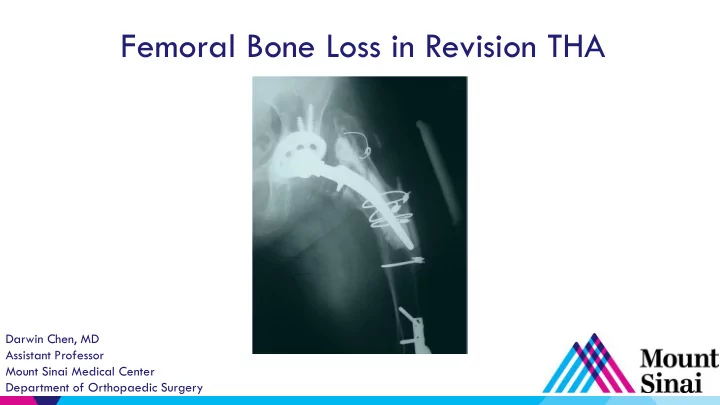
Femoral Bone Loss in Revision THA Darwin Chen, MD Assistant - - PowerPoint PPT Presentation
Femoral Bone Loss in Revision THA Darwin Chen, MD Assistant Professor Mount Sinai Medical Center Department of Orthopaedic Surgery Disclosures Monogram Orthopedics Consultant The Challenge of Femoral Revision Proximal femoral
Darwin Chen, MD Assistant Professor Mount Sinai Medical Center Department of Orthopaedic Surgery
▶ Monogram Orthopedics
– Consultant
▶ Proximal femoral bone loss
▶ Loose stems - varus and retroverted femoral
▶ Goal: Stable distal fixation and
▶ Reliable, reproducible ▶ Predicts intraoperative bone loss ▶ Quantifies remaining femoral host bone ▶ Guides reconstructive options ▶ Can easily turn a I/II into a III with iatrogenic
▶ Minimal metaphyseal
▶ Diaphysis intact ▶ Tx: standard stem
▶ Metaphysis damaged, non-
▶ Isthmus fully intact ▶ Diaphyseal cortices supportive ▶ Tx – diaphyseal engaging
▶ Proximally coated, distally fixed - SROM
▶ Diaphyseal engaging – modular tapered Ti
▶ Metaphysis is severely damaged
▶ Diaphysis intact
▶ Diaphyseal fixation ▶ Tx: 3A - fully coated cylindrical
▶ >4cm isthmus - fully coat cylindrical
▶ <4cm isthmus - tapered fluted Ti
▶ Extensive meta-diaphyseal
▶ Nonsupportive isthmus ▶ Analogous to Vancouver B3 ▶ Tx
▶ Megaprosthesis
▶ Facilitates
~12-15cm
▶ Applicable for almost every revision
▶ Reliable, reproducible, simple
▶ “Pot” the distal stem where it wants to
▶ “Build” up with the proximal body –
▶ Taper angle
▶ Spline design
▶ Distal geometry
▶ Modular junction problems
▶ Subsidence ▶ Cost
▶ B/l loose hemis, severe varus remodeling (R cemented, infected)
▶ Vancouver B3 periprosthetic fx / Paprosky IV (1cm isthmus left)
▶ ETO for implant removal or
▶ Distal prophylactic cable if ETO
▶ Ream on power vs hand? ▶ Ream to a mid size proximal
▶ Low threshold for intraop XR
▶ Be wary of anterior distal stem perforation
▶ Make sure to bottom out the proximal body reamer
▶ Diaphyseal fixation is key for femoral revisions ▶ ETO for safe implant removal, deformity correction, and easier
▶ Modular tapered Ti stems are the workhorse for most revisions ▶ “Pot” and “build” ▶ Be watchful for subsidence, perforation, junctional failures
Darwin Chen, MD Assistant Professor Mount Sinai Medical Center Department of Orthopaedic Surgery