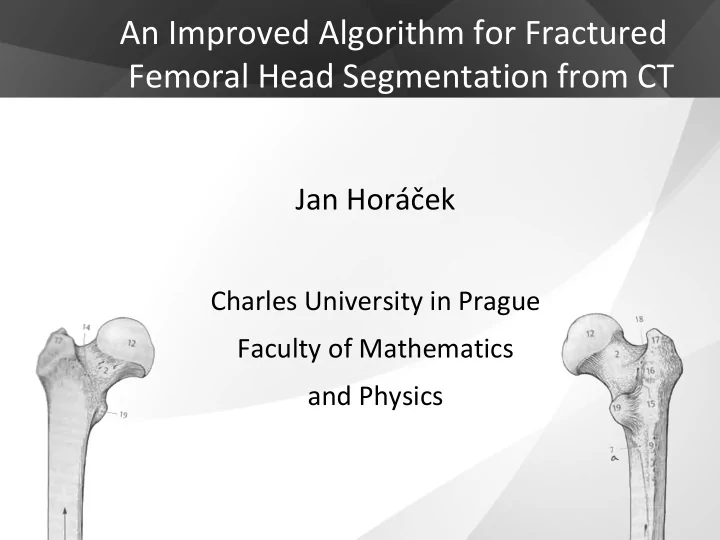
SLIDE 1
Jan Horáček
Charles University in Prague Faculty of Mathematics and Physics
An Improved Algorithm for Fractured Femoral Head Segmentation from CT
SLIDE 2
Femoral neck fracture
SLIDE 3
Screw treatment
SLIDE 4
Segmentation strategy
(1) User-defined control points (2) Preprocessing (3) Segmentation (4) Postprocessing (5) Statistical analysis
SLIDE 5 Preprocessing
Original Gauss-filtered original Gradient size Corticallis-enhancement Gauss-filt. cort.-enh. Final cost function
SLIDE 6 Segmentation
- Uses spherical coordinates and different data
walkthrough than our previous work
- Avoids problems of slice-by-slice methods
- Based on shortest path search, but neighbour
points on shortest paths relaxed, so that they do not diverge too much
SLIDE 7 Spherical transformation
+ + = = + + =
2 2 2 2 2 2
arccos ) , ( 2 arctan z y x z x y z y x r
θ ϕ
) cos( ) sin( ) sin( ) sin( ) cos(
θ θ ϕ θ ϕ ⋅ = ⋅ ⋅ = ⋅ ⋅ =
r z r y r x
SLIDE 8 Primary polar point
- User selects one primary control point, which is
taken as the pole for spherical transformation
- Before the transformation from spatial to spherical
coordinates a rotation is performed to move the pole to an axis (for example +Z)
SLIDE 9
First walkthrough
Starting pole (user input) Walkthrough direction
r θ φ
SLIDE 10
Find second pole
Search for the smallest value
r θ φ
SLIDE 11
Second pole
Starting pole for backtracing Step for each path point along descending values with relaxation
SLIDE 12
Start finding paths
Found path
SLIDE 13 Curve relaxation
- Curve is divided into discontinuous segments
±2 discontinuity Move shorter segment Move both segments ±1 discontinuity
SLIDE 14 Optional control points
- Optional control points locally decrease the cost
function
- Subtract f(d) from the original cost function, d is
the euclidean distance to the control point
− ⋅ = λ λ
d K d f exp ) (
SLIDE 15 Advantages
- Very fast processing through dynamic
programming
- Easy to run in parallel
- No “thin holes” in the volume that
make problems during morphological
- perations
- Many datasets segmented with much less control
points (thus user interaction is much faster)
SLIDE 16 Disadvantages
- A little bit weaker control abilities (weaker control
points)
– Some patients need more control points
- Due to the relaxation method some “spikes” may
still appear
– For smoother results some optimization method
may be used
- Still sensitive to the control points location (like our
- lder slice-by-slice method)
SLIDE 17
Fractures
SLIDE 18 Another utilization
acetabulum inspection
inspect the inner part of hip joint for fractures
SLIDE 19
Thank you for your attention