
SLIDE 1
Female Reproductive Aging & Egg Freezing
JOSHUA U. KLEIN, MD, FACOG ASSISTANT CLI NICAL PROFESSOR OF OBSTETRICS, GYNECOLOGY, & REPRODUCTIVE SCI ENCE I CAHN SCHOOL OF MEDICINE AT MOUNT SI NAI
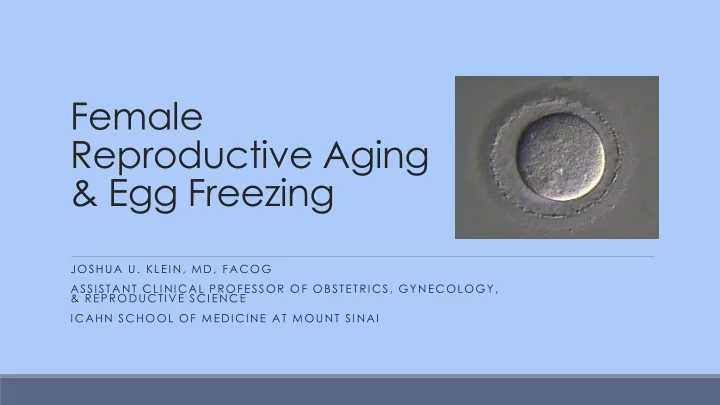
Female Reproductive Aging & Egg Freezing JOSHUA U. KLEIN, MD, - - PowerPoint PPT Presentation
Female Reproductive Aging & Egg Freezing JOSHUA U. KLEIN, MD, FACOG ASSISTANT CLI NICAL PROFESSOR OF OBSTETRICS, GYNECOLOGY, & REPRODUCTIVE SCI ENCE I CAHN SCHOOL OF MEDICINE AT MOUNT SI NAI Egg Freezing: Media Darling What You Need
JOSHUA U. KLEIN, MD, FACOG ASSISTANT CLI NICAL PROFESSOR OF OBSTETRICS, GYNECOLOGY, & REPRODUCTIVE SCI ENCE I CAHN SCHOOL OF MEDICINE AT MOUNT SI NAI
Egg Freezing: Media Darling
What You Need To Know
Female Fertility and Aging Eggs as Gumballs Quantity and Quality Egg Freezing in 2016: A Primer Jewish Considerations
Natural Fertility and Age
30 40 50 60 70 80 90 100 Age = 30 Age = 35 Age = 40 % Achieving Live Birth Birth within 4 years Birth Within 1 Year
Leridon, H. Human Reproduction Vol.19, No.7 pp. 1548-1553, 2004
Fertility and Age: IVF
Percentages of ART C ycles Using Fresh Nondonor Eggs or Embryos That Resulted in Pregnancies, Live Births, and Single-Infant Live Births, by Age of Woman,* 2013
Percent 10 20 30 40 50 60 Age (years) <24 24 26 28 30 32 34 36 38 40 42 44 >44 Pregnancies Live births S ingle-infant live births
* For consistency, all percentages are based on cycles started. Primacy of the Egg
Percentages of Transfers Using Fresh Embryos from Donor or Nondonor E ggs That Resulted in Live Births, by Age of Woman, 2013
Percent 10 20 30 40 50 60 70 80 90 100 Age (years) <30 30 32 34 36 38 40 42 44 46 >47 Donor eggs Nondonor eggs
Miscarriages and Age
11.8 12.2 13.5 16 20 27 37 5 10 15 20 25 30 35 40 Age = 15-20 Age = 21-25 Age = 26-30 Age = 31-35 Age = 36-40 Age = 41-45 Age = 46-50 % Risk Miscarriage
Leridon, H. Human Reproduction Vol.19, No.7 pp. 1548-1553, 2004
Down Syndrome and Age
20 40 60 80 100 120 140 Age <20 Age 20-24 Age 25-29 Age 30-34 Age 35-39 Age 40+ Down Syndrome per 10,000 Births
CDC National Data 2013
What is Female Reproductive Aging?
Fertility Miscarriage Down Syndrome
What is Reproductive Aging?
Aging
Fertility
Mis- carriage
Down Syndrome
Unifying Concept: Eggs as Gumballs
Age
Eggs as Gumballs
Young
(genetically normal)
Older
(genetically abnormal)
Unifying Concept: Eggs as Gumballs
Eggs: Quality & Quantity
“Egg Quality” “Egg Quantity”
Quantity: Ovarian Reserve Testing
2 4 6 8 10 12 25 30 35 40 >43
AMH (ng/mL) Age (years)
AMH and Age
10th Percentile 50th Percentile 90th Percentile
Hormone (AMH)
Hormone (FSH) and Estradiol on Day 2-3 of Menstrual Cycle
Shebl et al. Fertility and Sterility 2011;95: 832–4
Eggs: Quality & Quantity
“Egg Quality” “Egg Quantity”
Quality: Age and Genetic Aneuploidy
for a given age
diagnostic test for unfertilized eggs
embryos is closest approximation
Franasiak et al. Fertility and Sterility 2014: 101:656-663.e1
Egg Freezing: Managing Reproductive Aging
deterioration of those eggs over time
not just one
when many are still genetically normal
Brief History of Egg Freezing
40,000 degrees Celsius per minute)
American Congress of Obstetricians and Gynecologists (ACOG) remove “experimental” designation for egg freezing
Egg Freezing Process
Consultation and Ovarian Reserve Testing 10 days of daily hormone injections and 5-6 brief visits for sonogram and hormone testing 15 minute outpatient minor surgical procedure to extract the eggs using a needle, done under "twilight" anesthesia
Who Should Consider Freezing Eggs?
supply, e.g. chemotherapy
have children in the near future, or are concerned about family size
Egg Freezing Outcomes
to using the eggs
Photo Courtesy Leslie Ramirez PhD
Egg Freezing: Safety
Short Term:
Long Term:
Egg Freezing: Areas for Research
eggs to target
Egg Freezing: Cost
freezing benefits as part of their employment package
Egg Freezing in Jewish Community
treatment later in life
encourage single women who are in their 30’s to consider freezing eggs
Summary
quality of eggs
increased miscarriages and genetic problems like Down Syndrome at
eggs and can help women have healthy children at an age when they might not otherwise have that opportunity
women to consider freezing their eggs
Contact Information
Joshua U. Klein, MD Email address: doctorklein@joshuakleinmd.com