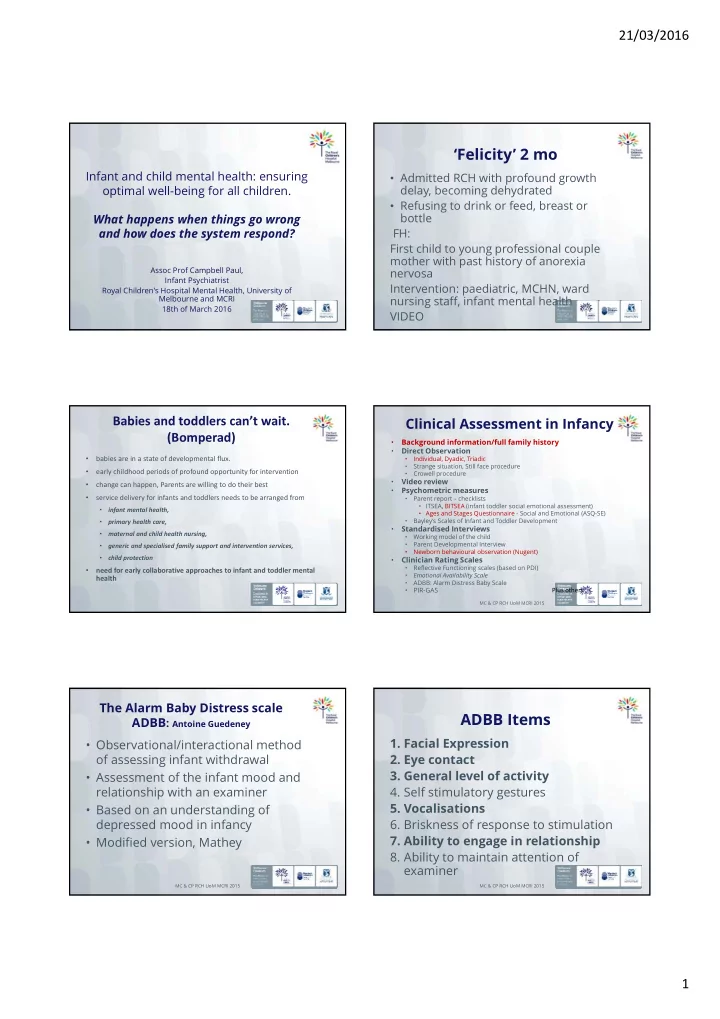
Felicity 2 mo Infant and child mental health: ensuring Admitted RCH - - PDF document

felicity 2 mo
SMART_READER_LITE
LIVE PREVIEW

Felicity 2 mo Infant and child mental health: ensuring Admitted RCH - - PDF document

21/03/2016 Felicity 2 mo Infant and child mental health: ensuring Admitted RCH with profound growth optimal well-being for all children. delay, becoming dehydrated Refusing to drink or feed, breast or bottle What happens when


slide-1
SLIDE 1

21/03/2016 1

Infant and child mental health: ensuring

  • ptimal well-being for all children.

What happens when things go wrong and how does the system respond?

Assoc Prof Campbell Paul, Infant Psychiatrist Royal Children's Hospital Mental Health, University of Melbourne and MCRI 18th of March 2016

‘Felicity’ 2 mo

  • Admitted RCH with profound growth

delay, becoming dehydrated

  • Refusing to drink or feed, breast or

bottle FH: First child to young professional couple mother with past history of anorexia nervosa Intervention: paediatric, MCHN, ward nursing staff, infant mental health VIDEO

Babies and toddlers can’t wait. (Bomperad)

  • babies are in a state of developmental flux.
  • early childhood periods of profound opportunity for intervention
  • change can happen, Parents are willing to do their best
  • service delivery for infants and toddlers needs to be arranged from
  • infant mental health,
  • primary health care,
  • maternal and child health nursing,
  • generic and specialised family support and intervention services,
  • child protection
  • need for early collaborative approaches to infant and toddler mental

health

Clinical Assessment in Infancy

  • Background information/full family history
  • Direct Observation
  • Individual, Dyadic, Triadic
  • Strange situation, Still face procedure
  • Crowell procedure
  • Video review
  • Psychometric measures
  • Parent report – checklists
  • ITSEA, BITSEA (infant toddler social emotional assessment)
  • Ages and Stages Questionnaire - Social and Emotional (ASQ-SE)
  • Bayley’s Scales of Infant and Toddler Development
  • Standardised Interviews
  • Working model of the child
  • Parent Developmental Interview
  • Newborn behavioural observation (Nugent)
  • Clinician Rating Scales
  • Reflective Functioning scales (based on PDI)
  • Emotional Availability Scale
  • ADBB: Alarm Distress Baby Scale
  • PIR-GAS

MC & CP RCH UoM MCRI 2015

Plus others.....

The Alarm Baby Distress scale ADBB: Antoine Guedeney

  • Observational/interactional method
  • f assessing infant withdrawal
  • Assessment of the infant mood and

relationship with an examiner

  • Based on an understanding of

depressed mood in infancy

  • Modified version, Mathey

MC & CP RCH UoM MCRI 2015

ADBB Items

  • 1. Facial Expression
  • 2. Eye contact
  • 3. General level of activity
  • 4. Self stimulatory gestures
  • 5. Vocalisations
  • 6. Briskness of response to stimulation
  • 7. Ability to engage in relationship
  • 8. Ability to maintain attention of

examiner

MC & CP RCH UoM MCRI 2015

slide-2
SLIDE 2

21/03/2016 2

Newborn response to still face paradigm : Nagy 2008

BRIEF REPORTS

Innate Intersubjectivity: Newborns’ Sensitivity to Communication Disturbance

Emese Nagy

University of Dundee

In most of our social life we communicate and relate to others. Successful interpersonal relating is crucial to physical and mental well-being and growth. This study, using the still-face paradigm, demonstrates that even human neonates (n _ 90, 3–96 hr after birth) adjust their behavior according to the social responsiveness of their interaction partner. If the interaction partner becomes unresponsive, newborns will also change their behavior, decrease eye contact, and display signs of distress. Even after the interaction partner resumes responsiveness, the effects of the communication disturbance persist as a

  • spillover. These results indicate that even newborn infants sensitively monitor the behavior of others and

react as if they had innate expectations regarding rules of interpersonal interaction. Keywords: neonate, still-face, interaction, intersubjectivity

Developmental Psychology 2008, Vol. 44, No. 6, 1779–1784

What is Infant Mental Health?

  • Early relationships have permanent effects on

brain development, health and later mental health

  • Social emotional and physical health are

inseparable

  • The baby is a person with a mind
  • Responsive caregiving can mediate the effects
  • f chronic problems: poverty, prematurity
  • Intervention can be effective for the infant’s

emotional, social, physical development

  • Babies can be traumatised by disruption of

attachment relationships, witnessing violence as well as direct physical violence

Infant and Preschool Mental Health

  • Who works with the infant and the family?
  • Therapeutic intervention can occur in any

setting…

  • Key Concepts
  • Baby has a mind
  • Parental Reflective capacity..mentalizing
  • [THERAPIST REFLECTIVE CAPACITY]
  • We have a responsibility to engage the infant

and parents

  • Developmental transactional models
  • Behaviour has meaning

Mental health problems occur across any age Egger & Aingold

Helen Egger 2006 J Ch Psycol Psych

“Review highlights how early we are in the process of characterising the nosology and epidemiology of preschool behavioural and emotional disorders, particularly depression and anxiety disorders.… How late we are in recognising the distress and impairment of preschool children and their families”.

Babies and toddlers do have mental health problems

Few large scale epidemiological surveys of mental health problems and infants and toddlers

  • BITSEA (Brief Infant Toddler Social

Emotional Assessment) 10.4% of infant’s aged 12 to 36 months were judged to be in the “of concern range” for social emotional development/behaviour problems.

  • There was a high correlation with

mental health problems aged 6 commencing primary school:

  • The early detected problems were largely
  • nes which endured into primary school
  • Briggs-Gowan and Carter(2008)

21/03/2016 CP RCH UoM

12

slide-3
SLIDE 3

21/03/2016 3

ICD 10 diagnoses axis I, II and III In Children aged 1½ years (N : 211) Copenhagen Child Cohort 2000

Axis I Psychiatric Syndrome

  • Developmental Disorders 2.8%
  • Hyperactivity/Attention Deficit

Disorder 2.4%

  • Disorders of Conduct and

Emotions 4.3%

  • Reactive Attachment Disorder

0.9%

  • Eating Disorder 2.8%
  • Sleeping Disorder 1.4%
  • Adjustment Disorder 3%
  • Other 0.5%

All diagnoses = 16.1% Axis II Specific Developmental Disorder

  • Developmental Disorder 1.9%

Axis III Intellectual Level

  • Psychomotor Retardation 1.4%

‘The prevalence of mental health problems in children 1½ years of age – the Copenhagen Child Cohort 2000 ‘ Skovgaard et al Journal of Child Psychology and Psychiatry 48:1 (2007), pp 62–70

21-Mar-16

“Development of children’s internalising and externalising problems from infancy to 5 years of age.”

  • follow-up of 733 children recruited aged 6 to 7

months through to 5 years of age.

  • Include CBCL,
  • 20% exhibited consistently elevated

symptoms for each problem.

  • Maternal stress, harsh discipline important

problems.

  • Recommend importance of effective population

approaches to preventing mental health problems, with RCT of preventive interventions

  • Bayer, Ukoumunne, Mathers, Wake, Abdi & Hiscock (2012)

ANZJPsych

Preschool Feelings Checklist

MY CHILD: Is almost always interested in playing with

  • ther kids. Y N

Frequently appears sad or says he/she feels sad. Y N Has a lot of trouble following simple directions or rules. Y N Seems not to be as excited about play or activities as much as other kids Y N . Whines or cries a lot. Y N Can’t pay attention to games or tasks for very long. Y N Keeps to him/herself. Y N Pretend plays about scary or sad things. Y N Blames him/herself for things. Y N Seems to lack confidence. Y N Doesn’t react to things that other children his/her age find exciting or upsetting. Y N Often seems to be very tired and has low energy. Y N Seems to feel overly guilty. Y N Failed to gain weight or has lost weight (without being on a diet). Y N Used to behave his/her age but now seems to act younger (for example used to be potty trained but now soiling clothes). Y N Seems more irritable or grouchy than other children his/her age. Luby J, Heffelfinger A, Mrakotsky C, Hildebrand T (1999), Preschool Feelings Checklist. St. Louis, MO: Washington University

PTSD & Infants (non verbal)

  • Infant is capable of perceiving

danger/threat..can perceive range of emotions (fear, anger… joy) ,esp in carer

  • Less able to process cognitively.. And

make ‘sense'. the infant depends on carer to interpret the world and its safety

  • Loss of responsive carer is a trauma in

itself

Post trauma Post traumatic tic response: Infa : Infant nt & & toddl toddler er

  • 0 -6 months
  • hyper

vigilance

  • 6-12 months
  • increased

anxiety in strange situations

  • 12-18 months
  • unusual

clinginess with caregiver

1. Re experiencing traumatic event 1. Re-enactment play 2. Dissociative response 1. Dazed expression 2. Stereotypical behaviour 3. Extreme withdrawal 4. Periodic unresponsiveness 3. Numbing of responsiveness 1. Emotionally subdued 2. Socially withdrawn 3. Restricted play 4. Hyper-arousal 1. Irritability 2. Emotional lability 3. Temper tantrums 4. Hypervigilance

The baby's mind Infant mental health networks The parents mind

CAMHS infant mental health teams PIRI Perinatal psychiatry Hospitalised sick baby, NICU RCHIMHS Inter-departmental team Developmental; Specialist Children Services, Autism Mother baby psychiatric units: public, private High-risk infants Child protective services, DHS Take 2, PASDA Aboriginal health Bumps to Babes Infant parent psychotherapies Parent infant psychotherapy Mother and father Specialized programs Infant psychotherapy

THE INFANT, TODDLER

Maternal and Child Health Nurse, Mother's Groups Paediatrician, general practitioner CIP, Boulder, PIP, San Francisco Minding the Baby Watch Wait and Wonder, Circle of Security Siblings, grandparents Enhanced Home Visiting Nurse Young Mothers, Drug Treatment Programmes, Nurse Home Visiting Private practitioners Early Parenting Centres: QEC, Tweddle, O’Connell Maternity hospitals, RWH, Mercy, Monash Mentalisation- based intervention Group therapies :RCH model, PAIRS Child care Family support agencies Preschool Fathers: community, jail, national network Self-help: Panda, SANDS Culturally-based programs, Koori, Afghan OS: Early Head Start, Sure Start, Mellow Parenting Parenting guides, the media

The baby’s environment The baby's body

CP UoM RCH

18

slide-4
SLIDE 4

21/03/2016 4

Interventions with infants and families

  • Universal level.
  • Education/ Mental health promotion
  • Maternal and child health services.
  • Touchpoints model, USA Perinatal screening
  • NBO in maternity services; Stern-Bruschweiler , NBO
  • Infant mental health screening(?BITSEA)
  • Focussed/Indicated for at-risk groups of families & children.
  • Paediatrics clinics, private practice
  • Tummies to toddlers, Bumps to Babes model
  • Risk specific: eg PASDA, Playsteps
  • Early Parenting Centres
  • Nurse family partnership model (NFP)
  • For teenage parents: AMPLE at RWH,
  • Healthy Steps :paediatric IMH collaboration USA (Talmi)
  • Tertiary Ivn Services : individual families.
  • CAMHS, ( rural services developing, conflicting demands)
  • Diagnostic assessment & Mental Health Treatment of parent and child : PIRI,

Private practitioners, Specialist Programs eg

  • Child-Parent Therapy (Lieberman) Interactional Guidance (McDonough)
  • Relational Psychotherapy Mothers Group (Suchman)
  • RCH Model of infant parent psychotherapy
  • Anna Freud Centre, Parent Infant Program.
  • East London program for parents with mental illness

Mother baby Inpatient Units Melbourne

RCH Infant Mental Health

1.Clinical Service Delivery: Infant Mental Health Assessment and Treatment:

  • Community CAMHS Teams: referrals from families and other professionals
  • Hospital Consultation & Liaison: e.g. NICU, PICU, general medical regular

clinical meetings.

  • pimhi program (infants whose parents have serious mental illness: direct

intervention, secondary consultation, teaching, training)

  • Perinatal Emotional Health program

Secondary Consultation:

  • Intra-hospital
  • Local MCHN
  • Mother Baby Psych units

2.Clinical Research:

Robin Study, NICU Cardiology Research Complex Feeding Clinic (Izaak Lim) NBO Newborn Behavioural Observation (NBO with babies in NICU RWH) Research Methods Training (e.g. ADBB, EAS,

RCH Infant Mental Health

3.Teaching and Training:

Master of Mental Health Sciences, infant stream (21st year) Engaging Infants, Introductory 2 Day Training IMH, Annual NBO training Reflective Family Play, Diane Philipp, Toronto Working with High Risk Infants, with Berry Street (annual 3 day training)

4.Advocacy and Community Development.

Involvement with World Association for Infant Mental Health and Australian Association for Infant Mental Health. IACAPAP contribute to Queen Elizabeth Centre intervention programs, Mother-Baby Psychiatric Unit Programs

Goals of the process of engagement with the baby

Why make a specific connection with the infant in her own right?

  • Acknowledge the importance of the

infant’s own self and identity, the baby as a person

  • Acknowledge the infant’s own capacities

for understanding and giving meaning to behaviour

  • The interview becomes the infant’s

interview, as if it was her own possession (see Winnicott (1971) on the role of the therapeutic consultation)

21/03/2016 CP RCH UoMelb

22

Parental Embodied Mentalizing

Shai & Belsky (2011)

Parental reflective capacity/mentalizing:

  • Parents capacity to appreciate, even unconsciously,

their infant’s mental states…Not just measured with semantic and verbal expression, but includes : Embodied Mentalizing Capacity : which is to

  • a. implicitly conceive, comprehend and extrapolate the

infant’s mental states from the infant’s whole-body movement

  • b. adjust their own kinaesthetic patterns accordingly.

<To engage with the baby or toddler the therapist could do the same>

21/03/2016 CP RCH UoMelb

23

Neonatal Behavioral Observation NBO @thewomens Melbourne Meeting the baby & Relationship Building The 18 items include observations of the infant's:

  • capacity to habituate to external light and

sound stimuli (sleep protection)

  • the quality of motor tone and activity level
  • capacity for self-regulation (including

crying and consolability)

  • response to stress (indices of the infant's

threshold for stimulation)

  • visual, auditory and social-interactive

capacities (degree of alertness and response to both human and non-human stimuli)

  • https://www.thewomens.org.au/health-

professionals/clinical-education- training/nbo-australia/

21/03/2016 CP RCH UoMelb

24

slide-5
SLIDE 5

21/03/2016 5

The AMPLE Intervention RWH

Part 1:Introducing Babies: with video clips to vulnerable teen expectant couples Part 2:‘Let’s meet your baby’

  • Builds on the antenatal intervention via:
  • Seeing their baby’s capacity and urge to socially connect with them

from birth, using the NBO (Newborn Behavioural Observations)

  • Conversation about their perception of their baby’s personality

(likes and dislikes) before birth and as a newborn

  • Recollections of the antenatal video clips and how they relate to

their experience so far of their own baby

  • Memento of the session (brief video or photo)

3/21/2016 C Paul

25

Interpretation of findings

  • Brief relationship support incorporating the NBO as

part of maternity care makes a difference to young lives:

  • Associated with improved mother-infant interaction

4 months after brief intervention.

  • Acceptable to a culturally diverse population of

young mothers

  • Potentially affordable, reproducible and fits with

routine maternity care

‘Supporting the adolescent mother-infant relationship: Preliminary trial of a brief, perinatal attachment intervention’ : Susan Nicolson, Fiona Judd, Frances Thomson-Salo, Archives of Women’s Mental Health 2013

RCH Treatment Model

Understand the emotional meaning of the situation that the infant and parents find themselves in.

  • Need for immediate intervention: baby can’t wait

(Bomperad)

  • Use psychoanalytic, behavioural and family systems

theories

  • Selective use of key theories eg psychoanalytic/

attachment, psycho-physiological regulation.

  • May include selective use of other intervention

models eg developmental guidance, interaction coaching, brief serial treatment, long term psychotherapy

  • work with systems
  • sharing our hypothesis and work with other

hospital/community staff

27

CP RCH UoM 21-Mar-16

RCH treatment model: Specificity

  • f the intervention
  • make an emotional connection with the infant -

gaze, touch, talking, playfulness.

  • Help the infant ‘symbolize’…play is integral ..crucial
  • Help the parents understand the baby’s

mind/body.

  • holding and containing of projective

identification

  • making links
  • unhooking projections
  • space for ambivalence
  • Transformational Therapeutic moment

(Stern et al)

28

CP RCH UoM 21-Mar-16

The RCH approach is:

  • There are common features in psycho-

therapeutic interventions

  • Therapist responds with (initiates) age-appropriate,

affective communication with sensitivity, authenticity and vitality

  • Using voice with infant, then interaction and

vocalisation, and gestural language with an older infant

  • Similar to embodied parental mentalizing (Shai,

Belsky 2011)

  • Space of silence also allows time for watching, for a

baby to digest and respond, for their response to be heard, for taking turns.

  • The intervention may appear 'sloppy' (Stern 2004)
  • FTS

Minding the Baby program Yale Arietta Slade et al

  • Aim in therapy is to

enable parents to develop a reflective stance

  • Able to envision mental

states in themselves, and in their children

  • Begins with the ability to

identify basic mental states, namely thoughts, feelings, desires, intentions and beliefs, both in self and other

  • From recognition stems a

capacity to think about and imagine them in a variety of ways – to mentalize

  • Development of

Reflective functioning

  • ccurs within the

context of a relationship with clinician

  • The therapeutic

relationship is crucial to enabling change across a range of dimensions.

  • Understanding and

developing the therapeutic relationship is crucial to every aspect

  • f the work.
slide-6
SLIDE 6

21/03/2016 6

Minding the Baby program

  • In wondering, you become

the voice for the mother’s, and the other’s internal experience

  • Help the mother wonder

about both herself, and the child, as separate entities

  • Use of video
  • Capacity to play
  • Play evokes feelings, ideas,

fantasies and wishes, which are experiences that can be “played” with in potentially an unthreatening way

  • A parent’s mentalizing

capacity – as it pertains specifically to her relationship with her child – is predictive of secure attachment organisation in the child

  • Targeting parental

mentalization capacities should be central to parent-infant interventions

  • Reflective capacities serve

a range of protective functions in relation to trauma

Conclusions

  • Infants and toddlers can experience

significant mental health distress: prevalence15 to 20% of the population

  • Infants can experience mental health disorders

developmentally analogous to older children

  • Early childhood healthcare professionals can

provide mental health interventions

  • Keep the baby at the centre of the intervention,

but always engaging her parents

  • Ensure we have opportunities for

consultation, support and reflective supervision for what can be emotionally painful work

Universal and Preventive Approaches: Challenges and Opportunities

(Shonkoff and Phillips, 2000; Zeanah, et al 2005)

  • General lack of data on timing, intensity and duration of intervention

and training and skills required with work with targeted populations

  • need for more descriptive, exploratory investigations regarding family‐

centred, community‐based coordination of services‐oriented programs.

  • Dropout rates impact service delivery and evaluation of programs
  • Need for adequate resources and commitment for rigorous

evaluation, including random assignment.

  • Cultural competence for specific subgroups.
  • Infrastructure may not be adequate.
  • Cost‐effectiveness studies to make choices about investment in early

childhood

References

  • ‘Demystifying Infant Mental Health: What the Primary Care Provider

Needs to Know’

  • Tanika E. Simpson, Eileen Condon,, Rosemary M. Price, Bennie Kelly Finch, Lois S.

Sadler, & Monica Roosa Ordway, Journal of Pediatric Health Care, Volume 30_1

  • Infusing Mental Health Services into Primary Care for Very Young

Children and Their Families

  • Kapln‐Sanof, Talmi, Augustyn , Zero to Three Journal, November 2012

Infant Mental Health Training

  • Training:

1. Master of Mental Health Science, Infant stream, University of Melbourne 2. NBO Training Melbourne RWH contact: https://www.thewomens.org.au/health- professionals/clinical-education-training/nbo- australia/ 3.RCH Engaging Infants 2 day training February 2017

  • ‘The Baby as Subject’ : Campbell Paul and

Frances Salo Karnac, 2010

Contact email: campbell.paul@rch.org.au

3/21/2016 CP UoM RCH

35

Recommended Books

Diagnostic Classification of Mental Health and Developmental Disorders of Infancy and Early Childhood By Zero To Three Handbook of Infant Mental Health (3rd edition) by Charles Zeanah Psychotherapy with Infants and Young Children: Repairing the Effects of Stress and Trauma on Early Attachment By Alicia F. Lieberman, & Patricia van Horn Mind to Mind: Reflecting on the Future of Psychoanalysis: Mentalization, Internalization, and Representation. Edited by Elliot L. Jurist, Arietta Slade, Sharone Bergner Parenthood and Mental Health: A Bridge Between Infant and Adult Psychiatry (World Psychiatric Association) Sam Tyano, Miri Keren, Helen Herrman, & Prof. John Cox Becoming Attached: First Relationships. By Robert Karen Exploring in Security. By Jeremy Holmes

slide-7
SLIDE 7

21/03/2016 7

Resources

Australian Association for Infant Mental Health http://www.aaimhi.org/index.php World Association for Infant Mental Health http://www.waimh.org ZERO TO THREE: National Center for Infants, Toddlers and Families www.zerotothree.org Alarm Baby Distress Scale www.adbb.net The Anna Freud Centre http://www.annafreud.org/

Upcoming Conferences:

AAIMHI 2017 – stay tuned http://www.aaimhiconference.org/ The Marce Society – Melbourne, September 2016 www.marce2016.com WAIMH – Prague 29th May to 2nd June 2016 http://www.waimh.org