February 25, Week 7 Today: Chapter 5, Applying Newtons Laws - - PowerPoint PPT Presentation

february 25 week 7
SMART_READER_LITE
LIVE PREVIEW

February 25, Week 7 Today: Chapter 5, Applying Newtons Laws - - PowerPoint PPT Presentation

February 25, Week 7 Today: Chapter 5, Applying Newtons Laws Homework Assignment #5 - Due March 1. Mastering Physics: 10 problems from chapters 4 and 5. Written Questions: 5.74 Thursday Office Hours: 12:00-2:30, 4:00-5:00(???) Exam #2, Next


slide-1
SLIDE 1

Newton’s Laws February 27, 2013 - p. 1/8
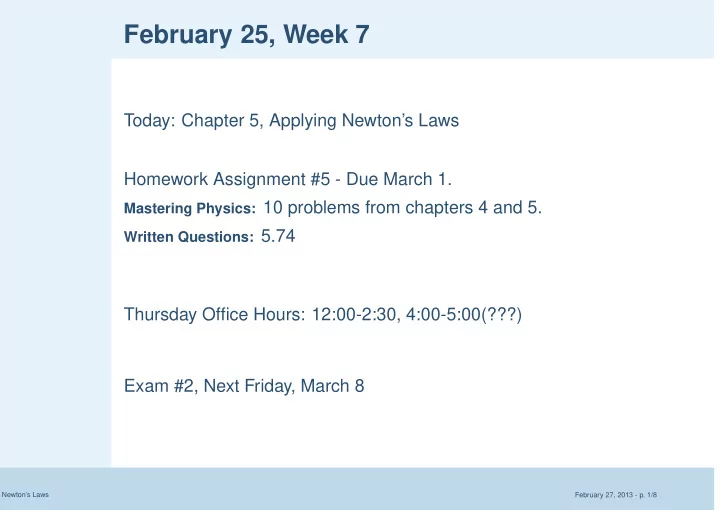
February 25, Week 7

Today: Chapter 5, Applying Newton’s Laws Homework Assignment #5 - Due March 1.

Mastering Physics: 10 problems from chapters 4 and 5. Written Questions: 5.74

Thursday Office Hours: 12:00-2:30, 4:00-5:00(???) Exam #2, Next Friday, March 8

slide-2
SLIDE 2

Newton’s Laws February 27, 2013 - p. 2/8

Maximum Static Friction

Experiments show that the static friction’s maximum value

  • beys a simple equation.
slide-3
SLIDE 3

Newton’s Laws February 27, 2013 - p. 2/8

Maximum Static Friction

Experiments show that the static friction’s maximum value

  • beys a simple equation.

fs,max = µsn

slide-4
SLIDE 4

Newton’s Laws February 27, 2013 - p. 2/8

Maximum Static Friction

Experiments show that the static friction’s maximum value

  • beys a simple equation.

fs,max = µsn

slide-5
SLIDE 5

Newton’s Laws February 27, 2013 - p. 2/8

Maximum Static Friction

Experiments show that the static friction’s maximum value

  • beys a simple equation.

fs,max = µsn Example: A wooden block is placed on a wooden ramp which is initially hor-

  • izontal. When the ramp is

slowly raised, at what an- gle will the block begin to slide?

slide-6
SLIDE 6

Newton’s Laws February 27, 2013 - p. 3/8

Static Friction Exercise

A 50 N crate is placed on a horizontal surface. The coefficient

  • f static friction between the crate and the table is 0.5. A

horizontal force of 15 N is applied to the crate. It does not

  • move. How much static friction is acting on the crate?

15 N

slide-7
SLIDE 7

Newton’s Laws February 27, 2013 - p. 3/8

Static Friction Exercise

A 50 N crate is placed on a horizontal surface. The coefficient

  • f static friction between the crate and the table is 0.5. A

horizontal force of 15 N is applied to the crate. It does not

  • move. How much static friction is acting on the crate?

15 N (a) 0.5 N

slide-8
SLIDE 8

Newton’s Laws February 27, 2013 - p. 3/8

Static Friction Exercise

A 50 N crate is placed on a horizontal surface. The coefficient

  • f static friction between the crate and the table is 0.5. A

horizontal force of 15 N is applied to the crate. It does not

  • move. How much static friction is acting on the crate?

15 N (a) 0.5 N (b) 15 N

slide-9
SLIDE 9

Newton’s Laws February 27, 2013 - p. 3/8

Static Friction Exercise

A 50 N crate is placed on a horizontal surface. The coefficient

  • f static friction between the crate and the table is 0.5. A

horizontal force of 15 N is applied to the crate. It does not

  • move. How much static friction is acting on the crate?

15 N (a) 0.5 N (b) 15 N (c) 25 N

slide-10
SLIDE 10

Newton’s Laws February 27, 2013 - p. 3/8

Static Friction Exercise

A 50 N crate is placed on a horizontal surface. The coefficient

  • f static friction between the crate and the table is 0.5. A

horizontal force of 15 N is applied to the crate. It does not

  • move. How much static friction is acting on the crate?

15 N (a) 0.5 N (b) 15 N (c) 25 N (d) 50 N

slide-11
SLIDE 11

Newton’s Laws February 27, 2013 - p. 3/8

Static Friction Exercise

A 50 N crate is placed on a horizontal surface. The coefficient

  • f static friction between the crate and the table is 0.5. A

horizontal force of 15 N is applied to the crate. It does not

  • move. How much static friction is acting on the crate?

15 N (a) 0.5 N (b) 15 N (c) 25 N (d) 50 N (e) 65 N

slide-12
SLIDE 12

Newton’s Laws February 27, 2013 - p. 3/8

Static Friction Exercise

A 50 N crate is placed on a horizontal surface. The coefficient

  • f static friction between the crate and the table is 0.5. A

horizontal force of 15 N is applied to the crate. It does not

  • move. How much static friction is acting on the crate?

15 N (a) 0.5 N (b) 15 N (c) 25 N (d) 50 N (e) 65 N Problem never specified that fs at max Fx = 0 ⇒ fs − 15 N = 0

slide-13
SLIDE 13

Newton’s Laws February 27, 2013 - p. 4/8

Kinetic Friction

Kinetic Friction - − → fk, sliding friction.

slide-14
SLIDE 14

Newton’s Laws February 27, 2013 - p. 4/8

Kinetic Friction

Kinetic Friction - − → fk, sliding friction. Experiments show that the kinetic friction’s value is approximately constant and obeys a simple equation. fk = µkn

slide-15
SLIDE 15

Newton’s Laws February 27, 2013 - p. 4/8

Kinetic Friction

Kinetic Friction - − → fk, sliding friction. Experiments show that the kinetic friction’s value is approximately constant and obeys a simple equation. fk = µkn

slide-16
SLIDE 16

Newton’s Laws February 27, 2013 - p. 5/8

Kinetic Friction Exercise I

A wooden block is sliding down a 37◦ wooden incline. What is its acceleration? α = 37◦

slide-17
SLIDE 17

Newton’s Laws February 27, 2013 - p. 5/8

Kinetic Friction Exercise I

A wooden block is sliding down a 37◦ wooden incline. What is its acceleration? α = 37◦ − → n − → w

→ fk − → w

slide-18
SLIDE 18

Newton’s Laws February 27, 2013 - p. 5/8

Kinetic Friction Exercise I

A wooden block is sliding down a 37◦ wooden incline. What is its acceleration? α = 37◦ − → n − → w

→ fk − → w

(a) a = g (sin α + µk cos α) = 7.45 m/s2

slide-19
SLIDE 19

Newton’s Laws February 27, 2013 - p. 5/8

Kinetic Friction Exercise I

A wooden block is sliding down a 37◦ wooden incline. What is its acceleration? α = 37◦ − → n − → w

→ fk − → w

(a) a = g (sin α + µk cos α) = 7.45 m/s2 (b) a = g (sin α − µk cos α) = 4.33 m/s2

slide-20
SLIDE 20

Newton’s Laws February 27, 2013 - p. 5/8

Kinetic Friction Exercise I

A wooden block is sliding down a 37◦ wooden incline. What is its acceleration? α = 37◦ − → n − → w

→ fk − → w

(a) a = g (sin α + µk cos α) = 7.45 m/s2 (b) a = g (sin α − µk cos α) = 4.33 m/s2 (c) a = g (cos α + µk cos α) = 9.39 m/s2

slide-21
SLIDE 21

Newton’s Laws February 27, 2013 - p. 5/8

Kinetic Friction Exercise I

A wooden block is sliding down a 37◦ wooden incline. What is its acceleration? α = 37◦ − → n − → w

→ fk − → w

(a) a = g (sin α + µk cos α) = 7.45 m/s2 (b) a = g (sin α − µk cos α) = 4.33 m/s2 (c) a = g (cos α + µk cos α) = 9.39 m/s2 (d) a = g (cos α − µk cos α) = 6.26 m/s2

slide-22
SLIDE 22

Newton’s Laws February 27, 2013 - p. 5/8

Kinetic Friction Exercise I

A wooden block is sliding down a 37◦ wooden incline. What is its acceleration? α = 37◦ − → n − → w

→ fk − → w

(a) a = g (sin α + µk cos α) = 7.45 m/s2 (b) a = g (sin α − µk cos α) = 4.33 m/s2 (c) a = g (cos α + µk cos α) = 9.39 m/s2 (d) a = g (cos α − µk cos α) = 6.26 m/s2 (e) a = g (sin α − µk sin α) = 4.72 m/s2

slide-23
SLIDE 23

Newton’s Laws February 27, 2013 - p. 5/8

Kinetic Friction Exercise I

A wooden block is sliding down a 37◦ wooden incline. What is its acceleration? α = 37◦ − → n − → w

→ fk − → w

(a) a = g (sin α + µk cos α) = 7.45 m/s2 (b) a = g (sin α − µk cos α) = 4.33 m/s2 (c) a = g (cos α + µk cos α) = 9.39 m/s2 (d) a = g (cos α − µk cos α) = 6.26 m/s2 (e) a = g (sin α − µk sin α) = 4.72 m/s2

slide-24
SLIDE 24

Newton’s Laws February 27, 2013 - p. 5/8

Kinetic Friction Exercise I

A wooden block is sliding down a 37◦ wooden incline. What is its acceleration? α = 37◦ − → n − → w

→ fk − → w

(b) a = g (sin α − µk cos α) = 4.33 m/s2 F⊥ = Ma⊥ ⇒ n − w⊥ = 0 ⇒ n = w⊥ = Mg cos α F = Ma⊥ ⇒ w − fk = Ma ⇒ Mg sin α − µkMg cos α = Ma

slide-25
SLIDE 25

Newton’s Laws February 27, 2013 - p. 6/8

Kinetic Friction Exercise II

A 5.0 kg wooden block is given a push and slides up a 37◦ wooden incline. After the pushing force is removed but the block is still going up the incline, which of the following is a correct statement about the block’s acceleration?

slide-26
SLIDE 26

Newton’s Laws February 27, 2013 - p. 6/8

Kinetic Friction Exercise II

A 5.0 kg wooden block is given a push and slides up a 37◦ wooden incline. After the pushing force is removed but the block is still going up the incline, which of the following is a correct statement about the block’s acceleration? (a) The acceleration’s magnitude is larger than 4.33 m/s2.

slide-27
SLIDE 27

Newton’s Laws February 27, 2013 - p. 6/8

Kinetic Friction Exercise II

A 5.0 kg wooden block is given a push and slides up a 37◦ wooden incline. After the pushing force is removed but the block is still going up the incline, which of the following is a correct statement about the block’s acceleration? (a) The acceleration’s magnitude is larger than 4.33 m/s2. (b) The acceleration’s magnitude is smaller than 4.33 m/s2.

slide-28
SLIDE 28

Newton’s Laws February 27, 2013 - p. 6/8

Kinetic Friction Exercise II

A 5.0 kg wooden block is given a push and slides up a 37◦ wooden incline. After the pushing force is removed but the block is still going up the incline, which of the following is a correct statement about the block’s acceleration? (a) The acceleration’s magnitude is larger than 4.33 m/s2. (b) The acceleration’s magnitude is smaller than 4.33 m/s2. (c) The acceleration’s magnitude is equal to 4.33 m/s2.

slide-29
SLIDE 29

Newton’s Laws February 27, 2013 - p. 6/8

Kinetic Friction Exercise II

A 5.0 kg wooden block is given a push and slides up a 37◦ wooden incline. After the pushing force is removed but the block is still going up the incline, which of the following is a correct statement about the block’s acceleration? (a) The acceleration’s magnitude is larger than 4.33 m/s2. (b) The acceleration’s magnitude is smaller than 4.33 m/s2. (c) The acceleration’s magnitude is equal to 4.33 m/s2. (d) We cannot determine the acceleration without knowing the pushing force.

slide-30
SLIDE 30

Newton’s Laws February 27, 2013 - p. 6/8

Kinetic Friction Exercise II

A 5.0 kg wooden block is given a push and slides up a 37◦ wooden incline. After the pushing force is removed but the block is still going up the incline, which of the following is a correct statement about the block’s acceleration? (a) The acceleration’s magnitude is larger than 4.33 m/s2. (b) The acceleration’s magnitude is smaller than 4.33 m/s2. (c) The acceleration’s magnitude is equal to 4.33 m/s2. (d) We cannot determine the acceleration without knowing the pushing force. (e) Intentionally left blank

slide-31
SLIDE 31

Newton’s Laws February 27, 2013 - p. 6/8

Kinetic Friction Exercise II

A 5.0 kg wooden block is given a push and slides up a 37◦ wooden incline. After the pushing force is removed but the block is still going up the incline, which of the following is a correct statement about the block’s acceleration? (a) The acceleration’s magnitude is larger than 4.33 m/s2. (b) The acceleration’s magnitude is smaller than 4.33 m/s2. (c) The acceleration’s magnitude is equal to 4.33 m/s2. (d) We cannot determine the acceleration without knowing the pushing force. (e) Intentionally left blank

slide-32
SLIDE 32

Newton’s Laws February 27, 2013 - p. 6/8

Kinetic Friction Exercise II

A 5.0 kg wooden block is given a push and slides up a 37◦ wooden incline. After the pushing force is removed but the block is still going up the incline, which of the following is a correct statement about the block’s acceleration? (a) The acceleration’s magnitude is larger than 4.33 m/s2. α − → n − → w

→ fk − → w

slide-33
SLIDE 33

Newton’s Laws February 27, 2013 - p. 7/8

Objects in Contact

When objects are in contact with each other and being pushed, they must have an equal acceleration.

slide-34
SLIDE 34

Newton’s Laws February 27, 2013 - p. 7/8

Objects in Contact

When objects are in contact with each other and being pushed, they must have an equal acceleration.

A B

slide-35
SLIDE 35

Newton’s Laws February 27, 2013 - p. 7/8

Objects in Contact

When objects are in contact with each other and being pushed, they must have an equal acceleration.

A B

aA = aB

slide-36
SLIDE 36

Newton’s Laws February 27, 2013 - p. 8/8

Contact Exercise I

A 5 kg mass A is placed in front of a 7 kg mass B on a frictionless table. If a 12 N force is applied to mass A, what is the acceleration of the masses?

A B

12 N

slide-37
SLIDE 37

Newton’s Laws February 27, 2013 - p. 8/8

Contact Exercise I

A 5 kg mass A is placed in front of a 7 kg mass B on a frictionless table. If a 12 N force is applied to mass A, what is the acceleration of the masses?

A B

12 N (a) 12 N 5 kg = 2.4 m/s2

slide-38
SLIDE 38

Newton’s Laws February 27, 2013 - p. 8/8

Contact Exercise I

A 5 kg mass A is placed in front of a 7 kg mass B on a frictionless table. If a 12 N force is applied to mass A, what is the acceleration of the masses?

A B

12 N (a) 12 N 5 kg = 2.4 m/s2 (b) 12 N 7 kg = 1.7 m/s2

slide-39
SLIDE 39

Newton’s Laws February 27, 2013 - p. 8/8

Contact Exercise I

A 5 kg mass A is placed in front of a 7 kg mass B on a frictionless table. If a 12 N force is applied to mass A, what is the acceleration of the masses?

A B

12 N (a) 12 N 5 kg = 2.4 m/s2 (b) 12 N 7 kg = 1.7 m/s2 (c) 12 N 12 kg = 1 m/s2

slide-40
SLIDE 40

Newton’s Laws February 27, 2013 - p. 8/8

Contact Exercise I

A 5 kg mass A is placed in front of a 7 kg mass B on a frictionless table. If a 12 N force is applied to mass A, what is the acceleration of the masses?

A B

12 N (a) 12 N 5 kg = 2.4 m/s2 (b) 12 N 7 kg = 1.7 m/s2 (c) 12 N 12 kg = 1 m/s2 (d) 24 N 5 kg = 4.8 m/s2

slide-41
SLIDE 41

Newton’s Laws February 27, 2013 - p. 8/8

Contact Exercise I

A 5 kg mass A is placed in front of a 7 kg mass B on a frictionless table. If a 12 N force is applied to mass A, what is the acceleration of the masses?

A B

12 N (a) 12 N 5 kg = 2.4 m/s2 (b) 12 N 7 kg = 1.7 m/s2 (c) 12 N 12 kg = 1 m/s2 (d) 24 N 5 kg = 4.8 m/s2 (e) 24 N 12 kg = 2 m/s2

slide-42
SLIDE 42

Newton’s Laws February 27, 2013 - p. 8/8

Contact Exercise I

A 5 kg mass A is placed in front of a 7 kg mass B on a frictionless table. If a 12 N force is applied to mass A, what is the acceleration of the masses?

A B

12 N Treat as single object (a) 12 N 5 kg = 2.4 m/s2 (b) 12 N 7 kg = 1.7 m/s2 (c) 12 N 12 kg = 1 m/s2 (d) 24 N 5 kg = 4.8 m/s2 (e) 24 N 12 kg = 2 m/s2