FEBRUARY 2010 REVENUE TRACKING Presented to the Legislative Finance - - PDF document

february 2010 revenue tracking presented to the
SMART_READER_LITE
LIVE PREVIEW

FEBRUARY 2010 REVENUE TRACKING Presented to the Legislative Finance - - PDF document

FEBRUARY 2010 REVENUE TRACKING Presented to the Legislative Finance Committee April 22, 2010 Thomas Clifford, Chief Economist & Becky Gutierrez, Senior Economist BACKGROUND In January of this year LFC began publishing a monthly revenue


slide-1
SLIDE 1

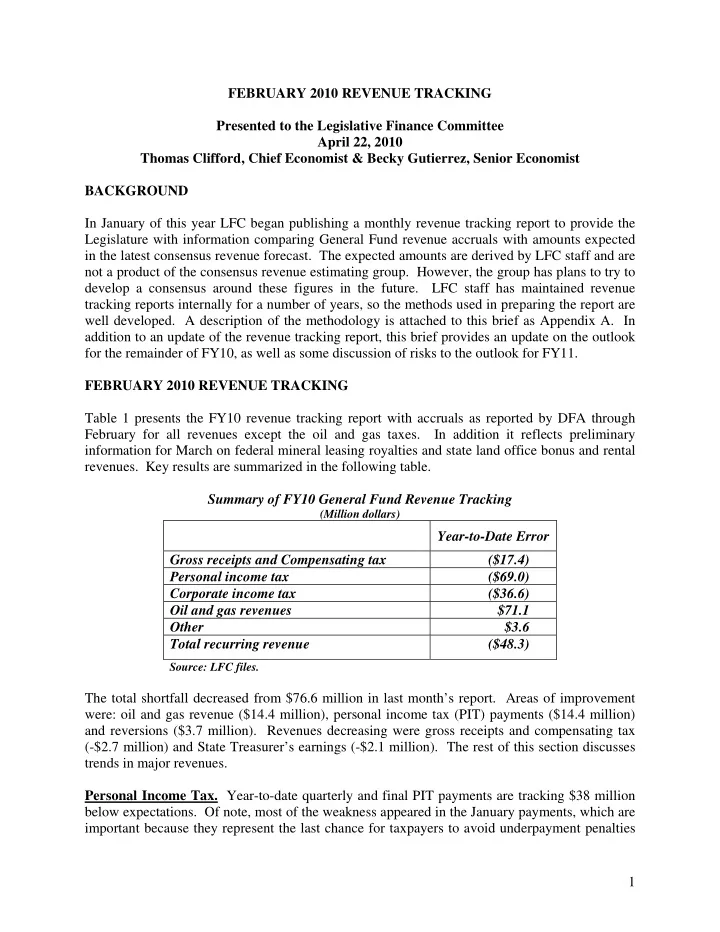
FEBRUARY 2010 REVENUE TRACKING Presented to the Legislative Finance Committee April 22, 2010 Thomas Clifford, Chief Economist & Becky Gutierrez, Senior Economist BACKGROUND In January of this year LFC began publishing a monthly revenue tracking report to provide the Legislature with information comparing General Fund revenue accruals with amounts expected in the latest consensus revenue forecast. The expected amounts are derived by LFC staff and are not a product of the consensus revenue estimating group. However, the group has plans to try to develop a consensus around these figures in the future. LFC staff has maintained revenue tracking reports internally for a number of years, so the methods used in preparing the report are well developed. A description of the methodology is attached to this brief as Appendix A. In addition to an update of the revenue tracking report, this brief provides an update on the outlook for the remainder of FY10, as well as some discussion of risks to the outlook for FY11. FEBRUARY 2010 REVENUE TRACKING Table 1 presents the FY10 revenue tracking report with accruals as reported by DFA through February for all revenues except the oil and gas taxes. In addition it reflects preliminary information for March on federal mineral leasing royalties and state land office bonus and rental

  • revenues. Key results are summarized in the following table.

Summary of FY10 General Fund Revenue Tracking

(Million dollars)

Year-to-Date Error Gross receipts and Compensating tax ($17.4) Personal income tax ($69.0) Corporate income tax ($36.6) Oil and gas revenues $71.1 Other $3.6 Total recurring revenue ($48.3)

Source: LFC files.

The total shortfall decreased from $76.6 million in last month’s report. Areas of improvement were: oil and gas revenue ($14.4 million), personal income tax (PIT) payments ($14.4 million) and reversions ($3.7 million). Revenues decreasing were gross receipts and compensating tax (-$2.7 million) and State Treasurer’s earnings (-$2.1 million). The rest of this section discusses trends in major revenues. Personal Income Tax. Year-to-date quarterly and final PIT payments are tracking $38 million below expectations. Of note, most of the weakness appeared in the January payments, which are important because they represent the last chance for taxpayers to avoid underpayment penalties 1

slide-2
SLIDE 2

for the full year. Refund claims are 2 percent greater than last year’s and $22 million above the amount expected. Although withholding payments have been slightly below the forecast of no growth for the year, the actual decrease in these payments is greater because FY09 amounts were reduced by accounting adjustments. After adjusting for that timing change, FY10 withholding payments through February are down 6.5 percent. Fiduciary payments have been below forecast, but oil and gas withholding is tracking close to forecast amounts. Corporate Income Tax. Accruals of corporate income tax were only $30 million in the first eight months of the fiscal year, about $36.6 million less than forecast. Reports from TRD’s Gentax system suggest that gross payments during the period were about $122 million, so that refund claims and film credits were about $90 million (some of the receipts have gone into increased cash balances at TRD). Cash deposits for March – when tax return payments were due – were $38 million, about 37 percent less than the same month last year. Gross receipts and compensating tax. GRT accruals are down 13 percent for the first eight months of the fiscal year, $12.5 million less than expected. A decrease of 7 percent was forecast for the full year. Some improvement of year-over-year growth is expected because revenues began to decline sharply last spring. Compensating tax collections are down 37 percent from the same period last year, tracking $4.6 million below the forecast. Figure 1 shows that taxable gross receipts first fell sharply in the third quarter in FY09. The FY10 estimate assumed large negative growth in the first two quarters (average of -12.5%) and relatively small negative growth in the last two quarters (average of -2%). The third quarter is not looking as strong as the consensus had estimated, with an average 11.4 percent decrease in January and February. The third quarter was estimated to decrease 2.7 percent and in order to meet this estimate March TGR would have to increase 14.5 percent over FY09. Figure 1

Monthly Taxable Gross Receipts

  • 20.00%
  • 15.00%
  • 10.00%
  • 5.00%

0.00% 5.00% 10.00% 15.00% 20.00%

  • Jul. 08
  • Aug. 08
  • Sept. 08
  • Oct. 08
  • Nov. 08
  • Dec. 08
  • Jan. 09
  • Feb. 09
  • Mar. 09
  • Apr. 09

May 09

  • Jun. 09
  • Jul. 09
  • Aug. 09
  • Sept. 09
  • Oct. 09
  • Nov. 09
  • Dec. 09
  • Jan. 10
  • Feb. 10

Percent Change vs. Year Ago $3.5 $3.6 $3.7 $3.8 $3.9 $4.0 $4.1 $4.2 $4.3 $4.4 $ in billions

% Change 3-month Moving Average

2

slide-3
SLIDE 3

Oil and gas revenues. Although oil and gas revenues are down by 34 percent in the first eight months of the year, much of that weakness was built in to the December 2009 revenue forecast. During the winter months natural gas prices rose well above the levels expected in the December consensus forecast. As a consequence, monthly revenue transfers have been $71.1 million above the amounts expected. As illustrated in Figure 2, the last sales month with high spot prices was February, which determines the February accrual of O&G school taxes and the May accrual of federal leasing revenue. After that both revenues will likely fall back closer to the forecast. State Land Office revenue from lease bonus payments has been up sharply from the forecast. According to the Land Office, there has been a great deal of industry interest in leases enabling access to shale formations in the Permian Basin. Most of those leases have already been awarded, so the Office expects bonus payments to drop significantly in future months. YEAR-TO-DATE AND FULL YEAR GROWTH RATES Table 2 compares actual revenue in the first eight months of the fiscal year with amounts collected in the same period last year and also with the amounts forecast for the full year.

Revenue Category Year-to-date growth Projected full year growth: December 2009 Forecast FY09 FY10 General sales taxes $1,287.5 $1,123.2

  • 13%
  • 7%

Personal income tax $569.4 $504.1

  • 11%

3% Corporate income tax* $121.5 $30.2

  • 75%
  • 17%

Oil & gas revenues $781.8 $513.6

  • 34%
  • 30%

Investment income & other $838.0 $578.3

  • 31%
  • 5%

Total recurring revenue $3,598.2 $2,936.7

  • 18%
  • 9%

Total excluding oil & gas $2,816.4 $2,423.1

  • 14%
  • 5%

*FY09 pattern of distributions adjusted to exclude accrual method changes during the year.

(dollar amounts in millions) Fiscal Year-to-Date through February 2010 General Fund Revenue Accruals Growth FY10 vs. FY09 Table 2

 Total recurring revenue was down 18 percent compared with FY09. This is unchanged from last month. 9 percent decline is forecast for the full year.  Excluding oil and gas revenues revenue is down by 14 percent compared with a 5 percent decline forecast for the full year.  Gross receipts and compensating taxes were down by 13 percent compared with a 7 percent full year forecast decline.  Personal income tax was down 11 percent compared with 3 percent growth forecast for the full year.  Corporate income tax was down 75 percent compared with 17 percent decline for the full

  • year. These values were adjusted to reflect accounting changes introduced in the middle of

FY09.  Oil and gas revenues were down 34 percent compared with a 30 percent full year forecast decline. 3

slide-4
SLIDE 4

NATURAL GAS PRICE TRENDS Figure 2 presents recent trends in Natural Gas prices. Spot prices at the Henry Hub in Louisiana rose during the winter months but have fallen by roughly one-third in the last two months – from almost $6.00 in January to less than $4.00 in late March. Industry specialists cite concerns about sluggish economic growth, relatively high inventories and sharply increasing supplies from shale and tight sands formations. On a positive note, for the seventh straight month January taxable gas value reported on New Mexico tax returns significantly exceeded spot prices reported by various industry surveys. Industry specialists have noted that declining supplies in the western producing basins have increased prices relative to eastern markets like the Henry Hub. However, their analysis does not explain as large a positive differential as seen in recent months. Since the “differential” between taxable value and spot prices is an important part of the forecast assumptions, we have requested the assistance of TRD’s Oil and Gas Audit Bureau in researching why the state has been receiving such a large positive price differential. In addition, we have contacted industry representatives to see if they can help to explain these trends.

Source: Henry Hub spot price from Conoco-Phillips daily reports.

Figure 2 Natural Gas Prices

$2.00 $2.50 $3.00 $3.50 $4.00 $4.50 $5.00 $5.50 $6.00 $6.50 $7.00 Jan 09 Feb 09 Mar 09 Apr 09 May 09 Jun 09 Jul 09 Aug 09 Sep 09 Oct 09 Nov 09 Dec 09 Jan 10 Feb 10 Mar 10 Apr 10 Price per thousand cubic feet Henry Hub ONGARD

TIMELINE FOR REVENUE REPORTS Key reports and timelines in the revenue tracking process are as follows: Daily Deposit TRD Batch Reports. These reports are provided by TRD about once per week and more frequently during income tax return season. For some programs, these reports provide a good snapshot of the amount that will be accrued in the General Fund for that month. Combined revenue system (CRS) deposits include withholding payments and local government GRT amounts as well as General Fund GRT and are therefore not as useful in predicting

  • accruals. Accrual of corporate income tax payments is often delayed because the payments are

not matched to a return. 4

slide-5
SLIDE 5

5 CRS Month-End Matrix. Provides details of the distributions for the CRS program: GRT, withholding, compensating tax, governmental GRT, etc. Usually available about one and a half months after the revenue accrual period. TRD Gentax Distribution Report. Provides detailed information on cash flows and accounting adjustments in each tax program managed by TRD. This report is usually available one to two months after the revenue accrual period. DFA General Fund Report. This report is the final record of revenue accruals. Usually available within two months after the end of the accrual period. Timeline for PIT reports. Preliminary information on cash deposits with PIT returns will be available around the middle of May. This will allow time to account for payments received at the end of the month but not actually deposited until early May. TRD has also offered to provide a weekly report on refund payments through the PIT processing season. Thus, we should have a reasonable picture of the results of the PIT processing season by the third week of May. Year-end accruals. After the end of the fiscal year, TRD and DFA apply modified accrual accounting procedures to determine how much revenue that is processed after the end of the year should be accrued to the prior fiscal year. In some previous years these amounts have been

  • significant. In FY09, however, the year-end accruals were consistent with expectations. If a

large amount of revenue is accrued to the end of the fiscal year, it could have a positive impact

  • n FY10 but the implications for FY11 would be negative.

FY10 solvency actions will generate an unusually large amount of reversions, but most of this revenue should be regarded as non-recurring. U.S. AND NEW MEXICO ECONOMIC INDICATORS Table 3 attached presents updated economic and oil and gas indicators. According to Global Insight, the U.S. economic outlook is largely unchanged since the December forecast. GDP growth and inflation are expected to remain subdued until the second half of FY11. New Mexico’s economic outlook in FY11 is weaker than forecast in December. Personal income growth is significantly weaker due to downward data revisions on personal income and

  • employment. Employment and wage and salary growth are down about 1 percent each in FY11.
slide-6
SLIDE 6

###### 4/20/10 2:13 PM

FY10 Row July Aug Sept Oct Nov Dec Jan Feb Mar Apr May June Actual + % Chng FY 10 YTD YTD FY09 Row # Act. Act. Act. Act. Act. Act. Act. Act. Est. Est. Est. Est. Forecast FY09

  • Dec. 09 Est% Error $ Error

Actual # 1 Gross Receipts Tax 127.6 140.6 132.7 133.6 137.7 156.4 133.3 129.0 144.5 141.2 148.9 164.0 1,689.5

  • 7.8%

1,702.0

  • 0.7%

(12.5) 1,831.9 1 2 Compensating Tax 4.0 3.9 4.6 4.0 4.4 5.0 2.8 3.7 5.8 4.7 4.7 5.6 53.0

  • 24.2%

58.0

  • 8.6%

(5.0) 69.9 2 3 TOTAL GENERAL SALES TAXES 131.5 144.5 137.3 137.6 142.0 161.4 136.1 132.7 150.3 145.9 153.6 169.6 1,742.6

  • 8.4%

1,760.0

  • 1.0%

(17.4) 1,901.9 3 4 Tobacco Products & Cigarette Taxes 3.2 3.5 4.6 4.1 3.3 3.1 4.1 4.2 3.6 4.3 4.6 4.4 47.0

  • 5.1%

47.2

  • 0.4%

(0.2) 49.6 4 5 Liquor Excise Tax 2.1 2.2 2.2 2.2 2.1 2.6 1.5 1.8 2.2 2.0 1.7 2.9 25.5

  • 1.2%

26.5

  • 3.5%

(0.9) 25.8 5 6 Insurance Premiums Tax 1.4 34.3 0.3 3.8 31.6 0.4 1.1 26.2 2.9 0.8 35.5 0.2 138.5 13.6% 133.9 3.4% 4.6 121.9 6 7 Fire Protection Fund Reversion 0.0 0.0 0.0 0.0 0.0 0.0 0.0 0.0 0.0 0.0 0.0 21.7 21.7

  • 29.6%

21.7 0.0% 0.0 30.8 7 8 Motor Vehicle Excise Tax 8.2 8.1 9.2 7.3 5.9 6.4 6.9 6.9 8.1 7.3 7.7 8.1 90.0

  • 10.4%

92.5

  • 2.7%

(2.5) 100.5 8 9 Gaming Excise Tax 5.4 5.1 5.0 5.2 4.9 5.1 5.5 5.8 6.0 5.7 6.8 5.6 66.4

  • 4.1%

65.3 1.6% 1.1 69.2 9 10 Leased Vehicle Surcharge 1.0 0.5 0.7 0.4 0.4 0.3 0.3 0.3 0.4 0.4 0.4 0.6 5.6 14.7% 5.5 2.6% 0.1 4.9 10 11 Other 0.4 0.1 0.2 0.1 0.1 0.0 0.8 0.3 0.1 0.2 0.0 0.2 2.6 301.8% 1.9 40.1% 0.8 0.7 11 12 TOTAL SELECTIVE SALES TAXES $21.8 $53.8 $22.2 $23.1 $48.3 $18.0 $20.2 $45.5 $23.4 $20.7 $56.9 $43.8 397.7

  • 1.4%

394.5 0.8% 3.2 403.4 12 13 Withholding 87.6 68.6 79.9 80.5 68.1 105.5 70.7 70.7 83.7 74.0 71.9 83.0 944.2

  • 1.3%

950.2

  • 0.6%

(6.0) 956.9 13 14 Final Settlements & Estimated Payments 24.3 12.0 36.1 13.5 8.2 13.0 43.7 8.0 20.3 73.8 35.9 58.2 347.0

  • 6.5%

385.0

  • 9.9%

(38.0) 371.1 14 15 Oil and Gas Withholding Tax 0.3

  • 0.1

1.1 6.4 0.0 0.4 5.7 0.5 4.3 3.5 0.8 7.5 30.5 17.7% 30.0 1.6% 0.5 25.9 15 16 Fiduciary Tax 0.0 0.3

  • 0.1
  • 3.0
  • 0.6

0.9 0.0 0.0 1.0 1.7 1.1 0.1 1.4

  • 89.7%

5.0

  • 71.8%

(3.6) 13.7 16 17 GROSS PERSONAL INCOME TAX 112.3 80.9 117.0 97.4 75.6 119.8 120.1 79.2 109.3 153.0 109.8 148.9 1,323.2

  • 3.2%

1,370.2

  • 3.4%

(47.0) 1,367.2 17 18 Less: Refunds, distributions to other funds 8.4 7.7 12.7 23.6 8.1 102.2 79.2 56.4 52.8 26.8 15.6 9.4 402.7

  • 1.5%

380.7 5.8% 22.0 408.7 18 19 NET PERSONAL INCOME TAX 103.8 73.2 104.3 73.9 67.5 17.7 40.8 22.8 56.5 126.2 94.2 139.4 920.5

  • 4.0%

989.5

  • 7.0%

(69.0) 958.5 19 20 NET CORPORATE INCOME TAX

  • 2.7

1.0

  • 1.4

32.6

  • 9.0
  • 8.4

12.6 5.3 5.8 31.5 24.8 31.2 123.4

  • 24.0%

160.0

  • 22.9%

(36.6) 162.5 20 22 Oil and Gas School Tax 22.6 25.0 21.3 26.4 28.3 29.7 34.7 24.1 24.2 24.0 24.3 24.1 308.7

  • 16.6%

290.8 6.2% 17.9 370.4 22 23 Oil Conservation Tax 1.1 1.3 1.1 1.3 1.4 1.5 1.7 1.3 1.3 1.3 1.3 1.3 15.9

  • 12.9%

15.3 4.2% 0.6 18.3 23 24 Resources Excise Tax 0.6 0.3 1.3 0.8 0.7 1.2 0.8 0.7 0.4 1.2 1.1 0.9 10.1

  • 10.4%

10.0 0.7% 0.1 11.2 24 25 Natural Gas Processors Tax 3.5 2.9 4.2 3.7 3.5 3.3 3.2 3.0 3.4 3.4 3.8 3.2 41.0 1.6% 41.0 0.0% 0.0 40.3 25 26 TOTAL MINERAL PROD. TAXES 27.9 29.5 27.9 32.3 33.9 35.7 40.4 29.0 29.3 29.9 30.4 29.5 375.7

  • 14.6%

357.1 5.2% 18.7 440.2 26 27 LICENSE FEES 2.2 1.9 1.9 1.8 1.9 7.5 1.9 4.1 8.1 10.5 2.9 2.8 47.5

  • 5.3%

47.5

  • 0.1%

0.0 50.1 27 28 Land Grant Perm. Fund Distributions 36.4 36.4 36.4 36.4 36.4 36.4 36.4 36.4 36.4 36.4 36.4 36.3 436.8 0.8% 436.5 0.1% 0.3 433.5 28 29 State Treasurer's Earnings 3.5 1.8 1.6 1.0 1.4 5.4 0.1 1.2 2.5 0.3 3.4

  • 4.1

17.8

  • 73.7%

21.5

  • 17.0%

(3.7) 67.8 29 30 Severance Tax Perm. Fund Distributions 15.6 15.6 15.6 15.6 15.6 15.6 15.6 15.6 15.6 15.6 15.6 15.6 187.1

  • 2.2%

187.1 0.0% (0.0) 191.3 30 31 TOTAL INVESTMENT EARNINGS 55.5 53.8 53.6 53.0 53.4 57.4 52.1 53.2 54.5 52.2 55.3 47.7 641.7

  • 7.3%

645.1

  • 0.5%

(3.4) 692.5 31 32 Federal Mineral Leasing Royalties 22.8 22.5 23.8 27.2 27.5 19.9 34.6 34.7 35.4 28.5 26.6 29.3 332.9

  • 34.4%

301.0 10.6% 31.9 507.2 32 33 State Land Office Bonuses, Rents 1.6 6.0 9.5 4.7 5.9 4.7 6.4 4.8 6.8 1.2 1.2 1.3 54.4 49.2% 33.8 60.9% 20.6 36.4 33 34 TOTAL RENTS & ROYALTIES 24.4 28.5 33.3 32.0 33.5 24.7 41.1 39.5 42.3 29.7 27.8 30.6 387.2

  • 28.8%

334.8 15.7% 52.4 543.7 34 35 TRIBAL REVENUE SHARING 0.1 0.0 16.2 0.1 0.0 15.6 0.2 0.0 14.2 0.7 6.2 10.0 63.1

  • 3.5%

63.1 0.0% 0.0 65.4 35 36 MISCELLANEOUS RECEIPTS 1.4 1.1 1.4 2.0 1.4 1.5 3.1 1.3 3.4 5.9 2.5 17.1 42.1

  • 5.0%

41.8 0.8% 0.4 44.3 36 37 REVERSIONS 0.0 0.0 0.0 1.0 3.7 1.7 0.7 5.2 2.6 2.3 1.6 14.7 33.5

  • 41.5%

30.0 11.6% 3.5 57.3 37 38 TOTAL RECURRING REVENUE 365.9 387.4 396.7 389.3 376.8 332.8 349.2 338.6 390.2 455.5 456.2 536.4 4,775.0

  • 10.2%

4,823.3

  • 1.0%

(48.3) 5,319.8 38 39 HB3 - Laws 2009 SS, Chapter 2 0.0 0.0 0.0 0.0 0.0 33.3 5.0 0.1 0.0 0.0 0.0 69.4 107.8 NA 107.8 NA 0.0 0.0 39 40 HB16 - Laws 2009 SS, Chapter 4 0.0 0.0 0.0 0.0 0.0 0.0 0.0 0.7 0.0 0.0 0.0 0.0 0.7 NA 0.7 NA 0.0 0.0 40 41 HB17 - Laws 2009 SS, Chapter 5 0.0 0.0 0.0 0.0 0.0 0.0 3.7 0.0 0.0 0.0 0.0 0.0 3.7 NA 3.7 NA 0.0 0.0 41 42 SB29 - Laws 2009 SS, Chapter 7 0.0 0.0 0.0 0.0 0.0 103.3 6.0 0.0 0.0 0.0 0.0 19.9 129.2 NA 129.2 NA 0.0 0.0 42 43 Non-Recurring 0.0 0.0 0.1 0.3 0.5 0.4 0.4 0.0 0.0 0.0 0.0 0.0 1.8 NA 0.0 NA 1.8 425.6 43 44 TOTAL NON-RECURRING REVENUE 0.0 0.0 0.1 0.3 0.5 137.0 15.1 0.7 0.0 0.0 0.0 89.4 243.2 NA 241.4 NA 1.8 425.6 44 45 GRAND TOTAL REVENUE 365.9 387.4 396.8 389.6 377.3 469.8 364.3 339.3 390.2 455.5 456.2 625.8 5,018.2

  • 12.7%

5,064.7

  • 0.9%

(46.5) 5,745.4 45 Table 1

FISCAL YEAR 2010 GENERAL FUND MONTHLY REVENUE TRACKING

(dollars in millions; blue font indicates actual revenue, italics indicate preliminary actual revenue)

TRACKING ERROR ACTUAL REVENUE ACCRUALS FORECAST REVENUE ACCRUAL

slide-7
SLIDE 7

Dec 09 Apr 10 Dec 09 Apr 10 Dec 09 Apr 10 Dec 09 Apr 10 Dec 09 Apr 10 Actuals Estimate Estimate Estimate Estimate Estimate Estimate Estimate Estimate Estimate Estimate NATIONAL ECONOMIC INDICATORS US Real GDP Growth (level annual avg, % yoy)* (2.2) 0.4 0.8 2.4 3.1 3.5 3.3 3.4 3.1 2.6 2.6 US Inflation Rate (CPI, annual avg, % yoy)** 1.4 0.9 1.1 1.5 1.6 2.1 2.3 1.9 2.3 1.8 2.1 Federal Funds Rate (%) 0.70 0.13 0.14 0.78 0.74 2.69 2.69 3.50 3.50 4.02 4.02 NEW MEXICO LABOR MARKET AND INCOME DATA New Mexico NM Non-Agricultural Employment Growth (%) (1.9) (3.5) (3.1) 1.6 0.7 2.0 1.5 1.8 1.7 1.5 1.4 NM Personal Income Growth (%)*** 5.0 (0.5) (0.1) 3.2 1.6 4.5 3.6 4.4 4.3 4.3 4.5 NM Private Wages & Salaries Growth (%) (0.1) (3.1) (3.3) 3.8 2.9 4.1 4.1 4.2 4.4 4.3 4.3 *Real GDP is BEA chained 2005 dollars, billions, annual rate. FY2010 FY2011 Sources: April Global Insight, March FOR-UNM BBER

U.S. AND NEW MEXICO ECONOMIC INDICATORS

**CPI is all urban, BLS 1982-84=1.00 base. FY2014 ***Personal Income growth rates are for the calendar year in which each fiscal year begins. FY2013 FY2012 FY2009

TABLE 3

slide-8
SLIDE 8

1 APPENDIX A General Fund Revenue Tracking Report Methodology Background: For several years, LFC staff has prepared a monthly report to compare actual General Fund revenue collections with the most recent forecast by the consensus revenue estimating group. Given the depth of the current budget crisis, and the heightened interest in the revenue outlook, it seems appropriate that the monthly tracking information should be shared with a wider audience. To that end, a monthly revenue tracking report will be published on the LFC’s website for the information of legislators and others. Many assumptions must be made to prepare a tracking report, and therefore its results should be interpreted with caution. This memo describes methods used to prepare the

  • report. In addition, each monthly report will discuss significant deviations of actual

revenue from the expected amounts. Report methodology: Monthly revenue forecasts are prepared by multiplying the latest annual consensus forecast of each revenue by a fraction representing the average share of total annual collections typically collected in each month. Once monthly forecast values have been determined, the report is updated each month with new information on actual revenue collections. Monthly shares of some taxes are relatively even but for others there is a “lumpy”

  • pattern. A good example is the personal income tax, for which there are large refund

claims and also large amounts paid with returns during tax filing season (January through April). Also, some revenues, like the Insurance Premiums Tax and the Oil and Gas Withholding Tax are paid quarterly. Monthly forecasts of revenues based on oil and gas production are prepared differently. Since these revenues depend primarily on the prices of oil and natural gas, a monthly price forecast is prepared using the annual price forecast of the consensus group. A monthly pattern of prices is based on traditional seasonal patterns as well as information

  • n current year patterns from futures markets. Monthly prices are used to calculate

monthly revenue estimates using the appropriate tax and royalty rates, deductions, etc. How to read the table: Actual receipts recognized by DFA for accrual to the General Fund are shown in blue while preliminary amounts are shown in italics. A column toward the right hand side of the table titled “FY10 Actual + Forecast” provides the total of actual collections for the year to date plus the forecast monthly amounts for the remainder of the year. The next column compares this amount with FY09 collections. The next three columns titled “Tracking Error” compare this amount with the latest consensus forecast for annual

  • collections. Differences from the forecast are shown both in percentage terms and in
slide-9
SLIDE 9

2 actual dollar amounts. The final column shows the FY09 total collections for purposes of comparison. Accounting procedures: General Fund revenues are reported according to modified accrual methods as recommended in Generally Accepted Accounting Principles. For most revenues, this means that they are recognized in the month the cash is transferred to the General Fund by the agency that first collected the money. For some revenues, the revenue is accrued in the period when the revenue is “earned.” For example, gross receipts tax (“GRT”) revenue is accrued in the month prior to the receipt of the revenue by the Taxation and Revenue Department (“TRD”), which is typically two months before the cash is received by the General Fund. This reflects the fact that the sales that give rise to the liability generally occur in the month prior to the due date of the tax return. It then takes approximately a month for TRD to process returns and distribute cash to the General

  • Fund. The same treatment is applied to withholding revenue. Some other revenues –

including personal and corporate income tax payments – are accrued in the month the payments are received by TRD, or one month before cash is received by the General

  • Fund. Oil and gas emergency school taxes are accrued in the period two months before

the revenue is received by TRD – three months before the General Fund receives the cash – because taxpayers are permitted a two-month delay before returns are due for the tax. A new complication has been added to the revenue tracking process in the last two years. In the past, most revenue collected by the Taxation Department was transferred to the General Fund the following month. When new accounting software was implemented, the Department decided to delay distribution until a tax payment has been matched to a

  • return. Since payments of some taxes come in without documentation this results in

amounts being withheld temporarily by the department. Under section 7-1-6.1, the department is required to distribute to the General Fund any such amounts that have been withheld for 60 days. Thus, all amounts due to the General Fund are eventually transferred, but the actual amount transferred in a given month is a combination of amounts received in the current period that were matched to a return plus amounts held for over 60-days and less amounts previously distributed to the General Fund subsequently found to belong in other funds. These procedures sometimes result in General Fund distributions that are substantially different from cash received by the Department in a given month. As more experience is gained, it may be possible to predict the impacts of these adjustments on distributions, but at the present time they still cause substantial uncertainty, especially in the distributions of corporate income tax and personal income tax final settlements and estimated payments. Limitations of the revenue tracking method: The revenue tracking report is not intended to provide a new revenue forecast every

  • month. Thus, for example, the forecast monthly values are not revised each month. Only

the actual amounts received are changed. In addition, the report does not attempt to incorporate new information about future energy prices. The report is intended to provide information on how actual revenue collections for the year-to-date compare with the forecast amounts for the same period. Given the uncertainties associated with the

slide-10
SLIDE 10

3 process, there are likely to be fluctuations from month to month in the projected shortfall

  • r excess of revenues compared with forecast amounts. Thus the report provides only

general guidance on revenue trends, not a precise estimate of likely shortfalls or excesses.