February 10 th and 12 th , 2010 Biochemistry Recitation MBioS 303 - - PDF document

february 10 th and 12 th 2010 biochemistry recitation
SMART_READER_LITE
LIVE PREVIEW

February 10 th and 12 th , 2010 Biochemistry Recitation MBioS 303 - - PDF document

2/10/2010 February 10 th and 12 th , 2010 Biochemistry Recitation MBioS 303 Spring 2010 Review: Beta Sheets 1 2/10/2010 Review: Beta Sheets QUIZ 2 2/10/2010 Todays Topics Myoglobin and Hemoglobin! Myoglobin Versus Hemoglobin


slide-1
SLIDE 1

2/10/2010 1 MBioS 303 Spring 2010

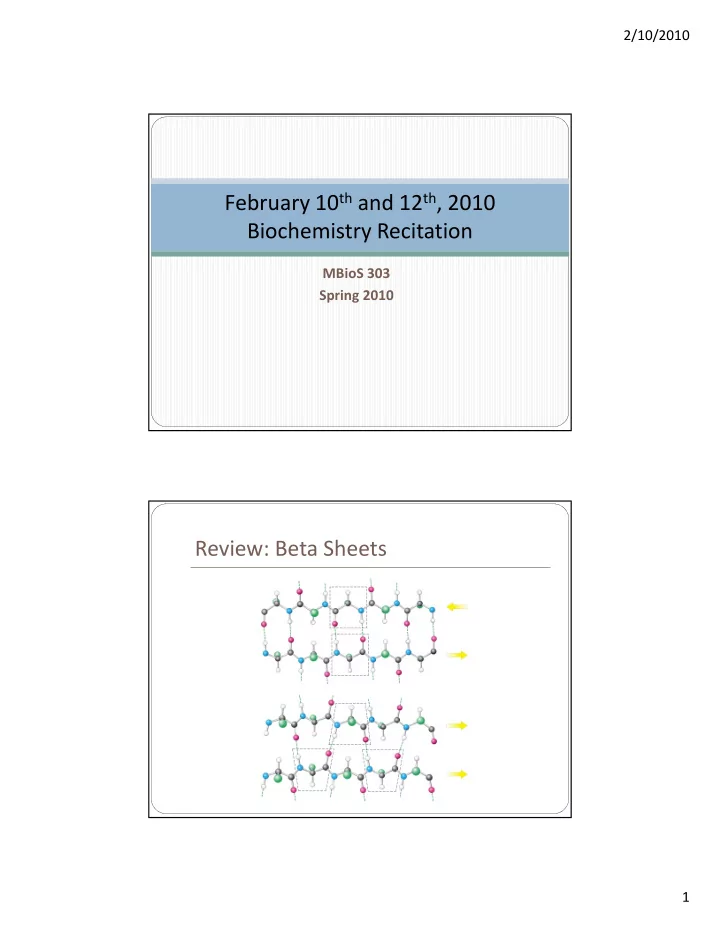
February 10th and 12th, 2010 Biochemistry Recitation Review: Beta Sheets

slide-2
SLIDE 2

2/10/2010 2

Review: Beta Sheets QUIZ

slide-3
SLIDE 3

2/10/2010 3

Today’s Topics

Myoglobin and Hemoglobin!

Myoglobin Versus Hemoglobin

MYOGLOBIN:

One polypeptide 8 -helices (A-H) Heme group – how many? Extremely compact protein

structure

Oxygen STORAGE in muscle

Must be able to bind O2, then

release where and when needed

HEMOGLOBIN:

Four polypeptides 8 -helices (A-H) Heme group – how many? Extremely compact protein

structure WITHIN SUBUNITS

Oxygen TRANSPORT from

lungs to tissue

Must be able to bind O2, then

release where and when needed

Each human red blood cell is 95% hemoglobin (dry weight), which is about 270,000,000 hemoglobin molecules

slide-4
SLIDE 4

2/10/2010 4

Myoglobin and Hemoglobin Myoglobin and Hemoglobin

slide-5
SLIDE 5

2/10/2010 5

Heme Group

What molecule(s) bind to the iron atom in heme?

slide-6
SLIDE 6

2/10/2010 6

Allostery and Cooperativity

Allostery: binding of a

ligand at one site effects binding of ligand at another site

Cooperativity: special

case of allostery in which affinity for ligand changes with amount of ligand already added

Characteristic sigmoidal

curve

Hemoglobin: T to R Transition

slide-7
SLIDE 7

2/10/2010 7

What Initiates T to R State Change? Hemoglobin: T to R Transition

!

slide-8
SLIDE 8

2/10/2010 8

Hemoglobin: T to R Transition

!

Stabilization of R and T States

T STATE:

Hydrogen bonds Salt bridges H+ CO2 2,3-BPG

R STATE: O2 CO

slide-9
SLIDE 9

2/10/2010 9

Hemoglobin: O2 binding

1st O2 that binds binds

weakly

T to R transition Increased affinity

(cooperativity!)

Hemoglobin: H+ and CO2 binding

Binding of H+ and CO2

inversely related to O2 binding

pH of blood = 7.6 in lungs,

7.2 in tissues

H+ binds amino acids,

stabilizing T state

CO2 binds as carbamate to

N-terminal amino group, forming additional salt bridges that stabilize T state

slide-10
SLIDE 10

2/10/2010 10

Hemoglobin: 2,3-BPG binding

Binds in pocket between

β subunits

Stabilizes T state Important for

adaptation at high altitudes

Hemoglobin: CO binding

Binds to iron in heme

group – competes with O2!

Stabilizes R state

(prevents release of O2 back into tissues)

slide-11
SLIDE 11

2/10/2010 11

Homotropic vs. Heterotropic

Homotropic effector: same as ligand

Example?

Heterotropic effector: molecule other than ligand

Example of positive effector? (Stabilizes R state) Example of negative effector? (Stabilizes T state)

Exam #1 on Tuesday, February 16th

Check website for review time(s)