Fast Interaction Trigger FIT Project Organization The concept of - - PDF document

fast interaction trigger fit
SMART_READER_LITE
LIVE PREVIEW

Fast Interaction Trigger FIT Project Organization The concept of - - PDF document

Fast Interaction Trigger FIT Project Organization The concept of the FIT detector evolved from the experience gained by two ALICE groups: T0 and V0. We propose that FIT would also incorporate both the Cherenkov radiators (T0+) and plastic


slide-1
SLIDE 1

1

Fast Interaction Trigger – FIT

Project Organization

The concept of the FIT detector evolved from the experience gained by two ALICE groups: T0 and V0. We propose that FIT would also incorporate both the Cherenkov radiators (T0+) and plastic scintillator plates (V0+) but that the electronics and the readout would be fully integrated and follow the conceptual design developed originally for T0. This is the rationale for joining forces behind FIT and forming a single project. The project is coordinated by the Project Leader (PL). PL is assisted by two Deputy Project Leaders: one representing T0+ (DPL-T) and the other representing V0+ (DLP-V). This specialization is necessary as the bulk of the work on the design, prototyping and production of the T0+ and V0+ is done in two different and distant locations with a specific funding and organizational

  • arrangements. T0+ will be manufactured in Russia while V0+, in Mexico. It is

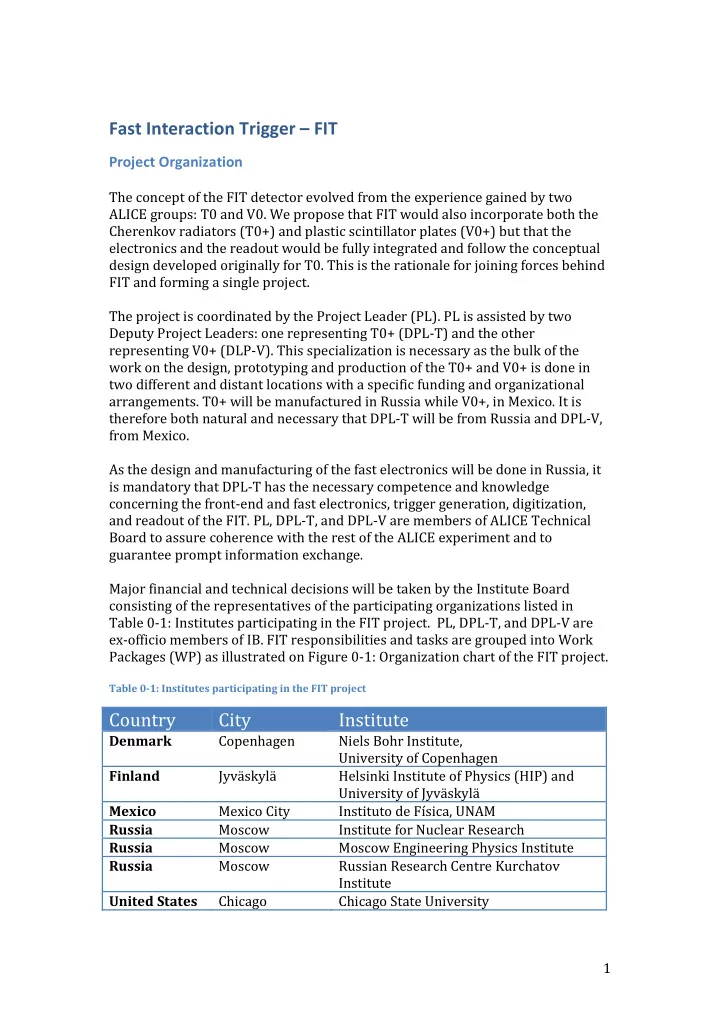
therefore both natural and necessary that DPL-T will be from Russia and DPL-V, from Mexico. As the design and manufacturing of the fast electronics will be done in Russia, it is mandatory that DPL-T has the necessary competence and knowledge concerning the front-end and fast electronics, trigger generation, digitization, and readout of the FIT. PL, DPL-T, and DPL-V are members of ALICE Technical Board to assure coherence with the rest of the ALICE experiment and to guarantee prompt information exchange. Major financial and technical decisions will be taken by the Institute Board consisting of the representatives of the participating organizations listed in Table 0-1: Institutes participating in the FIT project. PL, DPL-T, and DPL-V are ex-officio members of IB. FIT responsibilities and tasks are grouped into Work Packages (WP) as illustrated on Figure 0-1: Organization chart of the FIT project.

Table 0-1: Institutes participating in the FIT project

Country City Institute

Denmark Copenhagen Niels Bohr Institute, University of Copenhagen Finland Jyväskylä Helsinki Institute of Physics (HIP) and University of Jyväskylä Mexico Mexico City Instituto de Física, UNAM Russia Moscow Institute for Nuclear Research Russia Moscow Moscow Engineering Physics Institute Russia Moscow Russian Research Centre Kurchatov Institute United States Chicago Chicago State University

slide-2
SLIDE 2

2

Figure 0-1: Organization chart of the FIT project Figure 0-2: Organization of the V0-Plus Work Package

As shown in Figure 0-2: Organization of the V0-Plus Work Package, the V0-Plus project is organized as a single work package (WP), having the PL acting as WP coordinator, endorsed by the V0-plus Institute Board, which itself acts as Coordination Board (CB). Other scientists with dedicated technical expertise are also nominated “ad personam” by the PL to be members of the V0-plus CB. The main reason for showing the detailed structure of this WP is its size and

  • scope. It is the largest in terms of the number of people involved and in the range
  • f the covered topics. The rationale for having a single WP for V0-Plus is that all

that work will be done by the same institute – Instituto de Física, UNAM, Mexico City, Mexico.

slide-3
SLIDE 3

3

Manpower for FIT

Denmark Ian Bearden, Professor, 2014 - 2018, data analysis, 0.3 FTE Borge Nielsen, Senior Scientist, 2014 - 2018, data analysis, 0.3 FTE Not Known, Ph.D. Student or postdoc, 2015 - 2018, software, data analysis, 0.5 - 1 FTE Finland Wladyslaw Henryk Trzaska, Senior Scientist, 2014 - 2018, Project Leader, 0.5 FTE Maciej Slupecki, Ph.D. Student, 2014 - 2018, DAQ, DCS, detector R&D, 0.5 FTE Mexico Arturo Menchaca-Rocha, Professor, 2014-2018, Sub-project Leader, 0.5 FTE Varlen Grabski, Professor, 2014-2018, R&D, Sub-project Deputy Leader, responsible for R&D, prototyping, detector design, construction, integration and testing, 0.5 FTE Ruben Alfaro, Professor, 2014-2018, responsible for photosensor: study, selection and integration, data analysis, 0.2 FTE Ernesto Belmont, Professor, 2014-2018, responsible for scintillators and fibers: request for purchase, machining, testing, data analysis, 0.2 FTE Andres Sandoval, Professor, 2014-2018, responsible for integration, detector control, testing, data analysis, 0.2 FTE Saul Aguilar, Electronics Engineer, 2014-2018, responsible for electronics integration, testing, data analysis, 0.3 FTE.

  • H. Leon, Postoctoral, 2014-2015, simulation, software integration, 0.3 FTE

Roberto Nunez, Undergraduate student-1: 2014-2015, R&D, prototyping, mechanics, machining and testing. 0.8 FTE Unknown Graduate student-1: 2014-2015, R&D, prototyping, simulation and

  • tests. 0.8 FTE

Unknown Graduate student-2: 2014-2015, Scintillators, fibers and photosensor selection and tests. 0.8 FTE Russia INR Tatiana Karavicheva, Senior Scientist, 2014 - 2018, Deputy Project Leader, 0.5 FTE Alla Mayevska, Ph.D. Student, 2014 - 2018, Software, QA, Simulations, 0.5 FTE Alexandr Kurepin, Ph.D. Student, 2014 - 2018, DCS, 0.5 FTE Alexei Kurepin, professor,2014 - 2018, INR group leader 0.2 FTE Andrey Reshetin, Senior Scientist, 2014 - 2018, detector R&D, 0.25 FTE Dmitry Serebryakov, Engineer, 2014 - 2018, detector and electronics R&D, 0.5 FTE Anatoliy Tikchonov ,Engineer , 2014 - 2018, electronics R&D 0.3 FTE Oleg Karavichev, Senior Engineer, 2014 - 2018, electronics R&D 0.25 FTE Artem Konevskich ,PhD student, 2014-2014,DCS, software, data analysis, 0.5 FTE Not Known, two Ph.D. Student , 2015 - 2018, software, data analysis, 1 FTE MEPHI

slide-4
SLIDE 4

4 Vladislav Grigirieev, professor,2014 - 2018, Mephi group leader 0.1 FTE Vladimir Kaplin, Senior Scientist, 2014 - 2018, detector and electronics R&D, 0.5 FTE Vitaly Loginov, PhD student, 2014 - 2018, electronics R&D, 0.25 FTE Nataliya Kondratieva, PhD student, 2014 - 2018, electronics R&D, 0.25 FTE KI Anatoly Klimov, Engineer,2014-2018,electronics R&D 0.25 FTE Not Known, Ph.D. Student , 2015 - 2018, software, electronics R&D 0.25 FTE USA Edmundo Garcia, Professor, 2014 - 2018, simulations, test measurements, data analysis, 0.2 FTE Austin Harton, Faculty Physicist, 2014 - 2018, simulations, test measurements, data analysis, 0.2 FTE Not Known, Undergraduate Students, 2014 - 2018, simulations, test measurements, data analysis, 0.6 FTE

Budget explanation and justification

This chapter addresses important design choices and their possible impact on the project cost and schedule. The evaluation has been done for the baseline solution but it is understood that the ongoing R&D may modify the baseline. V0-Plus (510 USD) With a total budget of 510 USD, the V0-Plus construction project, as occurred with V0A, shall be executed by just one institution: Instituto de Física, UNAM, and shall be funded by a sole institution. The estimated costs per item, breaking it among sub activities, when appropriate is given in Table 0-2: Cost breakdown structure of the ALICE V0-Plus divided into material cost and cost for externally hired manpower. Note that, except for clear fiber machining, no manpower external to the institution is foreseen. Activity Material Cost USD Manpower Cost Total Cost/Item

  • 1. R&D

50 50

  • 2. Scintillators & Fibers

85 85

  • 3. Photo Sensors

160 160

  • 4. Electronics

190 190

  • 5. Integration

25 25 TOTAL 510

Table 0-2: Cost breakdown structure of the ALICE V0-Plus divided into material cost and cost for externally hired manpower

The spending profile for V0-Plus is listed in Table 0-3: Expected spending profile for the ALICE V0+ upgrade. Year 2014 2015 2016 2017 2018 2019 Total Spending (USD) 50 100 360 510

Table 0-3: Expected spending profile for the ALICE V0+ upgrade

slide-5
SLIDE 5

5 Risk assessment The Mexican team has proven their competence and reliability by designing, constructing, and operating two of the ALICE subdetectors: V0-A and ACORDE. There are no difficulties foreseen with respect to the technical knowhow and adhering to the timetable. Having just one funding agency may be considered to represent a risk. Yet, CONACYT (Mexico´s main funding agency) already signed an upgrade MOU with CERN, which includes the participation of IFUNAM and the construction of a V0-Plus, within the parameters already described in the TDR. T0-PLUS (1305 kCHF) Item Quantity Cost per item (kCHF) Subtotal (kCHF) MCP-PMT sensors 50 8.5 425 Housing + quartz for sensors 50 1.5 75 Electronics per channel 50 6 300 Services and mechanics 1 40 40 TRM DRM (TOF type) for T0+ 70 Prototype electronics 25 Laser calibration system 20 Prototype detector module 10 Manpower (soft- & hardware dev.) 340 Total 1305

Table 0-4: Cost breakdown for ALICE T0+ Upgrade

The spending profile for T0+ is listed in Tab.X. The total is larger by about 3% from the estimated cost because it includes contingency. The value of the annual spending is followed by the contribution breakdown from each of the funding

  • agency. Although the detector will be completed by the early 2018, we list the

funding till the end of 2020 as a guarantee of the financial stability of the project. Also some of the spares will be produced later to smoothen out the spending profile. Year 2014 2015 2016 2017 2018 2019 2020 Total Finland HIP 10 10 10 30 48.1 48.1 48.1 204.3 Academy of Finland 150 150 Denmark 10 10 10 150 10 10 200 USA 10 10 150 10 10 10 200 Russia 5 5 5 5 5 5 30 Russia (in kind) 10 10 20 40 60 60 20 220 Russia (visit to CERN) 20 20 20 70 70 70 70 340 Total annual spending 50 65 75 595 203 193 163 1344

Table 0-5: Expected annual spending profile in kCHF for the ALICE T0+ upgrade

slide-6
SLIDE 6

6 Risk assessment The T0+ part of the FIT upgrade is funded from 7 sources in 4 countries. The groups involved have all made substantial contribution to the first phase of

  • ALICE. For instance the core contribution from Denmark was 1.2 MCHF and from

Finland 1.0 MCHF. The members of the FIT collaboration have designed, build and are responsible for M&O and data analysis of FMD and T0 detectors. While the possibility of failure can never be completely eliminated, we are confident that our team is sufficiently diverse and robust to be able to sail through the difficulties and challenges ahead of us and deliver the FIT detector in time and according to the specifications. Manpower (software+ hardware development) for T0+ (340 kCHF) The cost of the manpower provided by the participating institutes is not usually included in the costs. Indeed neither Denmark, Finland nor Mexico have marked it and there is no mention of it in the TDR. However, the Russian funding agencies requested from us to include these figures and this is the reason for having a separate entry as well as the apparent increase in the total cost. Accordingly the tables with the cost- and with the spending profile have been modified to include the Russian in kind contribution and the travel allowances for the Russian team members. Risk assessment Pulling out of ALICE of the Russian institutes that contribute substantial manpower to the project would have a serious impact not only on FIT but also on the entire experiment. Finding alternatives would not be easy causing serious

  • delays. Fortunately such a scenario is still considered as unlikely.

MCP-PMT sensors (425 kCHF) XP85012 Planacon from Photonis USA is the current baseline for the MCP-PMT

  • sensor. There are two other producers on the market: Hamamatsu from Japan

and BINP from Novosibirsk in Russia. Based on our recent (June 2013) market survey, XP85012 is the most suitable. However, it is expected that within two years Hamamatsu would come with the compatible product providing an alternative for FIT and possibly reducing the price. This would have a noticeable impact on the cost, as MCP-PMT sensors are the most expensive part of the upgrade. Risk assessment MCP-PMT technology is developing very dynamically so the risks of Photonis going out of business are very low at this time. In any case soon there will be available a compatible product from Hamamatsu. The funding for the sensors will be provided in equal parts by 3 countries: Finland, Denmark, and the USA. Even if one of the partners would fail to obtain the full share of the grant, the subtotals (150 kCHF each) are relatively low as compared to the total budgets of the participating institutes so we are confident that we would be able to come up with alternative funding and cash flow solutions. For instance, the purchase of the spares could be delayed and some of the unit used for R&D could be reused.

slide-7
SLIDE 7

7 Electronics (300 kCHF) The electronics for FIT follows closely the concept that has been designed and proven to work well for the T0 detector. There are also the same research institutes working on the upgrade. This gives us confidence that the job will be done well and according to the schedule. We also have a realistic assessment of the cost. In fact, a lot of the work has already started as part of the preparations

  • f T0 for the Run 2. The main difference between T0 and FIT electronics will be

the sharp increase in the number of channels (from 24 for T0 to 160 for T0+). As shown on Figure 0-1: Organization chart of the FIT project, there are four Work Packages dealing with electronics: Front End Electronics (FEE), Fast Electronics (FE), Trigger & Readout (T&R), and DCS ECS (Detector Control System and Experiment Control System). Such work division with clear responsibility distribution should facilitate the design, prototyping, production, and M&O of the electronics. Risk assessment The strongest asset of our team is the experience gained from T0 and the fact that the detector and the electronics have performed very well during the Run 1. Therefore the biggest thread to our project would come if one or more of the Russian institutes involved in the upgrade would pull out of the collaboration or run out of funding. A possible remedy would be to rehire or sub-contract the key people or/and search for the required know-how in other institutes. For instance, Niels Bohr Institute has knowhow and experience in that field and in Finland the Lapperanta University of Technology has expressed the interest to join CERN projects. The total cost of the electronics (300 kCHF) is high but since the R&D and production is spread over several years and co-funded by all participating institutes through annual contribution listed in Tab. XX, there should not be serious funding problems. TRM DRM (TOF type) (70 kCHF) FIT will follow the TOF-based readout scheme developed for T0. This solution has worked very well during the Run 1 so we do not anticipate any major problems. Risk assessment Since TOF is the largest of ALICE detectors it is unlikely that the upgrade of TRM and DRM to the requirement of Run 3 will fail. The worst-case scenario for FIT would be if the bandwidth limitation were not overcome forcing us to increase the number units. This however would be straightforward to fix with additional funding of about 70 kCHF – a relative low figure in the FIT budget that can Housing, quartz for sensors, services and mechanics (70kCHF + 40 kCHF) As it is explained in the TDR, T0-Plus will consist of two arrays of 20 Detector Units (DU) on each side of the interaction side. Each DU is functionally divided into 4 independent parts but is housed in one light-tight box enclosing the quartz

slide-8
SLIDE 8

8 radiator, MCP-PMT sensor, and a PCB with the first stage of the electronics. Due to the limited space on the C-side, the requirement to minimize the radiation length, modularity, and the intricacy of the interface with the rest of ALICE, DC housing will be relatively complex. Accordingly, we had to allocate adequate budget for this part of the project. Risk assessment Our cost estimate is based on the experience with T0. The work will be done in Russia but as a backup solution there is a possibility to involve the mechanical workshop at the Accelerator Lab at the Physics Department, University of Jyväskylä. DM and electronics prototypes (25 kCHF + 10 kCHF) The need for prototyping is self evident and the experience gained from ALICE T0 project is our strongest asset. No major problems are foreseen. Risk assessment The Russian teams have remarkable competence and experience. As a backup solution we may consider involving NBI electronics experts or/and one of the Finnish Universities of Technology. Laser calibration system (20 kCHF) The concept of the Laser Calibration System for T0-Plus is based on LCS used by

  • T0. It consists of a pico-second blue laser, optical splitter and optical fibers. The

intensity is regulated with a digital attenuator and the system is triggered remotely. Risk assessment No major problems are foreseen.

Timetable for FIT

(Detailed information will be provided later) 2013 – 2016 R&D phase; prototyping of T0-Plus detector modules and electronics; in-beam tests 2016 Purchase of all remaining components for V0-Plus 2017 Purchase of MCP-PMT sensors and assembly of detector modules and electronics January 2018 FIT ready for installation

slide-9
SLIDE 9

9 2018 – 2019 Production of the spares