Fast Facts about Bill Alert Pilot One-year pilot from August 2012 - - PowerPoint PPT Presentation

fast facts about bill alert pilot
SMART_READER_LITE
LIVE PREVIEW

Fast Facts about Bill Alert Pilot One-year pilot from August 2012 - - PowerPoint PPT Presentation

Fast Facts about Bill Alert Pilot One-year pilot from August 2012 through July 2013 Implemented by Freeman, Sullivan & Co. for a midsized North American utility Around 18,500 customers were solicited by email Nearly


slide-1
SLIDE 1

Fast Facts about Bill Alert Pilot

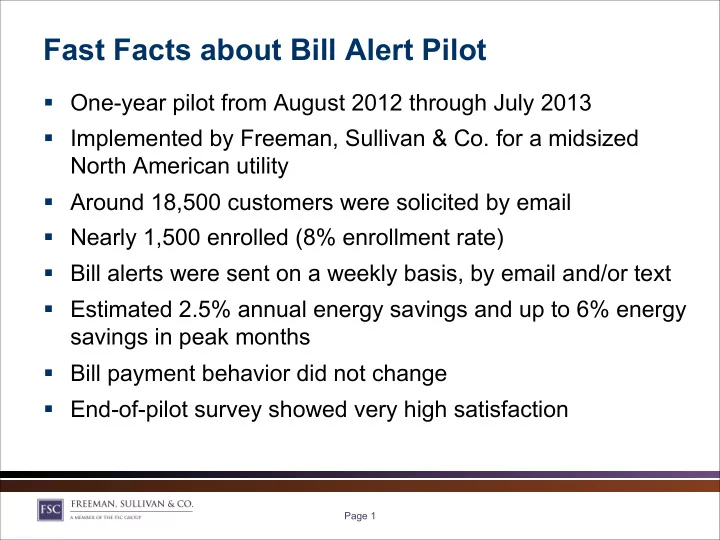
§ One-year pilot from August 2012 through July 2013 § Implemented by Freeman, Sullivan & Co. for a midsized North American utility § Around 18,500 customers were solicited by email § Nearly 1,500 enrolled (8% enrollment rate) § Bill alerts were sent on a weekly basis, by email and/or text § Estimated 2.5% annual energy savings and up to 6% energy savings in peak months § Bill payment behavior did not change § End-of-pilot survey showed very high satisfaction

Page 1

slide-2
SLIDE 2

Page 2

Bill Alerts are Low Hanging Fruit

§ Generate easy energy savings § Low marketing cost § Customer does not have to purchase and install expensive technology § No paper necessary § In this pilot, fancy graphics weren’t necessary either…

slide-3
SLIDE 3

Simple Messages Can Create Behavior Change

Page 3

Example Email Bill Alert 16 days into the billing cycle, you have used $91.89

  • f electricity since your last bill.

So far your average daily electricity cost is $5.74. This is $1.40 per day over your goal of $4.34 per day. For more information on your usage and to adjust your goals, please visit www.billalertwebsite.com or call 1-800-XXX-XXX (available on weekdays from 9 AM to 9 PM). Thank you for participating in the Bill Alert program.

slide-4
SLIDE 4

Simple Messages Can Create Behavior Change

Page 4

Example Text Message Bill Alert

slide-5
SLIDE 5

How Can Utilities Pick this Low Hanging Fruit?

§ Many utilities already have a bill alert program, but marketing of this type of program is usually limited because utilities feel that they cannot claim energy savings § Utilities should test different strategies for bill alerts

Ø Default vs. opt-in enrollment Ø Varying marketing messages Ø Bill alert messages with and without user defined goals Ø Bill alert messages with and without neighborhood comparisons Ø Bill alerts that are sent on a weekly basis (as in this pilot) vs. being triggered by a certain usage threshold

§ With experimental design, utilities can determine their optimal strategy and prove that the energy savings are real

Page 5

slide-6
SLIDE 6

For Any Comments or Questions, Contact…

Josh Schellenberg, M.A. Joshschellenberg@fscgroup.com Stephen George, Ph.D. Stephengeorge@fscgroup.com Freeman, Sullivan & Co. San Francisco, CA 415-777-0707

Page 6