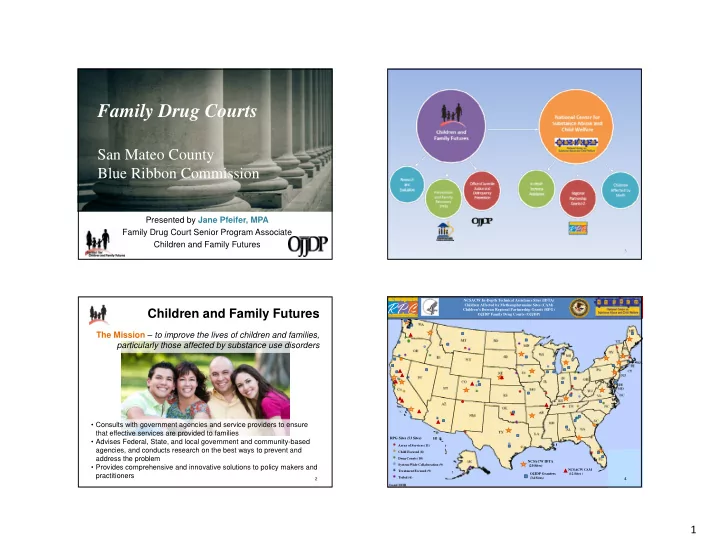
Family Drug Courts San Mateo County Blue Ribbon Commission - - PowerPoint PPT Presentation

family drug courts
SMART_READER_LITE
LIVE PREVIEW

Family Drug Courts San Mateo County Blue Ribbon Commission - - PowerPoint PPT Presentation

Family Drug Courts San Mateo County Blue Ribbon Commission Presented by Jane Pfeifer, MPA Family Drug Court Senior Program Associate Children and Family Futures 3 NCSACW In-Depth Technical Assistance Sites (IDTA) Children Affected by


slide-1
SLIDE 1

1

Family Drug Courts

San Mateo County Blue Ribbon Commission

Presented by Jane Pfeifer, MPA Family Drug Court Senior Program Associate Children and Family Futures

Children and Family Futures

The Mission – to improve the lives of children and families, particularly those affected by substance use disorders

  • Consults with government agencies and service providers to ensure

that effective services are provided to families

  • Advises Federal, State, and local government and community-based

agencies, and conducts research on the best ways to prevent and address the problem

  • Provides comprehensive and innovative solutions to policy makers and

practitioners

2 3

NCSACW IDTA (20 Sites) NCSACW CAM (12 Sites ) OJJDP Grantees (34 Sites) Array of Services (11) Child Focused (8) Drug Courts (10) System-Wide Collaboration (9) Treatment Focused (9) Tribal (6) RPG Sites (53 Sites)

Title

NCSACW In-Depth Technical Assistance Sites (IDTA) Children Affected by Methamphetamine Sites (CAM) Children’s Bureau Regional Partnership Grants (RPG) OJJDP Family Drug Courts (OJJDP) 4

slide-2
SLIDE 2

2

FAMILY

Drug Courts

Lessons Learned from

559,000 513,000 400,540 299,000 311,000 252,320

In Care Entries

1999 2005 2011

6 7

38 FDCs in 29 California Counties

8

slide-3
SLIDE 3

3

13.9 15.8 18.5 19.6 21.6 22.7 23.4 24.9 26.1 26.3 25.8 26.1 28.4 29.3

10 20 30 40 50 60 70 1998 1999 2000 2001 2002 2003 2004 2005 2006 2007 2008 2009 2010 2011

PERCENT

PARENTAL AOD AS REASON FOR REMOVAL IN THE UNITED STATES 1998-2011

S

  • urc e : AF

CARS Data F ile s 9

Parental AOD as Reason for Removal slide from BtB

10

How far have we come?

Adoption and Safe Families Act

  • Cases lingering in Court

system as parents cycled in and out of treatment

  • Children left in foster care for

months or even years

  • Emphasis on establishing

permanency within federally mandated time frames

12

slide-4
SLIDE 4

4

The Birth of the FDC Movement

First FDCs convened in Reno, Nevada and Pensacola, Florida in 1994 - 1995

13

Drug Treatment Court Child Welfare

Common Vision Extraordinary Effort

3

Systems with multiple:

  • Mandates
  • Training
  • Values
  • Timing
  • Methods

14

New Partnerships, Creative Approaches

The need for immediate and efficient intervention became overwhelmingly important in the face of implementing the Adoption and Safe Families Act

15

Common Ingredients of FDCs

  • System of

identifying families

  • Earlier access

to assessment and treatment services

  • Increased

management of recovery services and compliance

  • Responses to

participant behaviors (sanctions & incentives)

  • Increased

judicial

  • versight

2002 Process Evaluation

  • Collaborative

approach across service systems and Court

16

slide-5
SLIDE 5

5

HIGHER TREATMENT COMPLETION RATES SHORTER TIME IN FOSTER CARE HIGHER FAMILY REUNIFICATION RATES LOWER TERMINATION OF PARENTAL RIGHTS FEWER NEW CPS PETITIONS AFTER REUNIFICATION COST SAVINGS PER FAMILY

17

FDC Local Evaluations

Jackson County, OR (N=329, 340) Washoe, NV (N=84,127) Santa Clara, CA (N=100, 370) Sacramento, CA (N=4,858, 111) Marion County, OR (N=39, 49) Baltimore, MD (N=200, 200)

(Source: Marlowe and Carey, May 2012)

Maine (3) (N=49, 38*) San Diego, CA (N=438, 388) Suffolk, NY (N=117, 239) London, England (N=55, 31) Pima County, AZ (N=33, 45)

11 FDC Sites

(N= FDC, Comparison) * Maine = only 1 of 2 comparison groups are

reported in this presentation 18

24 Grantee Sites

RPG FDC

  • 5,200

children

  • 8,000

adults

Regional Partnership Grants Family Drug Courts

19

20 40 60 80 Completion Rate

Treatment Completions

Up to 20-30% higher

20 40 60 80 100 FR Rates

Reunification Rates

FDC vs Comparison

200 400 600 800 # of Days

Days in Foster Care

Several Fewer Months

10 20 30 New Petition

New CPS Petition after FR

Up to 20-40% higher Infrequent, In all conditions

(Source: Marlowe and Carey, May 2012) 20

slide-6
SLIDE 6

6

80 61.1 10 20 30 40 50 60 70 80 90

Children Remain Home

RPG FDC Services as Usual

21

3.4% 4.9% 5.8%

0.0% 1.0% 2.0% 3.0% 4.0% 5.0% 6.0% 7.0%

RPG Children‐FTDC RPG Children‐No FTDC 25 State Contextual Subgroup

Recurrence of Child Maltreatment within Six Months

Cost Savings Per Family $5,022

Baltimore, MD

$5,593

Jackson County, OR

$13,104 Marion County, OR

Burrus, et al., 2011 Carey , et al., 2010 Carey , et al., 2010

23

 Holistic approach, addresses family well-being  FDCs hold parents accountable for their recovery and

systems accountable for child outcomes

 Family stress and trauma can greatly contribute to relapse  Family stability can greatly contribute to recovery

FDCs are Serving Families

24

slide-7
SLIDE 7

7

What about families with:

  • Co-occurring

mental health

  • Criminal

history

  • Inadequate

housing

  • Domestic

violence

25

Parents with extensive criminal histories, inadequate housing, and a greater risk for DV were more likely to complete FDC than those without these risk factors.

*Douglas Marlowe and Shannon Carey, Research Update on Family Drug Courts, NADCP, May 2012

26

Prevalence Rate slide from BtB

Prevalence of the Issue

How many c hildr en in the c hild welfar e system have a par ent in need of tr eatment?

  • Be twe e n 60-80% o f substantiate d c hild abuse and

ne gle c t c ase s invo lve substanc e s by a c usto dial pare nt o r guardian (Yo ung, e t al, 2007)

  • 61% o f infants, 41% o f o lde r c hildre n who are in
  • ut-o f-ho me c are (Wulc zyn , E

rnst and F ishe r, 2011)

  • 87% o f familie s in fo ste r c are with o ne pare nt in ne e d
  • f tre atme nt; 67% with two pare nts in ne e d (Smith,

Jo hnso n, Pe ars, F ishe r, De Garmo , 2007)

28

slide-8
SLIDE 8

8

Defining the Need in San Mateo County

Total # of children in substantiated cases: 449 Number due to substance abuse : 269 (60% estimate) 65: Potential served in FDC (35%) Number of parents: 188 (.7 parents per child)

http://cssr.berkeley.edu/ucb_childwelfare/Alle gations.aspx

29

No magic wands, but a range of tools

  • Best practice

standards

  • Information systems
  • Screening and

assessment tools

  • Research capacity
  • Training and technical

assistance

  • Leadership and

champions

30

Questions & Discussion

32

Just released!

To download, please visit:

http://www.cffutures.org/files/publications/FDC-Guidelines.pdf

slide-9
SLIDE 9

9

 CFF in partnership with OJJDP, Federal and State

stakeholders crafted a guidance document

 Best practices and principles for developing performance

guidelines for FDC

 Based on research, previous publications, expert input and

established standards adopted by various States

 Resource tool for States to create their own guidelines that

reflect their local and unique needs

FDC Guidelines

33

FDC Recommendations

Shared Outcomes

  • Funding &

Sustainability

  • Cross System

Knowledge

  • Information Sharing
  • Interagency

Partnerships

  • Early

Identification & Assessment

  • Needs of Adults
  • Needs of Children
  • Community

Support

Mission & Vision Collaboration Services

34

 Recommendations, Strategies, Research Findings –

information on best practices and collaborative principles to develop and sustain FDCs

 Appendix – structure that States and counties can use to

create a multi‐disciplinary and collaborative structure for their FDC

 Facilitator’s Guide – to guide collaborative implementation

efforts and provide suggestions, tools, and templates to help staff create, govern, and work within a collaborative structure

Includes:

35 36

slide-10
SLIDE 10

10

National Center for Substance Abuse and Child Welfare

1. Understanding Substance Abuse and Facilitating Recovery: A Guide for Child Welfare Workers 2. Understanding Child Welfare and the Dependency Court: A Guide for Substance Abuse Treatment Professionals 3. Understanding Substance Use Disorders, Treatment and Family Recovery: A Guide for Legal Professionals

Please visit: http://www.ncsacw.samhsa.gov/

NCSACW Online Tutorials

37

  • Conference presentations
  • Workshop trainings
  • Online tutorials
  • Toolkits
  • Publications
  • Video

National Center on Substance Abuse and Child Welfare Resources

Please visit: www.ncsacw.samhsa.gov/

38

CON CONTACT US US FO FOR MO MORE RE IN INFORMATION: Peer erLear arni ningCo Cour urts@cffut utures es.o .org Baltimore City Circuit Court, Juvenile Division Maryland Judge: Robert B. Kershaw Chatham County Juvenile Court, Family Dependency Treatment Court Georgia Judge: Patricia P. Stone Jackson County Family Drug Court 16th Judicial District Missouri Commissioner: Molly Merrigan Pima County Juvenile Court Arizona Judge: Susan A. Kettlewell

F amily Drug Court Learning Academy Webinar Series

This Changes Everything

2014

F

  • r more information, please visit the F

DC Learning Academy Webinar Library

www.cffutures.org/presentations/webinars/category/fdc-series

slide-11
SLIDE 11

11

March 6th

Tested and Proven – Utilization of Recovery Support Specialists as a Key Engagement and Retention Strategy in FDC (and Beyond)

April 10th

Our Grant is Over – Now What? Re-financing and Re- Directing as Real Sustainability Planning for Your FDC

June 12th

Closed Doors or Welcome Mat? Opening the Way for Medical Assisted Treatment in FDC

July 10th

So How Do You Know They Are Really Ready? Key Considerations for Assessing Families in Recovery for Reunification

  • Aug. 14th

Exploring Solutions Together – The Issue of Racial and Ethnic Disproportionality in FDCs

  • Sept. 11th

Matching Service to Need – Exploring What “High- Risk, High-Need” Means for FDCs

This Changes E verything – 2014

41

Visit the FDC Learning Academy Blog

www.familydrugcourts. blogspot.com

  • Webinar updates
  • Presenter info
  • Learning resources
  • Post a follow-up question

Links to Resources

42

Ask our presenters Webinar registration

Contact Information

Jane Pfeifer, MPA Senior Program Associate Children and Family Futures jpfeifer@cffutures.org RESOURCES Please visit: http://www.cffutures.org/projects/ family-drug-courts GENERAL INQUIRES fdc@cffutures.org VISIT www.cffutures.org FOLLOW