Fair Information Sharing for Treasure Hunting Harvard EconCS, Feb - - PowerPoint PPT Presentation

fair information sharing for treasure hunting
SMART_READER_LITE
LIVE PREVIEW

Fair Information Sharing for Treasure Hunting Harvard EconCS, Feb - - PowerPoint PPT Presentation

Fair Information Sharing for Treasure Hunting Harvard EconCS, Feb 2015 Yiling Chen Kobbi Nissim Bo Waggoner 1 pirates searching for treasure. 2 and wants the treasure each has some for herself prior knowledge 3 4 5 Problem: could


slide-1
SLIDE 1

Fair Information Sharing for Treasure Hunting

Yiling Chen Kobbi Nissim Bo Waggoner

1
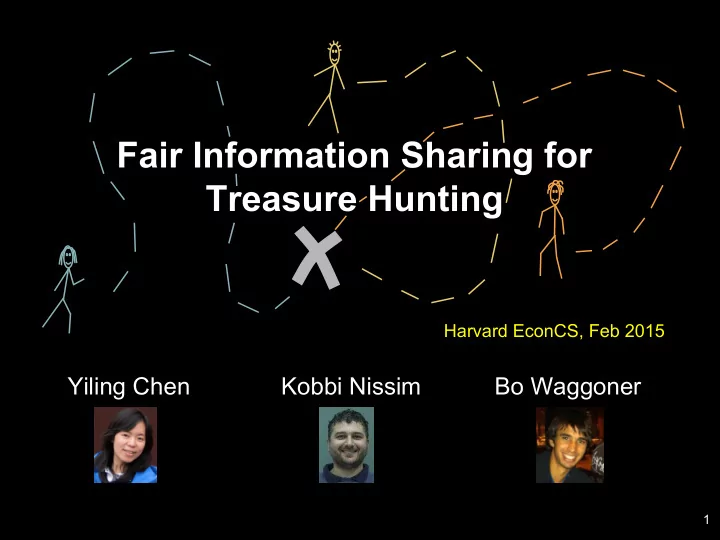
Harvard EconCS, Feb 2015

slide-2
SLIDE 2

pirates searching for treasure….

2

slide-3
SLIDE 3

each has some prior knowledge

3

and wants the treasure for herself

slide-4
SLIDE 4

4

slide-5
SLIDE 5

5

slide-6
SLIDE 6

6

Problem: could take a long time to find the treasure!

slide-7
SLIDE 7

...but they don’t want to share the treasure! pooling info would greatly speed search...

7

slide-8
SLIDE 8

Working together?

Captain wants to convince pirates to pool info

  • Goal: design a mechanism

(without money) for cooperation in a competitive environment

  • Examples: scientific credit, …

8

slide-9
SLIDE 9

Outline

  • 1. Bo talks: summary of paper (~30min)
  • a. model and goals
  • b. proposed mechanism
  • c. results about the mechanism
  • d. extension to “composable” mechanisms
  • 2. “Guided Discussion” (~20-30min)
  • a. approaches / solution concepts
  • b. goals / desiderata
  • c. models
  • 3. Recap (~5min)

9

slide-10
SLIDE 10

Outline

  • 1. Bo talks: summary of paper
  • a. model and goals
  • b. proposed mechanism
  • c. results about the mechanism
  • d. extension to “composable” mechanisms

10

slide-11
SLIDE 11

Model

  • island:

set S of locations

  • pirate knows:

subset Si containing the treasure

(believes treasure is uniformly random in Si)

  • beliefs about Sk:

arbitrary

(but believes treasure is uniformly random in Si)

  • each location takes one day to dig

11

discuss: other models, variants

slide-12
SLIDE 12

Goals -- informally

  • 1. “Welfare”

subject to

  • 2. “Fairness”
  • 3. “Truthfulness”

12

slide-13
SLIDE 13

Goals -- our interpretation

  • 1. Welfare -- reduce number of digs

subject to

  • 2. Fairness -- preserve “winning chances”
  • 3. Truthfulness -- true report maximizes Pr[win]

13

discuss: other interpretations

slide-14
SLIDE 14

Outline

  • 1. Bo talks: summary of paper
  • a. model and goals
  • b. proposed mechanism
  • c. results about the mechanism
  • d. extension to “composable” mechanisms

14

slide-15
SLIDE 15
  • 1. Each pirate reports his/her set Si
  • 2. Captain partitions the intersection
  • 3. Pirate i may only dig in assigned area

Mechanism: Framework

15

discuss: other frameworks

slide-16
SLIDE 16

How to Partition the Intersection?

16

Simplified exploration game:

  • pretend i explores Si in uniformly random order
  • pretend treasure is uniformly random in intersection
  • i has some probability pi of winning the treasure
  • partition according to p and assign i a pi fraction
slide-17
SLIDE 17

How to Partition the Intersection?

17

Simplified exploration game:

  • pretend i explores Si in uniformly random order
  • pretend treasure is uniformly random in intersection
  • i has some probability pi of winning the treasure
  • partition according to p and assign i a pi fraction

Computational efficiency points:

  • key obs: probabilities do not depend on set structure!
  • to implement, just need to compute set intersection

and partition it efficiently

slide-18
SLIDE 18

How to Partition the Intersection?

18

Simplified exploration game:

  • pretend i explores Si in uniformly random order
  • pretend treasure is uniformly random in intersection
  • i has some probability pi of winning the treasure
  • partition according to p and assign i a pi fraction

One implementation:

  • draw random order

for each i

  • give i all locations

that i would win

slide-19
SLIDE 19

How to Partition the Intersection?

19

Simplified exploration game:

  • pretend i explores Si in uniformly random order
  • pretend treasure is uniformly random in intersection
  • i has some probability pi of winning the treasure
  • partition according to p and assign i a pi fraction

One implementation:

  • draw random order

for each i

  • give i all locations

that i would win

slide-20
SLIDE 20

How to Partition the Intersection?

20

Simplified exploration game:

  • pretend i explores Si in uniformly random order
  • pretend treasure is uniformly random in intersection
  • i has some probability pi of winning the treasure
  • partition according to p and assign i a pi fraction

One implementation:

  • draw random order

for each i

  • give i all locations

that i would win

slide-21
SLIDE 21

How to Partition the Intersection?

21

Simplified exploration game:

  • pretend i explores Si in uniformly random order
  • pretend treasure is uniformly random in intersection
  • i has some probability pi of winning the treasure
  • partition according to p and assign i a pi fraction

One implementation:

  • draw random order

for each i

  • give i all locations

that i would win

slide-22
SLIDE 22

How to Partition the Intersection?

22

Simplified exploration game:

  • pretend i explores Si in uniformly random order
  • pretend treasure is uniformly random in intersection
  • i has some probability pi of winning the treasure
  • partition according to p and assign i a pi fraction

One implementation:

  • draw random order

for each i

  • give i all locations

that i would win

slide-23
SLIDE 23

Outline

  • 1. Bo talks: summary of paper
  • a. model and goals
  • b. proposed mechanism
  • c. results about the mechanism
  • d. extension to “composable” mechanisms

23

slide-24
SLIDE 24
  • 1. Welfare: reduce # of digs

Idea: compare to simplified exploration game Result: If all sets ≥ 10*(intersection size), number of digs is reduced by factor of 10 (as number of pirates grows, → factor of 20).

Goals -- how did we do?

24

slide-25
SLIDE 25
  • 2. Fairness: preserve winning chances

Idea: compare to simplified exploration game Result: Pr[win] is exactly the same as in simplified exploration game.

Goals -- how did we do?

25

slide-26
SLIDE 26
  • 3. Truthfulness: reporting truthfully maximizes

Pr[win] if others are being truthful Result: yes

Sidenote: ε-voluntary participation

  • not clear how to formally define IR
  • ε comes (in some sense) from ties and small set sizes

Goals -- how did we do?

26

slide-27
SLIDE 27
  • 3. Truthfulness: reporting truthfully maximizes

Pr[win] if others are being truthful Proof idea part 1: Don’t want to report a location not in Si

  • may or may not change intersection
  • either way, hurts i’s chances most

Goals -- how did we do?

27

slide-28
SLIDE 28
  • 3. Truthfulness: reporting truthfully maximizes

Pr[win] if others are being truthful Proof idea part 2: Don’t want to omit a location in Si

  • may or may not change intersection
  • will help i’s chances
  • but balanced by chance

it contained the treasure

Goals -- how did we do?

28

slide-29
SLIDE 29

Outline

  • 1. Bo talks: summary of paper
  • a. model and goals
  • b. proposed mechanism
  • c. results about the mechanism
  • d. extension to “composable” mechanisms

29

slide-30
SLIDE 30

Mega-Coalitions

30

slide-31
SLIDE 31

Mega-Coalitions

Goal: create a mechanism taking in coalitions and outputting a mega-coalition

31

slide-32
SLIDE 32

Mega-Mechanism

32

Idea: less-simplified exploration game

  • 1. Each coalition (recursively) partitions its intersection

(agents are coalitions of size one that give themselves their whole set)

  • 2. Now each agent has some resulting set Si
  • 3. Run the simplified exploration game with these sets
slide-33
SLIDE 33

Results

33

Fairness: sure Truthfulness: yes Dynamics: a coalition ε-prefers to join earlier

slide-34
SLIDE 34

Outline

  • 1. Bo talks: summary of paper
  • a. model and goals
  • b. proposed mechanism
  • c. results about the mechanism
  • d. extension to “composable” mechanisms
  • 2. “Guided Discussion”
  • a. approaches / solution concepts
  • b. goals / desiderata
  • c. models
  • 3. Recap

34

slide-35
SLIDE 35

Outline

  • 2. “Guided Discussion”
  • a. approaches / solution concepts
  • b. goals / desiderata
  • c. models

35

slide-36
SLIDE 36

Working together?

Captain wants to convince pirates to pool info

  • Goal: design a mechanism

(without money) for cooperation in a competitive environment

  • Examples: scientific credit, …

36

Q: Is this a reasonable problem to solve? a reasonable approach to solving it?

slide-37
SLIDE 37
  • Knowledge of pirates?
  • Power of captain?
  • ...

Challenges of formalizing the setting

37

Cooperative Game Theory? Seemed a bad fit...

slide-38
SLIDE 38
  • 1. Collect reports Si
  • 2. Give “hints” to each i
  • 3. Pirates do whatever they want

Dream framework/approach

38

Achievable?

slide-39
SLIDE 39

Outline

  • 2. “Guided Discussion”
  • a. approaches / solution concepts
  • b. goals / desiderata
  • c. models

39

slide-40
SLIDE 40

Goals / Desiderata

  • 1. Welfare - ok, but what is your benchmark?

40

slide-41
SLIDE 41

Goals / Desiderata

  • 1. Welfare - ok, but what is your benchmark?
  • 2. Fairness (what is “fair”?)
  • urs: preserve “spirit of competition”

compare: Shapley Value type solution

(do other notions of fairness admit truthful solutions?)

41

slide-42
SLIDE 42

Goals / Desiderata

  • 1. Welfare - ok, but what is your benchmark?
  • 2. Fairness (what is “fair”?)
  • urs: preserve “spirit of competition”

compare: Shapley Value type solution

(do other notions of fairness admit truthful solutions?)

  • 3. Truthfulness - necessary?

max Pr[win] vs max E[utility] perhaps digging is costly

(is our mechanism is truthful in E[utility] sense?)

42

slide-43
SLIDE 43

Outline

  • 2. “Guided Discussion”
  • a. approaches / solution concepts
  • b. goals / desiderata
  • c. models

43

slide-44
SLIDE 44

Digging into our model

  • island:

set S of locations

  • pirate knows:

subset Si containing the treasure

(believes treasure is uniformly random in Si)

  • beliefs about Sj:

arbitrary

(but believes treasure is uniformly random in Si)

  • each location takes one day to dig

44

slide-45
SLIDE 45

Example Bayesian game captured by

  • ur model

45

  • 1. Each pirate has a partition of S (the island)
  • 2. Nature picks treasure location uniformly at random
  • 3. Each pirate observes Si = element of partition
slide-46
SLIDE 46

Example Bayesian game captured by

  • ur model

46

  • 1. Each pirate has a partition of S (the island)
  • 2. Nature picks treasure location uniformly at random
  • 3. Each pirate observes Si = element of partition
slide-47
SLIDE 47
  • 1. Each pirate has a partition of S (the island)
  • 2. Nature picks treasure location uniformly at random
  • 3. Each pirate observes Si = element of partition

Example Bayesian game captured by

  • ur model

47

slide-48
SLIDE 48

Example Bayesian game captured by

  • ur model
  • 1. Each pirate has a partition of S (the island)
  • 2. Nature picks treasure location uniformly at random
  • 3. Each pirate observes Si = element of partition

48

slide-49
SLIDE 49

Example Bayesian game captured by

  • ur model
  • 1. Each pirate has a partition of S (the island)
  • 2. Nature picks treasure location uniformly at random
  • 3. Each pirate observes Si = element of partition

49

slide-50
SLIDE 50

Example Bayesian game captured by

  • ur model
  • 1. Each pirate has a partition of S (the island)
  • 2. Nature picks treasure location uniformly at random
  • 3. Each pirate observes Si = element of partition

50

slide-51
SLIDE 51

What about non-uniform priors?

51

Problem 1: what if pirate beliefs are inconsistent?

slide-52
SLIDE 52

What about non-uniform priors?

52

Problem 1: what if pirate beliefs are inconsistent? → Ok, suppose they are consistent…. Problem 2: how does the mechanism aggregate reports?

slide-53
SLIDE 53

What about non-uniform priors?

53

Problem 1: what if pirate beliefs are inconsistent? → Ok, suppose they are consistent…. Problem 2: how does the mechanism aggregate reports? → OK, suppose it knows the prior or something…. Q for audience: why can’t we re-cut the island so that the prior is now uniform, then run our mechanism?

slide-54
SLIDE 54

What about non-uniform priors?

54

Problem 1: what if pirate beliefs are inconsistent? → Ok, suppose they are consistent…. Problem 2: how does the mechanism aggregate reports? → OK, suppose it knows the prior or something…. Q for audience: why can’t we re-cut the island so that the prior is now uniform, then run our mechanism? Problem 3: how to get “fairness” and truthfulness?? Ideally: robust to beliefs about other agents

slide-55
SLIDE 55

A “perfect” mechanism?

55

Q for audience: how to change “simulated exploration” mechanism to be truthful with more general agent beliefs?

slide-56
SLIDE 56

A “perfect” mechanism?

56

Q for audience: how to change “simulated exploration” mechanism to be truthful with more general agent beliefs?

  • 1. Each pirate submits an exploration strategy
  • 2. The mechanism simulates everyone’s strategy
  • 3. Give each location to the pirate that explores it first in

simulation

slide-57
SLIDE 57

A “more perfect” mechanism

57

  • 1. Each pirate submits their “signal” / information
  • 2. The mechanism simulates an “equilibrium” (like what?)
  • 3. Give each location to the pirate that explores it first in

simulation

  • 1. Satisfying?
  • 2. How to compute “equilibrium”?
slide-58
SLIDE 58

Outline

  • 1. Bo talks: summary of paper
  • a. model and goals
  • b. proposed mechanism
  • c. results about the mechanism
  • d. extension to “composable” mechanisms
  • 2. “Guided Discussion”
  • a. approaches / solution concepts
  • b. goals / desiderata
  • c. models
  • 3. Recap

58

slide-59
SLIDE 59

What did we do?

  • Model of competitive search problem
  • Mechanism for cooperation
  • Welfare, fairness, and truthfulness properties

59

slide-60
SLIDE 60

Future Work

  • Building up: Extensions, variants, dynamics
  • f coalition formation...
  • Digging down: assumptions, model,

alternative frameworks, bargaining with information sharing, alternative solution concepts...

60

slide-61
SLIDE 61

Future Work

  • Building up: Extensions, variants, dynamics
  • f coalition formation...
  • Digging down: assumptions, model,

alternative frameworks, bargaining with information sharing, alternative solution concepts...

61

Thanks!