FAEC DATA Act Working Group Update Presenters: Bob Taylor and Jim - - PowerPoint PPT Presentation

faec data act working group update
SMART_READER_LITE
LIVE PREVIEW

FAEC DATA Act Working Group Update Presenters: Bob Taylor and Jim - - PowerPoint PPT Presentation

Presentation to the CIGIE/GAO Financial Statement Audit Conference USDA Jefferson Auditorium Washington, DC April 28, 2016 FAEC DATA Act Working Group Update Presenters: Bob Taylor and Jim Lisle on behalf of the Federal Audit Executive


slide-1
SLIDE 1

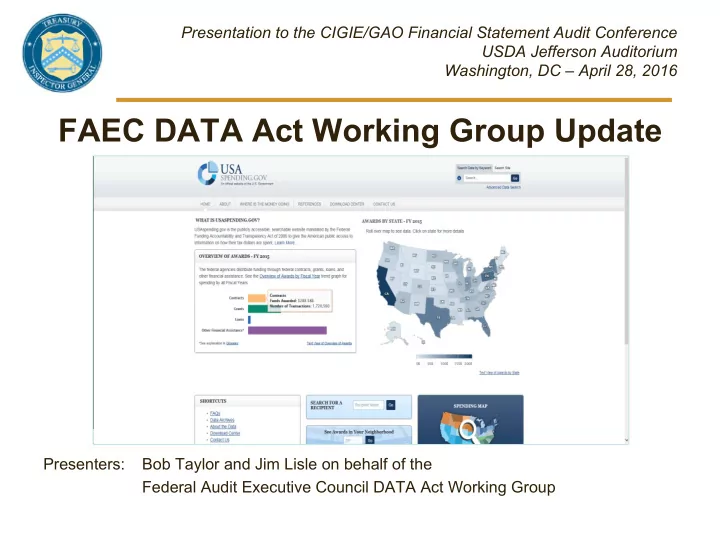
Presentation to the CIGIE/GAO Financial Statement Audit Conference USDA Jefferson Auditorium Washington, DC – April 28, 2016

FAEC DATA Act Working Group Update

Presenters: Bob Taylor and Jim Lisle on behalf of the Federal Audit Executive Council DATA Act Working Group

slide-2
SLIDE 2

What We’ll Talk About Today—

ü DATA Act Overview ü Oversight Requirements ü IG Community DATA Act Working Group ü Addressing the IG Date Anomaly ü Readiness Reviews ü Developing the IG Required Review Methodology ü Looking Beyond the First IG Review

Slide 2

slide-3
SLIDE 3

18

slide-4
SLIDE 4

DATA Act Overview

Digital Accountability and Transparency Act of 2014

Purposes, in part: Ø expand FFATA by disclosing direct Federal agency expenditures and linking Federal contract, loan, and grant spending information to programs of Federal agencies Ø establish Government-wide data standards for financial data and provide consistent, reliable, and searchable Government-wide spending data that is displayed accurately on USASpending.gov (or a successor system) Ø improve the quality of data submitted to USASpending.gov by holding Federal agencies accountable for the completeness and accuracy of the data submitted

Slide 4

slide-5
SLIDE 5

Key Dates

Ø May 2015 – Treasury/OMB to Issue Guidance on Government-wide Financial Data Standards Ø May 2017 – Treasury/OMB to Ensure Financial Data Is Posted on USASpending.gov (or a successor system) Ø May 2018 – Treasury/OMB to Ensure Standards Are Applied to Data

  • n USASpending.gov (or a successor system)

Slide 5

slide-6
SLIDE 6

So, who must comply?

ü Federal Agency. The term “Federal agency” has the meaning given the term “Executive agency” under section 105 of title 5, United States Code. ü 5 USC §105: “For the purpose of this title, “Executive agency” means an Executive department, a Government corporation, and an independent establishment.”

Slide 6

slide-7
SLIDE 7

Does that include my agency?

Ø Executive departments (5 USC §101): State, the Treasury, Defense, Justice, the Interior, Agriculture, Commerce, Labor, Health and Human Services, Housing and Urban Development, Transportation, Energy, Education, Veterans Affairs, Homeland Security

Slide 7

slide-8
SLIDE 8

Does that include my agency (cont’d)?

Ø Government corporation (5 USC §103): (1) “Government corporation” means a corporation owned or controlled by the Government of the United States; and (2) “Government controlled corporation” does not include a corporation owned by the Government of the United States.”

Slide 8

slide-9
SLIDE 9

Does that include my agency (cont’d)?

Ø Independent establishment (5 USC §104):

(1) an establishment in the executive branch (other than the United States Postal Service or the Postal Regulatory Commission) which is not an Executive department, military department, Government corporation, or part thereof, or part of an independent establishment; and (2) the Government Accountability Office.

Slide 9

slide-10
SLIDE 10

Oversight Requirements

Agency Inspectors General– 3 reviews

Ø In consultation with GAO, review a statistically valid sampling of the spending data submitted by the Federal agency Ø Submit to Congress and make publically available, a report assessing ü completeness, timeliness, quality, and accuracy of the data sampled ü implementation and use of Data Standards by the Federal agency Ø Reviews due November 2016, November 2018, November 2020

Slide 10

slide-11
SLIDE 11

Ø GAO – 3 Reviews

Ø After a review of IG reports, submit to Congress and make publically available, a report assessing and comparing ü data completeness, timeliness, quality, and accuracy of the data submitted by Federal agencies ü implementation and use of Data Standards by Federal agencies Ø Reviews due November 2017, November 2019, November 2021

Slide 11

slide-12
SLIDE 12

Slide 12

DATA Act Enacted

  • May 9, 2014

Treasury/OMB Issue Data Standards

  • By May 2015

1st IG Report

  • By Nov 2016

Federal Agencies Start Using Data Standards

  • By May 2017

1st GAO Report

  • By Nov 2017

Treasury/OMB Ensure Data Standards Applied

  • By May 2018

2nd IG Report

  • By Nov 2018

2nd GAO Report

  • By Nov 2019

3rd IG Report 3rd GAO Report

  • By Nov 2020 (IG)
  • By Nov 2021 (GAO)
slide-13
SLIDE 13

IG Community DATA Act Working Group

Ø Mission

Assist the IG Community in understanding and meeting its DATA Act oversight requirements by (1) serving as a working level liaison with Treasury, (2) consulting with the Government Accountability Office, (3) developing a common review approach and methodology, and (4) coordinating key communications with other stakeholders.

Ø Stood up January 2015 Ø 97 members from 29 OIGs Ø Accomplishments to date ü Established consultative protocol with GAO (e.g., meet monthly) ü Defined and communicated strategy for IG reporting anomaly ü Developed common methodology for “readiness reviews” Ø Next steps ü Update common methodology for readiness reviews ü Develop common methodology for required reviews

Slide 13

slide-14
SLIDE 14

OIGs represented on the Working Group

Slide 14

USAID FDIC NCUA USDA FEC NSF FRB/CFPB FLRA SEC Commerce GSA SBA CNCS HHS SSA DoD DHS State IC IG TIGTA Transportation Education Justice Treasury EPA Labor VA FCC NASA

slide-15
SLIDE 15

Addressing the IG Date Anomaly

Ø Working Group Activity – CIGIE Letter to Congress (December 22, 2015)

ü First agency IG report pushed back 1 year, to November 2017. Subsequent reports to follow in November 2019 and November 2021 ü Encourage IGs to perform DATA Act “readiness reviews”

Slide 15

slide-16
SLIDE 16
slide-17
SLIDE 17

Ø Working Group Activity – OMB Meeting

ü FEAC Chair and Working Group representatives met with Mark Reger and Karen Lee of OMB on April 6th to discuss the IG community approach to DATA Act oversight ü Continued meetings are planned Ø Serve as mechanism to surface government-wide issues Ø OMB asked for Working Group help in getting the word out

  • n the importance of internal control

Ø Understanding of “completeness” and “reconciliation”

Slide 17

slide-18
SLIDE 18

Ø Working Group Activity – CFO Council

  • CFO Council was briefed April 19th

ü CFO Council was told IGs will be looking for:

  • A description of the design, and documentation of the

regular execution, of the control procedures and systems through which agency management gains assurance that the data submitted by the agency under the Act is complete, timely, accurate, and compliant with applicable data standards; and

  • A description of how systems and processes interact to

provide an auditable record of the data submitted under the Act

  • In other words – document, document, document

Slide 18

slide-19
SLIDE 19
  • We encouraged agencies to share information with their IG

about plans and processes as they are developed and implemented

ü Management, not the IGs, are responsible for completeness, timeliness, quality, and accuracy of spending data

  • Controls over agency source systems
  • Controls over non-agency systems
  • Controls over data acquisition and submission
  • Agency certification requirement

How is the SAO getting happy with agency numbers?

Slide 19

slide-20
SLIDE 20

Readiness Reviews

Ø Readiness review common methodology

ü Issued early December 2015 ü Focus on agency implementation plan that was to be submitted to OMB in September 2015

  • 8-step DATA Act Playbook

ü Updates planned for May 2016

Ø 11 Agencies have begun readiness reviews so far Ø Encourage reports by November 2016

Slide 20

slide-21
SLIDE 21

Ø Gain an understanding of the processes, systems and controls which your agency has implemented, or plans to implement, to report financial and payment data in accordance with the requirements of the DATA Act

ü Project Governance ü Data Element Review and Mapping ü Implementation Planning ü Plan Execution

Slide 21

slide-22
SLIDE 22

Ø Benefits ü Assess agency readiness ü Identify risks to successful implementation ü Inform your approach to the required IG review ü Build rapport with Senior Accountable Officials and agency implementation team ü Early emphasis on internal control

Slide 22

slide-23
SLIDE 23

Ø Preliminary Observations/Risks ü Importance of Shared Service Providers ü Treasury/OMB Guidance still a work in process ü Resource Constraints ü Short (and shrinking) Window for Required System Changes ü Data Quality of Source Systems

Slide 23

slide-24
SLIDE 24

Slide 24

Source: Draft Data Flow Diagram, Treasury and OMB

slide-25
SLIDE 25

Developing the IG Required Review Methodology

Ø Principal Working Group focus Ø We are consulting with GAO Ø Issues

ü Establishing review boundaries ü Tests for completeness ü Statistical sampling approach Ø Source system risk assessment – impact on sampling parameters and test design Ø Summary financial data testing Ø Intergovernmental transaction testing Ø Award level data testing ü Form and content of reporting

Slide 25

slide-26
SLIDE 26

Looking Beyond the First IG Review

Ø The DATA Act allows for the 2nd (November 2019) and 3rd (November 2021) required IG review to be part of the annual financial audit report ü This approach, if elected by the IG, will likely entail amending contracts

Slide 26

slide-27
SLIDE 27

Questions?

The Sidney Yates Building, formerly called the Auditors Building Complex, was built as the Bureau of Engraving and Prin;ng in 1878–1880. It is Romanesque in style and was designed by the

  • ffice of James G. Hill. In 1915, aKer the Bureau

relocated, it was renovated to house the Treasury Department's Auditors Division. It is now part of the complex of buildings that houses the U.S. Department of Agriculture. An 1891 addi;on to the complex known as the South Annex was demolished in 1988 so that the Holocaust Museum could expand into the space.