
SLIDE 1
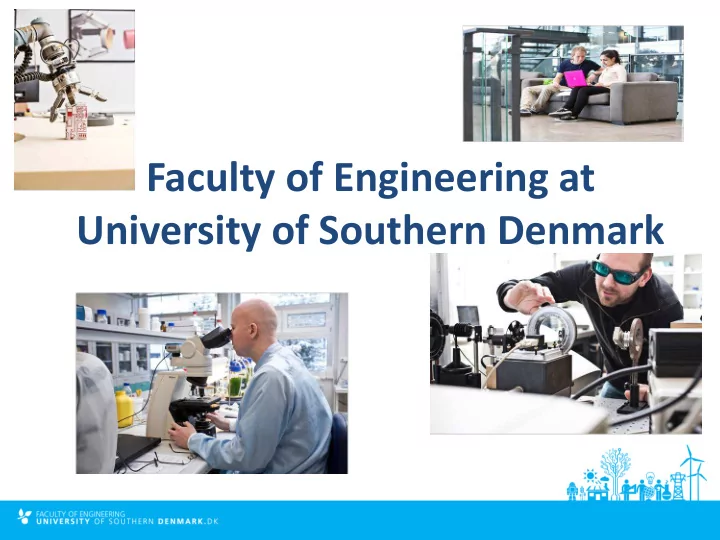
Faculty of Engineering at University of Southern Denmark University - - PowerPoint PPT Presentation
Faculty of Engineering at University of Southern Denmark University of Southern Denmark Established 1966 Turnover: 351 mill. EUR 5 faculties: Engineering Science Health Sciences Humanities Business and Social Sciences 6
Established 1966 Turnover: 351 mill. EUR 5 faculties:
6 campuses Academic staff: 1.973 Technical and adm. staff: 1445 Students, total no : 28.700 International students: 4700 Number of programmes: 222 of which 81 is in English Leiden World Ranking: 188
Facts
Established in 2006 – Merger between SDU and IOT Turnover: 32 mill. EUR Research and educational activities in Odense and Sønderborg 4 departments Research centres and an innovation unit 175 researchers and lectures 104 technical and administrative employees 77 PhD students – hereof 7 industrial PhD students 2900 students 600 international students 23 engineering programmes
Faculty Management
Department of Chemical Engineering, Biotechnology and Environmental Technology
Department of Innovation and Technology
Mechatronics, Control, Power Electronics, New Energy Sources, Energy Efficiency, Modeling, Nano- Micro- og Cleanroom Technology, New light Sources, Microfluidics, User-Oriented Design, Innovation & Business. Nano-optics, Structural dynamics, Energy Technology, Production, Robot Mechanics, Supply Chain Management, Product Development & Innovation, Design.
Analytical Chemistry, Spectroscopy, Natural Products Chemistry, Purification, drugs, Food Quality, Biogas, Biodiesel, Bacteria, Microalgae, Recombinant Proteins, Environment, Greenhouse Gases, Waste Management, Life Cycle Analysis, Advanced Materials Chemistry, Chemical Separation Techniques, Process Design.
Robot and Software Technology, Biological inspired robot technology, Cognitive vision, Mathematic Modelling, Embedded Systems, Power Electronics, Robot and IT technology for industry, agriculture, healthcare and welfare.
Dean Henrik Bindslev Director of Studies Henning Andersen Head of Secretariat Søren Lind Christiansen
Head of Department Michael Evan Goodsite
The Maersk Mc-Kinney Moller Institute The Mads Clausen Institute (Sønderborg)
Head of Department Lars Porskjær Christensen Head of Department Lars Dyhr Head of Department Horst-Günter Rubahn
TEK2017
Strategic focus areas – up to 2017 Multidisciplinary challenges in society, where TEK makes a difference
These areas will get extra funding through strategic projects and initiatives at the Faculty.
Strategic focus areas connecting research, education and innovation
11 Bachelor of Engineering programmes 12 Master of Science in Engineering programmes
Furthermore TEK has:
Energy Technology (master offered from 2014) Physics and Technology Innovation & Business Chemistry Structural Engineering (Master) Learning and Experience Technology Mechatronics Environmental Technology (Master) Product Development and Innovation Robot Systems Software Engineering Welfare Technology
Civil Engineering Electrical and Electronic Engineering Global Management and Manufacturing Integrated Design Interaction Design Information and Communication Technology Chemical Engineering Mechanical Engineering Mechatronics Manufacturing Engineering & Management Electrical Power Engineering
Optimised harvest Oil seeds Straw Optimised logistics Pre treatment
Enzymatic transesterification - continuous process Biodiesel and by-products production Glycerol to monomer for polymers conversion Straw pretreatment steam hydrolysis Simultaneous saccharification and fermentation in membrane bioreactor Fatty acids to nutraceuticals conversion & glucosinolates Biodiesel Bioethanol
15% to biodiesel production
Animal feed 1 1 Biogas plant Power and Heat Conversion to methanol Biohydrogen
BIO-fuel production
SDU part SDU design
Development of cheaper and more durable alternative membranes (longer lifetume) based on readily available commercial membranes modified by radiation grafting and reinforced with nano sized inorganic fillers. To understand the degradation mechanisms of electrodes and to improve electrode materials and develop ”safe” operational protocols.
Bioenergy production with focus on energy carriers: biogas and biodiesel. Green house gas (GHG) reduction. Nitrogen (N) and phosphorous (P) recycling. Environmental technologies for managing organic waste from agriculture. Developing country projects. see www.susane.info.
14
SDU biomass for bioenergy and biochemicals
SDU Biomass for bioenergy and biochemicals
NH3 GHG
Biogas NH3 GHG Kinetics Chemometrics Thermic model Pre- Interstage Posttreatment Lignocellosic Industrial waste New biomass
PhD Charlotte Rennuit PhD Simon V. Pedersen PhdD Ali Heidarzadeh Vazifehkhoran