Factor Vocab Word 2 Its meaning Introduction to (As it is used - - PDF document

factor
SMART_READER_LITE
LIVE PREVIEW

Factor Vocab Word 2 Its meaning Introduction to (As it is used - - PDF document

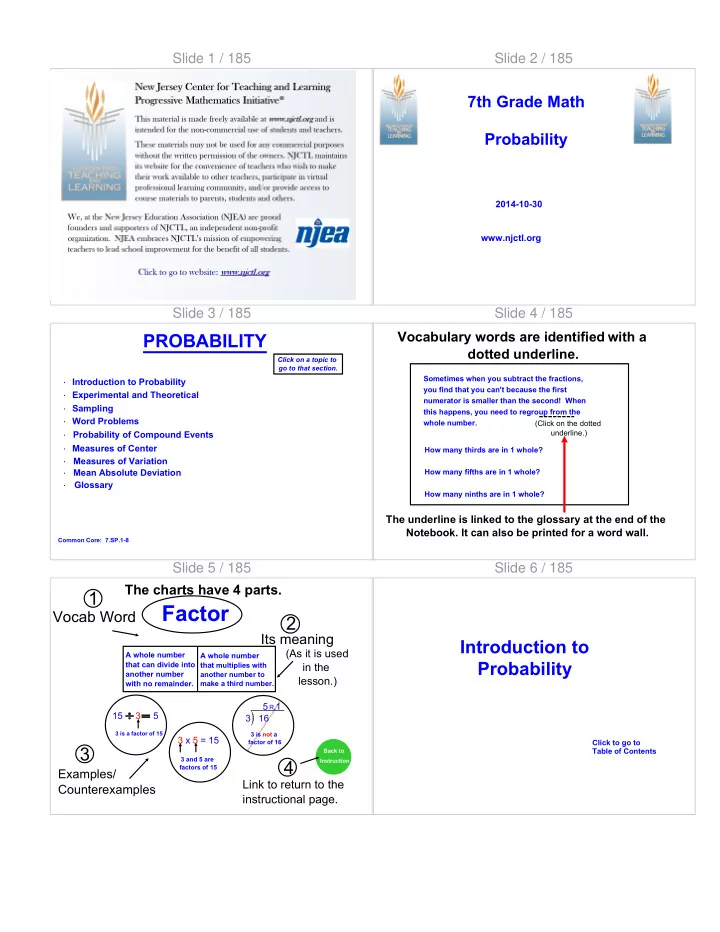
Slide 1 / 185 Slide 2 / 185 7th Grade Math Probability 2014-10-30 www.njctl.org Slide 3 / 185 Slide 4 / 185 Vocabulary words are identified with a PROBABILITY dotted underline. Click on a topic to go to that section. Sometimes when you


slide-1
SLIDE 1

Slide 1 / 185 Slide 2 / 185

www.njctl.org 2014-10-30

7th Grade Math Probability

Slide 3 / 185

PROBABILITY

· Introduction to Probability · Experimental and Theoretical · Word Problems · Probability of Compound Events

Click on a topic to go to that section.

Common Core: 7.SP.1-8

· Sampling · Measures of Center · Measures of Variation · Mean Absolute Deviation · Glossary

Slide 4 / 185

Sometimes when you subtract the fractions, you find that you can't because the first numerator is smaller than the second! When this happens, you need to regroup from the whole number. How many thirds are in 1 whole? How many fifths are in 1 whole? How many ninths are in 1 whole?

Vocabulary words are identified with a dotted underline.

The underline is linked to the glossary at the end of the

  • Notebook. It can also be printed for a word wall.

(Click on the dotted underline.)

Slide 5 / 185

Back to Instruction

Factor

A whole number that can divide into another number with no remainder.

15 3 5

3 is a factor of 15

3 x 5 = 15

3 and 5 are factors of 15

16 3 5 .1

R 3 is not a factor of 16

A whole number that multiplies with another number to make a third number.

The charts have 4 parts.

Vocab Word

1

Its meaning

2

Examples/ Counterexamples

3

Link to return to the instructional page.

4

(As it is used in the lesson.)

Slide 6 / 185

Introduction to Probability

Click to go to Table of Contents

slide-2
SLIDE 2

Slide 7 / 185

· One way to express probability is to use a fraction.

Number of favorable outcomes Total number of possible outcomes Probability

  • f an event

= P(event) Slide 8 / 185

Example: What is the probability of flipping a nickel and the nickel landing on heads? Step 1: What are the possible outcomes? Step 2: What is the number of favorable outcomes? Step 3: Put it all together to answer the question. The probability of flipping a nickel and landing on heads is: 1 . 2

Pull Pull

click

click

click

Pull Pull

Slide 9 / 185

Probability can be expressed in many forms. For example, the probability of flipping a head can be expressed as: 1 or 50% or 1:2 or 0.5 2 The probability of randomly selecting a blue marble can be expressed as: 1 or 1:6 or 16.7% or .167 6

Slide 10 / 185

When there is no chance of an event occurring, the probability of the event is zero (0). When it is certain that an event will occur, the probability of the event is one (1). 1 4 1 2 3 4 1 I m p

  • s

s i b l e Unlikely Equally Likely Likely C e r t a i n The less likely it is for an event to occur, the probability is closer to 0 (i.e. smaller fraction). The more likely it is for an event to occur, the probability is closer to 1 (i.e. larger fraction).

Slide 11 / 185

Without counting, can you determine if the probability of picking a red marble is lesser or greater than 1/2? It is very likely you will pick a red marble, so the probability is greater than 1/2 (or 50% or 0.5)

Click to Reveal

What is the probability of picking a red marble? 5 6

Click to Reveal

Add the probabilities of both events. What is the sum? 1 + 5 = 1 6 6

Click to Reveal

Slide 12 / 185 Note:

The sum of all possible outcomes is always equal to 1. There are three choices of jelly beans - grape, cherry and orange. If the probability of getting a grape is 3/10 and the probability of getting cherry is 1/5, what is the probability of getting orange? 3 + 1 + ? = 1 10 5 ? 5 + ? = 1 10 ? The probability of getting an orange jelly bean is 5 . 10

slide-3
SLIDE 3

Slide 13 / 185

1Arthur wrote each letter of his name on a separate

card and put the cards in a bag. What is the probability of drawing an A from the bag? A B 1/6 C 1/2 D 1

A R T H U R

Probability = Number of favorable outcomes Total number of possible outcomes

Pull Pull

Need a hint? Click the box.

Slide 14 / 185

2Arthur wrote each letter of his name on a separate

card and put the cards in a bag. What is the probability of drawing an R from the bag? A B 1/6 C 1/3 D 1

A R T H U R

Probability = Number of favorable outcomes Total number of possible outcomes

A

Pull Pull

Need a hint? Click the box.

Slide 15 / 185

3Matt's teacher puts 5 red, 10 black, and 5 green

markers in a bag. What is the probability of Matt drawing a red marker?

A 0 B

1/4

C

1/10

D

10/20

Pull Pull

Probability = Number of favorable outcomes Total number of possible outcomes

Need a hint? Click the box.

Slide 16 / 185

4What is the probability of rolling a 5 on a fair number

cube?

Pull Pull

Slide 17 / 185

5What is the probability of rolling a composite

number on a fair number cube?

Pull Pull

Slide 18 / 185

6What is the probability of rolling a 7 on a fair number

cube?

Pull Pull

slide-4
SLIDE 4

Slide 19 / 185

7You have black, blue, and white t-shirts in your

  • closet. If the probability of picking a black t-shirt is

1/3 and the probability of picking a blue t-shirt is 1/2, what is the probability of picking a white t-shirt?

Pull Pull

Slide 20 / 185

8If you enter an online contest 4 times and at the

time of drawing its announced there were 100 total entries, what are your chances of winning?

Pull Pull

Slide 21 / 185

9Mary chooses an integer at random from 1 to 6. What is the

probability that the integer she chooses is a prime number? A B C D

From the New York State Education Department. Office of Assessment Policy, Development and

  • Administration. Internet. Available from www.nysedregents.org/IntegratedAlgebra; accessed 17,

June, 2011.

Pull Pull

Slide 22 / 185

10Each of the hats shown below has colored marbles placed inside. Hat A

contains five green marbles and four red marbles. Hat B contains six blue marbles and five red marbles. Hat C contains five green marbles and five blue marbles.

Hat A Hat B Hat C

If a student were to randomly pick one marble from each of these three hats, determine from which hat the student would most likely pick a green marble. Justify your answer.

From the New York State Education Department. Office of Assessment Policy, Development and

  • Administration. Internet. Available from www.nysedregents.org/IntegratedAlgebra; accessed 17, June, 2011

Pull Pull

Slide 23 / 185

Determine the fewest number of marbles, if any, and the color of these marbles that could be added to each hat so that the probability of picking a green marble will be one-half in each of the three hats. Hat A contains five green marbles and four red marbles. Hat B contains six blue marbles and five red marbles. Hat C contains five green marbles and five blue marbles.

Hat A Hat B Hat C

From the New York State Education Department. Office of Assessment Policy, Development and

  • Administration. Internet. Available from www.nysedregents.org/IntegratedAlgebra; accessed 17, June, 2011

Pull Pull

Slide 24 / 185

Experimental & Theoretical Probability

Click to go to Table of Contents

slide-5
SLIDE 5

Slide 25 / 185

Click on an object. What is the outcome?

Slide 26 / 185

number of times the outcome happened

number of times experiment was repeated

Experimental Probability

Flip the coin 5 times and determine the experimental probability of heads.

Answers

Probability

  • f an event

Heads Tails

Slide 27 / 185

Example 1 - Golf A golf course offers a free game to golfers who make a hole-in-one on the last hole. Last week, 24 out of 124 golfers achieved this. Find the experimental probability that a golfer makes a hole-in-one on the last hole. Out of 31 golfers, you could expect 6 to make a hole-in-one on the last hole. Or there is a 19% chance of a golfer making a hole-in-one on the last hole. Experimental Probability P(hole-in-one) = # of successes # of trials = 24 124 = 6 31

Slide 28 / 185

Example 2 - Surveys Of the first 40 visitors through the turnstiles at an amusement park, 8 visitors agreed to participate in a survey being conducted by park employees. Find the experimental probability that an amusement park visitor will participate in the survey. You could expect 1 out of every 5 people to participate in the survey. Or there is a 20% chance of a visitor participating in the survey. Experimental Probability P(participation) = # of successes # of trials = 8 40 = 1 5

Slide 29 / 185

# on Die Picture of Roll Results 1 1 one 2 3 twos 3 1 three 4 0 fours 5 4 fives 6 1 six

Sally rolled a die 10 times and the results are shown below. Use this information to answer the following questions.

Slide 30 / 185

11

A B C D

What is the experimental probability of rolling a 5? 1/2 5/4 4/5 2/5 # on Die Picture of Roll Results 1 1 one 2 3 twos 3 1 three 4 0 fours 5 4 fives 6 1 six

These are the results after 10 rolls of the die Pull Pull

slide-6
SLIDE 6

Slide 31 / 185

12

A B C D

What is the experimental probability of rolling a 4? 1/2 5/4 4/4 # on Die Picture of Roll Results 1 1 one 2 3 twos 3 1 three 4 0 fours 5 4 fives 6 1 six

These are the results after 10 rolls of the die

Slide 32 / 185

13

A B C D Based on the experimental probability you found, if you rolled the die 100 times, how many sixes would you expect to get? 6 sixes 10 sixes 12 sixes 60 sixes

# on Die Picture of Roll Results 1 1 one 2 3 twos 3 1 three 4 fours 5 4 fives 6 1 six

These are the results after 10 rolls of the die Pull Pull

Slide 33 / 185

14Mike flipped a coin 15 times and it landed on tails 11 times.

What is the experimental probability of landing on heads? Pull Pull

Slide 34 / 185

Theoretical Probability

What is the theoretical probability of spinning green?

A n s w e r

FAIR Slide 35 / 185

number of favorable outcomes total number of possible outcomes

Probability

  • f an event

Theoretical Probability

Slide 36 / 185

Theoretical Probability Example 1 - Marbles Find the probability of randomly choosing a white marble from the marbles shown. There is a 2 in 5 chance of picking a white marble or a 40% possibility. P(white) = # of favorable outcomes # of possible outcomes 4 2 10 5 = =

slide-7
SLIDE 7

Slide 37 / 185

Theoretical Probability Example 2 - Marbles Suppose you randomly choose a gray marble. Find the probability of this event. There is a 3 in 10 chance of picking a gray marble or a 30% possibility. P(gray) = # of favorable outcomes # of possible outcomes 3 10 =

Slide 38 / 185

There is a 1 in 2 chance of getting tails when you flip a coin or a 50% possibility. Theoretical Probability Example 3 - Coins Find the probability of getting tails when you flip a coin. P(tails) = # of favorable outcomes # of possible outcomes 1 2 =

Slide 39 / 185

15

A B C D

What is the theoretical probability of picking a green marble? 1/8 7/8 1/7 1

R R G W W Y Y B Pull Pull

Slide 40 / 185

16

A B C D

What is the theoretical probability of picking a black marble? 1/8 7/8 1/7

R R G W W Y Y B Pull Pull

Slide 41 / 185

17

A B C D

What is the theoretical probability of picking a white marble? 1/8 7/8 1/4 1

Pull Pull R R G W W Y Y B

Slide 42 / 185

18

A B C D

What is the theoretical probability of not picking a white marble? 3/4 7/8 1/7 1

Pull Pull R R G W W Y Y B

slide-8
SLIDE 8

Slide 43 / 185

19What is the theoretical probability of rolling a three?

A 1/2 B 3 C 1/6 D 1 Pull Pull

Slide 44 / 185

20What is the theoretical probability of rolling an odd number?

A 1/2 B 3 C 1/6 D 5/6 Pull Pull

Slide 45 / 185

21What is the theoretical probability of rolling a number less

than 5? A 2/3 B 4 C 1/6 D 5/6 Pull Pull

Slide 46 / 185

22What is the theoretical probability of not rolling a 2?

A 2/3 B 2 C 1/6 D 5/6 Pull Pull

Slide 47 / 185

23Seth tossed a fair coin five times and got five heads.

The probability that the next toss will be a tail is A B C D

From the New York State Education Department. Office of Assessment Policy, Development and

  • Administration. Internet. Available from www.nysedregents.org/IntegratedAlgebra; accessed 17, June, 2011.

Pull Pull

Slide 48 / 185

24Which inequality represents the probability, x, of

any event happening? A x ≥ 0 B 0 < x < 1 C x < 1 D 0 ≤ x ≤ 1

From the New York State Education Department. Office of Assessment Policy, Development and

  • Administration. Internet. Available from www.nysedregents.org/IntegratedAlgebra; accessed 17, June, 2011

Pull Pull

slide-9
SLIDE 9

Slide 49 / 185 Class Activity

· Each student flips a coin 10 times and records the number of heads and the number of tail outcomes. · Each student calculates the experimental probability of flipping a tail and flipping a head. · Use the experimental probabilities determined by each student to calculate the entire class's experimental probability for flipping a head and flipping a tail.

Slide 50 / 185

Answer the following: What is the theoretical probability for flipping a tail? A head? Compare the experimental probability to the theoretical probability for 10 experiments. Compare the experimental probability to the theoretical probability when the experiments for all of the students are considered?

Slide 51 / 185

Sampling

Return to Table of Contents

Slide 52 / 185

Your task is to count the number of whales in the ocean or the number of squirrels in a park. How could you do this? What problems might you face? A sample is used to make a prediction about an event or gain information about a population. A whole group is called a POPULATION. A part of a group is called a SAMPLE.

Slide 53 / 185

A sample is considered random (or unbiased) when every possible sample of the same size has an equal chance of being

  • selected. If a sample is biased, then information obtained from it

may not be reliable. Example: To find out how many people in New York feel about mass transit, people at a train station are asked their opinion. Is this situation representative of the general population?

  • No. The sample only includes people who take the train and

does not include people who may walk, drive, or bike.

Slide 54 / 185

Determine whether the situation would produce a random sample. You want to find out about music preferences of people living in your area. You and your friends survey every tenth person who enters the mall nearest you. Pull Pull

slide-10
SLIDE 10

Slide 55 / 185

25Food services at your school wants to increase the number

  • f students who eat hot lunch in the cafeteria. They

conduct a survey by asking the first 20 students that enter the cafeteria to determine the students' preferences for hot

  • lunch. Is this survey reliable? Explain your answer.

Yes No Pull Pull

Slide 56 / 185

26The guidance counselors want to organize a career day.

They will survey all students whose ID numbers end in a 7 about their grades and career counseling needs. Would this situation produce a random sample? Explain your answer. Yes No Pull Pull

Slide 57 / 185

27The local newspaper wants to run an article about reading

habits in your town. They conduct a survey by asking people in the town library about the number of magazines to which they subscribe. Would this produce a random sample? Explain your answer. Yes No Pull Pull

Slide 58 / 185

How would you estimate the size of a crowd? What methods would you use? Could you use the same methods to estimate the number

  • f wolves on a mountain?

Slide 59 / 185

A whole group is called a POPULATION. A part of a group is called a SAMPLE. When biologists study a group of wolves, they are choosing a

  • sample. The population is all the wolves on the mountain.

Population Sample

Slide 60 / 185

Suppose this represents all the wolves on the mountain. One way to estimate the number of wolves on a mountain is to use the CAPTURE - RECAPTURE METHOD.

slide-11
SLIDE 11

Slide 61 / 185

Wildlife biologists first find some wolves and tag them.

Slide 62 / 185

Then they release them back onto the mountain.

Slide 63 / 185

They wait until all the wolves have mixed together. Then they find a second group of wolves and count how many are tagged.

Slide 64 / 185

Biologists use a proportion to estimate the total number of wolves on the mountain: tagged wolves on mountain tagged wolves in second group

total wolves on mountain total wolves in second group

For accuracy, they will often conduct more than one recapture.

=

8 2 w 9 2w = 72 w = 36 = There are 36 wolves on the mountain

Slide 65 / 185

Try This: Biologists are trying to determine how many fish are in the Rancocas Creek. They capture 27 fish, tag them and release them back into the Creek. 3 weeks later, they catch 45 fish. 7 of them are tagged. How many fish are in the creek? 27 7 f 45 27(45) = 7f 1215 = 7f 173.57 = f = There are 174 fish in the river

Slide 66 / 185

Try This: 315 out of 600 people surveyed voted for Candidate A. How many votes can Candidate A expect in a town with a population of 1500? Pull

slide-12
SLIDE 12

Slide 67 / 185

28860 out of 4,000 people surveyed watched

Dancing with the Stars. How many people in the US watched if there are 93.1 million people?

Pull

Slide 68 / 185

29Six out of 150 tires need to be realigned. How

many out of 12,000 are going to need to be realigned?

Pull

Slide 69 / 185

30You are an inspector. You find 3 faulty bulbs out of 50.

Estimate the number of faulty bulbs in a lot of 2,000. Pull Pull

Slide 70 / 185

31You survey 83 people leaving a voting site. 15 of them voted

for Candidate A. If 3,000 people live in town, how many votes should Candidate A expect? Pull Pull

Slide 71 / 185

32The chart shows the number of people wearing

different types of shoes in Mr. Thomas' English

  • class. Suppose that there are 300 students in the
  • cafeteria. Predict how many would be wearing

high-top sneakers. Explain your reasoning.

Number of Students Low-top sneakers 12 High-top sneakers 7 Sandals 3 Boots 6 Shoes

Pull Pull

Slide 72 / 185

Multiple Samples The student council wanted to determine which lunch was the most popular among their students. They conducted surveys on two random samples of 100 students. Make at least two inferences based on the results.

Student Sample Hamburgers

Tacos Pizza Total

#1 12

14 74 100

#2 12

11 77 100 · Most students prefer pizza. · More people prefer pizza than hamburgers and tacos combined.

slide-13
SLIDE 13

Slide 73 / 185

Try This! The NJ DOT (Department of Transportation) used two random samples to collect information about NJ drivers. The table below shows what type of vehicles were being driven. Make at least two inferences based on the results of the data.

Driver Sample

Cars SUVs Mini Vans Motorcycles Total

#1

37 43 12 8 100

#2

33 46 11 10 100 Pull Pull

Slide 74 / 185

Note to Teacher

The student council would like to sell potato chips at the next basketball game to raise money. They surveyed some students to figure out how many packages of each type of potato chip they would need to buy. For home games, the expected attendance is approximately 250 spectators. Use the chart to answer the following questions.

Student Sample Regular BBQ Cheddar #1 8 10 7 #2 8 11 6

Slide 75 / 185

33How many students participated in each survey? Pull Pull

Slide 76 / 185

34According to the two random samples, which flavor potato

chip should the student council purchase the most of? A Regular B BBQ C Cheddar Pull Pull

Slide 77 / 185

35Use the first random sample to evaluate the

number of packages of cheddar potato chips the student council should purchase.

Pull Pull

Slide 78 / 185

Word Problems

Click to go to Table of Contents

slide-14
SLIDE 14

Slide 79 / 185

19 shots made 100 shots attempted = 19% Example 1 - Soccer Erica loves soccer! The ladies' coach tells Erica that she scored 19% of her attempts on goal last season. This season, the coach predicts the same percentage for Erica. Erica reports she attempted approximately 1,100 shots on goal last season. Her coach suggests they estimate the number of goals using experimental probability. What do you know about percentages to figure out the relationship of goals scored to goals attempted? Experimental Probability =number of times the outcome happened number of times experiment was repeated Please continue on next slide... number of goals number of attempts Erica's Experimental Probability = Move to Reveal Move to Reveal

click to reveal

Slide 80 / 185

19 100 20 100 is very close to so she makes about 20%

  • f her shots on goal.

Let's estimate the number of goals Erica scored. 1,100 is very close to 1,000. So we will estimate that Erica has about 1,000 attempts About what percent would be a good estimate to use? About how many attempts did Erica take? Erica makes 19% of her shots on goal. Erica takes 1,100 shots on goal.

click click

Slide 81 / 185

Erica figures she made about 200 of her shots on goal. Erica wants to find 20% of 1,000. Her math looks like this:

click to reveal

Slide 82 / 185

Can you find the actual values that will give you 19%?

Challenge

Hint Answer

Slide 83 / 185

Example 2 - Gardening Last year, Lexi planted 12 tulip bulbs, but only 10

  • f them bloomed. This year she intends to plant 60 tulip
  • bulbs. Use experimental probability to predict how many

bulbs will bloom. Based on her experience last year,Lexi can expect 50

  • ut of 60 tulips to bloom.

Solve this proportion by looking at it times 5 Experimental Probability 10 bloom 12 total x bloom 60 total = 10 bloom 12 total 50 bloom 60 total =

Slide 84 / 185

Example 3 - Basketball Today you attempted 50 free throws and made 32 of them. Use experimental probability to predict how many free throws you will make tomorrow if you attempt 75 free throws. Based on your performance yesterday,you can expect to make 48 free throws out of 75 attempts. Solve this proportion using cross products Experimental Probability 32 75 = 50 x 2400 = 50x 48 = x 32 made 50 attempts x made 75 attempts =

slide-15
SLIDE 15

Slide 85 / 185

Number of attempts Number of goals Experimental Probability

100 1000 500 2000 30 600 150 1600

Now, its your turn. Calculate the experimental probability for the number of goals.

Slide 86 / 185

36Tom was at bat 50 times and hit the ball 10 times. What is

the experimental probability for hitting the ball? Pull Pull

Slide 87 / 185

37Tom was at bat 50 times and hit the ball 10 times. Estimate

the number of balls Tom hit if he was at bat 250 times. Pull Pull

Slide 88 / 185

38What is the theoretical probability of randomly selecting a

jack from a deck of cards? Pull Pull

Slide 89 / 185

39Mark rolled a 3 on a die for 7 out of 20 rolls. What is the

experimental probability for rolling a 3? Pull Pull

Slide 90 / 185

40Mark rolled a 3 on a die for 7 out of 20 rolls. What is the

theoretical probability for rolling a 3? Pull Pull

slide-16
SLIDE 16

Slide 91 / 185

41Some books are laid on a desk. Two are English, three are

mathematics, one is French, and four are social studies. Theresa selects an English book and Isabelle then selects a social studies book. Both girls take their selections to the library to read. If Truman then selects a book at random, what is the probability that he selects an English book? Pull Pull

Slide 92 / 185

42What is the probability of drawing a king or an ace from a

standard deck of cards? A 2/52 B 4/52 C 2/13 D 8/52 Pull Pull

Slide 93 / 185

43What is the probability of drawing a five or a diamond from

a standard deck of cards? A 4/13 B 13/52 C 2/13 D 16/52 Pull Pull

Slide 94 / 185

Probability of Compound Events

Click to go to Table of Contents

Slide 95 / 185

Probability of Compound Events

First - decide if the two events are independent or dependent. When the outcome of one event does not affect the

  • utcome of another event, the two events are

independent. Use formula: Probability (A and B) = Probability (A) Probability (B)

Slide 96 / 185

Independent Example Select a card from a deck of cards, replace it in the deck, shuffle the deck, and select a second card. What is the probability that you will pick a 6 and then a king?

P (6 and a king) = P(6) P(king) 4 4 = 1 52 52 169

slide-17
SLIDE 17

Slide 97 / 185

When the outcome of one event affects the outcome of another event, the two events are dependent. Use formula: Probability (A & B) = Probability(A) Probability(B given A)

Slide 98 / 185

Select a card from a deck of cards, do not replace it in the deck, shuffle the deck, and select a second card. What is the probability that you will pick a 6 and then a king?

Dependent Example P (6 and a king) = P(6) P(king given a six has been selected) 4 4 = 4 52 51 663

Notice your demominator when down by 1. Why?

Slide 99 / 185

Try to name some other independent and dependent events. Independent Dependent

Slide 100 / 185

44

The names of 6 boys and 10 girls from your class are put in a hat. What is the probability that the first two names chosen will both be boys? (w/o replacement) Pull Pull

Slide 101 / 185

45

A lottery machine generates numbers randomly. Two numbers between 1 and 9 are generated. What is the probability that both numbers are 5? Pull Pull

Slide 102 / 185

46

The TV repair person is in a room with 20 broken TVs. Two sets have broken wires and 5 sets have a faulty computer chip. What is the probability that the first TV repaired has both problems? Pull Pull

slide-18
SLIDE 18

Slide 103 / 185

47

What is the probability that the first two cards drawn from a full deck are both hearts? (without replacement) Pull Pull

Slide 104 / 185

48

A spinner containing 5 colors: red, blue, yellow, white and green is spun and a die, numbered 1 thru 6, is rolled. What is the probability of spinning green and rolling a two? Pull Pull

Slide 105 / 185

49

A drawer contains 5 brown socks, 6 black socks, and 9 navy blue socks. The power is out. What is the probability that Sam chooses two socks that are both black? Pull Pull

Slide 106 / 185

50 At a school fair, the spinner represented in the accompanying diagram is

spun twice.

A B C D

R G B

What is the probability that it will land in section G the first time and then in section B the second time?

From the New York State Education Department. Office of Assessment Policy, Development and

  • Administration. Internet. Available from www.nysedregents.org/IntegratedAlgebra; accessed 17,

June, 2011.

Pull Pull

Slide 107 / 185

51 A student council has seven officers, of which five are girls and two are boys. If

two officers are chosen at random to attend a meeting with the principal, what is the probability that the first officer chosen is a girl and the second is a boy?

A B C D

From the New York State Education Department. Office of Assessment Policy, Development and

  • Administration. Internet. Available from www.nysedregents.org/IntegratedAlgebra; accessed 17, June, 2011.

Pull Pull

Slide 108 / 185

52 The probability that it will snow on Sunday is .

The probability that it will snow on both Sunday and Monday is . What is the probability that it will snow on Monday, if it snowed on Sunday?

A B 2 C D

From the New York State Education Department. Office of Assessment Policy, Development and

  • Administration. Internet. Available from www.nysedregents.org/IntegratedAlgebra; accessed 17,

June, 2011.

Pull Pull

slide-19
SLIDE 19

Slide 109 / 185 Measures of Center

Return to Table of Contents

Slide 110 / 185

Measure of Center - Vocabulary Review Mean (Average) - The sum of the data values divided by the number of items Median - The middle data value when the values are written in numerical order Mode - The data value that occurs the most often

Slide 111 / 185

Joey wanted to convince his mom to give him some money for a snack from the concession stand. Below are the prices of the different snacks. $1.75, $0.75, $1.25, $0.75, $2.50, $2.00

Slide 112 / 185

What is the mean of this data set? $1.75, $0.75, $1.25, $0.75, $2.50, $2.00 Step 1: Add up all of the numbers. 1.75 + 0.75 + 1.25 + 0.75 + 2.50 + 2.00 = 9.00 Step 2: Divide the sum by the number of items listed. 9.00 / 6 = 1.50 The mean cost of concession stand snacks is $1.50. Mean Example

Slide 113 / 185

What is the median of this data set? $1.75, $0.75, $1.25, $0.75, $2.50, $2.00 Step 1: Order the numbers from least to greatest. 0.75, 0.75, 1.25, 1.75, 2.00, 2.50 Step 2: Find the middle value. 0.75, 0.75, 1.25, 1.75, 2.00, 2.50 The median cost of concession stand snacks is $1.50. Median Example

Find the mini mean 1.25 + 1.75 = 1.50 2 What do you do when you have two numbers left?

Slide 114 / 185

What is the mode of this data set? $1.75, $0.75, $1.25, $0.75, $2.50, $2.00 Step 1: Look for the number that appears most often. 1.75, 0.75, 1.25, 0.75, 2.50, 2.00 The mode cost of concession stand snacks is $0.75. Mode Example

slide-20
SLIDE 20

Slide 115 / 185

How can Joey use this information to ask his mom for money? $1.75, $0.75, $1.25, $0.75, $2.50, $2.00 Mean $1.50 Median $1.50 Mode $0.75

Slide 116 / 185

Use the dot plots to compare the 2 samples.

Time Spent Texting Daily by 7th Grade Students (in minutes)

60 15 30 45 75 90 105 120

Girls

60 15 30 45 75 90 105 120

Boys

Slide 117 / 185

Find the mean, median, and mode for the sample of girls.

60 15 30 45 75 90 105 120

Girls

Mean Median Mode

Slide 118 / 185

Find the mean, median, and mode for the sample of boys.

Mean Median Mode

60 15 30 45 75 90 105 120

Boys

Slide 119 / 185

Now compare the two measures of center. Girls Boys Mean 88.5 40.5 Median 90 30 Mode 60 30 and 60 Make a statement about the average time spent texting daily by 7th grade students.

Mean

Slide 120 / 185

53 What is the mean of the stem-and-leaf plot?

Stem Leaf 1 1 1 2 2 0 0 3 5 5 4 8

Key: 1 | 1 = 11

Pull

slide-21
SLIDE 21

Slide 121 / 185

54 What is the median of the stem-and-leaf plot?

Stem Leaf 1 1 1 2 2 0 0 3 5 5 4 8

Key: 1 | 1 = 11

Pull

Slide 122 / 185

55 What is the mode of the stem-and-leaf plot?

Stem Leaf 1 1 1 2 2 0 0 3 5 5 4 8

Key: 1 | 1 = 11

Pull

Slide 123 / 185

56 What is the mean of the stem-and-leaf plot?

Stem Leaf 1 8 9 3 7 7 9

Key: 1 | 8 = 1.8

Pull

Slide 124 / 185

57 What is the median of the stem-and-leaf plot?

Stem Leaf 1 8 9 3 7 7 9

Key: 1 | 8 = 1.8

Pull

Slide 125 / 185

58 What is the mode of the stem-and-leaf plot?

Stem Leaf 1 8 9 3 7 7 9

Key: 1 | 8 = 1.8

Pull

Slide 126 / 185

Use the dot plots to find the measures of center.

Miss M's Math Class Scores

90 50 60 70 80 100

1st Period Scores

Pull

slide-22
SLIDE 22

Slide 127 / 185

Use the dot plots to find the measures of center.

Miss M's Math Class Scores

90 50 60 70 80 100

8th Period Scores

Pull

Slide 128 / 185

Write a statement comparing the averages of Miss M's 1st period class scores to her 8th period class scores.

Slide 129 / 185 Measures of Variation

Return to Table of Contents

Slide 130 / 185

Measures of Variation - Vocabulary Review Range - The difference between the greatest data value and the least data value Quartiles - are the values that divide the data in four equal parts. Lower (1st) Quartile (Q1) - The median of the lower half of the data Upper (3rd) Quartile (Q3) - The median of the upper half of the data. Interquartile Range - The difference of the upper quartile and the lower quartile. (Q3 - Q1)

Slide 131 / 185

Sample Interquartile Range 1, 5, 8, 3, 2, 5, 2, 8, 9, 5 1, 2, 2, 3, 5, 5, 5, 8, 8, 9 · To find the interquartile range of the data set, we first have to find the quartiles. Step 1: Order the numbers from least to greatest.

Slide 132 / 185

1, 2, 2, 3, 5, 5, 5, 8, 8, 9 Step 2: Find the median. 5 median *Note: · If the median falls in between two data values, all of the values are still used to calculate the upper and lower quartiles. · If the median falls exactly on one of the two data values, than that values is NOT used to calculate the upper and lower quartiles.

slide-23
SLIDE 23

Slide 133 / 185

1, 2, 2, 3, 5, 5, 5, 8, 8, 9

5 median 8 Upper 2 Lower Quartile Quartile

Step 3: Find the upper and lower quartiles. Find the mean of each half of the data set.

Slide 134 / 185

Upper Lower Quartile Quartile Step 4: Subtract the lower quartile from the upper quartile. Interquartile = Range

  • 8
  • 2

= 6

Slide 135 / 185

Sample Range 1, 2, 2, 3, 5, 5, 5, 8, 8, 9 · To find the range, subtract the least value from the greatest value. Greatest Least Value Value = Range

  • 9
  • 1

= 8

Slide 136 / 185

1, 2, 2, 3, 5, 5, 5, 8, 8, 9

5 Median 8 Upper 2 Lower Quartile Quartile 1 Least Value 9 Greatest Value

Box-and-Whisker Plot These 5 values are used to create a box-and-whisker

  • plot. To do this, plot all 5 values on the number line

and then connect them to look like a box with whiskers on both sides. click the number line to reveal

5 6 4 3 2 1 7 8 9

Slide 137 / 185

59 What is the median of the data set?

5 6 4 3 2 1 7 8 9

Pull Pull Discussion Point Discussion Point

Slide 138 / 185

60 What is the interquartile range using the given information? Least Value = 3 Lower Quartile = 6 Median = 7 Upper Quartile = 10 Greatest Value = 11

Pull Pull

slide-24
SLIDE 24

Slide 139 / 185

61 What is the range for the following data set?

3, 5, 10, 4, 2, 2, 1

Pull Pull

Slide 140 / 185

62 What is the interquartile range for the following data set?

Pull Pull

3, 5, 10, 4, 2, 2, 1 Slide 141 / 185 Mean Absolute Deviation

Return to Table of Contents

Slide 142 / 185

Mean absolute deviation - the average distance between each data value and the mean. Mean Absolute Deviation - Vocabulary Review

Slide 143 / 185

Find the mean absolute deviation of the following data. Quiz Scores 65, 75, 90, 90, 100 Step 1: Find the mean. 65 + 75 + 90 + 90 + 100 = 420 = 84 5 5

Slide 144 / 185

Step 2: Find the absolute deviation. To do this you need to subtract the mean and each data point. Then take the absolute value of each difference.

Score Deviation from mean Absolute deviation from mean 65 65 - 84 = -19 |-19| = 19 75 75 - 84 = -9 |-9| = 9 90 90 - 84 = 6 |6| = 6 90 90 - 84 = 6 |6| = 6 100 100 - 84 = 16 |16| = 16

slide-25
SLIDE 25

Slide 145 / 185

Step 3: Find the mean absolute deviation (MAD). To do this find the mean using the absolute deviation numbers.

Absolute deviation from mean |-19| = 19 |-9| = 9 |6| = 6 |6| = 6 |16| = 16 19 + 9 + 6 + 6 + 16 5 = 56 = 11.2 5 The MAD is 11.2 points.

Pull Pull

Slide 146 / 185

Comparing Two Data Sets The number of goals scored by the players on the boys' and girls' LAX teams are displayed below.

5 6 4 3 2 1 7 8 9 10 5 6 4 3 2 1 7 8 9 10

Girls' Team Boys' Team

Compare the variability of the mean goals scored for both teams.

Slide 147 / 185

Pull Pull

Step 1: Find the mean for each team.

5 6 4 3 2 1 7 8 9 10

Girls' Team

5 6 4 3 2 1 7 8 9 10

Boys' Team

Pull Pull

Slide 148 / 185

Step 2: Find the absolute deviations.

Goals Mean Deviation Absolute Mean Dev. Goals Mean Deviation Absolute Mean Dev.

Girls' Team Boys' Team

Slide 149 / 185

Step 3: Find the mean absolute deviations. Girls' Team Boys' Team

Pull Pull Pull Pull

Slide 150 / 185

Comparison Statements 1.25 = 1.25 The variability is equal for both the boys and girls LAX teams. On average, the boy players scored 1 more goal than the girl players. (How do you know this?)

Pull Pull

slide-26
SLIDE 26

Slide 151 / 185

Use the following data to answer the next set of questions. Pages per Chapter in Hunger Games 10 15 20 25 30

x x x x x x x x x x x x x x x x x x x x x x x x x x x

10 15 20 25 30

x x x x x x x x x x x x x x x x x x x x x x

Pages per Chapter in Twilight

Slide 152 / 185

63What is the mean number of pages per chapter in

the Hunger Games?

Pull Pull

Slide 153 / 185

64What is the mean number of pages per chapter in

Twilight?

Pull Pull

Slide 154 / 185

65What is the difference of the means?

Pull Pull

Slide 155 / 185

66What is the mean absolute deviation of the data set

for Hunger Games? (Hint: Round mean to the nearest ones.)

Pull Pull

Slide 156 / 185

67What is the mean absolute deviation of the data set

for Twilight? (Hint: Round mean to the nearest ones.)

Pull Pull

slide-27
SLIDE 27

Slide 157 / 185

68Which book has more variability in the number of pages per

chapter? A Hunger Games B Twilight Pull Pull

Slide 158 / 185

69On average, there are ______ pages per chapter in

the Hunger Games than in Twilight.

Pull Pull

  • A. more
  • B. less

Slide 159 / 185

Glossary

Return to Table of Contents

Slide 160 / 185

Back to Instruction What is the probability

  • f flipping a nickel and

the nickel landing on heads?

1 favorable 2 possible

Probability

The ratio of the number of favorable

  • utcomes to the total number of

possible outcomes.

Number of favorable outcomes Total number of possible outcomes

Probability

  • f an event

P(event)

=

1 or 50% 2 1:2 or 0.5 Many Forms!

Slide 161 / 185

Back to Instruction

Experimental Probability

The ratio of the number of times an event occurs to the total number of times that the activity is performed.

number of times the outcome happened number of times experiment was repeated

Probability

  • f an event

Last week, 24 out

  • f 124 golfers hit a

hole-in-one on the last hole. Find the experimental probability that a golfer makes this shot.

P(hole-in-one) = # of successes = # of trials

24 124 = 6 31

Slide 162 / 185

Back to Instruction

Theoretical Probability

The ratio of the number of equally likely outcomes in an event to the total number of possible outcomes.

number of favorable outcomes total number of possible outcomes

Probability

  • f an event

Find the probability of getting tails when you flip a coin.

P(tails) =

# of favorable

  • utcomes

# of possible

  • utcomes

1 2 =

slide-28
SLIDE 28

Slide 163 / 185

Back to Instruction

Equally Likely

When all the outcomes have the same chance of occurring.

Sides on a Coin

A Fair Die A Fair Spinner Slide 164 / 185

Back to Instruction

Fair

An experiment with equally likely

  • utcomes.

Tossing a Coin Rolling a Fair Die Spinning a Fair Spinner

Slide 165 / 185

Back to Instruction

Sample

A part of a group.

Population Sample

random

  • r

unbiased

·

  • nly red m&ms

in a bag ·

  • nly poodles in a dog

park ·

  • nly girls wearing

glasses in a classroom

Slide 166 / 185

Back to Instruction

Random Sample

Every possible sample of the same size has an equal chance of being selected Unbiased

Asking everyone in a classroom if they believe flying is safe. Asking everyone in a classroom if they like chocolate. Asking everyone in a classroom if they like comic books.

Slide 167 / 185

Back to Instruction

Biased Sample

When every possible sample of the same size does not have an equal chance of being selected.

Asking only flight attendants if they believe flying is safe. Unreliable Asking everyone in Hershey Park if they like chocolate. Asking everyone at ComicCon if they like comic books.

Slide 168 / 185

Back to Instruction

Population

A whole group.

Population Sample

· All m&ms in a bag · All types of dogs in a dog park · All students wearing glasses in a classroom

NOT just people in a place

slide-29
SLIDE 29

Slide 169 / 185

Back to Instruction

Capture-Recapture Method

A method of sampling that is used to try and estimate the entire

  • population. A sample of animals are caught, tagged, and then

released into the wild. Later a second sample of animals are caught to compute using a ratio the amount of tagged animals to the population as a whole.

Slide 170 / 185

Back to Instruction

Compound Event

A combination of two or more simple events.

The prob. of flipping heads AND rolling 4 on a die. The prob. of selecting a Jack OR a 3 card. The prob. of selecting a Jack AND a 3 card.

Slide 171 / 185

Back to Instruction

Independent Event

When the outcome of one event does not affect the outcome of another event.

Probability (A and B) = Prob(A)Prob(B)

The prob. of flipping heads AND rolling 4 on a die.

Slide 172 / 185

Back to Instruction

Dependent Event

When the outcome of one affects the

  • utcome of another event.

Probability (A & B) = Prob(A) *Prob(B given A)

The prob. of selecting a Jack AND a 3 card.

Slide 173 / 185

Back to Instruction

Mean

The sum of the data values divided by the number of items. Average

1, 2, 3, 4, 5

Set of Data:

1+2+3+4+5 =15 15/5 = 3

The mean is 3. Slide 174 / 185

Back to Instruction

Median

The middle data value when the values are written in numerical order.

1, 2, 3, 4, 5

Median

1, 2, 3, 4

Median is 2.5

1+2+3+4 = 10 10/4 = 2.5

slide-30
SLIDE 30

Slide 175 / 185

Back to Instruction

Mode

The data value that occurs the most often. 2, 4, 6, 3, 4

The mode is 4.

2, 4, 6, 2, 4

The mode is 4 and 2.

2, 4, 6, 3, 8 There is no mode. Slide 176 / 185

Back to Instruction

Range

The difference between the greatest data value and the least data value. 2, 4, 7, 12 12 - 2 = 10

The range is 10.

5, 9, 10, 40 40 - 5 = 35

The range is 35.

1, 5, 9, 18 18 - 1 = 17

The range is 17.

Slide 177 / 185

Back to Instruction

Quartiles

The values that divide the data in four equal parts.

25% 25% 25% 25%

Q1 Q2 Q3 1,3,3,4,5,6,6,7,8,8 Q1 Q2 Q3

1 2 3 4 5 6 7 8

Q1 Q2 Q3

Slide 178 / 185

Back to Instruction

Lower (1st) Quartile The median of the lower half of data.

25% 25% 25% 25%

Q1 Q2 Q3 1,3,3,4,5,6,6,7,8,8 Q1 Q2 Q3

1 2 3 4 5 6 7 8

Q1 Q2 Q3

Median

}

Median

}

Slide 179 / 185

Back to Instruction

Upper Quartile

The median of the upper half of data.

25% 25% 25% 25%

Q1 Q2 Q3 1,3,3,4,5,6,6,7,8,8 Q1 Q2 Q3

1 2 3 4 5 6 7 8

Q1 Q2 Q3

Median

}

Median

}

Slide 180 / 185

Back to Instruction

Interquartile Range

The difference of the upper quartile and the lower quartile.

25% 25% 25% 25%

Q1 Q2 Q3 1,3,3,4,5,6,6,7,8,8 Q1 Q2 Q3

1 2 3 4 5 6 7 8

Q1 Q2 Q3

= Q3 - Q1 = Q3 - Q1 = 4

slide-31
SLIDE 31

Slide 181 / 185

Back to Instruction

Mean Absolute Deviation The average distance between each data value and the mean.

Find the mean

Subtract the mean from each data point

Find the mean of the differences

2,2,3,4,4

15 5=3

3-2=1 4-3=1 3-3=0

1+1+0+1+1 =4 5=.8

3-2=1 4-3=1

1. 2. 3. Slide 182 / 185

Back to Instruction

Slide 183 / 185

Back to Instruction

Slide 184 / 185

Back to Instruction

Slide 185 / 185

Back to Instruction