FACT Kirk Strosahl Ph.D. ASU DBH Conference, March 2013 - - PDF document

fact
SMART_READER_LITE
LIVE PREVIEW

FACT Kirk Strosahl Ph.D. ASU DBH Conference, March 2013 - - PDF document

3/11/2013 Brief Interventions for Radical Change: The Practice of Focused Acceptance and Commitment Therapy FACT Kirk Strosahl Ph.D. ASU DBH Conference, March 2013 moutainconsult@msn.com Workshop Objectives Learn about the evidence


slide-1
SLIDE 1

3/11/2013 1

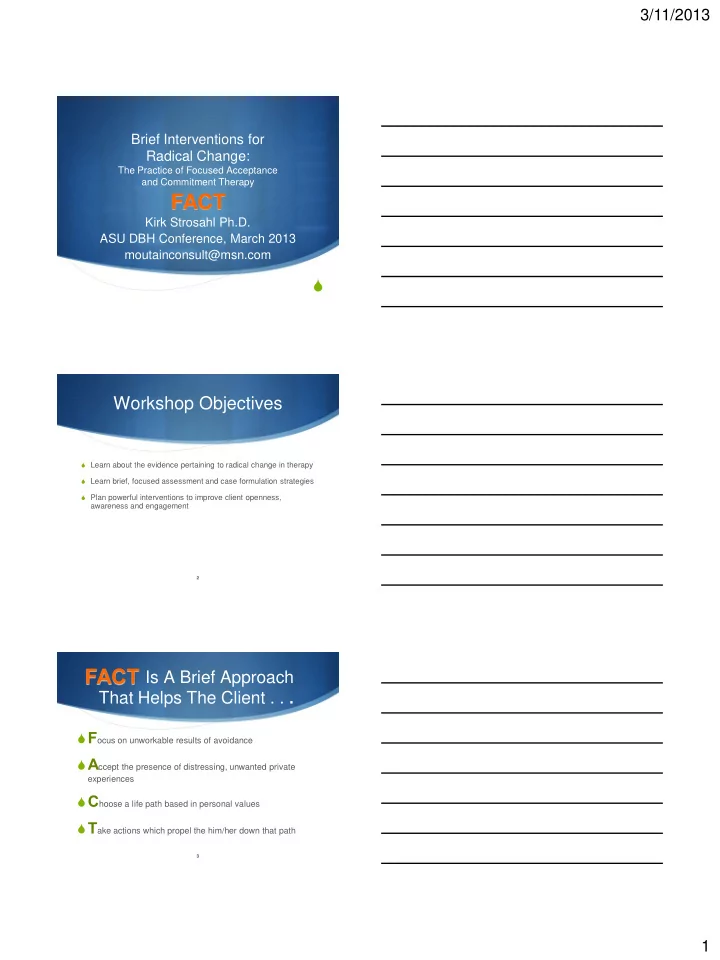
Brief Interventions for Radical Change:

The Practice of Focused Acceptance and Commitment Therapy

FACT

Kirk Strosahl Ph.D. ASU DBH Conference, March 2013 moutainconsult@msn.com

2

Workshop Objectives

 Learn about the evidence pertaining to radical change in therapy  Learn brief, focused assessment and case formulation strategies  Plan powerful interventions to improve client openness,

awareness and engagement

2 3

Is A Brief Approach That Helps The Client . . .

Focus on unworkable results of avoidance Accept the presence of distressing, unwanted private

experiences

Choose a life path based in personal values Take actions which propel the him/her down that path

FACT

3

slide-2
SLIDE 2

3/11/2013 2

FACT Assessment/Intervention Flow

Contextual Factors (Love, Work, Play, Health) Motivational Intervention: True North & Life Path

Functional Analysis of Problem (3 Ts Interview)

Workability: FACT Focusing Questions &“Reframe” Radical Change! (Bulls Eye Planning Tool; FACT Quick Guide) PsyFlex Profile Four Square Analysis

4 5

Why Brief Interventions? Practice Contexts Are Changing!

 More services delivered in brief intervention contexts such as

primary care, jails, schools, crisis units, home outreach services

 Conventional multi-session treatment protocols are not realistic

in these settings

 Even in specialty treatment settings, resources are dwindling

while the number of clients needing services is expanding exponentially

 Requires that we condense assessment and treatment activities,

empower clients and act more as a resource for the client rather than as a “therapist”

5 6

Brief Interventions: What Do Clients Want?

 In a naturalistic study of over 9000 patients in seeking

therapy, the modal number of psychotherapy visits was one (Brown & Jones, 2004)

 Clients seek treatment when psychological distress is

high and stop coming when distress level drops; for most this is within 5 visits (Brown & Jones, 2004)

 Their motives? Emotional reassurance and practical

problem solving

 30 to 40 percent drop out of treatment without

consulting their therapist (Talmon, 1990, Olfson et. al., 2009)

6
slide-3
SLIDE 3

3/11/2013 3

7

Rapid Change is The Rule, Not the Exception!

In one recent study, 40 to 45 percent of depressed clients exhibited sudden large gains within the first 2 to 4 treatment sessions (Doane, Feeny & Zoellner, 2010) Similar gain in CBT for PTSD (52 percent of clients; Doane, Feeny & Zoeller, 2010), adolescent depression (Renaud et. al., 1998), binge eating (62 percent of clients; Grilo, Masheb & Wilson, 2006) and irritable bowel syndrome (30 percent of clients; Lackner et. al., 2010) Rapid response is associated with long-term improvements in functioning, as well as a reduction in long term relapse rates (Crits- Cristoph et. al., 2001; Lutz, Stulz & Kock, 2009).

7 8

Change is a Non-Linear Process

 Studies of the “dose-effect” relationship (i.e., number of

therapy sessions received relative to the amount of clinical benefit experienced)

 15 percent of clients are clinically improved before they arrive

for the first session!

 50 percent of all clients are clinically improved by the 8th

session

 To get 75 percent of clients clinically improved requires at

least 26 sessions

 Conclusion: Treatment beyond session 8 is no where

near as cost effective as the first 8 sessions! (Howard, Kopta, Krause & Orlinsky, 1986)

8 9

Is More Necessarily Better?

 Greatest amount of improvement occurs very early in

treatment with diminishing returns of benefit over time. (Kopta ea al.; Ilardi & Craighead, 1994)

 Lengthier, time-unlimited therapies do not always

demonstrate incremental efficacy compared to brief therapies (Knekt et al., 2008; cf. Steenbarger, 1994 for a review)

9

slide-4
SLIDE 4

3/11/2013 4

10

Recent Studies of Brief Interventions

 Patients show clinically significant change across very few

treatment sessions (Bryan et al., 2009; Bryan et al., 2010; Cigrang et al., 2006)

 Patient receiving 2 or more sessions showed broad spectrum

improvements in symptoms, functioning and social integration (Bryan et. al. 2010)

 These changes were robust and stable during a two year follow

up period (Ray-Sannarud et. al., 2012)

 Patients with more severe impairment at pre-treatment improved

faster than patients with less severe impairment (Bryan et al., 2012)

10 11

ASSUME 1 VISIT, HOPE FOR 4 - 6

 Fact Mantra: Treat every session as if it is the last

session!

 A “brief therapy” is one that can achieve its’ goals before

the client’s natural tendency to drop out is realized.

 The change process begins in the first visit.  Talking in rapid change terms is likely to induce rapid

change.

 Clients with long-standing problems are just as likely to

experience rapid change as those with time limited problems!

11 12

Why is the ACT Approach Ideal for Brief Therapy?

 Trans-diagnostic model of human suffering  Strengths based approach to creating change (skill building

rather than curing illnesses)

 Acceptance and mindfulness are “qualitative” processes that can

instantly transform a situation

 Values and committed action are powerful motivational tools  The ACT approach is very transparent and the core concepts are

easily understood by non-mental health professionals

12

slide-5
SLIDE 5

3/11/2013 5

13

Learn To Conduct A Streamlined, Change-Oriented Interview

1.Quick, Focused, Accurate Assessment Templates

 Love, Work, Play & Health Questions  Three Ts  Problem Severity, Confidence, and

Helpfulness Assessment Questions

14

The Love, Work, Play & Health Questions

Love

Where do you live? With whom? How long have you been there? Are things okay at your home? Do you have loving relationships with your family or friends?

Work

Do you work? Study? If yes, what is your work? Do you enjoy it? If no, are you looking for work? If no, how do your support yourself?

Play

What do you do for fun? For relaxation? For connecting with people in your neighborhood or community?

Health

Do you use tobacco products, alcohol, illegal drugs? Do you exercise on a regular basis for your health? Do you eat well? Sleep well?

15

The Three T & Workability Questions

Time

When did this start? How often does it happen? What happens immediately before / after the problem? Why do you think it is a problem now?

Trigger

Is there anything--a situation or a person--that seems to set it off?

Trajectory

What’s this problem been like over time? Have there been times when it was less of a concern? More of a concern?

Workability What have you tried (to address the problem)? How

has that worked in the short run? In the long run or in the sense of being consistent with what really matters to you?

slide-6
SLIDE 6

3/11/2013 6

16

FACT Visit Assessment Questions

  • 1. How big of a problem is

this for you? On a scale of 0 = “not a problem” and 10 = “a very big problem”, how would you rate it?

  • 2. How confident are you

that you will follow through with our plan? Use a scale where 0 = “no confidence” and 10 = “very confident”.

  • 3. How helpful was this

visit? Use a scale where 0 = “not helpful” and 10 = “very helpful”.

17

Workability: The Central Question

 Has what you have been doing helped you get

to where you want to be according to your values?

Workability: Focus Questions

  • 1. What are you seeking?
  • 2. What have you tried?
  • 3. How has it worked?
  • 4. What has it cost you?
  • 5. What type of life would you choose if you could

choose?

18

slide-7
SLIDE 7

3/11/2013 7

The “Reframe”

 Often functions as the transition between assessment and

intervention phase of a session

 Three main components  Redefine the “problem” in a new way that the client hasn’t thought of before  Creates a positive, intentional path for the client to follow  Makes the “problem” seem solvable

19

Reframe Strategies

 Go to “30,000 feet” and portray the problem in terms of a

bigger life path the client is following

 Focus the discussion on the positive, value based

intentions of the client, rather than on what is not working

 Describe the necessity of the “problem” in teaching the

client about self or life

 State your confidence that the client is about to learn

something important and will do things differently

20 21

The Pillars of Flexibility

Open

  • Able to accept

distressing material without struggle

  • Behavior is

shaped by direct results rather than rigid rules

Aware

  • Able to

experience present moment

  • Able to take

perspective on self and self- story

Engaged

  • Strong

connection with values

  • Able to sustain

value-consistent action

slide-8
SLIDE 8

3/11/2013 8

22

Flexibility Profile Foursquare Tool

 Simple way to describe client strengths and weaknesses

and to focus therapeutic interventions

 Creates distinction between target behaviors and mental

processes that enable (or disable) them

 Often, planning a target behavior will also require work on

a mental process that is functioning as a barrier to that behavior

23 24

FACT Four Square Analysis

slide-9
SLIDE 9

3/11/2013 9

25

Bulls Eye Planning Tool

Value

Action Steps:

  • 1. Relates to which core processes?
  • 2. Relates to which core processes?

32 26 Living the Life I Choose

27

Life Path Graphic

slide-10
SLIDE 10

3/11/2013 10

28

Life Path Questions

29

FACT Practice Support Tools: The Quick Guide

 1 page pocket guide (put in on your wall, in your clip

board or in your pocket)

 3+ interventions for each of the 6 Processes / Points

  • f Psychological Flexibility

 Categorized by Process / Point  Bulls Eye involves multiple processes, as do several others

30

FACT Resources

Association for Contextual Behavioral Science”

http://www.contextualpsychology.org/ http://www.newharbingeronline.com/real-behavior-change-in-primary- care.html

slide-11
SLIDE 11

3/11/2013 11

31

FACT Resources