
SLIDE 1
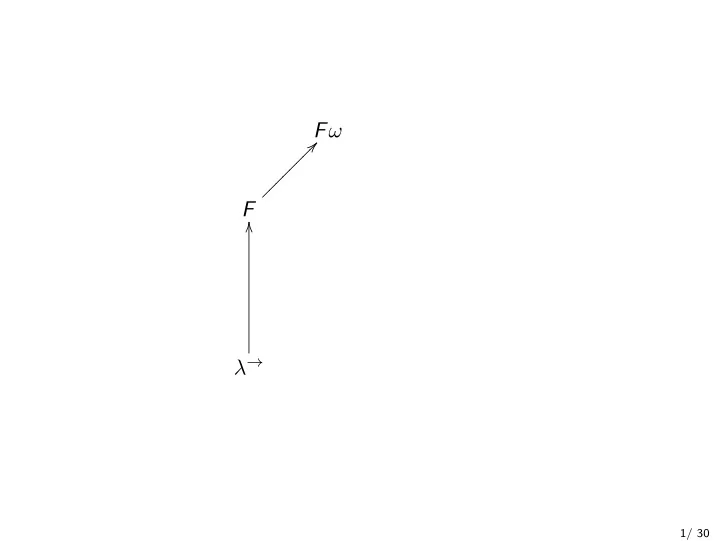
Fω F
- ⑧
⑧ ⑧ ⑧ ⑧ ⑧ ⑧ ⑧
λ→
- 1/ 30
F F 1/ 30 Last time: Simply typed lambda - - PowerPoint PPT Presentation
F F 1/ 30 Last time: Simply typed lambda calculus A B x:A.M M N ... with products A B M, N fst M snd M ... and sums A + B inl [B] M inr [A] M case L of x.M |
Fω F
⑧ ⑧ ⑧ ⑧ ⑧ ⑧ ⑧
λ→
Simply typed lambda calculus
A → B λx:A.M M N
... with products
A × B ⟨M, N⟩ fst M snd M
... and sums
A + B inl [B] M inr [A] M case L of x.M | y.N
Polymorphic lambda calculus
∀α::K.A Λα::K.M M [A]
... with existentials
∃α::K.A pack B,M as ∃α::K.A
2/ 30
Γ ⊢ M : A[α::=B] Γ ⊢ ∃α::K.A :: ∗ ∃-intro Γ ⊢ pack B, M as ∃α::K.A : ∃α::K.A Γ ⊢ M : ∃α::K.A Γ, α :: K, x : A ⊢ M′ : B ∃-elim Γ ⊢ open M as α, x in M′ : B
3/ 30
type u = Unit
4/ 30
The unit type has one inhabitant. We can represent it as the type of the identity function.
Unit = ∀α::∗.α → α
The unit value is the single inhabitant:
Unit = Λα::∗.λa:α.a
We can package the type and value as an existential:
pack (∀α::∗.α → α, Λα::∗.λa:α.a) as ∃U :: ∗.u
We’ll write 1 for the unit type and ⟨⟩ for its inhabitant.
5/ 30
A boolean data type:
type bool = False | True
A destructor for bool:
val _if_ : bool -> ’a -> ’a -> ’a let _if_ b _then_ _else_ = match b with False
| True -> _then_
6/ 30
The boolean type has two inhabitants: false and true. We can represent it using sums and unit.
Bool = 1 + 1
The constructors are represented as injections:
false = inl [1] ⟨⟩ true = inr [1] ⟨⟩
The destructor (if) is implemented using case:
λb:Bool. Λα::∗. λr:α. λs:α.case b of x.s | y.r
7/ 30
We can package the definition of booleans as an existential:
pack (1+1, ⟨inr [1] ⟨⟩, ⟨inl [1] ⟨⟩, λb:Bool. Λα::∗. λr:α. λs:α. case b of x.s | y.r⟩⟩) as ∃β::∗. β × β × (β → ∀α::∗.α → α → α)
8/ 30
A nat data type
type nat = Zero : nat | Succ : nat -> nat
A destructor for nat:
val foldNat : nat -> ’a -> (’a -> ’a) -> ’a let rec foldNat n z s = match n with Zero -> z | Succ n -> s (foldNat n z s)
9/ 30
The type of natural numbers is inhabited by Z, SZ, SSZ, ... We can represent it using a polymorphic function of two parameters:
N = ∀α::∗.α → (α → α) → α
The Z and S constructors are represented as functions:
z : N z = Λα::∗.λz:α.λs:α → α.z s : N → N s = λn:∀α::∗.α → (α → α) → α. Λα::∗.λz:α.λs:α → α.s (n [α] z s),
The foldN destructor allows us to analyse natural numbers:
foldN : N → ∀α::∗.α → (α → α) → α foldN = λn:∀α::∗.α → (α → α) → α.n
10/ 30
foldN : N → ∀α::∗.α → (α → α) → α
For example, we can use foldN to write a function to test for zero:
λn:N.foldN n [Bool] true (λb:Bool.false)
Or we could instantiate the type parameter with N and write an addition function:
λm:N.λn:N.foldN m [N] n succ
11/ 30
Of course, we can package the definition of N as an existential:
pack (∀α::∗.α → (α → α) → α, ⟨Λα::∗.λz:α.λs:α → α.z, ⟨λn:∀α::∗.α → (α → α) → α. Λα::∗.λz:α.λs:α → α.s (n [α] z s), ⟨λn:∀α::∗.α → (α → α) → α.n⟩⟩⟩) as ∃N::∗. N × (N → N) × (N → ∀α::∗.α → (α → α) → α)
12/ 30
13/ 30
A kind for binary type operators
∗ ⇒ ∗ ⇒ ∗
A binary type operator
λα::∗.λβ::∗.α + β
A kind for higher-order type operators
(∗ ⇒ ∗) ⇒ ∗ ⇒ ∗
A higher-order type operator
λφ::∗ ⇒ ∗.λα::∗.φ (φ α)
14/ 30
K1 is a kind K2 is a kind ⇒-kind K1 ⇒ K2 is a kind
15/ 30
Γ, α::K1 ⊢ A :: K2 ⇒-intro Γ ⊢ λα::K1.A :: K1 ⇒ K2 Γ ⊢ A :: K1 ⇒ K2 Γ ⊢ B :: K1 ⇒-elim Γ ⊢ A B :: K2
16/ 30
type (’a, ’b) sum = Inl : ’a -> (’a, ’b) sum | Inr : ’b -> (’a, ’b) sum val case : (’a, ’b) sum -> (’a -> ’c) -> (’b -> ’c) -> ’c let case s l r = match s with Inl x -> l x | Inr y -> r y
17/ 30
We can finally define sums within the language. As for N sums are represented as a binary polymorphic function:
Sum = λα::∗.λβ::∗.∀γ::∗.(α → γ) → (β → γ) → γ
The inl and inr constructors are represented as functions:
inl = Λα::∗.Λβ::∗.λv:α.Λγ::∗. λl:α → γ.λr:β → γ.l v inr = Λα::∗.Λβ::∗.λv:β.Λγ::∗. λl:α → γ.λr:β → γ.r v
The foldSum function behaves like case:
foldSum = Λα::∗.Λβ::∗.λc:∀γ::∗.(α → γ) → (β → γ) → γ.c
18/ 30
Of course, we can package the definition of Sum as an existential:
pack λα::∗.λβ::∗.∀γ::∗.(α → γ) → (β → γ) → γ, Λα::∗.Λβ::∗.λv:α.Λγ::∗.λl:α → γ.λr:β → γ.l v Λα::∗.Λβ::∗.λv:β.Λγ::∗.λl:α → γ.λr:β → γ.r v Λα::∗.Λβ::∗.λc:∀γ::∗.(α → γ) → (β → γ) → γ.c as ∃φ::∗ ⇒ ∗ ⇒ ∗. ∀α::∗.∀β::∗.α → φ α β × ∀α::∗.∀β::∗.β → φ α β × ∀α::∗.∀β::∗.φ α β → ∀γ::∗.(α → γ) → (β → γ) → γ
(However, the pack notation becomes unwieldy as our definitions grow.)
19/ 30
A list data type:
type ’a list = Nil : ’a list | Cons : ’a * ’a list -> ’a list
A destructor for lists:
val foldList : ’a list -> ’b -> (’a -> ’b -> ’b) -> ’b let rec foldList l n c = match l with Nil -> n | Cons (x, xs) -> c x (foldList xs n c)
20/ 30
We can define parameterised recursive types such as lists in System Fω. As for N lists are represented as a binary polymorphic function:
List = λα::∗.∀φ::∗ ⇒ ∗.φ α → (α → φ α → φ α) → φ α
The nil and cons constructors are represented as functions:
nil = Λα::∗.Λφ::∗ ⇒ ∗.λn:φ α.λc:α → φ α → φ α.n cons = Λα::∗.λx:α.λxs:List α. Λφ::∗ ⇒ ∗.λn:φ α.λc:α → φ α → φ α. c x (xs [φ] n c)
The destructor corresponds to the foldList function:
foldList = Λα::∗.Λβ::∗.λc:α → β → β.λn:β. λl:List α.l [λγ::∗.β] n c
21/ 30
We defined add for N, and we can define append for lists:
append = Λα::∗. λl:List α.λr:List α. foldList [α] [List α] l r (cons [α])
22/ 30
A regular type:
type ’a tree = Empty : ’a tree | Tree : ’a tree * ’a * ’a tree -> ’a tree
A non-regular type:
type ’a perfect = ZeroP : ’a -> ’a perfect | SuccP : (’a * ’a) perfect
23/ 30
We can represent non-regular types like perfect in System Fω:
Perfect = λα::∗.∀φ::∗ ⇒ ∗. (∀α::∗.α → φ α) → (∀α::∗.φ (α × α) → φ α) → φ α
This time the arguments to zeroP and succP are themselves polymorphic:
zeroP = Λα::∗.λx:α.Λφ::∗ ⇒ ∗. λz:∀α::∗.α → φ α.λs:∀α::∗.φ (α × α) → φ α. z [α] x succP = Λα::∗.λp:Perfect (α × α).Λφ::∗ ⇒ ∗. λz:∀α::∗.α → φ α.λs:∀β::∗.φ (β × β) → φ β. s [α] (p [φ] z s)
24/ 30
Recall Leibniz’s equality: consider objects equal if they behave identically in any context In System Fω:
Eq = λα::∗.λβ::∗.∀φ::∗ ⇒ ∗.φ α → φ β
25/ 30
Eq = λα::∗.λβ::∗.∀φ::∗ ⇒ ∗.φ α → φ β
Equality is reflexive (A ≡ A):
refl : ∀α::∗.Eql α α refl = Λα::∗.Λφ::∗ ⇒ ∗.λx:φ α.x
and symmetric (A ≡ B → B ≡ A):
symm : ∀α::∗.∀β::∗.Eql α β → Eql β α symm = Λα::∗.Λβ::∗. λe:(∀φ::∗ ⇒ ∗.φ α → φ β).e [λγ::∗.Eq γ α] (refl [α])
and transitive (A ≡ B ∧ B ≡ C → A ≡ C):
trans : ∀α::∗.∀β::∗.∀γ::∗.Eql α β → Eql β γ → Eql α γ trans = Λα::∗.Λβ::∗.Λγ::∗. λab:Eq α β.λbc:Eq β γ.bc [Eq α] ab
26/ 30
term parameters type parameters building terms A → B λx : A.M ∀α::K.A Λα::K.M building types K1 ⇒ K2 λα::K.A
27/ 30
term parameters type parameters building terms A → B λx : A.M ∀α::K.A Λα::K.M building types Πx : A.K Πx : A.B K1 ⇒ K2 λα::K.A
27/ 30
Fω F
⑧ ⑧ ⑧ ⑧ ⑧ ⑧ ⑧
λ→
Fω
λC
F
⑧ ⑧ ⑧ ⑧ ⑧ ⑧ ⑧ λP2
⑧ ⑧ ⑧ ⑧ ⑧ ⑧ ⑧
λω
⑧ ⑧ ⑧ ⑧ ⑧ ⑧
⑧ ⑧ ⑧ ⑧ ⑧ ⑧
Fω F
⑧ ⑧ ⑧ ⑧ ⑧ ⑧ ⑧
λω
⑧ ⑧ ⑧ ⑧ ⑧ ⑧
λC λP2
⑧ ⑧ ⑧ ⑧ ⑧ ⑧ ⑧ λPω
⑧ ⑧ ⑧ ⑧ ⑧ ⑧
30/ 30