f f i , C-ez,efT a- $ e ? eo**P 7ct "( ttl*' -t ? n 7 ' - - PDF document

f f i
SMART_READER_LITE
LIVE PREVIEW

f f i , C-ez,efT a- $ e ? eo**P 7ct "( ttl*' -t ? n 7 ' - - PDF document

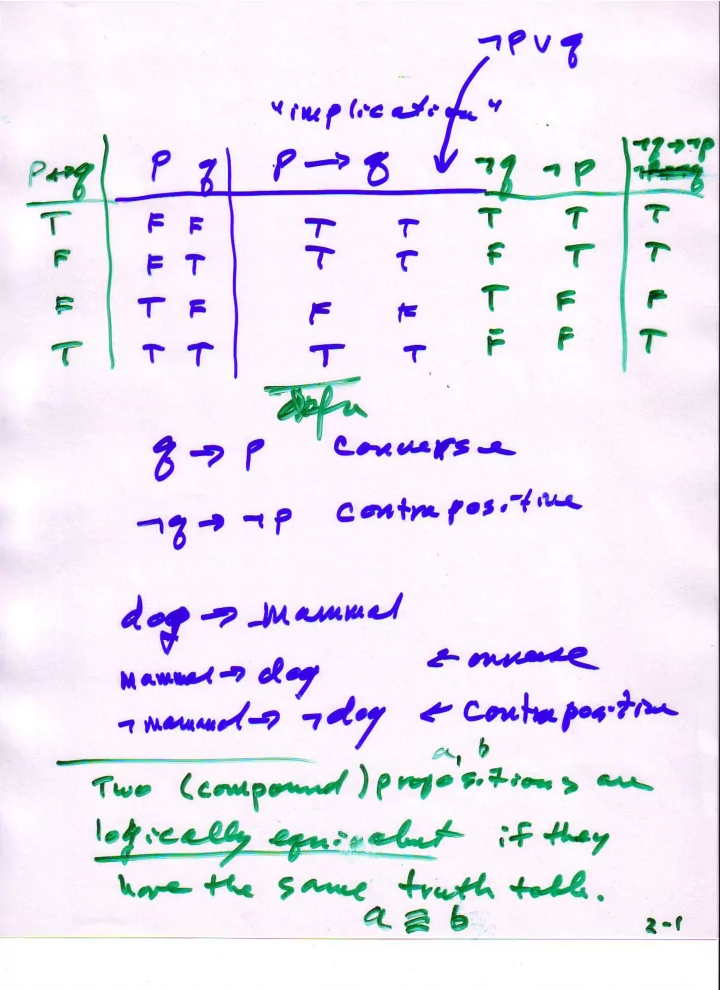
n ? v t / vt1a?bee{ef,.v 0 . 1 q l F a 6 ? T F F ? ' r T ? ?. T T F T F F ? ? F T F F F T F - F r , T ? F T T ? f f i , C-ez,efT a- $ e ? eo**P 7ct "( ttl*' -t ? n 7 ' a"g 2 -Iura*rlual *e*u4


slide-1
SLIDE 1

n ? v t

/

vt1a?bee{ef,.v

F a 6 0 . 1 q l

T

F F

T

? ?.

?

r

? ' r T ? T T F T F F T F

  • F

, T ? F F F

F ?

T F

T ?

f f i ,

? C-ez,efT a-

  • -(, b

fro (et*7wl ) ? rrrt''.jl-t-'> 3t'r'

lcl,v

th eta+:*n€ .* iE 1ut

=--J- +'-- +

1r,rr- ftc ,&*'C *rr'"e+ *-4.

$ e

n 7 '

a"g 2 -Iura*rlual *.ir,ndA *e*u4 nrlutlq'rl7 :?|'ry.ln',*u-

  • t ?

eo**P 7ct "( ttl*'

4 a b

l - l

slide-2
SLIDE 2

1:,*:::?t*L,,,

? - g

l - . 7

  • t a.7

t f v I

  • =
  • a-
slide-3
SLIDE 3 24 I / The Foundations: Logic and Proofs

TABLf, 6 Logical Equival nces.

\ p r q ) v r = p v \ q \ t r ) ( p ^ q ) ^ / = p ^ l q ^ t ) p v (.1 ^ /) = (p v tt) ^ \? v r) p ^ (r1't /) = Q, ^ q)v \1, ^t) " Reades fmillar wilh the concept
  • f a
Eoolean llgetB will noticc lhat rhese lde.tilies c a specitl G
  • f ij.tu
hold fot any Boolem algebn. ConPde dlen wilh set identities in T.ble I in Section 2 2 and rYith 8@16 id'ndc 6

Table 6 contains some important equivalences * In these equivalences' T denotes rhe c-( pouild proposition thai is always true and F denotes the compound proposinon thal t5 ways false. We also display some useful equivalences for compound proPosinons itnolr conditional statements and biconditional statemenis in Tables ? and 8, respectivev Th r ' is asked to veriry the equialences in Tables 6-8 in the exercises at the end

  • fthe s

cnoo_ The associative law lor disjunction sho{'s that the expression P v q v r is u ll defit in the sense tha! it does not matter whether we fust take the disjunction of p with g and t the disjunction ofp v q with /, or ifwe frrst take the disjunction of 4 and / ard then Bte disjunition ofp with q v r. Similarly, the expression P ^ 4 ,\ r'is well defned By er(renditrg rcaionhg, it f;llows that ptv p2\r " vr-arrdpi P2A /\p' are well deined sile r p t, p2, . ., p, Ne prcpositions. Furthermore, note that De Motgant laws extend lo

  • (p1\t p2't ..v pn)=

(-Pr A-p2A ^-?,) and

  • (pr r,

p2 /\.. ^p.)=(-prv-p,v v-?,). (Methods for proving these identities $'ill be given h Section 4 l )
slide-4
SLIDE 4

A

f + I =

' E ) a

  • lE
1- t-

r- r_

t-

=

1?,t 7 , v n ?

.Q 6lv 1?

n t . 1 ?

( cw/do*l

(t.eu)

er ivlb-lto., s? (X, ?trte, 1e

t *l CrrJ rAt J,l'r"<

? - Q v g ) a n ? v k r 8

E Pw r)"t

?- (f vil) vt

T . v Q

J ' D

= / ^ v T

u

A =

= l

l . ?

slide-5
SLIDE 5

UvWuuaa

qKa

Dcyral6

1 ..............Ecx)

*.rta

2..'1 , .w

Ftlla..*kA

(n<.;fIftulgg,'\

eryfr,

[e9'rcr1 r (et tc.() tQsaq)

A F

?

F

r

e t F

e q T

. J F

. ' T

a

ell

Ith

tqlq

>z

a^a

a

a

Yx

=,

? ro lo t,'(r u*'( $,uol' ^

?vty',zrt

E (r)

t

f t

tl'-+.:7tv

C ( r ) i r k - V t r s

ct €u c A

C3

E61).tcCx)