Extreme Values: Connecting Graphs of f, f', and f'' Curve Sketching - - PDF document

extreme values
SMART_READER_LITE
LIVE PREVIEW

Extreme Values: Connecting Graphs of f, f', and f'' Curve Sketching - - PDF document

Slide 1 / 163 Slide 2 / 163 AP Calculus Analyzing Functions Using Derivatives 2015-11-04 www.njctl.org Slide 3 / 163 Slide 4 / 163 Table of Contents click on the topic to go to that section Extreme Values - Graphically 1 st Derivative Test


slide-1
SLIDE 1

Slide 1 / 163 Slide 2 / 163

AP Calculus

Analyzing Functions Using Derivatives

2015-11-04 www.njctl.org

Slide 3 / 163 Table of Contents

Mean Value Theorem Connecting Graphs of f, f', and f''

click on the topic to go to that section

1st Derivative Test Concavity & 2nd Derivative Test Extreme Values - Graphically Curve Sketching Optimization Rolle's Theorem Newton's Method

Slide 4 / 163

Extreme Values: Graphically

Return to Table of Contents

Slide 5 / 163

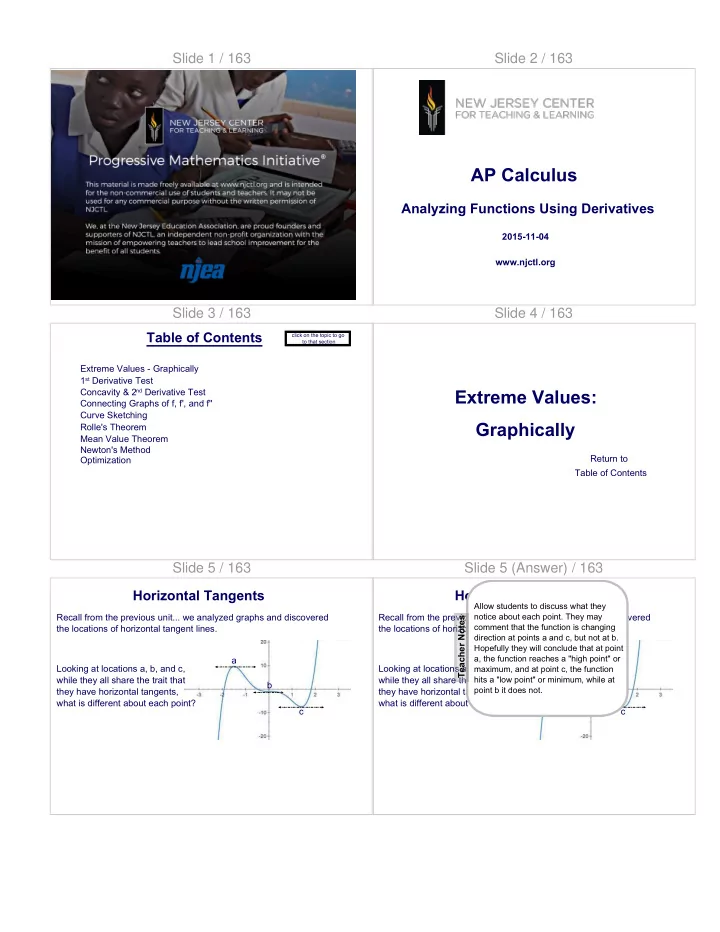
Recall from the previous unit... we analyzed graphs and discovered the locations of horizontal tangent lines. a b c Looking at locations a, b, and c, while they all share the trait that they have horizontal tangents, what is different about each point?

Horizontal Tangents Slide 5 (Answer) / 163

Recall from the previous unit... we analyzed graphs and discovered the locations of horizontal tangent lines. a b c Looking at locations a, b, and c, while they all share the trait that they have horizontal tangents, what is different about each point?

Horizontal Tangents

[This object is a pull tab]

Teacher Notes

Allow students to discuss what they notice about each point. They may comment that the function is changing direction at points a and c, but not at b. Hopefully they will conclude that at point a, the function reaches a "high point" or maximum, and at point c, the function hits a "low point" or minimum, while at point b it does not.

slide-2
SLIDE 2

Slide 6 / 163

a Looking specifically at point a, we know at the peak, the slope is zero. What do you notice about the slope on either side of a?

Slopes Surrounding Point a Slide 6 (Answer) / 163

a Looking specifically at point a, we know at the peak, the slope is zero. What do you notice about the slope on either side of a?

Slopes Surrounding Point a

[This object is a pull tab]

Teacher Notes

a

You may wish to have students draw tangent lines on either side of point a and make observations. The slope, or derivative, changes from positive to negative at point a.

Slide 7 / 163

c Similarly, we have a change in slopes at point c, however the slope is changing from negative to positive at this point.

Slopes Surrounding Point c Slide 8 / 163

b Now, consider point b. We know the slope is zero at b; however, the function's slope does not change signs at this point.

Slopes Surrounding Point b Slide 9 / 163 Local (Relative) Extrema

Local Maximum: a high point on any interval relative to points around it. At this point, the slope changes from positive to negative, and the function changes from increasing to decreasing. Local Minimum: a low point on any interval relative to points around

  • it. At this point the slope changes from negative to positive, and the

function changes from decreasing to increasing. NOTE: Local max/mins CANNOT occur at endpoints!

Slide 10 / 163 Absolute (Global) Extrema

Absolute Maximum: occurs at c if f(c)>f(x) for all x in domain Absolute Minimum: occurs at c if f(c)<f(x) for all x in domain NOTE: Absolute max/mins can occur at endpoints!

slide-3
SLIDE 3

Slide 11 / 163

Identify/Label each of the following with Local or Absolute Maximum or

  • Minimum. What do you notice about what is occuring at the star?

Extrema Slide 11 (Answer) / 163

Identify/Label each of the following with Local or Absolute Maximum or

  • Minimum. What do you notice about what is occuring at the star?

Extrema

[This object is a pull tab]

Answer

  • Abs. Min.

Local Max. Local Min.

  • Abs. & Local Max.

At the star, although the slope is zero, there is neither a maximum or minimum. Also, at point e, it cannot be a local max/min and isn't the lowest point, therefore not an abs. min.

nothing

Slide 12 / 163 Slide 12 (Answer) / 163 Slide 13 / 163 Critical Value

When asked to find local extrema, only critical values must be

  • considered. If asked to find absolute extrema, critical values as well

as endpoints are considered. A critical value (or critical point) is a point on the interior of the domain

  • f a function at which the slope is zero or undefined.

Slide 14 / 163

An extrema can only occur at critical values or endpoints (absolute); however, the presence of a critical value does not guarantee an extrema at that value. What does this mean?

Extrema & Endpoints

slide-4
SLIDE 4

Slide 14 (Answer) / 163

An extrema can only occur at critical values or endpoints (absolute); however, the presence of a critical value does not guarantee an extrema at that value. What does this mean?

Extrema & Endpoints

[This object is a pull tab]

Teacher Notes

It may be helpful to use the graphs of and to emphasize this point. Another analogy that may help: If you live in New Jersey, it is guaranteed that you live in the United States. However, the converse is not always true. If you live in the United States, you don't necessarily live in New Jersey.

Slide 15 / 163

1 Using the given graph, which of the following are

  • ccurring at point b?

A B C D E F local maximum local minimum absolute minimum absolute maximum slope is zero slope is undefined

Slide 15 (Answer) / 163

1 Using the given graph, which of the following are

  • ccurring at point b?

A B C D E F local maximum local minimum absolute minimum absolute maximum slope is zero slope is undefined

[This object is a pull tab]

Answer

A, E

Slide 16 / 163

2 Using the given graph, which of the following are

  • ccurring at point d?

A B C D E F local maximum local minimum absolute minimum absolute maximum slope is zero slope is undefined

Slide 16 (Answer) / 163

2 Using the given graph, which of the following are

  • ccurring at point d?

A B C D E F local maximum local minimum absolute minimum absolute maximum slope is zero slope is undefined

[This object is a pull tab]

Answer

A, C, F

Slide 17 / 163

3 Using the given graph, which of the following are

  • ccurring at point c?

A B C D E F local maximum local minimum absolute minimum absolute maximum slope is zero slope is undefined

slide-5
SLIDE 5

Slide 17 (Answer) / 163

3 Using the given graph, which of the following are

  • ccurring at point c?

A B C D E F local maximum local minimum absolute minimum absolute maximum slope is zero slope is undefined

[This object is a pull tab]

Answer

B, D, F

Slide 18 / 163

4 Using the given graph, which of the following are

  • ccurring at point a?

A B C D E F local maximum local minimum absolute minimum absolute maximum slope is zero slope is undefined

Slide 18 (Answer) / 163

4 Using the given graph, which of the following are

  • ccurring at point a?

A B C D E F local maximum local minimum absolute minimum absolute maximum slope is zero slope is undefined

[This object is a pull tab]

Answer

B, E

Slide 19 / 163

5 On which interval(s) is the function increasing? A B C (a,b) (b,c) (c,d)

Slide 19 (Answer) / 163

5 On which interval(s) is the function increasing? A B C (a,b) (b,c) (c,d)

[This object is a pull tab]

Answer

A, C

emphasize that the function is increasing on these intervals because the slope is positive

Slide 20 / 163

6 Using the given graph, which of the following are critical values? A B C D E F G H

slide-6
SLIDE 6

Slide 20 (Answer) / 163

6 Using the given graph, which of the following are critical values? A B C D E F G H

[This object is a pull tab]

Answer

B, C, D, E, F, G

Slide 21 / 163

7 Using the given graph, which of the following are

  • ccurring at ?

A B C D E F local maximum local minimum absolute minimum absolute maximum slope is zero slope is undefined

Slide 21 (Answer) / 163

7 Using the given graph, which of the following are

  • ccurring at ?

A B C D E F local maximum local minimum absolute minimum absolute maximum slope is zero slope is undefined

[This object is a pull tab]

Answer

B, E

Slide 22 / 163

8 On which interval(s) is the function decreasing? A B C D E F G

Slide 22 (Answer) / 163

8 On which interval(s) is the function decreasing? A B C D E F G

[This object is a pull tab]

Answer

B, D, F

emphasize the function is decreasing because the slope is negative

Slide 23 / 163

slide-7
SLIDE 7

Slide 23 (Answer) / 163 Slide 24 / 163 Slide 24 (Answer) / 163 Slide 25 / 163 Slide 25 (Answer) / 163 Slide 26 / 163

12 On which interval(s) is the function increasing?

slide-8
SLIDE 8

Slide 26 (Answer) / 163

12 On which interval(s) is the function increasing?

[This object is a pull tab] Answer

emphasize that the function is increasing because the slope is positive

Slide 27 / 163

13 If a function has a critical value at x=3, then there must be a local or absolute extrema at that value. True False

Slide 27 (Answer) / 163

13 If a function has a critical value at x=3, then there must be a local or absolute extrema at that value. True False

[This object is a pull tab]

Answer

False

Slide 28 / 163 Slide 28 (Answer) / 163 Slide 29 / 163

1st Derivative Test

Return to Table of Contents

slide-9
SLIDE 9

Slide 30 / 163

We have discovered how to graphically interpret local and absolute extrema, and now we will extend our understanding to calculate extrema algebraically.

Calculating Extrema Algebraically Slide 31 / 163

A local maxima/minima occurs when the slope of the function changes from positive to negative, or negative to positive at a critical value. Another way of thinking is that the original function changes from increasing to decreasing, or decreasing to increasing. For a function to contain an absolute extrema, it must be the highest

  • r lowest extrema on the interval, including endpoints.

Recall: Slide 32 / 163

Algebraically, we can find critical values and test points on either side to determine the change in slope, if there is one. This is known as the 1st Derivative Test. Helpful Steps:

  • 1. Find the derivative of the given function.
  • 2. Find x-values where the derivative equals zero or is
  • undefined. These are the critical values (locations of possible

extrema).

  • 3. Test x-values on either side of the critical values, substitute

into the derivative and observe sign change for maximum or minimum.

  • 4. Substitute x-values into original function to get

corresponding y-values for the extrema.

The 1st Derivative Test Slide 33 / 163

First let's practice finding critical values. Remember, a critical value is the potential location for an extreme value. Find the location of any critical value(s):

Critical Values Slide 33 (Answer) / 163 Slide 34 / 163

slide-10
SLIDE 10

Slide 34 (Answer) / 163 Slide 35 / 163

For the function, identify the intervals of increasing/decreasing:

Example Slide 35 (Answer) / 163

For the function, identify the intervals of increasing/decreasing:

Example

[This object is a pull tab]

Answer

increasing: decreasing:

+

_

+

(critical values) we will choose to test x=0, x=2, and x=4 *can use other values in each region is defined for all x

Slide 36 / 163

For the previous function, find any local extrema.

Example, Continued Slide 36 (Answer) / 163

For the previous function, find any local extrema.

Example, Continued

[This object is a pull tab]

Answer

Because the sign of the derivative is changing from positive to negative at x=1, there is a local maximum at (1,5). Because the sign of the derivative is changing from negative to positive at x=3, there is a local minimum at (3,1).

+

_

+

Using the sign chart we created:

Slide 37 / 163

For the following function, identify the intervals of increasing/decreasing.

Example

slide-11
SLIDE 11

Slide 37 (Answer) / 163 Slide 38 / 163

For the previous function, find any local extrema:

Example, Continued Slide 38 (Answer) / 163

For the previous function, find any local extrema:

Example, Continued

[This object is a pull tab]

Answer

The function has a local maximum at (-1,4) because the derivative changes from positive to negative at x=-1. The function has a local minimum at (1,-4) because the derivative changes from negative to positive at x=1.

+ + _ _ Using the sign chart we created:

Slide 39 / 163

Find any local extrema for

Example Slide 39 (Answer) / 163 Slide 40 / 163

Find any local extrema for

Example

slide-12
SLIDE 12

Slide 40 (Answer) / 163 Slide 41 / 163 Grading on the AP Exam

Drawing a sign chart is a great way to help visualize what is happening; however, a sign chart alone is not enough of an explanation on the AP Exam. Be sure to defend your answer, describing the sign change of the derivative. For example: The function has a local maximum at (-3,7) because f '(x) changes from positive to negative at x=-3.

Slide 42 / 163

Now that we feel comfortable solving for local extrema, we can go further and determine where absolute extrema occur. Remember, for absolute extrema we must compare all extrema within the given interval, as well as the endpoints of that interval.

Absolute Extrema Slide 43 / 163 Extreme Value Theorem

Given that is continuous on the interval then must attain an absolute maximum and minimum on that interval.

Slide 44 / 163

Which of the following graph(s) meet the criteria for the Extreme Value Theorem? Circle your answer, and for those graph(s) that do not, explain why.

Extreme Value Theorem Slide 44 (Answer) / 163

Which of the following graph(s) meet the criteria for the Extreme Value Theorem? Circle your answer, and for those graph(s) that do not, explain why.

Extreme Value Theorem

[This object is a pull tab]

Answer

This graph is not continuous on the given interval.

slide-13
SLIDE 13

Slide 45 / 163

Let's take a look back at an example we previously worked with: Example: Find the absolute extrema for on We found this function had a local minimum at and a local maximum at Now, to find the absolute extrema we need to compare these with the endpoints.

Absolute Extrema Slide 45 (Answer) / 163 Slide 46 / 163 Slide 46 (Answer) / 163 Slide 47 / 163 Slide 47 (Answer) / 163

slide-14
SLIDE 14

Slide 48 / 163 Slide 48 (Answer) / 163 Slide 49 / 163 Slide 49 (Answer) / 163 Slide 50 / 163 Slide 50 (Answer) / 163

slide-15
SLIDE 15

Slide 51 / 163 Slide 51 (Answer) / 163 Slide 52 / 163

20 If a function has a local minimum at then True False

Slide 52 (Answer) / 163

20 If a function has a local minimum at then True False

[This object is a pull tab]

Answer

FALSE

could be undefined at x=c.

Slide 53 / 163 Slide 53 (Answer) / 163

slide-16
SLIDE 16

Slide 54 / 163 Slide 54 (Answer) / 163 Slide 55 / 163

Concavity & 2nd Derivative Test

Return to Table of Contents

Slide 56 / 163

As we saw in the previous section, derivatives can tell us a lot of information about the original function. Next, we will discover what information the 2nd derivative provides about the original function.

Relationship Between Derivatives & Functions Slide 56 (Answer) / 163

As we saw in the previous section, derivatives can tell us a lot of information about the original function. Next, we will discover what information the 2nd derivative provides about the original function.

Relationship Between Derivatives & Functions

[This object is a pull tab]

Teacher Notes

A good introduction can be asking students if they are familiar with the word concavity. Often students will recall the science reference of concave and convex. While this isn't the exact same as the Calculus vocabulary, they will at least make the connection that concavity relates to the curved shape of the graph.

Slide 57 / 163

As we know, in mathematics, not all functions are linear. There are infinite curves created by functions and they take on unique shapes. Let's cover some new vocabulary to describe these curves.

Concavity

slide-17
SLIDE 17

Slide 57 (Answer) / 163

As we know, in mathematics, not all functions are linear. There are infinite curves created by functions and they take on unique shapes. Let's cover some new vocabulary to describe these curves.

Concavity

[This object is a pull tab]

Teacher Notes

concave up; decreasing concave up; increasing concave down; decreasing concave down; increasing Sometimes helpful for students: Concave up = looks like a "cup" Concave down = looks like a "frown"

Slide 58 / 163

Recall that the sign of the 1st derivative told us whether the function was increasing or decreasing. The sign of the second derivative will tell us where the function is concave up or concave down. Why is this helpful?

Concavity Slide 58 (Answer) / 163

Recall that the sign of the 1st derivative told us whether the function was increasing or decreasing. The sign of the second derivative will tell us where the function is concave up or concave down. Why is this helpful?

Concavity

[This object is a pull tab]

Teacher Notes Have a conversation with students about why it is beneficial to understand the behavior of the

  • riginal function when you have

various pieces of information about the derivatives. They will also gain further understanding when they get to the Curve Sketching section.

Slide 59 / 163

Some functions remain concave up or down for all x in their domain, but many others can change concavity at multiple points. For example: Label each section with the correct concavity.

Concavity Slide 59 (Answer) / 163

Some functions remain concave up or down for all x in their domain, but many others can change concavity at multiple points. For example: Label each section with the correct concavity.

Concavity

[This object is a pull tab]

Answer

concave up concave down concave down concave up

red sections - concave up blue sections - concave down

Slide 60 / 163

A point x=c is an inflection point (or point of inflection) if a function is continuous at that point and the function changes concavity at that point. Note: Each star represents an inflection point for the function above.

Inflection Point

slide-18
SLIDE 18

Slide 61 / 163

Use 2 colors to shade the different regions (either concave up or concave down) or shade one with pencil and leave the other unshaded. Then identify any points of inflection.

Concavity & Points of Inflection Slide 61 (Answer) / 163

Use 2 colors to shade the different regions (either concave up or concave down) or shade one with pencil and leave the other unshaded. Then identify any points of inflection.

Concavity & Points of Inflection

[This object is a pull tab]

Teacher Notes

It is extremely important to discuss why at point b there is no inflection point because the concavity does not change. p.o.i. p.o.i.

Slide 62 / 163

23 Which accurately describes the shape at the point ? A B C D E F none of the above concave up; decreasing concave down; decreasing point of inflection concave up; increasing concave down; increasing

a b c d e f g h i j k m n p q r s

Slide 62 (Answer) / 163

23 Which accurately describes the shape at the point ? A B C D E F none of the above concave up; decreasing concave down; decreasing point of inflection concave up; increasing concave down; increasing

a b c d e f g h i j k m n p q r s

[This object is a pull tab]

Answer

D

Slide 63 / 163

24 Which accurately describes the shape at the point ? A B C D E F none of the above concave up; decreasing concave down; decreasing point of inflection concave up; increasing concave down; increasing

a b c d e f g h i j k m n p q r s

Slide 63 (Answer) / 163

24 Which accurately describes the shape at the point ? A B C D E F none of the above concave up; decreasing concave down; decreasing point of inflection concave up; increasing concave down; increasing

a b c d e f g h i j k m n p q r s

[This object is a pull tab]

Answer

C

slide-19
SLIDE 19

Slide 64 / 163

25 Which accurately describes the shape at the point ? A B C D E F none of the above concave up; decreasing concave down; decreasing point of inflection concave up; increasing concave down; increasing

a b c d e f g h i j k m n p q r s

Slide 64 (Answer) / 163

25 Which accurately describes the shape at the point ? A B C D E F none of the above concave up; decreasing concave down; decreasing point of inflection concave up; increasing concave down; increasing

a b c d e f g h i j k m n p q r s

[This object is a pull tab]

Answer

E

Slide 65 / 163 Slide 65 (Answer) / 163 Slide 66 / 163 Slide 66 (Answer) / 163

slide-20
SLIDE 20

Slide 67 / 163

28 Which accurately describes the shape at the point ? A B C D E F none of the above concave up; decreasing concave down; decreasing point of inflection concave up; increasing concave down; increasing

a b c d e f g h i j k m n p q r s

Slide 67 (Answer) / 163

28 Which accurately describes the shape at the point ? A B C D E F none of the above concave up; decreasing concave down; decreasing point of inflection concave up; increasing concave down; increasing

a b c d e f g h i j k m n p q r s

[This object is a pull tab]

Answer

A

Slide 68 / 163

29 Which accurately describes the shape at the point ? A B C D E F none of the above concave up; decreasing concave down; decreasing point of inflection concave up; increasing concave down; increasing

a b c d e f g h i j k m n p q r s

Slide 68 (Answer) / 163

29 Which accurately describes the shape at the point ? A B C D E F none of the above concave up; decreasing concave down; decreasing point of inflection concave up; increasing concave down; increasing

a b c d e f g h i j k m n p q r s

[This object is a pull tab]

Answer

F

linear; neither concave up or down

Slide 69 / 163

30 Which accurately describes the shape at the point ? A B C D E F none of the above concave up; decreasing concave down; decreasing point of inflection concave up; increasing concave down; increasing

a b c d e f g h i j k m n p q r s

Slide 69 (Answer) / 163

30 Which accurately describes the shape at the point ? A B C D E F none of the above concave up; decreasing concave down; decreasing point of inflection concave up; increasing concave down; increasing

a b c d e f g h i j k m n p q r s

[This object is a pull tab]

Answer

D

slide-21
SLIDE 21

Slide 70 / 163

31 Which accurately describes the shape at the point ? A B C D E F none of the above concave up; decreasing concave down; decreasing point of inflection concave up; increasing concave down; increasing

a b c d e f g h i j k m n p q r s

Slide 70 (Answer) / 163

31 Which accurately describes the shape at the point ? A B C D E F none of the above concave up; decreasing concave down; decreasing point of inflection concave up; increasing concave down; increasing

a b c d e f g h i j k m n p q r s

[This object is a pull tab]

Answer

F

does not change concavity at x=k

Slide 71 / 163

32 Which accurately describes the shape at the point ? A B C D E F none of the above concave up; decreasing concave down; decreasing point of inflection concave up; increasing concave down; increasing

a b c d e f g h i j k m n p q r s

Slide 71 (Answer) / 163

32 Which accurately describes the shape at the point ? A B C D E F none of the above concave up; decreasing concave down; decreasing point of inflection concave up; increasing concave down; increasing

a b c d e f g h i j k m n p q r s

[This object is a pull tab]

Answer

E

Slide 72 / 163

33 Which accurately describes the shape at the point ? A B C D E F none of the above concave up; decreasing concave down; decreasing point of inflection concave up; increasing concave down; increasing

a b c d e f g h i j k m n p q r s

Slide 72 (Answer) / 163

33 Which accurately describes the shape at the point ? A B C D E F none of the above concave up; decreasing concave down; decreasing point of inflection concave up; increasing concave down; increasing

a b c d e f g h i j k m n p q r s

[This object is a pull tab]

Answer

E

slide-22
SLIDE 22

Slide 73 / 163

Since we are able to graphically interpret concavity, now we will discover how to algebraically determine concavity and points of inflection.

Algebraically Determining Concavity Slide 74 / 163

The first step in finding intervals of concavity algebraically is to find critical values for the 2nd derivative. These critical values will occur when the 2nd derivative equals zero or is undefined.

Critical Values Slide 75 / 163

The sign of the 2nd derivative determines the concavity of the original function. If for on an interval, , then is concave up

  • n that interval.

If for on an interval, , then is concave down

  • n that interval.

If has a critical value at and changes signs at , then is a point of inflection.

Sign of 2nd Derivative Slide 76 / 163

Find the critical values for the 2nd derivative using the following function:

Example Slide 76 (Answer) / 163 Slide 77 / 163

Find the intervals of concavity as well as any points of inflection:

Example, Continued

slide-23
SLIDE 23

Slide 77 (Answer) / 163 Slide 78 / 163

Find the intervals of concavity as well as any points of inflection:

Example Slide 78 (Answer) / 163 Slide 79 / 163 Slide 79 (Answer) / 163 Slide 80 / 163

slide-24
SLIDE 24

Slide 80 (Answer) / 163 Slide 81 / 163 Slide 81 (Answer) / 163 Slide 82 / 163 Slide 82 (Answer) / 163 Slide 83 / 163

slide-25
SLIDE 25

Slide 83 (Answer) / 163 Slide 84 / 163 The 2nd Derivative Test

This test allows us to identify local extrema for functions by combining information about the 1st and 2nd Derivative. Given that is a critical value of , and is continuous at . Then, if then is a local maximum and if then is a local minimum.

Slide 84 (Answer) / 163 The 2nd Derivative Test

This test allows us to identify local extrema for functions by combining information about the 1st and 2nd Derivative. Given that is a critical value of , and is continuous at . Then, if then is a local maximum and if then is a local minimum.

[This object is a pull tab]

Teacher Notes

It's important to also mention to students that if then could be a local maximum, minimum, or neither. Students may be confused with why a positive 2nd derivative correlates to a

  • minimum. You can remind them that a

positive 2nd derivative makes a concave up "cup" shape, therefore causing a minimum. minimum maximum

Slide 85 / 163

Note: The 2nd Derivative Test does not replace the 1

st Derivative Test.

Both are useful tools in finding extrema of functions. The 2nd Derivative Test simply provides an alternative method for classifying the extrema. That being said, there are situations where the 2nd Derivative Test would fail to supply any information about extrema: · does not exist · but does not exist · and In any of these scenarios, the 1st Derivative Test would need to be used.

2nd Derivative Test Slide 86 / 163

Using the 2nd Derivative Test, determine if the function below has any relative extrema.

Example Slide 86 (Answer) / 163

slide-26
SLIDE 26

Slide 87 / 163

39 The 2nd Derivative Test is used to find absolute extrema of functions. True False

Slide 87 (Answer) / 163

39 The 2nd Derivative Test is used to find absolute extrema of functions. True False

[This object is a pull tab]

Answer

False

It is used to find local extrema.

Slide 88 / 163 Slide 88 (Answer) / 163 Slide 89 / 163 Slide 89 (Answer) / 163

slide-27
SLIDE 27

Slide 90 / 163 Slide 90 (Answer) / 163 Slide 91 / 163 Slide 91 (Answer) / 163 Slide 92 / 163

Connecting Graphs

  • f f, f', and f''

Return to Table of Contents

Slide 93 / 163

In mathematics, we are often accustomed to being given a picture of a graph and being asked questions about that specific function which is graphed (much like we were practicing in the first section). However, as we venture further in to Calculus, we may be given the graph of the 1st or 2nd derivative and asked questions about the

  • riginal function. We must become familiar with the information that

each graph provides us in order to accurately answer the questions.

Analyzing Graphs

slide-28
SLIDE 28

Slide 94 / 163

So, let's review what we discovered in the first few sections: is increasing when ____________________ is decreasing when ____________________ has a local max when ____________________ has a local min when _____________________ is concave up when ______________________ is concave down when ____________________ has a point of inflection when __________________

Review Slide 94 (Answer) / 163

So, let's review what we discovered in the first few sections: is increasing when ____________________ is decreasing when ____________________ has a local max when ____________________ has a local min when _____________________ is concave up when ______________________ is concave down when ____________________ has a point of inflection when __________________

Review

[This object is a pull tab]

Teacher Notes

is increasing when f'(x) is positive is decreasing when f'(x) is negative has a local max when f'(x) changes from + to - at a critical value has a local min when f'(x) changes from - to + at a critical value is concave up when f''(x) is positive is concave down when f''(x) is negative has a point of inflection when f''(x) changes sign at a critical value

Slide 95 / 163

The #1 piece of advice when proceeding with questions involving graphs from now on: Ask yourself: Which graph am I looking at? · the original function? · the first derivative? · the second derivative?

Important Advice Slide 95 (Answer) / 163

The #1 piece of advice when proceeding with questions involving graphs from now on: Ask yourself: Which graph am I looking at? · the original function? · the first derivative? · the second derivative?

Important Advice

[This object is a pull tab]

Teacher Notes As you are teaching, be extremely intentional about asking students which graph is displayed. It seems fairly repetitive but will be very beneficial to students, so they are constantly aware of what they are looking at and how to interpret it.

Slide 96 / 163

At right is the graph of the derivative

  • f a function, f, whose domain is the

set of all real numbers and is continuous everywhere. Using the graph, determine the following:

  • 1. Intervals on which f is increasing: ________________
  • 2. Intervals on which f is decreasing: _______________
  • 3. Relative extrema: ___________________
  • 4. Intervals where f is concave up: _________________
  • 5. Intervals where f is concave down: _______________
  • 6. Point(s) of inflection: __________________

Example Slide 96 (Answer) / 163

slide-29
SLIDE 29

Slide 97 / 163 Slide 97 (Answer) / 163 Slide 98 / 163 Slide 98 (Answer) / 163 Slide 99 / 163 Slide 99 (Answer) / 163

slide-30
SLIDE 30

Slide 100 / 163 Slide 100 (Answer) / 163 Slide 101 / 163 Slide 101 (Answer) / 163 Slide 102 / 163 Slide 102 (Answer) / 163

slide-31
SLIDE 31

Slide 103 / 163 Slide 103 (Answer) / 163 Slide 104 / 163 Slide 104 (Answer) / 163 Slide 105 / 163

Curve Sketching

Return to Table of Contents

Slide 106 / 163

Interpreting information from the first or second derivative can allow us to come up with a fairly accurate sketch of the original function without knowing the equation itself. Think of yourself as a criminal sketch artist - although you may have never seen the actual person, based on eye witness description and detail, you can create a fairly accurate picture.

Curve Sketching

slide-32
SLIDE 32

Slide 107 / 163

Below is the graph of the derivative of a function f, whose domain is the set of all real numbers and which is continuous everywhere. Use the provided information to create a sketch of the original function, if the

  • nly zeros of f(x) are x=-4 and x=0.

Example Slide 107 (Answer) / 163 Slide 108 / 163 Slide 109 / 163 Slide 109 (Answer) / 163 Slide 110 / 163 Curve Sketching Practice Questions

slide-33
SLIDE 33

Slide 110 (Answer) / 163 Curve Sketching Practice Questions

[This object is a pull tab]

Teacher Notes While it is difficult to use responders to assess students ability to sketch curves, the next slides will still be helpful and give students a chance to

  • practice. It's important to circulate the

class and check student's work for accuracy.

Slide 111 / 163

52 Below is the graph of the derivative of a function f, whose domain is the set of all real numbers and which is continuous everywhere. Use the provided information to create a sketch of the original function, if the only zeros

  • f f(x) are x = -3.5, x = 0, x = 6, and x = 9.5.

When you are finished, type "done" with your SMART Responder.

Students type their answers here

Slide 111 (Answer) / 163

52 Below is the graph of the derivative of a function f, whose domain is the set of all real numbers and which is continuous everywhere. Use the provided information to create a sketch of the original function, if the only zeros

  • f f(x) are x = -3.5, x = 0, x = 6, and x = 9.5.

When you are finished, type "done" with your SMART Responder.

Students type their answers here

[This object is a pull tab]

Answer As the students finish, check their

  • sketches. Their graphs should be

similar to the figure below.

Slide 112 / 163

53 Below is the graph of the derivative of a function f, whose domain is the set of all real numbers and which is continuous everywhere. Use the provided information to create a sketch of the original function, if the only zeros

  • f f(x) are x = -7.5, x = -1.5, and x = 3.

When you are finished, type "done" with your SMART Responder.

Students type their answers here

Slide 112 (Answer) / 163

53 Below is the graph of the derivative of a function f, whose domain is the set of all real numbers and which is continuous everywhere. Use the provided information to create a sketch of the original function, if the only zeros

  • f f(x) are x = -7.5, x = -1.5, and x = 3.

When you are finished, type "done" with your SMART Responder.

Students type their answers here

[This object is a pull tab]

Answer As the students finish, check their

  • sketches. Their graphs should be

similar to the figure below.

Slide 113 / 163

54 Below is the graph of the derivative of a function f, whose domain is the set of all real numbers and which is continuous everywhere. Use the provided information to create a sketch of the original function, if the only zeros of f(x) are x = -3, x = 1, and x = 4. When you are finished, type "done" with your SMART Responder.

Students type their answers here

slide-34
SLIDE 34

Slide 113 (Answer) / 163

54 Below is the graph of the derivative of a function f, whose domain is the set of all real numbers and which is continuous everywhere. Use the provided information to create a sketch of the original function, if the only zeros of f(x) are x = -3, x = 1, and x = 4. When you are finished, type "done" with your SMART Responder.

Students type their answers here

[This object is a pull tab]

Answer As the students finish, check their

  • sketches. Their graphs should be

similar to the figure below.

Slide 114 / 163 Slide 115 / 163 Slide 116 / 163

57 A B C D If the graph of is below, which of the graphs at right is the graph of ?

Slide 116 (Answer) / 163

57 A B C D If the graph of is below, which of the graphs at right is the graph of ?

[This object is a pull tab]

Answer

C

Slide 117 / 163

58 A B C D If the graph of is below, which of the graphs at right is the graph of ?

slide-35
SLIDE 35

Slide 117 (Answer) / 163

58 A B C D If the graph of is below, which of the graphs at right is the graph of ?

[This object is a pull tab]

Answer

B

Slide 118 / 163

59 A B C D If the graph of is below, which of the graphs at right is the graph of ?

Slide 118 (Answer) / 163

59 A B C D If the graph of is below, which of the graphs at right is the graph of ?

[This object is a pull tab]

Answer

C

Slide 119 / 163

Rolle's Theorem

Return to Table of Contents

Slide 120 / 163

Interesting fact about French mathematician Michel Rolle: He originally criticized the subject of calculus, thinking it did not use sound reasoning and resulted in errors. Later

  • n, he published Rolle's theorem and thus approved the

usefulness of calculus. He also contributed to the work on Gaussian elimination.

Michel Rolle (1652-1719) Slide 121 / 163

On the graph below, connect the dots using any function that is continuous and differentiable. · Identify any points on your graph with a horizontal tangent. · Is it possible to connect the dots without creating a horizontal tangent, while still maintaining continuity and differentiability?

Activity

slide-36
SLIDE 36

Slide 121 (Answer) / 163

On the graph below, connect the dots using any function that is continuous and differentiable. · Identify any points on your graph with a horizontal tangent. · Is it possible to connect the dots without creating a horizontal tangent, while still maintaining continuity and differentiability?

Activity

[This object is a pull tab]

Teacher Notes You may have each student try this

  • n their own or have a couple

students come to the board and demonstrate. They should conclude that no matter how they connect the dots with a continuous and differentiable function, there will always be at least one location of horizontal tangency.

Slide 122 / 163 Rolle's Theorem

Suppose is a function that satisfies all of the following: · is continuous on the closed interval [a,b] · is differentiable on the open interval (a,b) · Then there exists a number c, such that a<c<b, and

Slide 122 (Answer) / 163 Rolle's Theorem

Suppose is a function that satisfies all of the following: · is continuous on the closed interval [a,b] · is differentiable on the open interval (a,b) · Then there exists a number c, such that a<c<b, and

[This object is a pull tab]

Teacher Notes In easier to understand terms: If a function is continuous and differentiable on a given interval, and the endpoints have the same y-value, then for at least one value on that interval the slope must equal zero.

Slide 123 / 163 A Visual Understanding of Rolle's Theorem: Slide 123 (Answer) / 163 A Visual Understanding of Rolle's Theorem:

[This object is a pull tab]

Teacher Notes

Reiterate to students that Rolle's Theorem guarantees at least one horizontal tangent, but there could be more as well.

Slide 124 / 163

Find the value, c, that satisfies Rolle's Theorem for the function:

Example

slide-37
SLIDE 37

Slide 124 (Answer) / 163

Find the value, c, that satisfies Rolle's Theorem for the function:

Example

[This object is a pull tab]

Answer

First, we must check that Rolle's Theorem can be applied. continuous on [0,3] differentiable on (0,3) Therefore, we know that at some point on the interval, c, the slope is zero.

Slide 125 / 163 Slide 125 (Answer) / 163 Slide 126 / 163 Slide 126 (Answer) / 163 Slide 127 / 163

slide-38
SLIDE 38

Slide 127 (Answer) / 163 Slide 128 / 163

63 Find the value(s), c, that satisfies Rolle's Theorem for the following function on the given interval:

Slide 128 (Answer) / 163 Slide 129 / 163

64 Find the value(s), c, that satisfies Rolle's Theorem for the following function on the given interval:

Slide 129 (Answer) / 163

64 Find the value(s), c, that satisfies Rolle's Theorem for the following function on the given interval:

[This object is a pull tab]

Answer continuous on differentiable on Rolle's Theorem can be applied.

Slide 130 / 163

Mean Value Theorem

Return to Table of Contents

slide-39
SLIDE 39

Slide 131 / 163

Consider going on a road trip with your friends. You are driving along and at noon you decide to enter a toll road. You pick up a toll entrance ticket and notice you are at mile marker 1. You also notice the posted speed of 55mph and see no police. At 2:00pm you exit the toll road at mile marker 141. You exit and hand the attendant your toll ticket. After a moment, the attendant says, "That will be $5.00 for the toll and $125.00 for the speeding violation." You sit in the car a few moments thinking; you didn't notice any police cars or speed cameras. Were you speeding on the toll road? And if so, how did the attendant know?

Road Trip! Slide 131 (Answer) / 163

Consider going on a road trip with your friends. You are driving along and at noon you decide to enter a toll road. You pick up a toll entrance ticket and notice you are at mile marker 1. You also notice the posted speed of 55mph and see no police. At 2:00pm you exit the toll road at mile marker 141. You exit and hand the attendant your toll ticket. After a moment, the attendant says, "That will be $5.00 for the toll and $125.00 for the speeding violation." You sit in the car a few moments thinking; you didn't notice any police cars or speed cameras. Were you speeding on the toll road? And if so, how did the attendant know?

Road Trip!

[This object is a pull tab]

Teacher Notes

This scenario allows for great classroom discussion! Allow students ample time to talk about their ideas and defend their opinions. Note: There was no time where the car got off the toll road from noon to 2:00, and no "time travel" that allowed the car to magically get to exit 141. After much discussion students should start discovering that if their average speed was 70mph, then at some point on their trip they must have been traveling that fast, and therefore speeding. And the attendant was an excellent Calculus student! :)

Slide 132 / 163 Mean Value Theorem

Suppose is a function that satisfies the following: · is continuous on the closed interval [a,b] · is differentiable on the open interval (a,b) Then there exists a number c, such that a<c<b, and

Slide 132 (Answer) / 163 Mean Value Theorem

Suppose is a function that satisfies the following: · is continuous on the closed interval [a,b] · is differentiable on the open interval (a,b) Then there exists a number c, such that a<c<b, and

[This object is a pull tab]

Teacher Notes In easier to understand terms: If a function is continuous and differentiable on a given interval, then there is a point where the instantaneous rate of change is equal to the average rate of change (there is a tangent line parallel to the secant line through the endpoints).

Slide 133 / 163 A Visual Understanding of the Mean Value Theorem Slide 134 / 163 Discussion:

How are Rolle's Theorem and Mean Value Theorem related? How are they different?

slide-40
SLIDE 40

Slide 134 (Answer) / 163 Discussion:

How are Rolle's Theorem and Mean Value Theorem related? How are they different?

[This object is a pull tab]

Teacher Notes

Allow students to discuss the similarities and differences between the 2 theorems. While Rolle's Theorem may seem like a specific case of the MVT; it was actually Rolle's Theorem that was proven first, and Mean Value Theorem came as an extension. Similarities: Both theorems relate secant slopes to equivalent tangent slopes Differences: Rolle's Theorem requires f(a)=f(b) and thus has a horizontal tangent, while MVT uses secant slopes of various values, both positive and negative

Slide 135 / 163

Find the value, c, which satisfies the Mean Value Theorem for the function:

Example Slide 135 (Answer) / 163

Find the value, c, which satisfies the Mean Value Theorem for the function:

Example

[This object is a pull tab]

Answer

continuous on [1,3] differentiable on (1,3)

MVT can be applied secant slope:

Slide 136 / 163 Slide 136 (Answer) / 163 Slide 137 / 163

65 Find the value(s), c, which satisfy the Mean Value Theorem for the function:

slide-41
SLIDE 41

Slide 137 (Answer) / 163 Slide 138 / 163 Slide 138 (Answer) / 163 Slide 139 / 163 Slide 139 (Answer) / 163 Slide 140 / 163

68 Find the value(s), c, which satisfy the Mean Value Theorem for the function:

slide-42
SLIDE 42

Slide 140 (Answer) / 163

68 Find the value(s), c, which satisfy the Mean Value Theorem for the function:

[This object is a pull tab]

Answer

Mean Value Theorem cannot be applied to this problem, as there is a corner at x=2. Thus, not differentiable on the open interval.

Slide 141 / 163

69 Find the value(s), c, which satisfy the Mean Value Theorem for the function:

Slide 141 (Answer) / 163

69 Find the value(s), c, which satisfy the Mean Value Theorem for the function:

[This object is a pull tab]

Answer

Slide 142 / 163

70 Find the value(s), c, which satisfy the Mean Value Theorem for the function:

Slide 142 (Answer) / 163 Slide 143 / 163

Newton's Method

Return to Table of Contents

slide-43
SLIDE 43

Slide 144 / 163

Newton's Method is a tool for approximating zeros (solutions) of

  • functions. It has very useful applications, as this is a process we

complete often in mathematics. The basic idea of Newton's Method is to start with an approximation for a zero and use the tangent line to narrow in on the actual

  • solution. This process will become more clear as we work through

some examples.

Newton's Method Slide 145 / 163

We are wanting to find the solution to a function f(x). We start by choosing an estimate, Notice: The solution to the tangent line at produces a closer approximation to the actual solution of f(x).

A Visual Representation of Newton's Method Slide 146 / 163

If we continue this process, of using the tangent line, we can gain closer and closer approximations to the actual solution. Now, we need to define a way to calculate each of these subsequent x values.

Newton's Method Slide 147 / 163 Newton's Method

If is an approximate solution of and if then the next approximation is given by:

Slide 147 (Answer) / 163 Slide 148 / 163

· How do we decide on our first "guess" for the root? –This can be done a variety of ways: · the "guess" is provided for you in the question · graphically or knowledge of the function, itself · Intermediate Value Theorem · How many times should we apply Newton's Method? –This depends on the accuracy you seek for the solution to the original function. Typically, the question will inform you

  • f how many digits are needed.

· Note: If the question asks for 6 decimal places, this does not mean that you simply get an answer with at least 6 decimal places. You must get 2 consecutive answers to agree for at least 6 decimal places.

2 Frequently Asked Questions:

slide-44
SLIDE 44

Slide 149 / 163 Slide 149 (Answer) / 163 Slide 150 / 163

Calculators are extremely useful during this section, due to the fact that the numbers/results contain so many digits, and need to be substituted time and time again. Next, we will cover how to effectively use your calculator on Newton's Method questions.

Newton's Method With a Calculator Slide 151 / 163 Newton's Method Calculator Instructions

  • 1. Use your initial guess and substitute value into algorithm:
  • 2. Using the ANS button, enter the same algorithm.
  • 3. Keep pushing ENTER until you get the desired number of digits to

match/agree.

Slide 151 (Answer) / 163 Newton's Method Calculator Instructions

  • 1. Use your initial guess and substitute value into algorithm:
  • 2. Using the ANS button, enter the same algorithm.
  • 3. Keep pushing ENTER until you get the desired number of digits to

match/agree.

[This object is a pull tab]

Teacher Notes The shown method is for a Texas Instruments calculator; however, this is just one of many ways to use a calculator on these problems. Any correct method is encouraged and if time allows, you can present more than one method, and cover methods for different calculators.

Slide 152 / 163

slide-45
SLIDE 45

Slide 152 (Answer) / 163 Slide 153 / 163 Slide 153 (Answer) / 163 Slide 154 / 163

73

Calculator OK

Use Newton's Method to approximate the root to accurate to 6 decimal places. Choose your own initial estimate.

Slide 154 (Answer) / 163

73

Calculator OK

Use Newton's Method to approximate the root to accurate to 6 decimal places. Choose your own initial estimate.

[This object is a pull tab]

Answer

Slide 155 / 163

slide-46
SLIDE 46

Slide 155 (Answer) / 163 Slide 156 / 163

Optimization

Return to Table of Contents

Slide 157 / 163

Often in businesses and real world situations, there is a need to maximize profit, minimize cost, minimize travel time, etc. We call these optimization problems. Now that we have a deeper understanding of calculus, we can apply it to these types of problems using the given constraints.

Optimization in the Real World Slide 158 / 163 Helpful Steps in Solving Optimization Problems

  • 1. Assign variables to unknown quantities (drawing pictures is helpful).
  • 2. Define the constraints for your variables, if there are any.
  • 3. Decide on the equation that needs to be maximized or minimized.

Write the equation in terms of only one variable.

  • 4. Take the derivative of the equation from step 3 and set equal to

zero, calculating max/min.

  • 5. Check your answer against the constraints to make sure it is

feasible.

  • 6. Answer question fully.

Note: Make sure to test endpoints if the interval is closed.

Slide 158 (Answer) / 163 Helpful Steps in Solving Optimization Problems

  • 1. Assign variables to unknown quantities (drawing pictures is helpful).
  • 2. Define the constraints for your variables, if there are any.
  • 3. Decide on the equation that needs to be maximized or minimized.

Write the equation in terms of only one variable.

  • 4. Take the derivative of the equation from step 3 and set equal to

zero, calculating max/min.

  • 5. Check your answer against the constraints to make sure it is

feasible.

  • 6. Answer question fully.

Note: Make sure to test endpoints if the interval is closed.

[This object is a pull tab]

Teacher Notes

Discuss with students why they must create constraints and test the reasonability of their answer. For example, If they only have 50 feet of supplies, they cannot use 75 feet. OR If they compute a negative value for time, this wouldn't make sense in a situation.

Slide 159 / 163

What is the minimum distance between and the point ?

Example

slide-47
SLIDE 47

Slide 159 (Answer) / 163 Slide 160 / 163

A farmer is creating a rectangular pen for animals and has 160 feet of

  • fence. The side of a barn will be used for one side of the fence. What

length and width would produce the largest area for the pen? What would the area be?

Example Slide 160 (Answer) / 163

A farmer is creating a rectangular pen for animals and has 160 feet of

  • fence. The side of a barn will be used for one side of the fence. What

length and width would produce the largest area for the pen? What would the area be?

Example

[This object is a pull tab]

Answer constraint: maximize: maximum area =

Slide 161 / 163

75 A can of tomatoes is being constructed from aluminum. The volume of the can is 180 cubic inches. What should the height of the can be in order to minimize the amount

  • f aluminum used?

Calculator OK

Slide 161 (Answer) / 163

75 A can of tomatoes is being constructed from aluminum. The volume of the can is 180 cubic inches. What should the height of the can be in order to minimize the amount

  • f aluminum used?

Calculator OK

[This object is a pull tab]

Answer

constraint: minimize:

Slide 162 / 163

76 An open top box is created by cutting out squares of side length x from each corner, and bending up the sides. The cardboard is 18 by 24 inches. What is the maximum possible volume of the box?

Calculator OK

slide-48
SLIDE 48

Slide 162 (Answer) / 163

76 An open top box is created by cutting out squares of side length x from each corner, and bending up the sides. The cardboard is 18 by 24 inches. What is the maximum possible volume of the box?

Calculator OK

[This object is a pull tab]

Answer

constraint: maximize:

not in domain

maximum volume:

Slide 163 / 163 Slide 163 (Answer) / 163