
SLIDE 1
Extensive Form Games
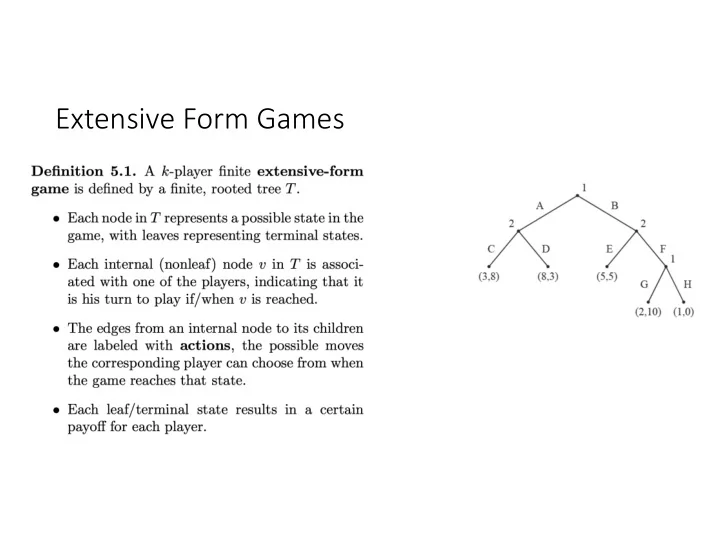
Extensive Form Games Extensive-form games with perfect information - - PowerPoint PPT Presentation
Extensive Form Games Extensive-form games with perfect information When moving, each player is aware of all previous moves 2,10 (perfect information). 3,8 A (pure) strategy for player i is a mapping from player is nodes to 2,10
Extensive Form Games
Extensive-form games with perfect information
aware of all previous moves (perfect information).
mapping from player i’s nodes to actions.
find one by backwards induction. 3,8 2,10 2,10
Centipede: Pot of money that starts out with $4, and increases by $1 each round. Two players take turns: The player whose turn it is can split the pot in his favor (and end the game) or allow the game to continue.
Finite games of perfect information
current state
payoffs each player will get.
computed by backwards induction.
Checking that a strategy profile is a subgame- perfect equilibrium
by a single node in the game tree.
utility in !!’ is strictly better than in !!, fixing all the others. Lemma A strategy profile is a subgame-perfect equilibrium in a finite extensive-form game if and only if there is no useful single deviation.
P payffinthissubtree
changes
pi
P
N
th
devotnat
purple
Other kinds of extensive form games
she is at)
poker
has
K
whatcards
each p
Player I: Startup Player II: Large Company I announces new technology threatening II’s business. II has a large research and development group so may be able to pull together competitive product. Regardless may announce competitive product, to intimidate startup and motivate it to accept buyout offer.
yPIb
d
can
O asf 4 so
0.546,0
Repeated Games
rounds?
Repeated Games
rounds?
∑!"#
$ "% (payoff in round t)
I
Interpretahous
round
stop withprobably
1 P
discount future
rewards
Grim Trigger:
FromC
for
II
deviating
pi
worse to deviate
4E P
6 Fps
6
t EEP
Ip
a
Tit-for-tat:
p
p
O
III
3
Q
for what p
is
Axelrod’s Tournaments
repeated PD.
62 entrants
TFT
Applications
without contributing anything.
dilemma.
those from whom he has downloaded the most data from recently.
nu
BitTyrant