Extended Producer Responsibility (EPR) Policy in East Asia in - - PDF document

extended producer responsibility epr policy in east asia
SMART_READER_LITE
LIVE PREVIEW

Extended Producer Responsibility (EPR) Policy in East Asia in - - PDF document

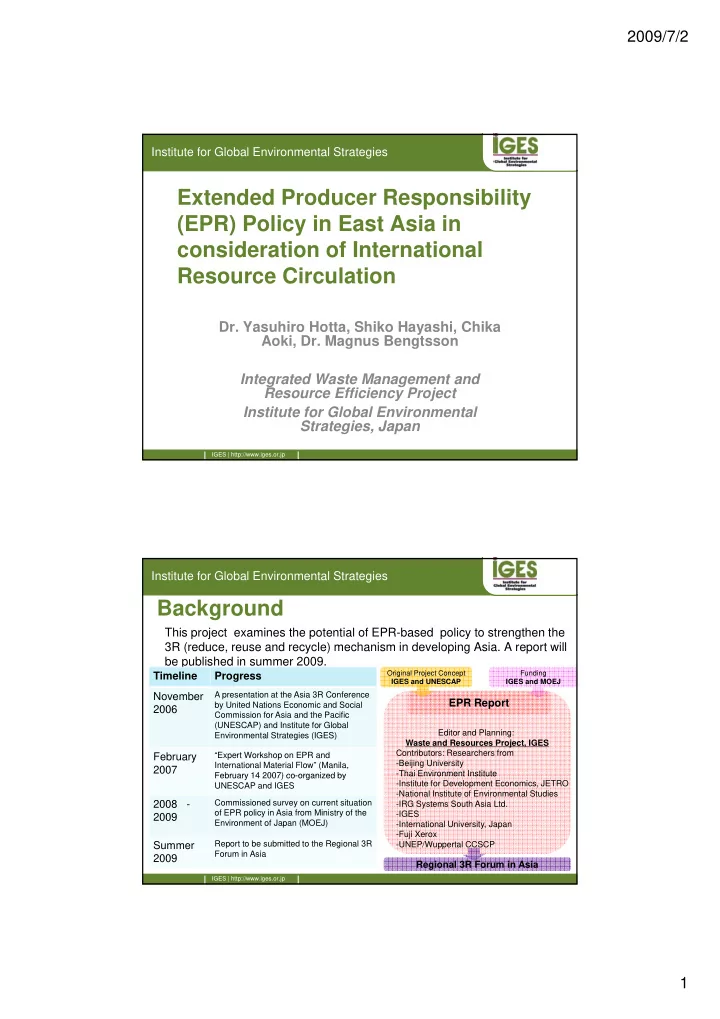
2009/7/2 Institute for Global Environmental Strategies Extended Producer Responsibility (EPR) Policy in East Asia in consideration of International id ti f I t ti l Resource Circulation Dr. Yasuhiro Hotta, Shiko Hayashi, Chika Aoki, Dr.


slide-1
SLIDE 1

2009/7/2 1

Institute for Global Environmental Strategies

Extended Producer Responsibility (EPR) Policy in East Asia in id ti f I t ti l consideration of International Resource Circulation

  • Dr. Yasuhiro Hotta, Shiko Hayashi, Chika

Aoki, Dr. Magnus Bengtsson

IGES | http://www.iges.or.jp

Integrated Waste Management and Resource Efficiency Project Institute for Global Environmental Strategies, Japan

Institute for Global Environmental Strategies

Background

This project examines the potential of EPR-based policy to strengthen the 3R (reduce, reuse and recycle) mechanism in developing Asia. A report will be published in summer 2009. p

Editor and Planning: Waste and Resources Project, IGES Contributors: Researchers from

  • Beijing University
  • Thai Environment Institute

Timeline Progress November 2006

A presentation at the Asia 3R Conference by United Nations Economic and Social Commission for Asia and the Pacific (UNESCAP) and Institute for Global Environmental Strategies (IGES)

February 2007

“Expert Workshop on EPR and International Material Flow” (Manila, February 14 2007) co-organized by

EPR Report

Original Project Concept IGES and UNESCAP Funding IGES and MOEJ

IGES | http://www.iges.or.jp

Thai Environment Institute

  • Institute for Development Economics, JETRO
  • National Institute of Environmental Studies
  • IRG Systems South Asia Ltd.
  • IGES
  • International University, Japan
  • Fuji Xerox
  • UNEP/Wuppertal CCSCP

February 14 2007) co-organized by UNESCAP and IGES

2008 - 2009

Commissioned survey on current situation

  • f EPR policy in Asia from Ministry of the

Environment of Japan (MOEJ)

Summer 2009

Report to be submitted to the Regional 3R Forum in Asia

Regional 3R Forum in Asia

slide-2
SLIDE 2

2009/7/2 2

Institute for Global Environmental Strategies

Table of contents of the EPR report

1. Introduction (IGES) 2. Current Situation of Introduction of EPR Policy in Asia

① Analysis of the situation in China (Beijing Univ.), Thailand (TEI), India (IRG Systems South Asia) by national experts Systems South Asia) by national experts. ② Comparative analysis of EPR implementation in Japan, Korea, and Taiwan.(NIES and IDE-JETRO)

3. EPR Policy and International Resource Circulation

① Analysis of impact of internationalization of waste and recycling-related issues

  • n domestic recycling system (IGES)

② Trade of secondhand goods (IGES) ③ International recycling system by industrial sector (International Univ and Fuji

IGES | http://www.iges.or.jp

③ International recycling system by industrial sector (International Univ. and Fuji Xerox)

4. Emerging Trend of EPR Principle

① The emerging need for sharing environmental product information (IGES) ② Resource Efficiency, Integrated Product Policy, EPR: EU Experiences (UNEP/Wuppertal CSCP)

5. Conclusion (IGES) Institute for Global Environmental Strategies

EPR and International Trade

Country A(EPR) Country B New Products No effective legislation and weak enforcement ll EPR scheme

Country A(EPR) Country B(EPR)

How to achieve this shift? Used goods Recycling Capacity

Inadequate Recycling Capacity

Pollution Possibility of loophole for EPR Program

Consumption Resource recovery

IGES | http://www.iges.or.jp

New Products Recycling Capacity

Recycling Capacity

Difficult-to-treat materials

Support for Institutional Building and the Capacity Development

Used goods

slide-3
SLIDE 3

2009/7/2 3

Institute for Global Environmental Strategies

Institution, infrastructure, and information

For implementation of EPR, the legislation should be supported by physical and

  • rganizational structure (including market) for collection, transportation, and recycling of

used products. Otherwise, it is difficult to establish formal sector which can be driven by financial and informative incentive from EPR policy.

Infrastructure Physical and

  • rganizational

structure for collection,

Institution

Legal or procedural regime

  • f rule and

enforcement on waste management and

Actor PHYSICAL RESPONSIBILITY FINANCIAL RESPONSIBILITY

IGES | http://www.iges.or.jp

transportation, and recycling

  • f used

products Market

management and recycling

Informal sector Formal sector Information

Delivery of data/meaning intended to regulate actor’s behavior Incentive

Institute for Global Environmental Strategies

China, Thailand and India

1. In the OECD context, up-stream environmental management is a pre-condition for EPR.. However, in some developing countries, EPR is discussed as a scheme to promote voluntary environmental management(i.e.: CSR from environmental perspective). 2. EPR policy supposes formal collection mechanism for used products. However, the infrastructure of non-OECD is informal. Establishment of competitive formal collection mechanism/collaboration with informal collection mechanism is inevitable. 3. EPR does not contribute to prevention of pollution from recycling. EPR needs many supporting mechanisms based on proper waste management legislation and systems. 4. “Large second hand goods market makes it difficult to identify “producers””. China

Pilot projects For waste batteries

IGES | http://www.iges.or.jp

  • Introduction of EPR

principle in Circular Economy (CE) Law (Jan. 2009)

  • Several recycling-

related legislation •Traditional collection scheme for EEE (partially informal)

  • Collector shall pay the price

for WEEE.

  • Strong secondhand market
  • Informal resource recovery

Several strategic plan and draft law on WEEE

  • Several examples
  • f environmental

CSR by major industries

  • Several industrial
  • infra. Useful for

resource recovery

  • No formal

collection/transportation scheme for WEEE

  • WEEE is emitted mainly

from business facilities

  • Informal sector is

competitive and can put higher price for recyclables

China

Pilot projects

  • n WEEE

collection and recycling

Thailand

Pilot projects

  • n product

take-back

India

Authorized Treatment Facilities For waste batteries, ELV, and PET, relatively formalized

slide-4
SLIDE 4

2009/7/2 4

Institute for Global Environmental Strategies

Japan, Taiwan, Korea (NIES and IDE-JETRO)

  • 1. Three countries have constructed their respective recycling

structure on the basis of EPR, but the details of each system

  • differ. Japan: To minimize landfill. Korea and Taiwan: To

formalize existing deposit refund principle.

  • 2. Each system has its own weak points. It is significant to decide

who will play the central role in collection and recycling.

  • 3. In the three countries, EPR systems enable to implement

economic responsibility. But the implementation of physical responsibility differs among countries

IGES | http://www.iges.or.jp

responsibility differs among countries.

  • 4. Even if similar EPR systems are introduced, the effects and

results differs based on each country’s legislation background and understanding of issues.

  • Increase in waste
  • Change in quality

and type of waste

  • Increased volume of

production and consumption

  • Change in lifestyle

Increase in resource demand

  • Waste-related

environmental issues

  • Improper recycling

Developing countries

EPR and International Resource Trade

economic integration

Lower demand for recyclables

Hollowing out of material industries Outflow of RR Damage to domestic International trade of RR (including illegal trade)

Internationalization

  • f product life-cycle

Rising international price of resources

Further international division of labor

RR=recyclab les and reusables

  • EPR

legislation

  • Support

for recycling industry

domestic recycling industry Accumulation

  • f RR

through EPR legislation Incentive to recover/minimize cost

Rising Dispos al cost

Developed countries

Source: Hotta, Elder et al. (2008)

slide-5
SLIDE 5

2009/7/2 5

Institute for Global Environmental Strategies

EPR CONCEPT (IGES)

The EPR principle identifies that producer’s ownership of their product is consist of various elements of responsibility: financial, physical, and informative responsibility and liability. The provision of information is identified as a fundamental element of producer responsibility in the EPR principle, but it has seldom been required or enforced in most countries. However, the hazardousness and high resource value of WEEE makes the provision of information highly desirable

IGES | http://www.iges.or.jp

WEEE makes the provision of information highly desirable, especially at the end-of-life (EOL) stages. The chapter recommends additional measures to make sure the producer’s informative responsibility needed for safe and efficient EOL treatment of products.

Institute for Global Environmental Strategies

International Policy Harmonization: Lessons from EU experience by Greg Tyson

WEEE Di ti

German Packing Ordinance and EU Packaging Directive WEEE Directive of EU

Effect of EPR

EPR can be effective in More complex products with WEEE Directive

Effect of EPR policy

EPR can be effective in stimulating new technology and design change, but not resulted in reduction of consumption More complex products with longer life-spans much more difficult to be effective

Trade and EPR policy

Markets can be significantly affected by trade in recyclables - particularly where funding schemes differ Treatment standards for exports - how to assure sound management?

IGES | http://www.iges.or.jp

where funding schemes differ substantially

Harmonization among EU

Simple products comparativly uncomplilcated - short lifespans, established recycling technology Cross border reuse trade can pose financing challenges - who takes responsibility for final end of life?

slide-6
SLIDE 6

2009/7/2 6

Institute for Global Environmental Strategies

Conclusion 1

  • 1. For the development of sound management

systems for E-waste in developing Asia, application of EPR mechanism in the wider sense is desirable. But, this requires comprehensive capacity development in terms of institution, infrastructure, and information.

IGES | http://www.iges.or.jp

  • 2. Some kind of measures, other than EPR-based

recycling policy, are necessary to prevent

  • loopholes. Also, some additional measures are

necessary to prevent pollution from improper recycling.

Institute for Global Environmental Strategies

Conclusion 2

  • 3. One measure to supplement EPR could be a

transfer of recycling fee of exporting countries to t ib ti t i tit ti l d t h i l it contribution to institutional and technical capacity development for proper recycling in developing Asia.

  • 4. In addition to institutional and technical capacity

development for proper recycling in developing A i t i id i t d i t d

IGES | http://www.iges.or.jp

Asia, countries may consider introducing trade rules for secondhand goods to gain positive benefits of reuse while preventing negative effects

  • f inefficiency posed by near end of life products.
slide-7
SLIDE 7

2009/7/2 7

Institute for Global Environmental Strategies

Contact

  • The report is planned to be published in

A t/S t b 2009 d ill b il bl f August/September 2009 and will be available from IGES website: http://www.iges.or.jp/en/wmr/report.html

  • For this study, please contact:

D Y hik H tt S b M /P li A l t

IGES | http://www.iges.or.jp

  • Dr. Yasuhiko Hotta, Sub-Manager/Policy Analyst

Institute for Global Environmental Strategies hotta@iges.or.jp http://www.iges.or.jp/en/wmr/index.html