Expressions c uses the standard ordering when determining the order - - PowerPoint PPT Presentation

expressions
SMART_READER_LITE
LIVE PREVIEW

Expressions c uses the standard ordering when determining the order - - PowerPoint PPT Presentation

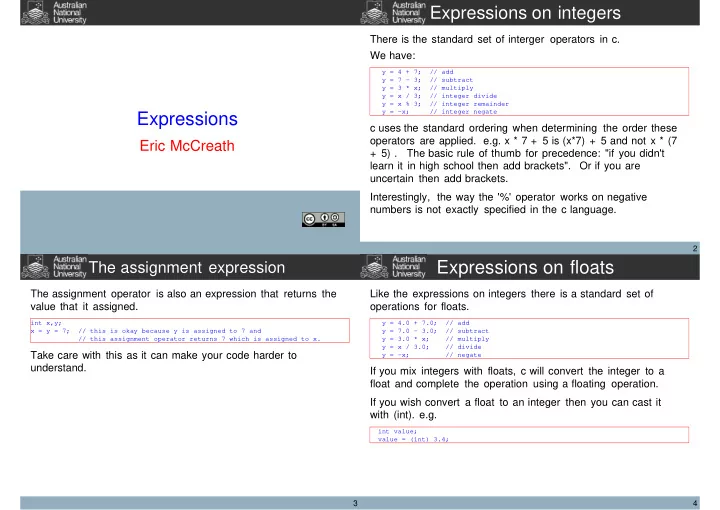
Expressions on integers There is the standard set of interger operators in c. We have: y = 4 + 7; // add y = 7 - 3; // subtract y = 3 * x; // multiply y = x / 3; // integer divide y = x % 3; // integer remainder y = -x; // integer


slide-1
SLIDE 1

Expressions

Eric McCreath

2

Expressions on integers

There is the standard set of interger operators in c. We have:

y = 4 + 7; // add y = 7 - 3; // subtract y = 3 * x; // multiply y = x / 3; // integer divide y = x % 3; // integer remainder y = -x; // integer negate

c uses the standard ordering when determining the order these

  • perators are applied. e.g. x * 7 + 5 is (x*7) + 5 and not x * (7

+ 5) . The basic rule of thumb for precedence: "if you didn't learn it in high school then add brackets". Or if you are uncertain then add brackets. Interestingly, the way the '%' operator works on negative numbers is not exactly specified in the c language.

3

The assignment expression

The assignment operator is also an expression that returns the value that it assigned.

int x,y; x = y = 7; // this is okay because y is assigned to 7 and // this assignment operator returns 7 which is assigned to x.

Take care with this as it can make your code harder to understand.

4

Expressions on floats

Like the expressions on integers there is a standard set of

  • perations for floats.

y = 4.0 + 7.0; // add y = 7.0 - 3.0; // subtract y = 3.0 * x; // multiply y = x / 3.0; // divide y = -x; // negate

If you mix integers with floats, c will convert the integer to a float and complete the operation using a floating operation. If you wish convert a float to an integer then you can cast it with (int). e.g.

int value; value = (int) 3.4;

slide-2
SLIDE 2

5

Comparison

You can compare both integers and floats using:

< less than <= less than or equal to > greater than >= greater than or equal to == equal to != not equal to

If you are using "==" on floating point numbers then this would generally indicate a problem with your code.

6

Working with Booleans

Booleans are represented using integers (remeber 0 is false, non-zero is true). Operators on booleans include:

&& logical add || logical or ! logical not

The == operator may not work on booleans as two true booleans in c may have different values. You can use "(a && b) || (!a && !b)" to see if booleans a and b are equal. Generally avoid side effects within boolean expressions.

7

  • perations on bits

There is a number of operations that you can do on bits within an integer. These include:

x >> 4 right shift x by 4 bits x << 2 left shift x by 2 bits x & y bitwise "and" of x with y x | y bitwise "or" of x with y ~x negate each bit within x x ^ y bitwise "xor" of x with y

Arithmetic right shift fills the left most bits with the sign bit. Logical right shift fills the left most bits with 0. ANSI c does not specify if arithmetic or logical shift is used.

8

conditional operator

One handy, but sometimes forgotten, operator is the ternary conditional operator.

(boolean_expression ? expression1 : expression1) // in the above expression if the boolean_expression evaluates to true // then expression1 is evaluated and returned otherwise, // expression2 is evaluated and returned.

The use of this operator will often save on using a extra local variable along with a if-else conditional. e.g. Using a if-else:

int maxval; if (a > b) { maxval = a; } else { maxval = b; } printf("The max is : %d",maxval);

Using ternary condidtional:

printf("The max is : %d",(a>b?a:b));

slide-3
SLIDE 3

9

math.h

Operators like square root, power, sin, cos, ... are not part of the c language. However, there are standard libraries that enable you to compute these functions. The math.h library contains a useful range of mathematical

  • perators. These include:

cos(x) calculate the cosine of x sin(x) calculate the sine of x acos(theta) calculate the arc sine of theta pow(x,y) take x to the power of y M_PI the pi constant sqrt(x) calculate the square root of x

See:

http://en.wikibooks.org/wiki/C_Programming/C_Reference/math.h

for a more extensive list. On some compilers you may need to link the math library for these to work (in gcc use the "-lm" option).

10

Exersizes

Write a program that calculates the area of a triangle given the lengths of the sides. The program should take input on a single line with three space separated floats which are the side lengths of the triangle. It should output on a single line the area

  • f the triangle. You may assume the triangles are possible.

Hint using Heron's formula (where , , are the side lengths):