EXPLORING STAR-FORMATION & INHOMOGENEITY IN PRISTINE - - PowerPoint PPT Presentation

exploring star formation inhomogeneity in pristine
SMART_READER_LITE
LIVE PREVIEW

EXPLORING STAR-FORMATION & INHOMOGENEITY IN PRISTINE - - PowerPoint PPT Presentation

EXPLORING STAR-FORMATION & INHOMOGENEITY IN PRISTINE ENVIRONMENTS: IFU STUDIES OF METAL-POOR DWARF GALAXIES Bethan James Nimisha Kumari, Sergey Koposov, Dan Stark, Kristy McQuinn, Vasily Belokurov, Max Pettini Alessandra Aloisi, Svea


slide-1
SLIDE 1

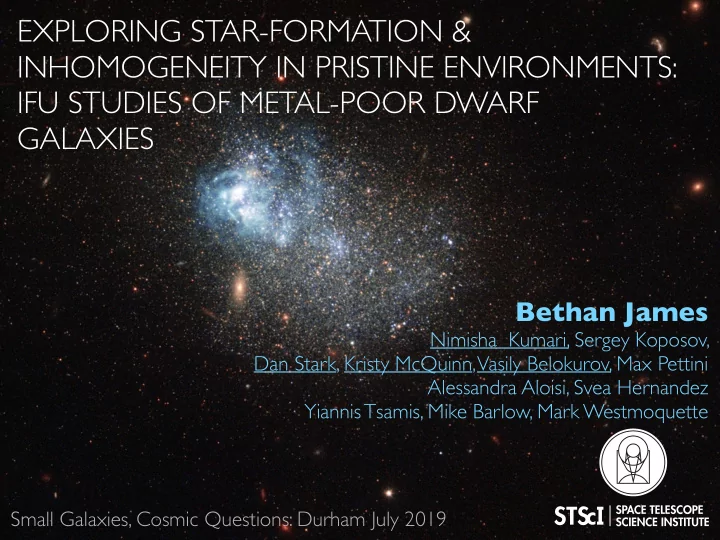
EXPLORING STAR-FORMATION & INHOMOGENEITY IN PRISTINE ENVIRONMENTS: IFU STUDIES OF METAL-POOR DWARF GALAXIES

Bethan James

Nimisha Kumari, Sergey Koposov, Dan Stark, Kristy McQuinn, Vasily Belokurov, Max Pettini Alessandra Aloisi, Svea Hernandez Yiannis Tsamis, Mike Barlow, Mark Westmoquette Small Galaxies, Cosmic Questions: Durham July 2019

slide-2
SLIDE 2

Small Galaxies, Cosmic Questions Bethan James

Are star-forming galaxies chemically homogeneous?

Yuan+ 2011

Dekel+ 2009

Metallicity

Metal Distribution

Outflows

Accretion Galaxy Evolution Star-Formation

109 spirals, 49 SF galaxies (Ho+2014)

Metallicity gradient

Negative gradients → inside-out growth, flattening with time Positive gradients → tidal mixing, interacting systems (low-z) → infall of pristine gas into center (high-z) → SNe blowout + fallback, metal mixings?, self pollution?

Are dwarf galaxies chemically homogeneous?

slide-3
SLIDE 3

Small Galaxies, Cosmic Questions Bethan James

Knot B Knot C Knot A 5” ~ 1.8 kpc N

Haro 11 (James+ 2013a)

Accretion of pristine gas → star-formation

Sanchez-Almeida+, 2014

Nearby Dwarf XMP Dwarfs

LESSONS FROM CHEMICAL VARIATIONS IN DWARFS….

How is star- formation triggered?

slide-4
SLIDE 4

Small Galaxies, Cosmic Questions Bethan James

James et al. 2010

A . M

  • n

r e a l

  • I

b e r

  • e

t a l . : P h y s i c a l a n

− 6 − 4 − 2 2 4 2 4 6

l

  • g

( N / O ) ( N 2 O 2 )

Δ x ( a r c s e c ) Δ y ( a r c s e c )

+ + +

− 1 . 6 − 1 . 3 5 − 1 . 1 − . 8 5 − . 6

6

l

  • g

( N / O ) ( N 2 S 2 )

1 . 3 5 − 1 . 1 − . 8 5 − . 6

0.3 log (N/O) (N2S2)

Monreal-Ibero et al. 2012

N/O

e.g. NGC5253

(Westmoquette, James et al. 2012)

Self-pollution + young (WR) cluster Metallicity gradient ⋍ stellar age gradient

LESSONS FROM CHEMICAL VARIATIONS IN DWARFS….

Star-formation ♻ metal mixing timescales

slide-5
SLIDE 5

Small Galaxies, Cosmic Questions Bethan James

Hot stars Ionisation Hα

Mrk 71 Star-formation efficiency

Teyssier, Chapon & Bournaud 2010

Surface Gas Density

Star-formation efficiency

Chemical variations on <10pc scales Thermal instabilities →gas fragmentation

James et al., 2016a, ApJ

1 pixel < 1pc WFC3 narrow band imaging

HeII emission from Wolf Rayet stars WFC3 Metallicity ‘image’ 1 pixel < 1pc

LESSONS FROM SMALL SCALE CHEMICAL VARIATIONS IN DWARFS….

slide-6
SLIDE 6

Small Galaxies, Cosmic Questions Bethan James

  • SDSS-search based on Leo-P

morphology

  • ~120 previously unknown low

surface brightness star-forming dwarf galaxies

  • 25% are extremely metal

poor (i.e. <0.1 Zsol)

  • Random regions of active SF in

diffuse continuum → akin to high- z systems

  • 50/120 observed with MMT
  • 7/120 observed with McDonald
  • 1/120 observed with VLT/MUSE…

James, Koposov, Stark, Belokurov, McQuinn et al. 2015a, 2017

BLUE DIFFUSE DWARF GALAXIES

slide-7
SLIDE 7

Small Galaxies, Cosmic Questions Bethan James

HOW IS STAR FORMATION TRIGGERED IN BLUE DIFFUSE DWARFS?

Hierarchical star-formation (e.g. Elmegreen+ 2010)

How stable is the gas? Is it turbulent? Are there signs of accretion? Is there an older stellar population?

Gas density too low for gravitational instability (dIrrs, Hunter+ 1998).

Lelli+ 2014

Triggered by external processes? Stream-fed? Internal factors? e.g. turbulence, stellar feedback (Elmegreen & Hunter 2006)

dIrrs: Zhang+ 2012

Stellar mass density Star-formation rate density

slide-8
SLIDE 8

Small Galaxies, Cosmic Questions Bethan James

−30 −20 −10 10 20 30 arcsecs −30 −20 −10 10 20 30 arcsecs

−18.50 −18.25 −18.00 −17.75 −17.50 −17.25 −17.00 −16.75 −16.50 log Flux(erg s−1 cm−2) −30 −20 −10 10 20 30 arcsecs −30 −20 −10 10 20 30 arcsecs

−20 −10 10 20 30 Radial V elocity (kms−1) −30 −20 −10 10 20 30 arcsecs −30 −20 −10 10 20 30 arcsecs

100 120 140 160 180 200 V elocity Dispersion (kms−1)

James, Kumari + 2019a, in-prep

λ=4650-9300Å 300x300 spaxels 900,000 spectra 0.2” spaxels ~0.9” seeing

JKB18: MUSE OBSERVATIONS

Regions of star-formation in arm-like structures Disturbed velocity field → past merger? Uniform velocity dispersion → no evidence of outflowing gas

1 spaxel~20pc

slide-9
SLIDE 9
  • 10
  • 5
5 10 15 20
  • 10
  • 5
5 10 15 20
  • 1.00
  • 0.75
  • 0.50
  • 0.25
0.00
  • 0.5
0.0 0.5 1.0
  • 10
  • 5
5 10 15 20
  • 10
  • 5
5 10 15 20
  • 1
1
  • 1.0
  • 0.5
0.0 0.5 1.0 1.5

JKB18: IONIZATION MAPPING

[OIII]/Hb [OIII]/Hb [NII]/Ha [SII]/Ha

  • Mostly photoionization
  • Gradients of high ionization mis-aligned with star-formation
  • Evidence of shocks/gas-interactions
  • No diffuse ionized gas
slide-10
SLIDE 10

Small Galaxies, Cosmic Questions Bethan James

  • Evidence of ~0.5 dex chemical variations
  • Variations depend on the metallicity diagnostic, but larger than diagnostic uncertainties

JKB18: METALLICITY MAP

−30 −20 −10 10 20 30 arcsecs −30 −20 −10 10 20 30 arcsecs

Z [O3N2]

8.0 8.1 8.2 8.3 8.4 8.5 8.6 Z (O3N2) 1 spaxel~20pc

slide-11
SLIDE 11

Small Galaxies, Cosmic Questions Bethan James

− 30 − 20 − 10 10 20 30 arcsecs − 30 − 20 − 10 10 20 30 arcsecs

1
  • Variations do exist outside the mean
  • Only small scale variations,

considering random distribution of SF regions, stellar ages, gas velocity

Direct Method O3N2

JKB18: INHOMOGENEITY?

1 HII region ~100pc

slide-12
SLIDE 12

Small Galaxies, Cosmic Questions Bethan James

What do simulations of low-mass galaxies show us at these scales? Can simulations see such small-scale metal variations?

JKB18: CAUSE/EFFECTS OF CHEMICAL INHOMOGENEITY

SFR (Msol/yr)

No sign of pristine gas accretion

  • r outflows

Age (Gyr)

Gas is well mixed no self-pollution

Light-Weighted Age (Gyr)

Metallicity Metallicity

− 30 − 20 − 10 10 20 30 arcsecs − 30 − 20 − 10 10 20 30 arcsecs

1
slide-13
SLIDE 13

Small Galaxies, Cosmic Questions Bethan James

HST-COS Survey of Local Star-Forming Galaxies (mostly BCDs)

(34 Orbits in Cycle17, 33 Orbits Cycle 25, PI: Aloisi)

~150 pc

~130 pc

Accurate line-of-sight abundances →Gemini-GMOS data (PI: James, Kumari et al. 2017, 2018, 2019) →Keck/CWI data (PI: Hernandez, due 2020)

MW Ly α emission Ly α

N I 1134.1, 1134.4,.9 Fe II 1142, 1143,44

P II 1152 Si II & SIII 1190

Si II 1193 Si III 1206

Si II & FeII 1260

S II 1250 S II 1253 C II 1334 Ni II 1370 Si IV 1393 Si IV 1402 CIII 1175 OI 1302 Ni II 1317

N I 1199, 1200.2,1200.7

C II* 1335.6,.7 Si II 1304

James et al., 2014b, ApJ

CHEMICAL VARIATION BETWEEN GAS PHASES

slide-14
SLIDE 14

Small Galaxies, Cosmic Questions Bethan James

New COS data allows for tailor made ICF models for each galaxy (Hernandez et al. 2019 in-prep)

Neutral Gas Abundance

Ionized Gas Abundance:

All elements

CHEMICAL VARIATION BETWEEN GAS PHASES

(saturated)

To be continued with +45 galaxies in CLASSY (PIs Berg, James & Stark +, Cycle 27)

slide-15
SLIDE 15

Small Galaxies, Cosmic Questions Bethan James

Just Oxygen

CHEMICAL VARIATION BETWEEN GAS PHASES

Amount of HI is strong function

  • f metallicity

Gas is well mixed, despite metallicity

Decrease in metals only seen at very low metallicities O/H in neutral phase increases in high mass galaxies

Ionised - Neutral

Ionised - Neutral

N(HI)

N(P), N(O) Metallicity Metallicity

Metallicity N(HI)

Galactic outflows and/or SF inefficiency in most metal poor systems

James & Aloisi 2018

slide-16
SLIDE 16

SUMMARY

Incorporating these variations into models is essential for accurate representation of galaxy evolution ...especially for dwarf galaxies Dwarf galaxies are not always chemically homogeneous Chemical variations in dwarfs tell us about:

  • chemical mixing timescales
  • past interactions
  • accretion of metal-poor gas
  • star-formation mechanisms
  • galactic outflows
  • Self pollution...or complete lack of.