Explanation The system must be able to justify that its answer is - - PowerPoint PPT Presentation

explanation
SMART_READER_LITE
LIVE PREVIEW

Explanation The system must be able to justify that its answer is - - PowerPoint PPT Presentation

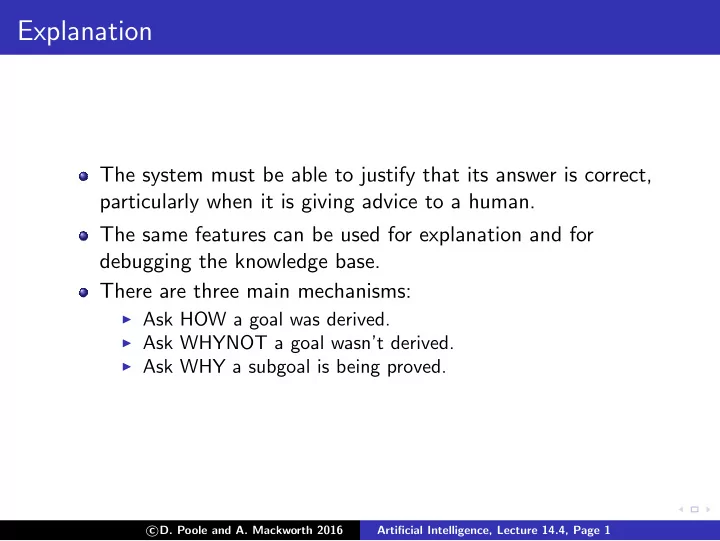
Explanation The system must be able to justify that its answer is correct, particularly when it is giving advice to a human. The same features can be used for explanation and for debugging the knowledge base. There are three main mechanisms:


slide-1
SLIDE 1

Explanation

The system must be able to justify that its answer is correct, particularly when it is giving advice to a human. The same features can be used for explanation and for debugging the knowledge base. There are three main mechanisms:

◮ Ask HOW a goal was derived. ◮ Ask WHYNOT a goal wasn’t derived. ◮ Ask WHY a subgoal is being proved. c

  • D. Poole and A. Mackworth 2016

Artificial Intelligence, Lecture 14.4, Page 1

slide-2
SLIDE 2

How did the system prove a goal?

If g is derived, there must be a rule instance g ⇐ a1 & . . . & ak. where each ai is derived. If the user asks HOW g was derived, the system can display this rule. The user can then ask

HOW i.

to give the rule that was used to prove ai. The HOW command moves down the proof tree.

c

  • D. Poole and A. Mackworth 2016

Artificial Intelligence, Lecture 14.4, Page 2

slide-3
SLIDE 3

Why Did the System Ask a Question?

It is useful to find out why a question was asked. Knowing why a question was asked will increase the user’s confidence that the system is working sensibly. It helps the knowledge engineer optimize questions asked of the user. An irrelevant question can be a symptom of a deeper problem. The user may learn something from the system by knowing why the system is doing something.

c

  • D. Poole and A. Mackworth 2016

Artificial Intelligence, Lecture 14.4, Page 3

slide-4
SLIDE 4

WHY question

When the system asks the user a question g, the user can reply with

WHY

This gives the instance of the rule h ⇐ · · · & g & · · · that is being tried to prove h. When the user asks WHY again, it explains why h was proved.

c

  • D. Poole and A. Mackworth 2016

Artificial Intelligence, Lecture 14.4, Page 4

slide-5
SLIDE 5

Debugging Knowledge Bases

There are four types of nonsyntactic errors that can arise in rule-based systems: An incorrect answer is produced; that is, some atom that is false in the intended interpretation was derived. Some answer wasn’t produced; that is, the proof failed when it should have succeeded, or some particular true atom wasn’t derived. The program gets into an infinite loop. The system asks irrelevant questions.

c

  • D. Poole and A. Mackworth 2016

Artificial Intelligence, Lecture 14.4, Page 5

slide-6
SLIDE 6

Debugging Incorrect Answers

An incorrect answer is a derived answer which is false in the intended interpretation. An incorrect answer means a clause in the KB is false in the intended interpretation. If g is false in the intended interpretation, there is a proof for g using g ⇐ a1 & . . . & ak. Either:

◮ Some ai is false: debug it. ◮ All ai are true. This rule is buggy. c

  • D. Poole and A. Mackworth 2016

Artificial Intelligence, Lecture 14.4, Page 6

slide-7
SLIDE 7

Debugging Missing Answers

WHYNOT g. g fails when it should have succeeded.

Either:

◮ There is an atom in a rule that succeeded with the wrong

answer, use HOW to debug it.

◮ There is an atom in a body that failed when it should have

succeeded, debug it using WHYNOT.

◮ There is a rule missing for g. c

  • D. Poole and A. Mackworth 2016

Artificial Intelligence, Lecture 14.4, Page 7

slide-8
SLIDE 8

Debugging Infinite Loops

There is no automatic way to debug all such errors: halting problem. There are many errors that can be detected:

◮ If a subgoal is identical to an ancestor in the proof tree, the

program is looping.

◮ Define a well-founded ordering that is reduced each time

through a loop.

c

  • D. Poole and A. Mackworth 2016

Artificial Intelligence, Lecture 14.4, Page 8