Experimental M. Betz (CERN, Geneva) M. Gasior (CERN, Geneva) - - PowerPoint PPT Presentation

experimental
SMART_READER_LITE
LIVE PREVIEW

Experimental M. Betz (CERN, Geneva) M. Gasior (CERN, Geneva) - - PowerPoint PPT Presentation

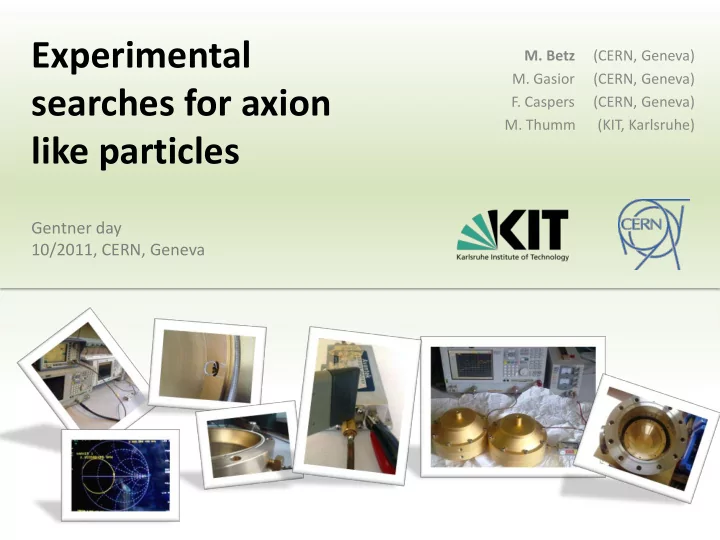
Experimental M. Betz (CERN, Geneva) M. Gasior (CERN, Geneva) searches for axion F. Caspers (CERN, Geneva) M. Thumm (KIT, Karlsruhe) like particles Gentner day 10/2011, CERN, Geneva Outline What this talk will be about


slide-1
SLIDE 1

Experimental searches for axion like particles

  • M. Betz (CERN, Geneva)
  • M. Gasior (CERN, Geneva)
  • F. Caspers (CERN, Geneva)
  • M. Thumm (KIT, Karlsruhe)

Gentner day 10/2011, CERN, Geneva

slide-2
SLIDE 2

Outline

  • Introduction to Axions
  • Existing experimental searches around the

world

  • The “microwaves shining through the wall”

experiment at CERN

2

What this talk will be about

  • M. Betz; Experimental searches for axion like particles,

Geneva 2011

slide-3
SLIDE 3

What is an axion?

  • A hypothetical elementary particle
  • Postulated by R. Peccei, H. Quinn, S. Weinberg

and F. Wilczek in 1977 – 1978 to explain the strong CP-violation

  • A candidate for dark matter in our universe
  • Also a washing detergent

3

Introduction

  • M. Betz; Experimental searches for axion like particles,

Geneva 2011

Some properties Charge: None Mass: 10-6 … > 100 eV/c² Mean lifetime: 1017 years No interaction with matter!

slide-4
SLIDE 4
  • The theory of quantum chromodynamics (QCD) is

explicitly CP-violating if one of its parameters θ>0

  • θ was expected to be of order 1

Puzzling questions for QCD-physicists:

  • Why is the parameter θ so small? (Fine tuning problem!)
  • Why is there apparently no CP-violation?

What is an axion?

4

The strong CP problem

  • M. Betz; Experimental searches for axion like particles,

Geneva 2011

 The result was puzzling Current experimental limit:

|dN| < 10-27 e cm

 Experimental verification QCD neutrons should have an electrical dipole moment in the

  • rder of

|dN| ≈ θ 10-16 e cm

slide-5
SLIDE 5

What is an axion?

  • What if θ is a dynamical variable?
  • It would oscillate around zero like a

pendulum

  • This would eliminate CP violating terms

from the QCD-Lagrangian

  • The oscillations can be seen as new

particle  The axion

  • So far the most elegant and widely

accepted solution to the strong CP- problem

  • For theoretical physics:

Problem solved!

  • But in experimental physics:

No observation of the axion yet

5

A solution to the strong CP problem

  • M. Betz; Experimental searches for axion like particles,

Geneva 2011

From: Fermilab Seminar Ultrasensitive Searches for the Axion Karl van Bibber, LLNL January 30, 2008

slide-6
SLIDE 6

What is an axion?

6

Also a candidate for dark matter

  • M. Betz; Experimental searches for axion like particles,

Geneva 2011

Dark energy (unknown identity), 73% Dark matter (unknown identity), 23% Matter made from particles we know, 4%

Some puzzling question for astrophysicists:

  • Why do clusters of galaxies rotate faster
  • n their outskirts than they should?
  • Why does the cosmic microwave

background radiation appear to be distorted?

  • Why is the gravitational lensing effect

stronger than predicted? All of those points could be explained by assuming there is more matter and energy in our universe than we can see But, what is this dark matter made of?

Axions are excellent candidates for dark matter

Note that axions could exist, even if the dark matter theory would be disproven

slide-7
SLIDE 7

The Primakoff Effect

7

Axions couple to photons in a strong magnetic field

  • M. Betz; Experimental searches for axion like particles,

Geneva 2011

From: Fermilab Seminar Ultrasensitive Searches for the Axion Karl van Bibber, LLNL January 30, 2008

 * is representing the virtual photons of the magneto-static field

γ can be a photon with energies between μeV (microwave photon) and up to keV and beyond (gamma quantum)

a = axion

All current experimental searches are based on this effect

slide-8
SLIDE 8

Experimental searches around the world

Polari- zation Helio- scopes Halo- scopes Light shining trough the wall

8

Overview

  • M. Betz; Experimental searches for axion like particles,

Geneva 2011

Experimental searches for the axion Looks for changes in light polarization of a laser beam in a strong magnetic field Looks for axions generated in the sun and sent to earth Looks for dark matter axions, uniformly distributed in our galaxy Looks for photon axion photon conversions in a strong magnetic field

slide-9
SLIDE 9

Laser polarization experiments

  • Linear polarized laser

beam transverses strong magnetic field

  • The component parallel to

the magnetic field is converted to hidden particles (primakoff effect)  selective absorption

  • The polarization is rotated

9

PVLAS (Istituto Nazionale di Fisica Nucleare, Padova, Italy)

  • M. Betz; Experimental searches for axion like particles,

Geneva 2011

The expected effect is tiny rotation of 3.9 · 10-12 rad ≈ width of mechanical pencil lead at the distance of the Moon

slide-10
SLIDE 10

Laser polarization experiments

  • In 2006 the PVLAS

collaboration published their results

  • They claimed to have
  • bserved the effect they

were looking for

  • After an update of the

detector, the results could not be confirmed

10

PVLAS (Istituto Nazionale di Fisica Nucleare, Padova, Italy)

  • M. Betz; Experimental searches for axion like particles,

Geneva 2011

http://physicsworld.com/cws/article/news/30423

Nonetheless the publication in 2006 triggered world wide interest and inspired many new experimental activities

slide-11
SLIDE 11

Axion helioscopes

Magnetic field converts photons to axions inside the sun

11

The CERN Axion Solar Telescope (CAST)

  • M. Betz; Experimental searches for axion like particles,

Geneva 2011

Magnetic field converts axions to X-ray photons

  • Prototype LHC magnet, 10 m long, 9 Tesla on a movable platform
  • Tracks the sun for 3h / day, 50 days / year
  • X-ray focusing system (prototype from the space based X-ray telescope ABRIXAS)
  • X-ray detectors (micromegas, CCD) at both ends of the magnet
  • Has been running since 2003 and is now waiting for an upgrade in 2012
slide-12
SLIDE 12

Axion helioscopes

  • Assumes: Axions are dark matter, a

relic from the big bang and already all around us

  • 8 T Magnet converts relic axions to

microwave photons

  • Tunable cavity 460 – 810 MHz to

“collect” those photons

  • SQUID amplifier, system noise

temperature TN = 2.5 K, one of the quietest microwave receivers in the world

  • Running since 2006 (at LLNL),

moved to University of Washington in 2010, upgrade of cryo system this year

12

The Dark Matter eXperiment (ADMX) in Washington

  • M. Betz; Experimental searches for axion like particles,

Geneva 2011

slide-13
SLIDE 13

Laser LSW experiments

13

LSW = Light shining through the wall

  • M. Betz; Experimental searches for axion like particles,

Geneva 2011

1020 photons/s < 1 photon/s

  • Some photons

convert to axions (emitting side)

  • axions can pass the

wall

  • Some axions

convert back to photons (detection side)

  • It seems like light is

shining through the wall!

  • Fabry-Perot

cavities allow to enhance the probability: photons make many passes

photons axions photons

(Optical resonator cavities)

slide-14
SLIDE 14

Laser LSW

14

A lot of activity around the world

  • M. Betz; Experimental searches for axion like particles,

Geneva 2011

ALPS at DESY (Germany) OSQUAR at CERN (next door) XAX at ESRF (France) GRIM REPR at Fermilab (USA)

slide-15
SLIDE 15

Experimental searches around the world

15

Results so far: No axion has been observed yet

  • M. Betz; Experimental searches for axion like particles,

Geneva 2011

Towards a new generation axion helioscope, Igor G Irastorza 7th Patras Workshop on Axions, WIMPs and WISPs

Laser LSW

(ADMX)

Laser polarization

Sensitivity Mass

slide-16
SLIDE 16

Microwaves shining through the wall

Why microwaves resonators?

  • High Q-factors around 105

(low loss) are easily achieved

  • Easier construction /

alignment

  • Homodyne detection

methods can be applied (very sensitive)

  • Instruments and know-how

exists But:

  • The “wall” becomes a faraday

cage  EMI shielding challenge

16

Cavities become coupled through axions

  • M. Betz; Experimental searches for axion like particles,

Geneva 2011

γ Photon a Axion EM. Electromagnetic

slide-17
SLIDE 17

The photon conversion cavities

17

Prototypes after machining (left) and coating (right)

  • M. Betz; Experimental searches for axion like particles,

Geneva 2011

Material: Brass (non magnetic) Fine thread tuning screw Coupler (β=1)

slide-18
SLIDE 18

TE011 mode, H–field on YZ-plane

The photon conversion cavities

18

Numerical simulation of the TE011 mode

  • M. Betz; Experimental searches for axion like particles,

Geneva 2011

Possible location of an inductive coupling loop for the TE011 mode (The loop extends on the XY- plane)

TE011 mode, E–field on XY-plane TE011 mode, E–field in X-direction

Tuning screw:

(20 mm diameter, fine thread)

slide-19
SLIDE 19

Electromagnetic shielding

  • Experiment is split into a

cryogenic and room temperature part

19

Splitting the experiment into two parts

  • M. Betz; Experimental searches for axion like particles,

Geneva 2011

Electric /

  • ptical

converter Optical / electric converter

Shielding Box 1 Contains the Axion detection cavity and will later be placed in the cryostat / magnet

Shielding Box 1 (Cryo.)

Optical Fibre Carries the weak signal from Axion conversion to the measurement instruments, unaffected by ambient EM. noise and without comprising the shielding boxes Shielding Box 2 Contains instruments for the detection of weak narrowband microwave signals and will be outside the cryostat / magnet

Shielding Box 2 (Room temp.)

Environmental RF noise

slide-20
SLIDE 20

Electromagnetic shielding

  • EM absorbing material

between shielding layers (non magnetic!)

  • Chain of lowpass

feedtrough filters for supply voltage If we still see leakage:

  • Power over optical fibre

– Commercial systems available (JDSU Photonic power module) – Efficiency 50 % (optical  electric)

  • We can always add

another layer of shielding

20

Some practical aspects

  • M. Betz; Experimental searches for axion like particles,

Geneva 2011

High power Laser diode

VCC Optical power converter

slide-21
SLIDE 21

DC – feedtrough filters

21

For feeding DC power through the shielding while keeping RF out

  • M. Betz; Experimental searches for axion like particles,

Geneva 2011

Measurement with a network analyser in transmission

  • 95 dB at 3 GHz

Syfer SFJNC2000684MX1

slide-22
SLIDE 22

Electromagnetic shielding

22

Shielding box 1 prototype, containing the receiving cavity

  • M. Betz; Experimental searches for axion like particles,

Geneva 2011

slide-23
SLIDE 23

Debugging of the faraday cage

  • Phase locked RF – Source (3 GHz)
  • Optical receiver for 10 MHz phase lock

signal

  • 50 W RF power amplifier
  • Custom made EMI - feed trough filter

for AC power

  • Faraday cage, containing detection part
  • Fibre optical converter for control

signals

  • Multimeter for tuning the cavity
  • Emitting cavity

23

The current status in the laboratory

  • M. Betz; Experimental searches for axion like particles,

Geneva 2011

E.M. leakage test setup

slide-24
SLIDE 24

Electromagnetic shielding

24

Shielding box 2 prototype, containing the instrumentation

  • M. Betz; Experimental searches for axion like particles,

Geneva 2011

  • Feedtrough

for optical fibres

  • Receiving

cavity

  • Spectrum

analyzer

  • Low noise

amplifier

E.M. leakage test setup

slide-25
SLIDE 25

Online diagnostics

Test tones (TXn)

  • Low power (μW) probe signals
  • Injected in laboratory space and

between shielding layers

  • Each one has a slightly different

frequency within the cavity bandwidth

  • Monitoring signal power (RXn)

allows to quantify the attenuation of each shielding layer

25

Supervising the shielding attenuation with test tones

  • M. Betz; Experimental searches for axion like particles,

Geneva 2011

We need ONLINE diagnostics showing, that the shielding performance is really maintained over the full lifetime of the

  • experiment. Degradation is possible due

to bad and ageing contacts

If dynamic range of the receivers is not sufficient, time multiplexing is an option. (Sender and receiver in the same shielding shell are not enabled at the same time)

slide-26
SLIDE 26

Online diagnostics

  • All possible signal paths are represented as

arrows

  • Green signals pass one shielding layer and can

be used to quantify its attenuation

  • Red signals pass more than one shielding
  • layer. Observation of a red signal = veto

condition on Axion detection

26

Possible signal-paths

  • M. Betz; Experimental searches for axion like particles,

Geneva 2011

Attenuation of the Shieldingbox is measured twice, giving us redundancy

Shieldingbox

slide-27
SLIDE 27

Detecting weak narrowband signals

27

Homodyne detection with an commercial vector signal analyser

  • M. Betz; Experimental searches for axion like particles,

Geneva 2011

Common reference clock

Vector signal analyser (Agilent N9010A EXA)

  • To detect signals down to -230 dBm we need resolution bandwidths in

the 10 μHz range

  • This can be achieved with a FFT on a 24 h time trace
  • Frequency drifts are unavoidable!
  • But by phase locking source and analyzer we can eliminate relative

frequency errors

slide-28
SLIDE 28

Photon regeneration exp. at CERN

28

Technical specifications and challenges for hidden photon search

  • M. Betz; Experimental searches for axion like particles,

Geneva 2011

Expected signal power from the receiving cavity

arXiv:0707.2063v1

  • F. Caspers, J. Jaeckel, A. Ringwald, A Cavity Experiment to Search for Hidden Sector Photons

What we want to achieve (for HSPs):

Pem 50 W = 47 dBm Signal power into emitting cavity Pdet 10-26 W = -230 dBm Signal power from receiving cavity Q 23 000 Quality factor emitting cavity Q‘ 23 000 Quality factor receiving cavity G ≈ 0.5 HSP. geometry factor mγ’ 12 μeV ≈ 3 GHz Hidden photon mass ω0 3 GHz Cavity resonance frequency Χ 1.1 · 10-9 Coupling factor (exclusion limit) 300 dB

slide-29
SLIDE 29

Acknowledgements

  • The author would like to thank the CERN BE and BI-dept.

management for support as well as R. Jones and R. Heuer for encouragement

  • Many thanks to A. Ringwald, A. Lindner and J. Jäckel for a

large number of hints as well as and K. Zioutas for having brought the right people in the right moment together as well as haven given very helpful comments

29

  • M. Betz; Experimental searches for axion like particles,

Geneva 2011