Experimental Investigations of Transient Emissions Behaviour Using - - PowerPoint PPT Presentation

experimental investigations of transient emissions
SMART_READER_LITE
LIVE PREVIEW

Experimental Investigations of Transient Emissions Behaviour Using - - PowerPoint PPT Presentation

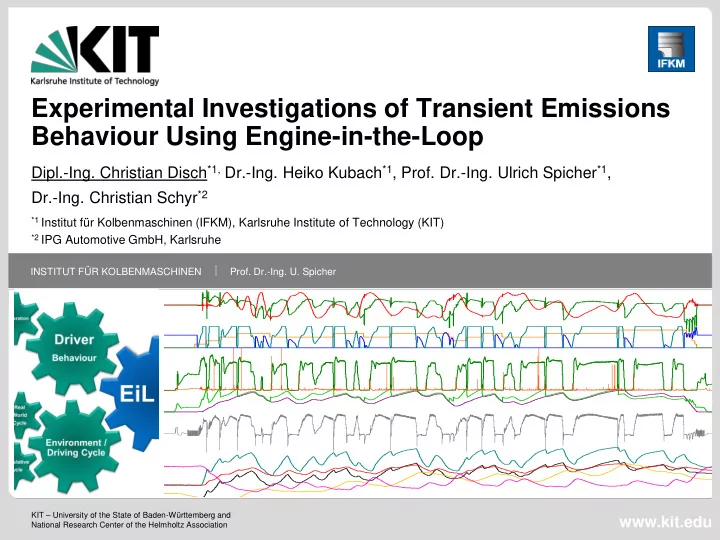
Experimental Investigations of Transient Emissions Behaviour Using Engine-in-the-Loop Dipl.-Ing. Christian Disch *1, Dr.-Ing. Heiko Kubach *1 , Prof. Dr.-Ing. Ulrich Spicher *1 , Dr.-Ing. Christian Schyr *2 *1 Institut fr Kolbenmaschinen (IFKM),


slide-1
SLIDE 1

KIT – University of the State of Baden-Württemberg and National Research Center of the Helmholtz Association

INSTITUT FÜR KOLBENMASCHINEN  Prof. Dr.-Ing. U. Spicher

www.kit.edu

Experimental Investigations of Transient Emissions Behaviour Using Engine-in-the-Loop

Dipl.-Ing. Christian Disch*1, Dr.-Ing. Heiko Kubach*1, Prof. Dr.-Ing. Ulrich Spicher*1, Dr.-Ing. Christian Schyr*2

*1 Institut für Kolbenmaschinen (IFKM), Karlsruhe Institute of Technology (KIT) *2 IPG Automotive GmbH, Karlsruhe

slide-2
SLIDE 2

2 20120918 Institut für Kolbenmaschinen

  • Prof. Dr.-Ing. U. Spicher

Abstract

Keywords: Engine-in-the-Loop (EiL), IFKM real world driving cycle, engine transient operation, raw emissions, fast response gas analyser, tip-in, HC emission peaks, diesel-hybrid, e-boost, SULEV In order to fulfil growing demands of new emission legislation and customer requirements real world driving cycles become more important. Investigations, especially under highly dynamic engine operation conditions have shown that the level of raw emissions could reach levels far greater than those under steady-state operation. Current legislative driving cycles like the NEDC do not have high proportions of transient operation. This finally leads to comparatively big differences in fuel consumption and raw emissions between legislative and real world driving cycles. Investigations to improve the combustion process under highly transient engine operation conditions using a real vehicle on public roads do not offer the required reproducibility due to ever changing traffic situations and other ambient conditions. Therefore the approach to use the internal combustion engine operated in a simulated environment is a promising technique, especially when stationary installed high-end testing equipment is indispensable to measure very detailed

  • improvements. The simulation of the demonstrated Engine-in-the-Loop (EiL) method contains the vehicle-, track-, and the

driver behaviour model. In this research project different newly defined IFKM driving cycles with a larger proportion of transient engine operation have been used to evaluate the level of CO, CO2, NO and HC emissions of a diesel engine operated virtually in a C-class

  • vehicle. The potential of combining an Engine-in-the-Loop test bench with fast emission measurement techniques is

exemplarily shown for an approach to reduce identified HC emission peaks during a tip-in situation. The improvement is finally demonstrated by using an additional virtual e-boost functionality like in a diesel-hybrid vehicle architecture. It is shown that the diesel-hybrid concept could be an opportunity not only for an improvement in fuel consumption but also be a part of a global vehicle emission-optimized operating strategy. Current developments in reducing diesel engine raw emissions are focusing on PM and NOx but future legislative restrictions like in the US SULEV LEVIII also require improvements for HCs. In conclusion the project demonstrates the possibility to identify elementary events causing transient emissions onset within a real world driving cycle. The aim is to show the potential of the EiL method in combination with fast response gas analyser for investigation and improvement of HC emission peaks with regard to reproducibility and level of detail.

Dipl.-Ing. Christian Disch - Engine-in-the-Loop “apply & innovate“ 2012 │ IPG Technology Conference │September 18-19 │Karlsruhe │Germany

slide-3
SLIDE 3

3 20120918 Institut für Kolbenmaschinen

  • Prof. Dr.-Ing. U. Spicher

Outline

Dipl.-Ing. Christian Disch - Engine-in-the-Loop “apply & innovate“ 2012 │ IPG Technology Conference │September 18-19 │Karlsruhe │Germany

Introduction EiL Measurement Setup Testruns and Results Conclusion and Outlook Live-Demo KIT

slide-4
SLIDE 4

4 20120918 Institut für Kolbenmaschinen

  • Prof. Dr.-Ing. U. Spicher

Introduction 1/2

Engine-in-the-Loop (EiL)

EiL

Vehicle

Environment / Driving Cycle Driver Behaviour Body Tires

Brakes

Power- train Clutch

Gearbox

Real World Cycle Legislative Cycle

Acceleration

Experimental Measurement Technique

Dipl.-Ing. Christian Disch - Engine-in-the-Loop “apply & innovate“ 2012 │ IPG Technology Conference │September 18-19 │Karlsruhe │Germany

slide-5
SLIDE 5

5 20120918 Institut für Kolbenmaschinen

  • Prof. Dr.-Ing. U. Spicher

Introduction 2/2

Engine-in-the-Loop (EiL)

Engine-in-the-Loop = Synergetic Effect of Experiment and Simulation Hardware Software

EiL

One

Method / Development Tool

(Engine-Level) (Vehicle-Level)

Keywords

Virtual test driving Legislative driving cycles Real world driving cycles Driver behaviour Detailed investigations with highest reproducibility Traffic conditions Ambient conditions Onboard diagnostics vs. additional high-end measurement equipment Efficient ECU calibration (transient operation) Combustion process Fuel consumption Raw emissions Driveability Flexibility in powertrain architecture (virtual and experimental) Global vehicle performance Electrification/ HEV Frontloading & Simultaneous engineering

EiL = Only possibility to investigate transient emissions behaviour in detail under real world operating conditions

Dipl.-Ing. Christian Disch - Engine-in-the-Loop “apply & innovate“ 2012 │ IPG Technology Conference │September 18-19 │Karlsruhe │Germany

Two Approaches

slide-6
SLIDE 6

6 20120918 Institut für Kolbenmaschinen

  • Prof. Dr.-Ing. U. Spicher

Measurement and Test Bench Setup

Research Topics – EiL Test Bench IFKM

Example of use in presentation: Detailed investigations of diesel engine transient emissions behaviour Possibility for improvement of HC emission peaks using a virtual diesel-hybrid powertrain

Combustion Process Transient Emissions Behaviour Real World Driving Cycles

Dipl.-Ing. Christian Disch - Engine-in-the-Loop “apply & innovate“ 2012 │ IPG Technology Conference │September 18-19 │Karlsruhe │Germany

Global Vehicle Performance

slide-7
SLIDE 7

7 20120918 Institut für Kolbenmaschinen

  • Prof. Dr.-Ing. U. Spicher

Measurement and Test Bench Setup

EiL Test Bench Setup

CLD500 emissions after catalyst real clutch (for real start) Fast Response Gas Analyser (FRGA) Cambustion NDIR500

AVL InMotion

powered by IPG CarMaker AVL Puma Open

AVL EMCON

CONTROLLER

AVL - APA 304/8

330 kW 8000 rpm 1400 Nm Inertia: 1,9 kg m2

Non-Dispersive Infra Red Carbon Monoxide CO Carbon Dioxide CO2

Real Time Node

Chemiluminescence Detector →Nitrogene Monoxide NO

Cambustion HFR500 (FID)

Flame Ionization Detector Total Hydrocarbons THC

raw emissions (after turbine) fan

1:1

4-cylinder diesel engine simulated gearbox

Response T90-10% ~2ms

Response T90-10% ~0.9ms Response T90-10% ~8ms Dipl.-Ing. Christian Disch - Engine-in-the-Loop “apply & innovate“ 2012 │ IPG Technology Conference │September 18-19 │Karlsruhe │Germany

Cambustion CLD500

Chemiluminescence Detector Nitrogene Monoxide NO Response T90-10% ~2ms

dyno

slide-8
SLIDE 8

8 20120918 Institut für Kolbenmaschinen

  • Prof. Dr.-Ing. U. Spicher

Increasing ecological and economical awareness of customers New legislative driving cycles (e.g. WHDC, US- SULEV LEVIII)

Testruns and Results

Real World Driving Cycle vs. Legislative Driving Cycle

100 200 300 400 500 600 700 800 900 1000 1100 1200 Time [s] Car.v [km/h]
  • 10
10 20 30 40 50 60 70 80 90 100 110 120 130

Necessity for investigations of real world driving cycles

Source: Spicher, MTZ 02/2012 Real fuel consumption [l/100km] Fuel consumption in NEDC [l/100km] Fuel consumption in NEDC [l/100km] Real fuel consumption [l/100km]

Certified fuel consumption vs. Real world fuel consumption

Gasoline Diesel

Vehicle speed [km/h ] Time [s]

NEDC

Dipl.-Ing. Christian Disch - Engine-in-the-Loop “apply & innovate“ 2012 │ IPG Technology Conference │September 18-19 │Karlsruhe │Germany

slide-9
SLIDE 9

9 20120918 Institut für Kolbenmaschinen

  • Prof. Dr.-Ing. U. Spicher

Testruns and Results

Definition of Real World Driving Cycles

IFKM - „High Load“ IFKM - „Part Load“

Start/Finish

Start/Finish

Possibility to compare vehicle through real and virtual test driving

Source: Google maps Bad Herrenalb

Dobel

Rotensol

Bad Herrenalb

Distance: 12.5 km

Source: Google maps

KIT- IFKM (Rintheimer Querallee) ↓ Right Theodor-Heuss- Allee ↓ Left L604 ↓ Right B36 ↓ Right L559 ↓ Right L560 ↓ Right Hirtenweg ↓ KIT- IFKM (Rintheimer Querallee)

Distance: 23.3km Dipl.-Ing. Christian Disch - Engine-in-the-Loop “apply & innovate“ 2012 │ IPG Technology Conference │September 18-19 │Karlsruhe │Germany

slide-10
SLIDE 10

10 20120918 Institut für Kolbenmaschinen

  • Prof. Dr.-Ing. U. Spicher

100 200 300 400 500 600 700 800 900 1000 1100 1200 1300 1400 1500 Time [s] Car.v [km/h] 20 40 60 80 100 120 140

Testruns and Results

Comparison of Different Driving Cycles

NEDC IFKM - „High Load“ IFKM - „Part Load“

Vehicle speed [km/h ] Time [s]

Dipl.-Ing. Christian Disch - Engine-in-the-Loop “apply & innovate“ 2012 │ IPG Technology Conference │September 18-19 │Karlsruhe │Germany

slide-11
SLIDE 11

11 20120918 Institut für Kolbenmaschinen

  • Prof. Dr.-Ing. U. Spicher

Testruns and Results

Engine Map - Requirements

NEDC IFKM - „Part Load“ IFKM - „High Load“ ADAC Highway Cycle

Different driving cycles → Different engine map requirements (Legislative vs. Real World Driving Cycles)

Dipl.-Ing. Christian Disch - Engine-in-the-Loop “apply & innovate“ 2012 │ IPG Technology Conference │September 18-19 │Karlsruhe │Germany

slide-12
SLIDE 12

12 20120918 Institut für Kolbenmaschinen

  • Prof. Dr.-Ing. U. Spicher

50 100 150 200 250 300 350 400 450 500 Time [s] Alpha [-] 1 Brake [-] 1 Gear No [-] 6 Car ax [m/s^2]

  • 10

10 CO2 [%] 20 CO [%] 3 HC [ppm] 1000 2000 NO [ppm] 2000

Testruns and Results

IFKM - „High Load“ (Raw Emissions (after Turbine))

Dipl.-Ing. Christian Disch - Engine-in-the-Loop “apply & innovate“ 2012 │ IPG Technology Conference │September 18-19 │Karlsruhe │Germany

Measurement Simulation

slide-13
SLIDE 13

13 20120918 Institut für Kolbenmaschinen

  • Prof. Dr.-Ing. U. Spicher

50 100 150 200 250 300 350 400 450 500 Time [s] Alpha [-] 1 Brake [-] 1 Gear No [-] 6 Car ax [m/s^2]

  • 10

10 CO2 [%] 20 CO [%] 3 HC [ppm] 1000 2000 NO [ppm] 2000

Testruns and Results

IFKM - „High Load“ (Raw Emissions (after Turbine))

Event 1 Event 2 Event 3 Event 4 Event 5 Event 6

Dipl.-Ing. Christian Disch - Engine-in-the-Loop “apply & innovate“ 2012 │ IPG Technology Conference │September 18-19 │Karlsruhe │Germany

slide-14
SLIDE 14

14 20120918 Institut für Kolbenmaschinen

  • Prof. Dr.-Ing. U. Spicher

Today: Focus for diesel engine on PM and NOx Future: Due to new legislative driving cycles (e.g. SULEV LEV-III) PM, NOx and HC

476,5 477,0 477,5 478,0 478,5 479,0 479,5 Time [s] Alpha [-] 0,0 0,2 0,4 0,6 0,8 1,0 HC [ppm] 400 800 1200 1600 2000 Gear No [-] 1 2 4 5 6 Clutch [-] 0,0 0,2 0,4 0,6 0,8 1,0 434,3 434,8 435,3 435,8 436,3 436,8 437,3 Time [s] Alpha [-] 0,0 0,2 0,4 0,6 0,8 1,0 HC [ppm] 400 800 1200 1600 2000 Gear No [-] 1 2 4 5 6 Clutch [-] 0,0 0,2 0,4 0,6 0,8 1,0 325,4 325,9 326,4 326,9 327,4 327,9 328,4 Time [s] Alpha [-] 0,0 0,2 0,4 0,6 0,8 1,0 HC [ppm] 400 800 1200 1600 2000 Gear No [-] 1 2 4 5 6 Clutch [-] 0,0 0,2 0,4 0,6 0,8 1,0 295,7 296,2 296,7 297,2 297,7 298,2 298,7 Time [s] Alpha [-] 0,0 0,2 0,4 0,6 0,8 1,0 HC [ppm] 400 800 1200 1600 2000 Gear No [-] 1 2 4 5 6 Clutch [-] 0,0 0,2 0,4 0,6 0,8 1,0 190,8 191,3 191,8 192,3 192,8 193,3 193,8 Time [s] Alpha [-] 0,0 0,2 0,4 0,6 0,8 1,0 HC [ppm] 400 800 1200 1600 2000 Gear No [-] 1 2 4 5 6 Clutch [-] 0,0 0,2 0,4 0,6 0,8 1,0 70,6 71,1 71,6 72,1 72,6 73,1 73,6 Time [s] Alpha [-] 0,0 0,2 0,4 0,6 0,8 1,0 HC [ppm] 400 800 1200 1600 2000 Gear No [-] 1 2 4 5 6 Clutch [-] 0,0 0,2 0,4 0,6 0,8 1,0

Testruns and Results

Identification of HC Emission Peaks

Event 1 Event 2 Event 3 Event 4 Event 5 Event 6

AVL 483 MicroSoot Sensor

HC-emissions during/after tip-in

Alpha [-] PM [mg/m3]

Example for PM during tip-in

testrun 1 testrun 2 testrun 3 testrun 4 average

Dipl.-Ing. Christian Disch - Engine-in-the-Loop “apply & innovate“ 2012 │ IPG Technology Conference │September 18-19 │Karlsruhe │Germany

Time [s] Time [s]

slide-15
SLIDE 15

15 20120918 Institut für Kolbenmaschinen

  • Prof. Dr.-Ing. U. Spicher

Testruns and Results

Identification of HC Emission Peaks

70,6 70,8 71,0 71,2 71,4 71,6 71,8 72,0 72,2 72,4 72,6 72,8 73,0 73,2 73,4 73,6 Time [s] Alpha [-] 0,0 0,2 0,4 0,6 0,8 1,0 HC [ ppm ] 300 600 900 1200 1500 Gear No [-] 1 2 4 5 6 Clutch [-] 0,0 0,2 0,4 0,6 0,8 1,0 1 9 , 8 1 9 1 , 1 9 1 , 2 1 9 1 , 4 1 9 1 , 6 1 9 1 , 8 1 9 2 , 1 9 2 , 2 1 9 2 , 4 1 9 2 , 6 1 9 2 , 8 1 9 3 , 1 9 3 , 2 1 9 3 , 4 1 9 3 , 6 1 9 3 , 8 Time [s] Alpha [-] 0,0 0,2 0,4 0,6 0,8 1,0 HC [ ppm ] 300 600 900 1200 1500 Gear No [-] 1 2 4 5 6 Clutch [-] 0,0 0,2 0,4 0,6 0,8 1,0 2 9 5 , 7 2 9 5 , 9 2 9 6 , 1 2 9 6 , 3 2 9 6 , 5 2 9 6 , 7 2 9 6 , 9 2 9 7 , 1 2 9 7 , 3 2 9 7 , 5 2 9 7 , 7 2 9 7 , 9 2 9 8 , 1 2 9 8 , 3 2 9 8 , 5 2 9 8 , 7 Time [s] Alpha [-] 0,0 0,2 0,4 0,6 0,8 1,0 HC [ ppm ] 300 600 900 1200 1500 Gear No [-] 1 2 4 5 6 Clutch [-] 0,0 0,2 0,4 0,6 0,8 1,0 3 2 5 , 4 3 2 5 , 6 3 2 5 , 8 3 2 6 , 3 2 6 , 2 3 2 6 , 4 3 2 6 , 6 3 2 6 , 8 3 2 7 , 3 2 7 , 2 3 2 7 , 4 3 2 7 , 6 3 2 7 , 8 3 2 8 , 3 2 8 , 2 3 2 8 , 4 Time [s] Alpha [-] 0,0 0,2 0,4 0,6 0,8 1,0 HC [ ppm ] 300 600 900 1200 1500 Gear No [-] 1 2 4 5 6 Clutch [-] 0,0 0,2 0,4 0,6 0,8 1,0 4 7 6 , 6 4 7 6 , 8 4 7 7 , 4 7 7 , 2 4 7 7 , 4 4 7 7 , 6 4 7 7 , 8 4 7 8 , 4 7 8 , 2 4 7 8 , 4 4 7 8 , 6 4 7 8 , 8 4 7 9 , 4 7 9 , 2 4 7 9 , 4 4 7 9 , 6 Time [s] Alpha [-] 0,0 0,2 0,4 0,6 0,8 1,0 HC [ ppm ] 300 600 900 1200 1500 Gear No [-] 1 2 4 5 6 Clutch [-] 0,0 0,2 0,4 0,6 0,8 1,0 4 3 4 , 3 4 3 4 , 5 4 3 4 , 7 4 3 4 , 9 4 3 5 , 1 4 3 5 , 3 4 3 5 , 5 4 3 5 , 7 4 3 5 , 9 4 3 6 , 1 4 3 6 , 3 4 3 6 , 5 4 3 6 , 7 4 3 6 , 9 4 3 7 , 1 4 3 7 , 3 Time [s] Alpha [-] 0,0 0,2 0,4 0,6 0,8 1,0 HC [ ppm ] 300 600 900 1200 1500 Gear No [-] 1 2 4 5 6 Clutch [-] 0,0 0,2 0,4 0,6 0,8 1,0

Event 1 Event 2 Event 3 Event 4 Event 5 Event 6

Today: Focus for diesel engine on PM and NOx Future: Due to new legislative driving cycles (e.g. SULEV LEV-III) PM, NOx and HC

HC-emissions during/after tip-in

Dipl.-Ing. Christian Disch - Engine-in-the-Loop “apply & innovate“ 2012 │ IPG Technology Conference │September 18-19 │Karlsruhe │Germany AVL 483 MicroSoot Sensor

Time [s] Alpha [-] PM [mg/m3]

Example for PM during tip-in

testrun 1 testrun 2 testrun 3 testrun 4 average

Time [s]

70,6 71,1 71,6 72,1 72,6 73,1 73,6 Time [s] Alpha [-] 0,0 0,2 0,4 0,6 0,8 1,0 HC [ppm] 400 800 1200 1600 2000 Gear No [-] 1 2 4 5 6 Clutch [-] 0,0 0,2 0,4 0,6 0,8 1,0

slide-16
SLIDE 16

16 20120918 Institut für Kolbenmaschinen

  • Prof. Dr.-Ing. U. Spicher

Testruns and Results

Sensitivity of Pedal Movement 𝜷 and Engine Speed

rpmconst.= 2200 rpmconst.= 1200

Higher engine speed and higher pedal movement 𝜷

enables higher HC emission peaks during tip-in

Δt Alpha 0→100% = 0.5 s Δt Alpha 0→100% = 1.0 s Δt Alpha 0→100% = 2.0 s Δt Alpha 0→100% = 5.0 s Δt Alpha 0→100% = 0.5 s Δt Alpha 0→100% = 1.0 s Δt Alpha 0→100% = 2.0 s Δt Alpha 0→100% = 5.0 s

trailing throttle rpm decrease pedal movement 𝜷 decrease

92,4 92,6 92,8 93,0 93,2 93,4 93,6 93,8 94,0 94,2 Time [s] 0,0 0,1 0,2 0,3 0,4 0,5 0,6 0,7 0,8 0,9 1,0 100 200 300 400 500 600 700 800 900 1000 152,4 152,6 152,8 153,0 153,2 153,4 153,6 153,8 154,0 154,2 Time [s] 0,0 0,1 0,2 0,3 0,4 0,5 0,6 0,7 0,8 0,9 1,0 100 200 300 400 500 600 700 800 900 1000 122,0 122,2 122,4 122,6 122,8 123,0 123,2 123,4 123,6 123,8 Time [s] 0,0 0,1 0,2 0,3 0,4 0,5 0,6 0,7 0,8 0,9 1,0 100 200 300 400 500 600 700 800 900 1000 183,8 184,0 184,2 184,4 184,6 184,8 185,0 185,2 185,4 185,6 Time [s] 0,0 0,1 0,2 0,3 0,4 0,5 0,6 0,7 0,8 0,9 1,0 100 200 300 400 500 600 700 800 900 1000 254,0 254,5 255,0 255,5 256,0 256,5 257,0 257,5 258,0 258,5 Time [s] 0,0 0,1 0,2 0,3 0,4 0,5 0,6 0,7 0,8 0,9 1,0 100 200 300 400 500 600 700 800 900 1000 216,5 217,0 217,5 218,0 218,5 219,0 219,5 220,0 220,5 221,0 Time [s] 0,0 0,1 0,2 0,3 0,4 0,5 0,6 0,7 0,8 0,9 1,0 100 200 300 400 500 600 700 800 900 1000 63,4 63,6 63,8 64,0 64,2 64,4 64,6 64,8 65,0 65,2 Time [s] Alpha [-] 0,0 0,1 0,2 0,3 0,4 0,5 0,6 0,7 0,8 0,9 1,0 HC [ ppm ] 100 200 300 400 500 600 700 800 900 1000 63,4 63,6 63,8 64,0 64,2 64,4 64,6 64,8 65,0 65,2 Time [s] Alpha [-] 0,0 0,1 0,2 0,3 0,4 0,5 0,6 0,7 0,8 0,9 1,0 HC [ ppm ] 100 200 300 400 500 600 700 800 900 1000

Dipl.-Ing. Christian Disch - Engine-in-the-Loop “apply & innovate“ 2012 │ IPG Technology Conference │September 18-19 │Karlsruhe │Germany

slide-17
SLIDE 17

17 20120918 Institut für Kolbenmaschinen

  • Prof. Dr.-Ing. U. Spicher

Testruns and Results

Diesel-Hybrid for Reduction of HC Emission Peaks during Tip-in

Vehicle data C-class Validated with real vehicle data Electric motor data 160 Nm 20 kW Internal combustion engine 4-cylinder engine Turbocharged diesel engine Production status

Software Hardware

Dipl.-Ing. Christian Disch - Engine-in-the-Loop “apply & innovate“ 2012 │ IPG Technology Conference │September 18-19 │Karlsruhe │Germany

Time [s] Alpha [-]

ICE EM

Real ICE Hybrid Alpha

Engine torque

CarMaker for Simulink

slide-18
SLIDE 18

18 20120918 Institut für Kolbenmaschinen

  • Prof. Dr.-Ing. U. Spicher

Testruns and Results

Tip-in Test Run Definition

10 20 30 40 50 60 70 80 90 100 110 120 130 140 150 160 Time [s] Vehicle speed [km/h] 60 120 VC.Gas 0,0 0,5 1,0 CO_2 [%] 10 20 CO [%] 0,0 0,3 0,6 NO [ ppm ] 600 HC [ ppm ] 600

Modified Tip-in 1 Modified Tip-in 2 Basic Tip-in 3

Hybrid Alpha

Dipl.-Ing. Christian Disch - Engine-in-the-Loop “apply & innovate“ 2012 │ IPG Technology Conference │September 18-19 │Karlsruhe │Germany

slide-19
SLIDE 19

19 20120918 Institut für Kolbenmaschinen

  • Prof. Dr.-Ing. U. Spicher

Testruns and Results

Linear vs. Non-Linear Pedal Movement 𝛽

HC emissions [ppm] Alpha [-]

ttip-in = 1 s

Time [s] Time [s]

HCAverage_max ≈ 750 ppm Identification:

Pedal movement 𝛽 and trailing throttle rpm before tip-in

Explanation:

Fast changes in mixture formation

Challenge

(trade-off):

Driveability vs. Emissions

Improvement:

New definition of pedal movement (Hybrid Alpha)

Result:

Significant reduction of HCs during tip-in

testrun 1 testrun 2 testrun 3 testrun 4 average testrun 1 testrun 2 testrun 3 testrun 4 average Dipl.-Ing. Christian Disch - Engine-in-the-Loop “apply & innovate“ 2012 │ IPG Technology Conference │September 18-19 │Karlsruhe │Germany

slide-20
SLIDE 20

20 20120918 Institut für Kolbenmaschinen

  • Prof. Dr.-Ing. U. Spicher

Testruns and Results

Linear vs. Non-Linear Pedal Movement 𝛽

Data-Logging-Frequency = 1kHz

average result (five testruns)

absolute HC emission peaks can be reduced up to 80% !

Dipl.-Ing. Christian Disch - Engine-in-the-Loop “apply & innovate“ 2012 │ IPG Technology Conference │September 18-19 │Karlsruhe │Germany

HC emissions [ppm] Time [s] HC emissions [ppm] Time [s] HCAverage_max ≈ 750 ppm

testrun 1 testrun 2 testrun 3 testrun 4 average

Basic (linear)

Hybrid Alpha [-] Time [s]

→ 𝒈 𝒚 = 𝒚𝟓 → 𝒈 𝒚 = 𝒚𝟕 → 𝒈 𝒚 = 𝒚𝟐𝟏 Basic (linear) → 𝒈 𝒚 = 𝒚𝟓 → 𝒈 𝒚 = 𝒚𝟕 → 𝒈 𝒚 = 𝒚𝟐𝟏

slide-21
SLIDE 21

21 20120918 Institut für Kolbenmaschinen

  • Prof. Dr.-Ing. U. Spicher

Testruns and Results

Linear vs. Non-Linear Pedal Movement 𝛽

Hybrid Alpha [-] Time [s] HC emissions [ppm] Time [s] Detailed modifications of the simulated pedal movement 𝛽 (hybrid alpha) are temporarily of interest for <0.4 sec. Basic

High reproducibility!

Differences between real alpha and emission-optimized hybrid alpha are only necessary up to 38% (acc. pedal position)

testrun 1 testrun 2 testrun 3 testrun 4 testrun 5 average

(𝒈 𝒚 = 𝒚𝟐𝟏 )

→ 𝒈 𝒚 = 𝒚𝟓 → 𝒈 𝒚 = 𝒚𝟕 → 𝒈 𝒚 = 𝒚𝟐𝟏 ttip-in = 1 s

Very detailed modification of pedal movement 𝛽 (injection quantity) → significant impact on HC emission peaks

Dipl.-Ing. Christian Disch - Engine-in-the-Loop “apply & innovate“ 2012 │ IPG Technology Conference │September 18-19 │Karlsruhe │Germany

slide-22
SLIDE 22

22 20120918 Institut für Kolbenmaschinen

  • Prof. Dr.-Ing. U. Spicher

Testruns and Results

Comparison of Tip-in 3 and Tip-in 1

68 69 70 71 72 73 74 75 76 77 78 79 80 Time [s] Hybrid Alpha [-] 0,0 0,1 0,2 0,3 0,4 0,5 0,6 0,7 0,8 0,9 1,0 HC [ ppm ] 200 400 600 800 1000 1200 1400 1600 1800 2000 CO [%] 0,00 0,02 0,04 0,06 0,08 0,10 0,12 0,14 0,16 0,18 0,20 NO [ ppm ] 100 200 300 400 500 600 700 800 900 1000 122 123 124 125 126 127 128 129 130 131 132 133 134 Time [s] Hybrid Alpha [-] 0,0 0,1 0,2 0,3 0,4 0,5 0,6 0,7 0,8 0,9 1,0 HC [ ppm ] 200 400 600 800 1000 1200 1400 1600 1800 2000 CO [%] 0,00 0,02 0,04 0,06 0,08 0,10 0,12 0,14 0,16 0,18 0,20 NO [ ppm ] 100 200 300 400 500 600 700 800 900 1000

Tip-in 3 Basic Best modification Tip-in 1

The lower engine torque during the tip-in is finally compensated by the electric motor

Dipl.-Ing. Christian Disch - Engine-in-the-Loop “apply & innovate“ 2012 │ IPG Technology Conference │September 18-19 │Karlsruhe │Germany

slide-23
SLIDE 23

23 20120918 Institut für Kolbenmaschinen

  • Prof. Dr.-Ing. U. Spicher

Conclusion and Outlook

Engine-in-the-Loop

Real world driving cycles will become more important due to customer demands and legislative restrictions for emissions (e.g. SULEV, WHDC) increasing customer demands → focus: fuel consumption new emissions legislations for certification → focus: raw emissions The increasing complexity of new global vehicle architectures require R&D tools able to deal with all different subsystems involved in the process → EiL The EiL-approach enables detailed experimental investigations of the engine performance in a virtual environment The combination of EiL-test bench and fast response gas analysers is the only way to study the detailed emissions behaviour in high dynamic engine operation during real world driving cycles The capability of the EiL-method is exemplarily demonstrated by an virtual diesel-hybrid concept to improve the HC emission peaks during a tip-in manoeuvre Addtional research work using EiL in combination with optical measurement technique and fast response gas analysers is in progress

Dipl.-Ing. Christian Disch - Engine-in-the-Loop “apply & innovate“ 2012 │ IPG Technology Conference │September 18-19 │Karlsruhe │Germany

slide-24
SLIDE 24

24 20120918 Institut für Kolbenmaschinen

  • Prof. Dr.-Ing. U. Spicher

Conclusion and Outlook

Engine-in-the-Loop

Virtual test driving Identification Detailed modification Validation

Real vehicle data Real driver data Real world driving cycles High reproducibility High sensitivity High repeatabliity

Dipl.-Ing. Christian Disch - Engine-in-the-Loop “apply & innovate“ 2012 │ IPG Technology Conference │September 18-19 │Karlsruhe │Germany

slide-25
SLIDE 25

25 20120918 Institut für Kolbenmaschinen

  • Prof. Dr.-Ing. U. Spicher

Live-Demo – KIT „Campus Ost“

X-in-the-Loop-Tour

Building 70.14

Performance and Emissions Assessments Using Engine-in-the-Loop

Contact: Dipl.-Ing. Christian Disch 0721 608 48560 Christian.Disch@kit.edu

Dipl.-Ing. Christian Disch - Engine-in-the-Loop “apply & innovate“ 2012 │ IPG Technology Conference │September 18-19 │Karlsruhe │Germany