Experiences with the beam-beam effect at HERA mm Georg - - PowerPoint PPT Presentation

experiences with the beam beam effect at hera
SMART_READER_LITE
LIVE PREVIEW

Experiences with the beam-beam effect at HERA mm Georg - - PowerPoint PPT Presentation

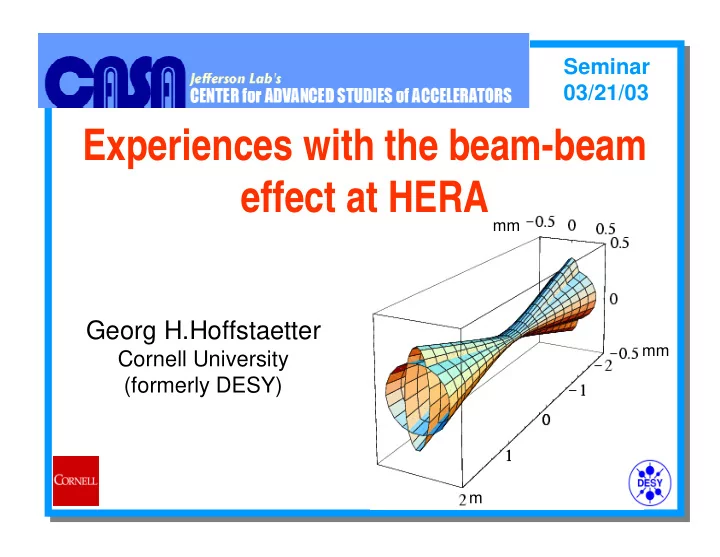
Seminar 03/21/03 Experiences with the beam-beam effect at HERA mm Georg H.Hoffstaetter mm Cornell University (formerly DESY) m Georg.Hoffstaetter@DESY.de HERA and its Pre-Accelerators Protons Electrons 20 keV Source Source 150 keV


slide-1
SLIDE 1

Georg.Hoffstaetter@DESY.de

Experiences with the beam-beam effect at HERA

Georg H.Hoffstaetter

Cornell University (formerly DESY) Seminar 03/21/03

m mm mm
slide-2
SLIDE 2

Georg.Hoffstaetter@DESY.de

HERA and its Pre-Accelerators

H1 ZEUS HERMES HERA-B

HERA

PETRA

778 m

6336 m long

DESY

Polarized Electrons Protons

  • Protons Electrons

20 keV Source Source 150 keV 750 keV RFQ Linac II 450 MeV 50 MeV Linac III Pia 450 MeV 8 GeV DESY III DESY II 7 GeV 40 GeV PETRA PETRA 12 GeV 920 GeV HERA-p HERA-e 27.5 GeV

slide-3
SLIDE 3

Georg.Hoffstaetter@DESY.de

ZEUS

HER A

H1 (318 GeV) HERA-B (42 GeV) HERMES (7 GeV)

PETR A

HERA under Hamburg

slide-4
SLIDE 4

Georg.Hoffstaetter@DESY.de

Superconducting HERA-p + HERA-e

slide-5
SLIDE 5

Georg.Hoffstaetter@DESY.de

Performance of HERA

  • Design luminosity had been surpassed
  • Then an Upgrade was needed

Georg.Hoffstaetter@DESY.de

  • Beam separation by super-conducting

magnets in the detectors

  • Focusing to ¼ of the old beam

cross-section

slide-6
SLIDE 6

Georg.Hoffstaetter@DESY.de

Absolute H1 Luminosity 0.00E+00 1.00E+31 2.00E+31 3.00E+31 4.00E+31 5.00E+31 6.00E+31 7.00E+31 8.00E+31 5000 10000 Ipb / mA x Ie / mA Luminosity/cm -2sec -1 Feb03 Run Oct02 Studies Design Y2002 Goal Feb03 Studies

Luminosity Studies Luminosity Studies

H1 February 03 Extrapolated Luminosity vs Bunch Currents

0.00E+00 1.00E+31 2.00E+31 3.00E+31 4.00E+31 5.00E+31 6.00E+31 7.00E+31 8.00E+31 0.05 0.1 0.15 0.2 0.25 Ieb / mA x Ipb / mA L / cm-2sec-1 Feb2003 Y2002 Goal Design Y2002 Studies Series5 Feb 03 Studies

Specific Luminosity vs Proton Intensity

0.00E+00 5.00E+29 1.00E+30 1.50E+30 2.00E+30 2.50E+30 3.00E+30 0.1 0.2 0.3 0.4 0.5 0.6 0.7 0.8 Ipb / mA Lsp/cm-2sec-1mA -2

Feb-03 Y2002 Goal design Y2002 Studies Feb03 Studies

120 Bunches Ip < 70 mA Ie < 35 mA Lpeak<2.7 x 1031 cm-

2s-1

120 Bunches 120 Bunches I Ip

p < 70

< 70 mA mA I Ie

e < 35

< 35 mA mA L Lpeak

peak<2.7 x 10

<2.7 x 1031

31 cm

cm-

  • 2

2s

s-

  • 1

1

(Courtesy F. Willeke)

Specific Luminosity (1/cm2/s/mA2)

Proton bunch current (mA)

L (1/cm2/s) Luminosity extrapolation Luminosity (1/cm2/s)

Ipb X Ieb (mA2) Ipb X Ie(mA2)

slide-7
SLIDE 7

Georg.Hoffstaetter@DESY.de

HERA III

Polarized protons in HERA e-A in HERA

  • Deuteron acceleration:

with same Linac

  • Ion Acceleration requires:
  • a new Linac
  • high energy e-cooling
  • Luminosity:

A A p A

L L

1 31 1

10 7 ⋅ ⋅ = ⋅ =

  • Polarimeters
  • Flattening Snakes
  • Spin rotators
  • At least 4 Siberian Snakes

Georg.Hoffstaetter@DESY.de

slide-8
SLIDE 8

Georg.Hoffstaetter@DESY.de

Parameters

slide-9
SLIDE 9

Georg.Hoffstaetter@DESY.de

Early experiences

p beam p beam p beam e e e beam p e

h 5 . = τ h 10 = τ h 100 = τ h 50 = τ

  • Beam sizes have to be matched

to let the proton lifetime be long.

  • Beams have to meet head on to

about 0.1 sigma to avoid bad electron lifetime.

  • Proton and electron tunes have to

be controlled to about 0.002.

  • Tunes chosen to avoid resonances

Qx=0.293 Qy=0.297

  • Crossing angles were avoided.
slide-10
SLIDE 10

Georg.Hoffstaetter@DESY.de

p lifetime drops with e current

Electron bunch current (A) Proton lifetime (h)

slide-11
SLIDE 11

Georg.Hoffstaetter@DESY.de

Ls is independent of e-current

Luminosity for different e currents

Ls (1/cm2/s2/mA2)

time (min)

slide-12
SLIDE 12

Georg.Hoffstaetter@DESY.de

Higher p halo production for higher Ie

Accumulated halo Newly produced halo

Tail scraping at HERA-B t(s) p bunch number p bunch number

HERA-B rates HERA-B rates HERA-B rates

slide-13
SLIDE 13

Georg.Hoffstaetter@DESY.de

Beam-Beam Force on e

No reduction of Ls by the second experiment No reduction of Ls by a larger -funktionen Ls

Ipp

b

So far no reduction of Ls by the bunch current

slide-14
SLIDE 14

Georg.Hoffstaetter@DESY.de

l The Luminosity was initially too small:

Lumiscan

The evaluation of lumi scans

) 60 ( °

s

L ) 60 ( °

s

L ) 72 ( °

s

L ) 72 ( °

s

L ) (mm x ∆ ) (mm x ∆ ) (mm y ∆ ) (mm y ∆

Bunch has no product distribution:

) ( ) ( y x ρ ρ

  • coupling

) 72 ( °

s

L ) 72 ( °

s

L x ∆ y ∆

l

A detailed analysis of lumi scans is

  • nly possible when the beam

beam kick is taken into account.

l

For strong beam beam forces also the changing during the ramp has to be considered.

slide-15
SLIDE 15

Georg.Hoffstaetter@DESY.de

Self Polarization of the Electron Beam

Each 1010-th photon flips the spin of the electron In HERA every 38.5 minutes In HERA every 16.2 hours Ideal ring: equilibrium polarization 92.38% HERA: routine operation with 60-65% polarization

slide-16
SLIDE 16

Georg.Hoffstaetter@DESY.de

First longitudinal lepton polarization

27.5 GeV 70% 1994 HERA 47 GeV 57% 1993 LEP 16.5 GeV 70% 1982 PETRA 5.0 GeV 80% 1983 DORIS 5.0 GeV 30% 1883 CESR 5.0 GeV 60% 1982 VEPP-4 3.7 GeV 90% 1975 SPEAR 2.0 GeV 80% 1976 VEPP-3 0.65 GeV 90% 1974 VEPP-2M 0.53 GeV 90% 1070 ACO 0.65 GeV 80% 1970 VEPP (longitudinal)

slide-17
SLIDE 17

Georg.Hoffstaetter@DESY.de

L

  • n

g i t u d i n a l E l e c t r

  • n

P

  • l

a r i z a t i

  • n

20 40 60 80

transverse polarization [%] longitudinal polarization [%]

0.5 1 1.5 2 2.5

time [h]

slide-18
SLIDE 18
  • (courtesy M. Minty)
slide-19
SLIDE 19

Georg.Hoffstaetter@DESY.de

40% 30% 20% 10%

3 Rotator Polarization Studies with Harmonic Bumps 26.-27. February 2003

Georg.Hoffstaetter@DESY.de

51%

First polarization at H1 and Zeus

51% polarization with e/p collisions was possible with Specific luminosities close to the design:

slide-20
SLIDE 20

Georg.Hoffstaetter@DESY.de

Second e-fills have more polarization

Explanation: The first fill and the refilling procedure have increased the proton emittances and decreased the beam beam force that acts on spins.

1 2 3 5 4 6 7 8 9

Ip Ie pol

Time(days)

slide-21
SLIDE 21

Georg.Hoffstaetter@DESY.de

Explanation: Runs with more initiall lumi (that is at the time of maximum lumi in this run) have a higher beam beam force than runs with lower initial lumi, given that the initial electron current is about the same from run to run.

Runs with more lumi have less pol.

Polarization

March 1999

L

slide-22
SLIDE 22

Georg.Hoffstaetter@DESY.de

Simulation by spin/radiation tracking

Explanation: The achievable polarization is the maximum of a dens resonance structure. This makes quantitative predictions hard, but a dependence on the beam beam tune shift is clearly visible.

Georg.Hoffstaetter@DESY.de

04 . =

ey

ξ

slide-23
SLIDE 23

Georg.Hoffstaetter@DESY.de

) (m

e y

β

measured s,

L

Where are the Beam-Beam Limits?

Upgrade and Ip=140mA: emittance starts to grow

) (m

e y

β

y

Q ∆ 2

x

Q ∆ 2 ) (m

e y

β

e measured x,

ε

e measured y,

ε ) (m

e y

β ) (

, e calc y s ε

L

measured s,

L ) (

, e measured y s ε

L

slide-24
SLIDE 24

Georg.Hoffstaetter@DESY.de

Simulation of large beam beam forces

) (m

e y

β

measured s,

L ) (

, e measured y s ε

L

Measured lumi Expected lumi for measured emit. Simulation

slide-25
SLIDE 25

Georg.Hoffstaetter@DESY.de

Dipole modes of Gaussian bunches

  • Beam beam tune shift for one particle in the

beam beam field of a Gaussian bunch:

  • Shift in the dipole modes oscillation

Frequency of a Gaussian bunch:

Assumption: the bunches remain Gaussian

) ( 2

py px px ppb e e

N r ex ex σ σ σ πγ

β ξ

+

= ) ( ) (

py px px py px px ex ex

Q Σ + Σ Σ + = ∆ σ σ σ ξ

This approximation is justified for a stiff beam hitting a much less stiff beam when the first beam creates a small beam beam kick.

slide-26
SLIDE 26

Georg.Hoffstaetter@DESY.de

013 . = ∆

sim ey

ν

Simulated coherent modes

m . 4

* = ey

β 272 . 041 . = =

ey ex

ξ ξ 013 . 009 . = ∆ = ∆

m ey m ex

ν ν

px

ν

ex

ν

ey

ν

py

ν

ex ex

ξ ν −

ey ey

ξ ν − / f f x / f f x / f f x / f f x

003 . = ∆

sim ex

ν

+

Why? how ?

(From work with Jack Shi, KU)

082 . 027 . = =

ey ex

dQ dQ

slide-27
SLIDE 27

Georg.Hoffstaetter@DESY.de

Beam Beam experiments of Feb. 2003

Higher p current Lower specific luminosity Unexplained lumi change over each bunch train:

slide-28
SLIDE 28

Georg.Hoffstaetter@DESY.de

Beam Beam Tune shifts

I p ( m A ) I p ( m A )

  • ey(comp.,meas.)
  • ex(comp.,meas.)

Bunch number

slide-29
SLIDE 29

Georg.Hoffstaetter@DESY.de

Lumi Reduction by Hourglass Effect

) (cm

py

β

e p

75 . 1 ) 5 . 12 ( = = L L cm

py

β

Length 19cm: 12cm:

9 . 1 ) 5 . 12 ( = = L L cm

py

β

Luminosity ( )

32

10

20cm bunch length: 6cm 30cm

slide-30
SLIDE 30

Georg.Hoffstaetter@DESY.de

Tuneshift Change by Hourglass Effect

m

mm mm

m

px

45 . 2 = β m

py

18 . = β m

ex

63 . = β m

ey

26 . = β

Protons Electrons Horizontal: grows slower

px

β

Vertical: grows faster

py

β

py py s

ξ ν ) ( ∆

px px s

ξ ν ) ( ∆

ps

s σ /

ps

s σ /

slide-31
SLIDE 31

Georg.Hoffstaetter@DESY.de

Tune Shift with Bunch Length Effect

How will the tune shift parameters change and have these been analyzed by accelerator experiments ?

slide-32
SLIDE 32

Georg.Hoffstaetter@DESY.de

Resonances with Bunch Length Effect

How will the resonance strength change and have these been analyzed by accelerator experiments ? All large resonance strength are due to the proton bunch length