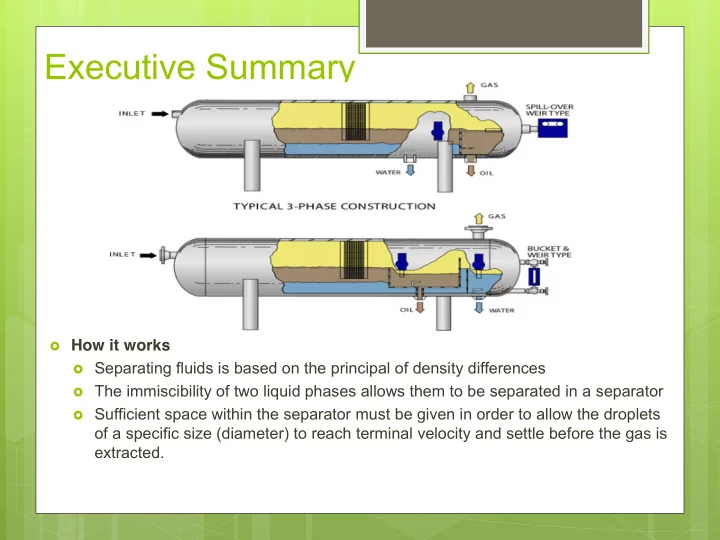
Executive Summary How it works Separating fluids is based on the - - PowerPoint PPT Presentation

executive summary
SMART_READER_LITE
LIVE PREVIEW

Executive Summary How it works Separating fluids is based on the - - PowerPoint PPT Presentation

Executive Summary How it works Separating fluids is based on the principal of density differences The immiscibility of two liquid phases allows them to be separated in a separator Sufficient space within the separator must be given


slide-1
SLIDE 1

Executive Summary

 How it works  Separating fluids is based on the principal of density differences  The immiscibility of two liquid phases allows them to be separated in a separator  Sufficient space within the separator must be given in order to allow the droplets

  • f a specific size (diameter) to reach terminal velocity and settle before the gas is

extracted.

slide-2
SLIDE 2

Advantages (vertical) Advantages (horizontal) Does not need significant liquid retention volume They are less expensive than vertical separators, though they are used for liquids with less sludge and sediments. Vertical separators are capable of handling large slugs of liquid and are therefore most often used

  • n low to intermediate

gas-oil ratio well streams Horizontal separators are ideally suited for streams having high gas-oil ratios, constant flow, and small liquid surge characteristics They are well suited for handling liquids that contain sands and other sediments Better at handling larger feed flow rate The separator occupies a small amount of plot space Due to its large interfacial areas, it has better phase separation capability

slide-3
SLIDE 3

 Sizing  Cost Estimation – Capital cost)

Cost (2011) Lower Bound ($) Upper Bound($) $ 41374.74 $24824.84 $57924.63 Abdel-Aal, H. A. (2003). Petroleum and Gas Field Processing. Marcel Dekker Inc. James H. Taylor, A. F. (n.d.). Modeling and Control of Three-Phase Gravity Separators in Oil Production Facilities. Retrieved November 10, 2012, from http://www.ece.unb.ca/jtaylor/Publications/acc07_pilot.pdf

References

slide-4
SLIDE 4

Carbon Capture Sequestration

  • Ultrafiltration for CCS
  • Hollow Fibers
slide-5
SLIDE 5

Overview of annual operating cost

  • Membrane Replacement
  • Membrane lifetime
  • Rate of replacement
  • Energy
  • Power and efficiency of pumps
  • Total flow rate

Reference

  • Wilcox.Jennifer “Carbon Capture”, New York: Springer, 2012
  • Sandeep. S, “Transient permeate flux analysis, cost estimation, and

design optimization in cross-flow membrane filtration” Department of Environmental Science and Engineering, Rice University,1997

Danny Luu Jessica Tang

slide-6
SLIDE 6

GLYCOL DEHYDRATION

by Dan Gariepy and Kristen Kolynchuk

Triethylene Glycol (TEG) Molecular Structure: Purpose:

  • removes water vapour from wet natural gas
  • water content decreases process efficiency

and can damage process equipment

  • companies have specifications on the water

content of gas they will purchase

(approx. 0.000112 kgH2O/m3gas)

Separation Mechanism:

  • an absorption column can remove water

vapour from natural gas, using TEG as the absorbent

  • TEG has high affinity for water, facilitated

by it's hydroxyl & ether groups

  • water vapour in the gas will be absorbed by

TEG as the streams are contacted

  • bubble-cap trays contact the wet natural gas

with TEG Absorption Column: Bubble-Cap Tray:

slide-7
SLIDE 7

COST ESTIMATION

References:

  • 1. Manning. Francis. S, Thompson, Richard. E. “Oilfield Processing: Natural Gas” PennWell Publishing Company, South Sheridan,

Tulsa, Oklahoma. 1991.

  • 2. Guo. Boyun, Lyons. William. C, Ghalambo. Ali, “Petroleum Production Engineering: A Computer Assisted Approach” Linacre

House, Jordan Hill, Oxford. 2007.

Column Properties

# of Trays 8 Spacing 3.625 ft Diameter 5.0 ft Height 29.0 ft Volume 569.4 ft3 Temperature 100oF Pressure 1200 psig Capacity 169.93 m3/h Circulation 25 LTEG/kgH2O TEG Price $0.09/kgTEG Duration 3840 h/year

Mass Balance:

  • amount of H2O in inlet gas was

determined using Raoult's law:

(Vapour pressures from Antoine's Equation)

  • mass of H2O removed determined

using the company specifications

  • circulation determined amount of

TEG required to remove H2O

First Year Costs[2012 dollars]

Unit Cost $136,436 Installation $272,872 Maintenance $10,593/year Labour $200,000/year TEG Flow $53,896/year

Total Cost: $673,797

slide-8
SLIDE 8

Biodiesel ¡Produc-on ¡from ¡Vegetable ¡Oil ¡

Triglyceride ¡ Methanol ¡ Glycerol ¡ Methyl ¡Esters ¡ (Biodiesel) ¡

Tubular ¡Centrifuge ¡

Light ¡Liquid= ¡Glycerol-­‑ ¡ Methanol ¡mixture ¡ Heavy ¡Liquid= ¡Biodiesel ¡

slide-9
SLIDE 9

Cos-ng ¡ ¡

BIODIESEL ¡PRODUCTION ¡ ¡ 70,000,000 ¡L/year ¡ PRODUCTION ¡PERIOD ¡ 52 ¡weeks ¡a ¡year, ¡24/7 ¡ ¡ ANTICIPATED ¡SALES ¡ $49,421,000/year ¡ CAPITAL ¡COST ¡(MOTOR+CENTRIFUGE) ¡ $2,455,000 ¡ UTILITY ¡COSTS ¡(ONLY ¡ASSOCIATED ¡WITH ¡ MOTOR) ¡ $2,428/year ¡ INLET ¡FEED ¡COMPOSITION ¡ 60.2% ¡Biodiesel, ¡39.1% ¡Methanol, ¡0.7% ¡ Glycerol ¡ EXTRA ¡READING ¡OPPORTUNITIES: ¡

  • Oh, ¡P., ¡Lik, ¡H., ¡Lau, ¡J.C., ¡Junghui, ¡C., ¡Chong, ¡M.F., ¡Choo, ¡Y.M. ¡A ¡review ¡on ¡convenSonal ¡

technologies ¡and ¡emerging ¡process ¡intensificaSon ¡(PI) ¡methods ¡for ¡biodiesel ¡

  • producSon. ¡Renewable ¡and ¡Sustainable ¡Energy ¡Reviews ¡16(2012) ¡5131-­‑5145 ¡
  • Coulson, ¡J.M., ¡Harker, ¡J.H., ¡Backhurst, ¡J.R., ¡Richardson. ¡(2002). ¡Coulson’s ¡and ¡

Richardson’s ¡Chemical ¡Engineering: ¡Par6cle ¡technology ¡and ¡separa6on ¡processes. ¡ Buberworth-­‑Heinemann ¡

slide-10
SLIDE 10

HF Alkylation – Process Overview

slide-11
SLIDE 11

HF Alkylation – Costs

Inlet

Column Condenser Kettle Reboiler

Alkylate Side draw

Separator

HF Light Oil Steam Condensate

Item Cost (C$)

Total CapEx 5,381,000 Operators 44,000 Steam 645,000 Maintenance 161,000 Electricity 93,000 Total OpEx 943,000

[1] G. Towler & R. Sinnot (2009), Chemical Engineering Design, 5th Ed., Elsevier [2] R. Meyers (2004), Handbook of Petroleum Refining Processes, 3rd Ed., McGraw-Hill

slide-12
SLIDE 12

Production of Benzene from Hydrodealkylation of Toluene (Alaa Salam and Saeed Mobayed) Process Flow Diagram

Reaction: Toluene + H2 → Benzene + CH4 (Irreversible reaction) 2 Benzene ⇌ Diphenyl + H2 (By-product of the reaction) Separation Units: Flash drum, Three Distillation Columns ( Stabilizer, Benzene, Toluene) Physical Principle: Exploiting the boiling point of component

slide-13
SLIDE 13

Estimated Costs of the Separation Process in HDA

Production Rate of benzene : 265 mol/hr Value of benzene is : $ 9.04/mol Value of the produced Benzene in one year: $ 17,410,500

Benzene column (product) Cost Toluene Column (recycling) Cost

The Grand Total of the Separation Process is: $ 672,800 / year References: [1]Richard Turton: Analysis, Synthesis and Design of Chemical Processes, Third Edition, (2008), Chapters 1-4. [2]Robert Perry; Don Green: Perry’s Chemical Engineers’ Handbook, Eighth Edition, McGraw-Hill, (2008), Chapter 13 Distillation Cost Benzene Distillation Column 120,000 $ Installation 20,000 $ Separation of (benzene) & (Toluene and diphenyl) 81,000 $/year Cooling Water 12,900 $/year Condenser 26,700 $/year Heat 20,800 $/ year Steam 102,600 $/year Total 384,000 $ /year Cost Toluene Distillation Column 85,000 $ Installation 15,000 $ Separation of Toluene & Diphenyl 26,300 $/year Cooling Water 2,600 $/year Condenser 6,500 $/year Heat 8,600 $/ year Steam 49,600 $/year Total 193,600 $/year

slide-14
SLIDE 14

Disk Stack Centrifuge for Insulin Production

Manufacturing Process of insulin

Inside of a Disk Stack Centrifuge

By: Ushna Ikram Allen Winata

slide-15
SLIDE 15

Design and Cost Analysis

N 120 r1 (m) 0.13 r2 (m) 0.08 (rpm) 6000 Angle 35

Sigma 35944.94

Design parameters

Equipment Cost - $155,000+/- 40% Operational Cost - $14,256/yr Design Equation

References:

Leung, Wallace Woon-Fong. (2007). Centrifugal Separations in

  • Biotechnology. Elsevier Science & Technology. Retrieved 14 November

2012 (Disk Stack Centrifuge) Petrides D. Bioprocess Design. 2000 (Insulin Process)

slide-16
SLIDE 16

Uranium Recovery using Counter Current Solvent Exchange

Stokes Law: 𝑤𝑡 =

2 𝜍𝑞−𝜍𝑔 9𝜈

𝑕𝑆2

slide-17
SLIDE 17

Operating Costs and Installation

Element Cost Bare Module $543,000-$1,627,000 Agitator Costs $1247/yr Solvent Costs ($4.5/gal) $121,000/yr Total Operating Costs $122,000/yr Useful References:

IAEA (1980). Technical Report Series No. 196. Significance of Mineralogy in the Development

  • f Flowsheets for Processing Uranium Ore [Online].

Available: http://www-pub.iaea.org/MTCD/publications/PDF/trs196_web.pdf

  • D. C. Seidel (1981). Vol . 32 No. 2. Extracting Uranium From its Ores [Online].

Available: http://www.iaea.org/Publications/Magazines/Bulletin/Bull232/23204882428.pdf

slide-18
SLIDE 18

Decanter Centrifuge

Unit Overview

 Capable of handling feed with significant solids concentration

 Ideal for solid-liquid separation processes

 Capable of three phase separation  Solid cylindrical bowl, conical shaped  Screw Conveyer, operated at differential speed

Thomas Oszustowicz Jordon Perry

Mass Balance on Solids:

F – Feed S – Solids stream C – Clarified liquids stream

slide-19
SLIDE 19

Annual Operating Costs

References:

  • 1. Perry’s Chemical Engineering Handbook (Don Green and Robert Perry)
  • 2. Decanter Centrifuge Handbook (Alan Records and Ken Sutherland)

Perry’s Chemical Engineering Handbook was used to obtain the purchase cost and energy usage for a typical decanter centrifuge, which are $160,000 and 30 hp respectively. The following table summarizes annual operating costs: *Using salvage value = $10,000 and an average life of 20 years **Assuming it runs 24 hours/day every day of the year with an energy cost of 8 cents.

slide-20
SLIDE 20

Froth Flotation

  • Separation based on gravity, densities and hydrophobic properties of bitumen
  • Separation unit sized as a typical clarifier
  • Feed : 8 wt% bitumen, 50 wt% water, 42 wt% sand
  • Froth: 66 wt% bitumen, 25 wt% water, 9 wt% sand
  • Calculated dimensions: Diameter = 37 m , Height = 14.5 m
slide-21
SLIDE 21
  • Total Capital Cost: $1,401,150 to $3,269,350

Operating Costs

  • 12 kW electricity requirement for skimmer/rake
  • Slow rotative speed of skimmer results in low operating costs
  • Annual Operating Cost = approx. $12,500

References: 1. Perry, R.H., and D.W. Green, Eds. Perry’s Chemical Engineering Handbook 6th Edition., McGraw-Hill New York (1984). 2. Heinemann, H., Speight, J. (2006). The Chemistry and Technology of Petroleum 4 th Edition, Recovery of Heavy Oil and Tar Sand Bitumen (pp. 117- 208). New York: CRC Press.

CAPITAL AND OPERATING COSTS

slide-22
SLIDE 22

Ethanol production from sugarcane – Absorption Column

James Scott & Sahil Azeez

The absorption column exploits the relatively high miscibility

  • f ethanol (EtOH) in water to separate it from carbon dioxide

(CO2) Mass Balance/operating line: Equilibrium line:

slide-23
SLIDE 23

Installation and Operating Costs

Item Material Cost (USD $) Labour Cost (USD $) Equipment and setting 152,400 7,491 Piping 17,676 16,792 Civil 1,845 2,745 Structural steel 14,952 5,005 Instrumentation 24,907 9,107 Electrical 3,311 1,358 Insulation 13,041 11,523 Paint 780 1,586 Subtotal 228,912 55,607 Total Installation Costs 284,519

Provided by Aspen Icarus in 2006 US dollars

Table 2: Absorbent costs Table 1: Material and Labour costs Parameter Value Flow rate (m3/hr) 6.26 Cost ($/m3) 0.20 Cost

($/year)

$14,000 References: 1. Sieder, Henly and Roper, Separation Process Principles, 3rd Edition, Wiley, Chapter 6

  • 2. B.Jaime, Priniples and Modern Applications of Mass Transfer Operations¸

Wiley & Sons, New Jersey, 1948 pg 252-270

slide-24
SLIDE 24

Condensers in the Production of Sulfur in the Claus Process

The Claus Process:

  • Makes sulfur from sour gas

(H2S)

  • Direct contact condensers

separate sulfur

Direct Contact Condenser:

  • Mixes vapour and coolant

streams

  • Results in liquid sulfur

product

1 Jonathan Howell & Heera Marway Chem Eng 4M04 ~ 2012 ~ Course Project

slide-25
SLIDE 25

Condensers in the Production of Sulfur in the Claus Process

Condenser cost:

For one direct contact condenser = $17177-40053*

*Calculated using Table 5-9 Woods, D. R. Cost Estimation for the Process Industries (Fall 1993.).

Annual Operating cost:

Main cost is cooling water = $ 2958000/year **

** based on industrial water cost in Toronto (Nov. 2012)

Considering an operation of 340 days a year and not considering recycle

Suggested references:

Geankoplis, C. J. (2009). 8.6 Condensers for Evaporators. Transport Processes and Separation Process Principles (Third ed.). Upper Saddle River, New Jersey: Prentice Hall. El-Bashtawi, R., & Haimour, N. Claus Recycle with Double Combustion

  • Process. Elsvier Fuel Processing Technology, 86(2004), 245–260.

2 Chem Eng 4M04 ~ 2012 ~ Course Project Jonathan Howell & Heera Marway

slide-26
SLIDE 26

FLOTATION SEPARATION IN POTASH PRODUCTION

By: Viktoriya Todorova and Hisham Al Dosouky

slide-27
SLIDE 27

Capital Cost

F.O.B. Cost: $27,121±11000

PER BANK (x5 CELLS)

Operation:

 24h/day/365 days/yr/

8 h/shift

 3 operators/day  Salary: $35/hr

Operating Cost

ENERGY COST $ 24,470 LABOR COST $ 306,600 MATERIALS COST

(COST+20%LOSSES)

$ 52,700 (ONCE)

REFERENCES

[1]Wills, B. (1992). Mineral Processing

  • Technology. Cornwall: Wheatons Ltd

[2]Tech:, M. (2012). Flotation

  • Fundamentals. Retrieved 2012, from

Department of Chemical Engineering: http://www.chem.mtu.edu/chem_eng/ faculty/kawatra/Flotation_Fundamenta ls.pdf [3] Ives, K. (1984). The Scientific Basis

  • f Flotation. London: NATO Scientific

Affairs

slide-28
SLIDE 28

Purpose: Removal of hydrogen sul5ide from natural gas Solvent: Methyl diethanolamine (MDEA) Gas Absorption unit acting in countercurrent 5low between the incoming sour gas 5low and MDEA solvent. Tower Choice: Trays were selected due to incredibly high 5low rate of natural gas Flow rate: 2000 cubic kilometers / day

Andrew Bovell, Jamie Chung

slide-29
SLIDE 29

Cost Es8ma8on

Sizing

Tower Height 45.72 m Tower Diameter 1.67 m Trays 21 Tray Spacing 2.1 m Material 316 S.S. Feed Rate 2000 km3/Day

Cos)ng

Unit Sizing (Height)*(Diameter)1.5 Using Don Woods Table 6-6 1970 Base $192,632 1970 Bare Module $801,353 2010 Bare Module $3,891,904 Actual Cost (1968 Cost Inflated) $4,787,042

References [1] Kohl, A. L. and F. C. Riesenfeld, Gas Purifica8on, 3rd Ed., Gulf Publishing Co., Houston [2] The Dow Chemical Company, "Gas Sweetening," October 1998. [Online]. Available: hSp://msdssearch.dow.com/PublishedLiteratureDOWCOM/dh_0039/0901b803800391f8.pdf? filepath=gastrea8ng/pdfs/noreg/170‐01395.pdf&fromPage=GetDoc

Andrew Bovell, Jamie Chung