Example 1 : Selecting a present for somebody You enter a large - - PDF document

example 1 selecting a present for somebody
SMART_READER_LITE
LIVE PREVIEW

Example 1 : Selecting a present for somebody You enter a large - - PDF document

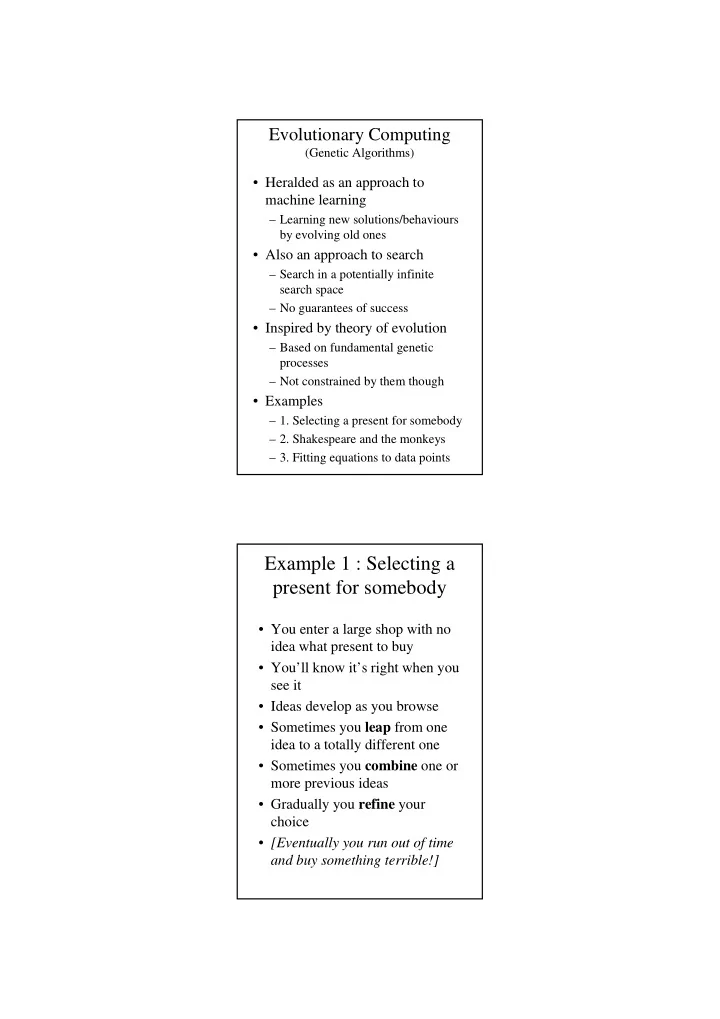
Evolutionary Computing (Genetic Algorithms) Heralded as an approach to machine learning Learning new solutions/behaviours by evolving old ones Also an approach to search Search in a potentially infinite search space No


slide-1
SLIDE 1

Evolutionary Computing

(Genetic Algorithms)

  • Heralded as an approach to

machine learning

– Learning new solutions/behaviours by evolving old ones

  • Also an approach to search

– Search in a potentially infinite search space – No guarantees of success

  • Inspired by theory of evolution

– Based on fundamental genetic processes – Not constrained by them though

  • Examples

– 1. Selecting a present for somebody – 2. Shakespeare and the monkeys – 3. Fitting equations to data points

Example 1 : Selecting a present for somebody

  • You enter a large shop with no

idea what present to buy

  • You’ll know it’s right when you

see it

  • Ideas develop as you browse
  • Sometimes you leap from one

idea to a totally different one

  • Sometimes you combine one or

more previous ideas

  • Gradually you refine your

choice

  • [Eventually you run out of time

and buy something terrible!]

slide-2
SLIDE 2

Example 2 : Shakespeare and the monkeys

  • Dawkins (1986) considered a single

line from Hamlet:

METHINKS IT IS LIKE A WEASEL

  • The probability of generating this line
  • f 28 characters (including the

spaces) from the 27 character alphabet by chance is (1/27)^28

  • Or, put another way, after 27^28

attempts you could expect to produce it just once (after millions of years)

  • Dawkins wrote a GA program which

generated the line in between 41 and 64 attempts (taking about 11 seconds)

  • Instead of single-step selection the

program used cumulative selection

Example 3 : Fitting equations to data points

  • Consider the equation for a straight

line between 2 points: y = mx + c

  • Given the points (x1,y1) and (x2,y2)

we can determine m and c

  • Using a GA we could start off with

random values for m and c and gradually evolve better and better values for m and c by making small changes and breeding from the best until the error is acceptably small

  • This is a trivial problem but with

larger data sets (more than just 2 points) the GA approach offers a potential route to a solution

slide-3
SLIDE 3

Three Main Forms

Three main forms of EC are distinguished–

  • Genetic Algorithm (GA)

– The classical form – Evolving new states from old during search

  • Genetic Programming (GP)

– Evolving computer programs – Using GAs to evolve source code or representations thereof

  • Evolutionary Strategies (ES)

– Probabilistic – Mutation-based search –

  • cf. stochastic random walk

Key Elements of a GA

  • Natural Selection

– A fitness measure determines which population members (solutions) survive

  • Reproduction

– Creating a successor generation by ...

  • Crossover of chromosomes

– Combining two or more “parents” to form “offspring”

  • Mutation of genes

– Introducing aberrant offspring at random intervals

  • Probability

– All choices are probabilistic

slide-4
SLIDE 4

The GA Method

  • A population pool is created

– This contains possible solutions

  • A fitness function is applied to each

individual

– This determines how “good” each solution is

  • Individuals are selected for a mating

pool probabilistically

– The fitter the individual the more likely it is to be selected

  • Individuals in the mating pool are

combined using crossover

– Again selection is probabilistic – Crossover points are also selected probabilistically (mutation may occur)

  • The fittest individuals become the

next generation

Fitness Functions

  • A quality function rates each

individual’s “goodness”

  • Fitness is commonly normalised

to lie between 0 and 1

– The fitness of an individual is then the quality of that individual divided by the total quality of all individuals in the population

  • Identifying fitness functions is
  • ne of the more difficult tasks in

evolutionary computing

slide-5
SLIDE 5

Selection Schemes

  • Rank

– The fittest individuals in the current generation are chosen for the mating pool

  • Roulette

– Fitter individuals are allocated a larger area of the wheel – Thus they are more likely to be chosen than less fit individuals

  • Tournament

– Pairs of individuals compete for entry to the mating pool by comparing their fitness scores – Successive rounds of pairing off can further reduce the number of candidates for the mating pool

  • Elitist

– The fittest individual(s) always proceed to the next generation – By-passing the mating pool

Reproduction

  • Reproduction creates candidates for

the next generation of individuals by recombining elements from the current generation which have been selected for the mating pool

  • Genetic recombination produces
  • ffspring

– Part of the genome of each parent is passed on to the offspring – In humans one half of each chromosome pair is passed on by each parent

  • Mutation of genes can occur during

recombination

– This is very rare – You can envisage mutation as changes within the substrings

slide-6
SLIDE 6

Crossover

Individual A a1 a2 a3 a4 a5 a6 Individual B b1 b2 b3 b4 b5 b6 Pick a crossover point, say 4 O ffspring 1 a1 a2 a3 a4 b5 b6 O ffspring 2 b1 b2 b3 b4 a5 a6 a1 a2 a3 a4 b5 b6 Select gene to mutate, say 3 and value to mutate it to, say c3 a1 a2 c3 a4 b5 b6

Mutation EC Bibliography

  • Dawkins, R., 1986, The Blind

Watchmaker, Penguin Books.

  • Fogel, L., Evans, M. & Walsh , M., 1966,

Artificial Intelligence through Simulated Evolution, John Wiley.

  • Goldberg, D.E. & Holland, J.H., (editors),

1988, special issue of Machine Learning, 3 (2/3).

  • Goldberg, D.E., 1989, Genetic Algorithms

in Search, Optimisation and Machine Learning, Addison-Wesley.

  • Holland, J.H., 1992, Adaptation in

Natural and Artificial Systems, 2nd edition, MIT Press.

  • Koza, J.R., 1992, Genetic Programming,

MIT Press.

  • Rechenberg, I., 1971, Evolutionsstrategie
  • Optimierung nach Prinzipien der

biologischen Evolution, Dr.-Ing. Thesis, Technical University of Berlin.